Tag: Brand Messaging

  • Your Website Content Sucks and Here’s Why

    Your Website Content Sucks and Here’s Why

    Your website content sucks.

    Ouch.

    Before you fire the copywriter, feed every page to AI, or pay for a prettier redesign, define what “sucks” actually means.

    Bad website content is not simply old, short, long, boring, or missing enough keywords. It sucks when the right visitor lands on a page and has to work too hard to understand why the page fits their situation, what you do, why it matters, why they should believe you, why they should prefer you, or what to do next.

    That is a decision-path problem before it is a writing-style problem. Better sentences help, but polished sentences wrapped around the wrong page job are still the wrong content.

    If you want to improve website content, start by diagnosing the page before rewriting it. Scope Design uses the five-part SUCKS Test below to find the weak link and fix that first. For the broader planning system—what belongs on the site, how pages work together, and how content supports the business—see our website content strategy guide.

    What bad website content actually means

    A business website is not a school essay. A page has a job.

    A service page may need to help a buyer decide whether an offer fits. A homepage may need to orient several types of visitors and route them. A case study may need to reduce risk. An article may need to answer a question well enough that the reader can make the next decision.

    Content gets weak when the page stops doing that job. You can usually see the failure in one of five places: the page does not fit the visitor’s situation, the value is hard to understand, the claims lack proof, the business sounds interchangeable, or the next step makes no sense.

    Notice what is not on that list: “The page is 1,200 words instead of 1,800” or “The publish date is six months old.” Google’s current people-first content guidance says there is no preferred word count, and it specifically warns against changing dates or adding and removing content merely to make a site appear fresh. A page should be as long as its job requires and updated when something meaningful changes—not because the calendar made you nervous.

    Run the Scope Design SUCKS Test

    The SUCKS Test is our page-level triage framework. It is not marketing scripture handed down from a mountain. It is a practical way to turn “this content feels weak” into five questions you can actually answer.

    S — Situation fit: does the page match why the visitor arrived?

    Start with the visitor’s situation, not your company history.

    Someone searching “emergency furnace repair” arrives with a different level of urgency than someone comparing HVAC maintenance plans. A referral who already trusts you needs different context than a cold visitor who has never heard your name. A buyer trying to compare two services does not need the same opening as someone trying to understand the problem for the first time.

    Ask: What did this person come here to understand, decide, or do? Then look at the first screenful of content. Does it meet that situation, or does it launch into “Welcome to Acme Solutions, where we have proudly served…”?

    A page that tries to serve every audience, awareness level, and buying stage usually serves none of them particularly well. Define the page job and its likely arrival intent first. Everything else gets easier after that.

    U — Understandable value: can the visitor explain what you do and why it matters?

    Clear content does not require tiny sentences or kindergarten vocabulary. It requires a coherent argument.

    After a quick scan, the right visitor should be able to explain what you offer, who it is for, what problem or outcome it addresses, and why the page deserves another minute of attention. If the answer is buried under “innovative solutions,” “customer-centric excellence,” and “industry-leading service,” the content is making the visitor decode your positioning for you.

    This is where a strong brand message earns its keep. The language should sound like something a customer could repeat after leaving the page—not something a committee approved because nobody objected to it.

    A useful test: hide your logo and company name. Could a qualified visitor still tell what business this is, what it helps with, and why the offer matters? If not, you may have polished copy without a useful message.

    C — Credible proof: did you support the claims where doubt appears?

    “We deliver exceptional results” is not proof. It is a claim wearing a tie.

    Credible content shows the reader why a statement deserves belief. Depending on the page, proof might include a relevant case study, a specific example, a review, a screenshot, a process explanation, a demonstration, a credential, a comparison, a documented result, or a clear limitation that shows you understand where the offer does not fit.

    Placement matters. If a visitor is likely to doubt a claim about turnaround time, put the supporting process or evidence near that claim. If price creates risk, put the explanation, scope, guarantee, comparison, or expectation-setting near the price discussion. Do not make the reader remember a logo carousel from 14 scrolls ago and perform their own trust archaeology.

    Our brand authority framework goes deeper on building a body of proof instead of decorating pages with authority signals.

    K — Key difference: is there a meaningful reason to choose you?

    “Trusted.” “Full service.” “Results-driven.” “Personalized.” “Innovative.”

    They may all be true. They also appear on enough business websites to qualify as corporate oatmeal.

    A useful difference is meaningful to the buyer, credible for the business, and comparative enough to change a decision. It could come from who you serve, what you refuse to do, the way you diagnose a problem, the trade-offs you optimize for, your delivery model, your expertise, your process, your proof, or a combination competitors have not made easy to copy.

    Do not invent a fake “unique selling proposition” because a worksheet demanded one. Find the difference that changes the buyer’s choice and explain it plainly. Our guide to brand differentiation covers that work in detail.

    S — Sensible next step: does the action match the visitor’s readiness?

    The old version of this article said every page and every post needed a compelling call to action. That sounds tidy. It is also too crude.

    Every useful page should help the visitor know what comes next, but “next” does not always mean “book a sales call.” It might mean read a comparison, view a case study, check pricing, use a calculator, understand the process, see related services, contact support, request an estimate—or simply leave with the answer they came for.

    The action should continue the buyer’s work. A strong educational answer followed by an unrelated “SCHEDULE A DEMO NOW” button is not a conversion strategy. It is a jump scare.

    Match the commitment to the visitor’s situation and the page’s job. If the reader has enough information to take a commercial step, make that path obvious. If they need one more decision first, help them make that one.

    What not to fix first

    Once someone decides “the content is bad,” it is tempting to reach for the most visible tactic. That is how businesses spend money polishing the symptom.

    Do not start with freshness theater

    Update content when the facts, offer, proof, customer questions, competitive context, or page job have changed—or when performance evidence shows a section no longer does its job. Do not change the date, swap three adjectives, and call the page fresh.

    Do not add words because a competitor has more

    More copy can help when the reader needs more explanation, evidence, comparison, or objection handling. More copy can also make a weak page longer. Word count is not a strategy.

    Do not copy the competitor’s structure by reflex

    Competitor research is useful for understanding category language, common claims, missing proof, and buyer expectations. It is not an instruction sheet. If five competitors use the same vague headline and three-card feature row, building a sixth version does not create differentiation.

    Do not assume a redesign will fix a content problem

    Design changes hierarchy, attention, comprehension, credibility, and friction. It matters. But stronger visual treatment cannot manufacture a clear offer, evidence, or point of view that does not exist. If you are deciding where the real problem lives, our web design vs. content guide separates the two without pretending either works alone.

    How to improve website content in the right order

    You do not need to rewrite the entire site to make progress. Pick one important page and fix the decision path in order.

    1. Confirm the page can be measured. Make sure the page loads, forms and key interactions work, analytics are collecting what matters, and you are not diagnosing from a broken instrument panel.
    2. Define the page job. Write one sentence: “This page helps [specific visitor] decide/do [specific job].” If you cannot finish the sentence, do not start rewriting paragraphs.
    3. Match the arrival situation. Identify how the visitor likely found the page and what they already know. Adjust the opening so it meets that context.
    4. Clarify the argument. State the problem or desired outcome, what you offer, who it fits, and why it matters in language the buyer uses.
    5. Add proof where doubt appears. Support the claims most likely to trigger skepticism. Remove unsupported precision and empty superlatives.
    6. Sharpen the meaningful difference. Explain the part of your approach, expertise, fit, or trade-off that can actually change a buying decision.
    7. Fit the next action. Give the reader a logical path that matches their readiness instead of forcing the same sales CTA onto every page.
    8. Connect useful paths. Add internal links when another page genuinely answers the reader’s next question. Google recommends descriptive, relevant anchor text because link context helps people and search systems understand the relationship between pages.
    9. Measure the last meaningful outcome the page can control. That might be a qualified click to pricing, a completed form, a product view, a comparison-page visit, or another behavior tied to the page’s job—not whatever metric looks happiest in the dashboard.

    If the page is primarily intended to earn organic visibility, the deeper mechanics belong in our SEO content writing guide. Do the content job first; then optimize how search systems discover and understand it.

    What if content is not the constraint?

    This is the part most “fix your website copy” articles skip.

    Sometimes the content is fine enough and the real problem is somewhere else.

    In one anonymized Scope Design project for a specialty-auction business, the surface request looked like a redesign problem. Deeper discovery found broken forms, disconnected data, manual handoffs, and legacy systems creating larger constraints. A prettier homepage would have preserved those failures underneath it.

    The same logic applies to content. Before you blame the copy, check the system around it:

    • Measurement and technical integrity: Are forms, tracking, pages, and integrations working?
    • Relevant traffic volume: Is enough of the right audience reaching the page to judge it?
    • Traffic quality and acquisition fit: Are ads, search queries, referrals, social posts, and email promises sending people whose intent matches the page?
    • UX friction: Can visitors find, scan, compare, and act without fighting the interface?
    • Offer and positioning: Is the underlying offer compelling and appropriately priced, scoped, and differentiated?
    • Sales and operational follow-through: Do inquiries get qualified, routed, answered, and followed up well?

    If one of those is the real constraint, a rewrite may still improve the page. It just may not improve the business result you care about.

    A 20-minute website content audit

    Do this on one important page—not the entire site. The goal is to find the first meaningful failure, not to create a 73-tab audit spreadsheet nobody wants to open again.

    • Minute 1–3: Situation. Write the likely visitor, arrival source, awareness level, and page job in one sentence.
    • Minute 4–7: Understandable value. Read only the headline, subhead, headings, and first sentence of each section. Can you explain the offer and argument without filling gaps from your own company knowledge?
    • Minute 8–11: Credible proof. Circle every important claim. Mark which claims have evidence nearby and which are asking for faith.
    • Minute 12–14: Key difference. Highlight phrases a direct competitor could copy without changing a word. If most of the page survives the test, your differentiation is probably hiding.
    • Minute 15–17: Sensible next step. Trace what the visitor can do after each major decision point. Remove dead ends and aggressive jumps.
    • Minute 18–20: Constraint check. Ask whether traffic quality, technical problems, UX, the offer, or follow-up could explain the result better than the copy.

    When you finish, you should have a short repair list tied to actual decisions: rewrite the opening for a specific visitor; add proof beside a high-risk claim; replace generic category language; change the next step; fix a broken form; or leave the page alone because it is not the constraint.

    That is much more useful than “make the copy punchier.”

    Frequently asked questions about bad website content

    Does bad website content hurt SEO?

    Weak content can make a page less relevant, less useful, less differentiated, and less worthy of links or citations, but rankings can also be limited by technical access, competition, authority, search intent, internal linking, and other factors. Do not treat “SEO problem” as a synonym for “write more copy.” Diagnose which constraint is actually limiting the page.

    How often should website content be updated?

    Update it when something meaningful changes: the facts, offer, pricing, proof, audience, regulations, competitive context, customer questions, search intent, or decision path. Also update when performance evidence shows the page no longer does its job. Do not revise solely to make the date look newer.

    Should I rewrite my entire website at once?

    Usually not. Start with pages closest to meaningful business outcomes or pages with enough relevant traffic to produce useful evidence. Fix one decision path, learn from it, and carry the lessons into the next page. A site-wide rewrite can be appropriate when the underlying positioning or offer changed, but “everything feels a little stale” is not much of a brief.

    Is website content strategy the same as copywriting?

    No. Copywriting is the language that persuades, explains, and moves the reader. Content strategy decides what information is needed, where it belongs, which audience and decision it serves, how pages connect, what evidence supports them, and how the content is maintained and measured. Strong copy can improve a bad strategy, but it cannot quietly replace one.

    Should design or content come first?

    Neither should be designed in isolation. Content determines what must be communicated; design creates hierarchy, comprehension, credibility, and interaction around that communication. In practice, both should evolve from the page job, visitor situation, evidence, and desired action. If one is obviously broken, fix the constraint rather than defending a philosophical order of operations.

    Can AI fix bad website content?

    AI can help summarize interviews, reorganize evidence, test alternate explanations, draft sections, critique clarity, and produce variations. It cannot manufacture a defensible market position, genuine customer evidence, first-hand expertise, or a business decision you have not made. Generic inputs still produce generic output faster.

    Fix the reason the content sucks

    The useful question is not, “How do we make this page sound better?”

    It is, “What decision is this page supposed to help the right visitor make, and what is getting in the way?”

    Run the SUCKS Test. Fix the first real failure. Measure what the page can actually influence. If the content passes and the result is still weak, keep diagnosing instead of ordering another rewrite out of habit.

    If several parts of the test fail across important pages, that is usually a strategy problem wearing a copy problem’s name tag. Scope Design can help you diagnose the website, messaging, content, conversion path, and surrounding system before deciding what deserves to be rebuilt.

  • When to Hire a Copywriter: 5 Situations Where It Makes Sense

    When to Hire a Copywriter: 5 Situations Where It Makes Sense

    If your message is the thing preventing good prospects from understanding, trusting, or acting on your offer, it probably makes sense to hire a copywriter. If the real problem is weak traffic, a weak offer, or a broken user experience, better sentences will not rescue the wrong constraint.

    That distinction matters more now that AI can produce a decent first draft in seconds. The question is no longer, “Can someone write these words?” The better question is, “Does this job require research, message hierarchy, customer perspective, evidence, judgment, and someone willing to own the final message?”

    That is the line this guide is built to find. If you already know you need help and want the companion view on value and process, read our guide to the benefits of hiring a professional copywriter for your website.

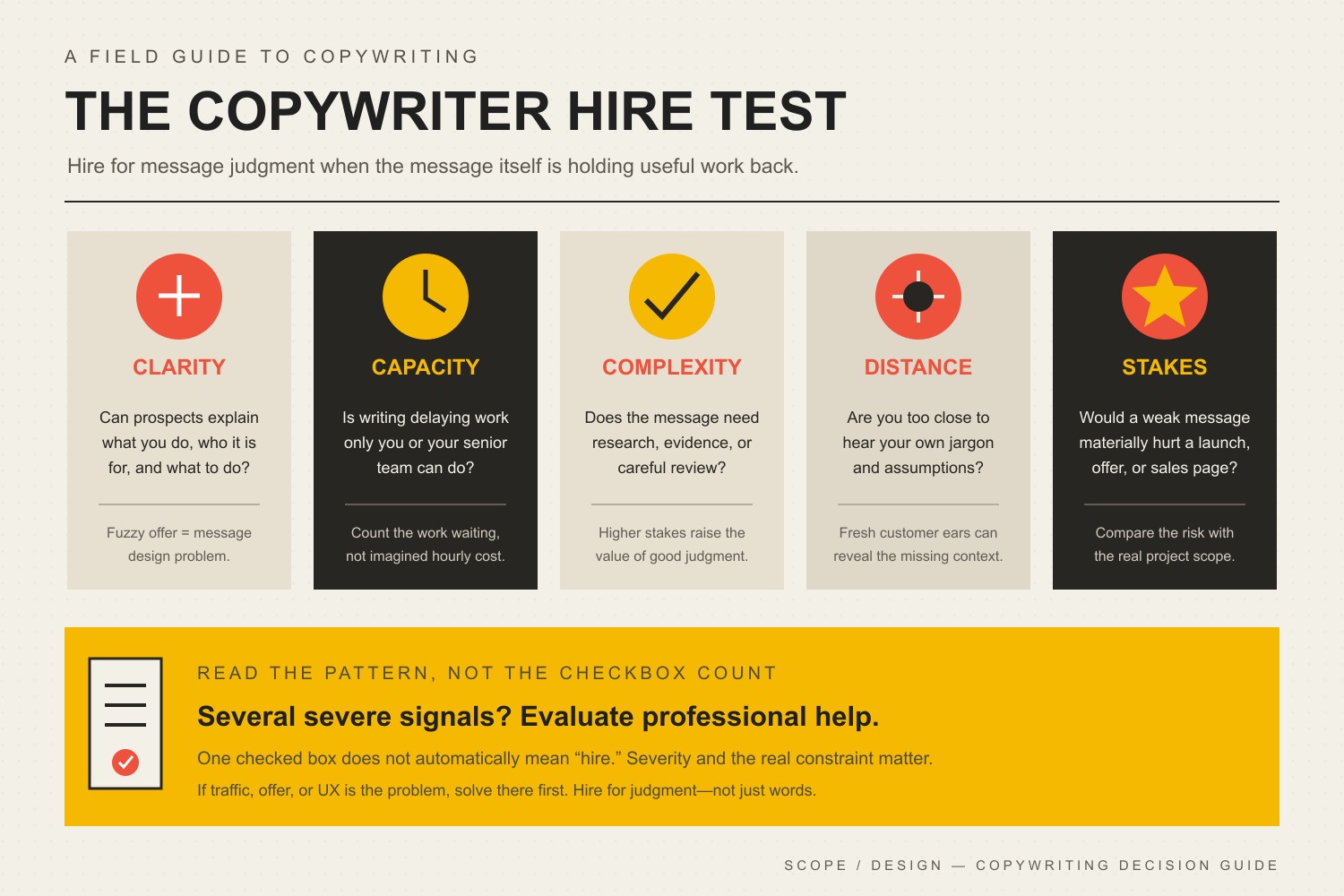
    TL;DR: The Copywriter Hire Test

    • Clarity: Prospects cannot quickly explain what you sell, who it is for, why it matters, or what to do next.
    • Capacity: Writing and rewriting are delaying higher-value work that only you or your senior team can do.
    • Complexity: The message requires customer research, technical accuracy, evidence, multiple reviewers, or careful handling of claims.
    • Distance: You are too close to the business to hear your own jargon, assumptions, and feature-heavy explanations.
    • Stakes: The copy sits on a launch, rebrand, core sales page, or major offer where confusion has a meaningful cost.

    One checked box does not automatically mean “hire someone.” Severity matters. But the more boxes you check, the stronger the case for professional help.

    The Copywriter Hire Test: 5 situations where professional help makes sense

    Five signals for deciding whether to hire a copywriter: Clarity, Capacity, Complexity, Distance, and Stakes. Several severe signals strengthen the case, but a checked box alone does not mean hire.

    1. Clarity: people reach the message but still do not understand the offer

    Clarity problems often hide in plain sight. You know what the company does, so your brain automatically fills in missing context. A new prospect does not have that luxury.

    A simple test is to ask whether a good-fit prospect can answer four questions after a quick read: What is this? Is it for me? Why should I care? What should I do next? If those answers are fuzzy, the problem is not “we need more words.” It is a message-design problem.

    That is where a professional copywriter should start with research rather than adjectives. Customer questions, sales objections, support conversations, competitor language, and actual behavior on the site all provide better raw material than an internal brainstorming session. Current Digital.gov plain-language guidance makes the same audience-first point: learn what users ask and need, then focus the content on what applies to them.

    Hire when: different people on your team explain the offer differently, prospects keep asking basic questions the page should answer, or your copy lists features without creating a clear decision path.

    2. Capacity: writing has become a bottleneck for higher-value work

    Being capable of writing your own copy does not mean you should write every piece of it. The real cost of DIY is not an hourly rate pulled from a calculator. It is what important work stops while the owner, founder, subject-matter expert, or marketing lead goes through another round of “maybe this headline is better.”

    For a low-risk announcement or rough first draft, internal writing or AI may be completely reasonable. But if a website launch is waiting on copy for three weeks, five people are rewriting the same paragraph, or the person with the most valuable expertise is spending half a day fighting a blank page, capacity has become a business constraint.

    Hire when: copy repeatedly misses deadlines, senior people are trapped in revision loops, or getting the message finished is more valuable than proving you can write it yourself.

    3. Complexity: the message needs research, evidence, or careful review

    Some copy is hard because the sentence is hard. More often, it is hard because the business decision behind the sentence is hard.

    Complexity rises when you have a technical offer, several audiences, multiple stakeholders, competing priorities, or claims that need evidence. A copywriter can help translate approved facts into language people can understand, organize the message, and keep reviewers from turning the final page into a committee-written casserole.

    There is an important boundary here: a copywriter is not a substitute for legal, compliance, medical, financial, or other qualified subject-matter review. In the United States, the FTC’s advertising guidance for small businesses says advertising claims must be truthful and non-deceptive and that advertisers need evidence to support express and implied claims. The writer’s job is to make approved truth clear—not invent proof that does not exist.

    Hire when: the work requires interviews, source review, claim substantiation, technical translation, or someone who can keep a complicated review process focused on the reader.

    4. Distance: you are too close to the business to hear your own assumptions

    Business owners usually know too much, not too little. That creates a strange communication problem: you stop noticing what a first-time buyer cannot possibly know.

    Internal shorthand becomes website copy. Features feel self-explanatory. Company history gets more space than the customer’s problem. The page answers the questions your team finds interesting instead of the questions a buyer needs answered.

    A good outside copywriter is useful partly because they are allowed to ask the “obvious” questions: Who is this really for? What changes after they buy? Why should they believe you? What objection is stopping the next step? What does the customer call this problem when nobody from your company is in the room?

    Hire when: your copy sounds accurate to insiders but confusing, generic, or jargon-heavy to everyone else.

    5. Stakes: the downside of a weak message is materially bigger than the cost of getting help

    Not every paragraph deserves a strategy workshop. Your core website, a rebrand, a new offer, a high-value sales page, or a campaign sending meaningful traffic to one decision deserves more care than a routine update.

    High stakes change the economics. If the message will be seen by thousands of prospects, reused across sales materials, or become the language your whole team repeats for the next two years, a cheap first draft can become expensive through repetition. The more durable and consequential the message, the more valuable research, hierarchy, and review become.

    Hire when: the copy will define how the market understands the business, support a major investment in traffic, or sit close to an important buying decision.

    When not to hire a copywriter yet

    This is the part many copywriting pages skip because it is bad for the hard sell and good for the reader: sometimes copy is not the problem.

    What you seeLikely constraintWhat to do first
    Almost no qualified prospects reach the pageTraffic or distributionFix acquisition and targeting before rewriting everything.
    People understand the offer but do not want itOffer or market fitRevisit the product, positioning, price, proof, or audience.
    People want the offer but cannot complete the taskUX or functionalityFix navigation, forms, checkout, mobile issues, or broken flows.
    People arrive, engage, but leave confused about value or next stepMessagingNow copywriting is a credible place to intervene.

    This constraint-first approach is part of our broader small-business marketing strategy: fix the system that is actually limiting growth instead of buying the next fashionable tactic. Our related copywriting guide goes deeper on the message-friction questions to diagnose before you hire.

    AI or a professional copywriter? Split the job, not the ideology

    AI changed the economics of drafting. It did not make every part of copywriting equally automatable.

    TaskAI can helpHuman ownership matters most when…
    Brainstorming angles or headline variantsYesYou need to choose the angle that matches real customer evidence.
    Summarizing approved source materialYes, with verificationAccuracy or nuance is consequential.
    Drafting low-risk routine copyOftenThe draft will represent the brand in an important decision.
    Interviewing customers or subject-matter expertsAssist with prep and synthesisFollow-up questions and interpretation matter.
    Building message hierarchyAssistYou must decide what the reader needs to believe, in what order.
    Choosing and validating proofAssist with organizationClaims require evidence and accountable review.
    Brand-voice governance and final judgmentAssist with consistency checksThe message is durable, high-stakes, or shared across channels.

    Google’s current guidance for generative-AI search makes a useful quality distinction too: it recommends unique, non-commodity content that adds genuine point of view and usefulness, rather than material that simply recycles what a generative model could produce. In practical terms, AI is excellent at accelerating parts of the work. It is a poor excuse for skipping the thinking.

    Formulas can help structure a draft, and AI can generate variations quickly. Our guide to copywriting formulas explains where structure helps and where diagnosis still matters. Use tools. Just do not confuse the tool with the decision-maker.

    What should a professional copywriter do before writing?

    If the process starts with “send me the word count,” you are probably buying typing, not strategic copywriting.

    1. Understand the business and offer. What is being sold, to whom, and what business outcome should the page support?
    2. Learn the audience’s language. Review customer questions, objections, interviews, reviews, support tickets, search behavior, and sales conversations when available.
    3. Decide the job of the page. One page should not try to teach everything, sell everything, and satisfy every stakeholder equally.
    4. Build the message hierarchy. Decide what comes first, what needs proof, what objections need answers, and what can wait.
    5. Gather and validate proof. Testimonials, data, examples, product facts, demonstrations, guarantees, and other evidence should support the claims being made.
    6. Write the full decision path. Headlines, body copy, proof, microcopy, and calls to action should work together rather than as disconnected “clever” lines.
    7. Revise after feedback without losing the reader. Stakeholder comments matter, but the final page still needs one coherent voice and purpose.

    That process is also why project pricing varies so much. The words are the visible output; the research and decisions behind them are most of the job.

    How to hire a copywriter without buying a mystery box

    Portfolios matter, but a polished sample cannot tell you how the work was produced. Before you hire a copywriter, ask questions that expose the process.

    • What do you need from us before you start writing?
    • Will you interview customers, salespeople, founders, or subject-matter experts when the project needs it?
    • How do you identify the main audience, objection, promise, proof, and next step?
    • How do you handle technical or regulated claims and source material?
    • What exactly is included: research, strategy, page copy, SEO considerations, microcopy, revisions, handoff?
    • How many stakeholders can review, and how do you consolidate conflicting feedback?
    • How will you work with the designer, developer, SEO team, or campaign owner?
    • What will we use to judge whether the finished copy is doing its job?

    The strongest answer is usually a process, not a promise that the writer has a secret vocabulary that “converts.”

    How much does it cost to hire a copywriter?

    There is no honest universal rate that tells you what professional copywriting should cost. A five-email sequence with supplied research is a different job from repositioning a technical company, interviewing customers, and rewriting a multi-page website.

    Price usually changes with the depth of research, number and type of deliverables, interviews, strategy work, SEO requirements, evidence and source handling, number of reviewers, revision scope, and how much responsibility the writer owns. Comparing two quotes by “price per word” can make wildly different scopes look falsely equivalent.

    A better comparison is: What thinking, research, deliverables, and revision responsibility am I actually buying? If you want a deeper explanation of that value, see our guide to what a professional website copywriter should actually do.

    Frequently asked questions about hiring a copywriter

    Do people still hire copywriters?

    Yes. The valuable part of the role is shifting away from “someone who can produce words” and toward research, audience understanding, message hierarchy, evidence, brand judgment, editing, and accountability. AI reduces the cost of a first draft; it does not eliminate the need to decide what the message should say or why anyone should believe it.

    Can I use ChatGPT for copywriting?

    Yes. It is useful for brainstorming, outlines, summarizing source material, generating variants, and rough drafts. The higher the stakes, the more important it becomes to verify facts, protect confidential information, validate claims, preserve brand voice, and have a qualified person own the final judgment. Google’s broader people-first content guidance also makes the core point that usefulness, originality, expertise, and trust matter more than whether a tool happened to generate part of the text.

    What exactly does a copywriter do?

    A professional copywriter should do more than write sentences. Depending on the project, the work can include discovery, customer and competitor research, interviews, positioning, message hierarchy, page structure, headlines, body copy, proof, calls to action, microcopy, editing, and revision with stakeholders.

    Is hiring a copywriter worth it?

    It is worth serious consideration when messaging is a meaningful constraint, the project is difficult to produce internally, and the consequence of weak communication is material. If the real bottleneck is traffic, the offer, or broken UX, spend there first.

    What is the 80/20 rule in copywriting?

    People often use “80/20” as shorthand for the idea that a small number of elements—such as the offer, headline, proof, and call to action—can do a disproportionate share of the work. Treat it as a prioritization reminder, not a fixed measurement or guarantee. Which elements matter most depends on the page, audience, and decision.

    When should I not hire a copywriter?

    Do not hire one just because writing is annoying. If almost nobody qualified reaches the page, fix traffic. If buyers understand the offer and still do not want it, fix the offer. If the site is confusing or broken, fix UX. Bring in copywriting when the message itself is a credible reason the right people are not moving forward.

    The decision: hire for judgment, not just words

    The strongest reason to hire a copywriter is not that you dislike writing. It is that the business consequence of a weak message now justifies better research and better judgment.

    Run the five tests: Clarity, Capacity, Complexity, Distance, and Stakes. If several are flashing red, professional help is probably worth evaluating. If none are, keep the work in-house, use AI where it saves time, and spend the budget on the constraint that actually matters.

    If you want help figuring out which problem you have before paying someone to rewrite everything, talk with Scope Design. If copy is the constraint, we can help research, structure, and write it. If it is not, the first useful answer should be to say so.

  • Compelling Taglines: What Psychology Actually Says About Memory, Emotion, and Brand Recall

    Compelling Taglines: What Psychology Actually Says About Memory, Emotion, and Brand Recall

    Compelling taglines do not need to “hack the brain.” They need to cue one useful idea, connect that idea to the right brand, survive a delay, and remain believable when a customer encounters the real business.

    That sounds less exciting than promises about subconscious triggers and neurological buy buttons. It is also much closer to what the evidence supports. Research on hundreds of real slogans shows that the wording people like most is not automatically the wording they remember best. Other research shows that repetition can help familiarity and liking, but not without limits. And decades of branding work point to another problem that famous-tagline lists often miss: people can remember the words and forget who said them.

    This guide focuses on the psychology of evaluating a tagline: memory, processing, repetition, brand association, credibility, and the limits of neuromarketing claims. If you need the full ideation and writing process, use our guide to writing memorable slogans and taglines. That page owns the writing craft; this one owns the evidence test.

    What Makes Compelling Taglines Work?

    A useful tagline is a compact brand cue, not a miniature sales page. It cannot explain the entire company, carry weak positioning on its back, or guarantee a sale by choosing the correct adjective.

    At minimum, a strong line should do five things well enough for its intended job:

    • Express one strategically useful idea. People should have a clear association to attach to the company.
    • Remain true. The line should survive contact with the actual product, service, proof, and customer experience.
    • Link to the brand. Remembered words have little value if the audience credits a competitor.
    • Leave useful memory. The goal is not merely immediate applause in a meeting.
    • Process well enough for the context. People must be able to understand, say, scan, or hear the line—but “easier” is not automatically “more memorable.”

    This is why a tagline should sit downstream from a coherent brand messaging system. The tagline compresses one idea from that system. It does not replace the system.

    Psychology Says Liking and Memory Are Different Jobs

    One of the most useful findings in slogan research is also one of the easiest to ignore: likability and memorability can pull in different directions.

    A Journal of Consumer Research study by Brady T. Hodges, Zachary Estes, and Caleb Warren analyzed more than 800 brand slogans and combined that work with laboratory experiments, eye tracking, and a field study. The researchers found a tradeoff between linguistic fluency and memory. Features that made slogans easier to process tended to improve liking while reducing memory; some less-fluent features improved memory at the cost of liking.

    In their data, shorter slogans, familiar words, and omitting the brand name were generally associated with greater liking. Longer slogans, more concrete or less-common words, and including the brand name were more likely to be remembered.

    That is not a recipe for making every tagline long or awkward. It is a warning against optimizing the wrong outcome.

    What the tagline needs to doWhat to testCommon mistake
    Create immediate easeComprehension and naturalnessAssuming the smoothest line will also be remembered
    Build recallDelayed unaided recallJudging memory immediately after exposure
    Strengthen brand linkageCorrect brand attributionCelebrating recall of the words alone
    Clarify the offerWhat people think the company means or doesConfusing cleverness with clarity
    Support a promiseCredibility and available proofChoosing a claim because it sounds powerful

    The practical question is not “What wording do we like best?” It is “What job does this line need to do, and what evidence would show that it is doing it?”

    Repetition Helps, but “More Is Always Better” Is Not Psychology

    Branding depends on repeated exposure. A line that appears once in a brainstorm deck is unlikely to become a durable cue. But the popular version of the mere-exposure effect—“show it enough and people will love it”—is too simple.

    A 2017 Psychological Bulletin re-examination of the mere-exposure effect synthesized 268 exposure-response curves from 81 articles. The results supported positive exposure effects, but also negative quadratic effects and meaningful moderators. In plain English: repeated exposure can increase familiarity and liking, yet the relationship is often curved rather than unlimited.

    For a business, the lesson is operational rather than mystical. Use a tagline consistently enough to build an association, but do not turn repetition into wallpaper. The line should appear where it has a job and alongside the same recognizable identity, promise, and experience. That is part of a larger brand strategy system, not a reason to stamp the same six words onto every available surface.

    Brand Linkage: Remembered Words Are Useless If the Wrong Brand Gets Credit

    Marketers often ask, “Will people remember the tagline?” A better question is, “Will they remember whose tagline it is?”

    In “Got slogan? Guidelines for creating effective slogans”, Chiranjeev Kohli, Lance Leuthesser, and Rajneesh Suri discuss the role slogans can play in recognition, recall, image, and differentiation—and the persistent problem of weak brand-slogan linkage.

    This changes how you evaluate famous taglines. A line may be culturally familiar because the company spent years pairing it with a logo, media budget, packaging, spokespeople, sound, and product experience. Copying its sentence shape does not copy the system that made it famous.

    It also changes the brand-name question. The Journal of Consumer Research work found that including the brand name could improve memory, even though omission tended to improve liking. That does not mean every company should force its name into the line. It means brand attribution is an outcome worth testing.

    Use the Scope Design STAMP Test for Compelling Taglines

    For this guide, we built the Scope Design STAMP Test to translate the evidence into a practical evaluation tool. It is not a neuroscience score. It is a way to stop five different questions from being mashed into one vague reaction like “I like it.”

    S — Strategic idea

    What useful association should this line create?

    The answer cannot be “we want something catchy.” Start with the thing worth remembering: a relevant difference, useful outcome, point of view, category cue, or promise. If the company has not decided why a buyer should choose it, the tagline is being asked to invent a position that does not exist. Our guide to brand differentiation goes deeper on finding a meaningful difference before turning it into language.

    T — Truth

    Can the business prove or consistently deliver what the line implies?

    A tagline can be aspirational without becoming fictional. If it contains a specific performance claim, the standard is higher. The Federal Trade Commission’s advertising guidance for small businesses explains that advertising must be truthful and non-deceptive and that objective claims need an adequate basis. That applies to meaningful implied claims too, not only numbers printed in giant type.

    The strongest brand claims are connected to actual evidence. That same principle is central to building brand authority from proof rather than from costume.

    A — Association

    Do people connect the line to the correct company and the intended idea?

    Ask people what company they think of and what they believe the line means. If the language could belong to ten competitors, you may have produced a pleasant sentence rather than a useful brand asset.

    M — Memory

    What survives after attention moves somewhere else?

    Do not ask people to repeat the line three seconds after reading it and call that brand recall. Add a filler task. Ask again later. If possible, check again the next day. Delayed memory is closer to the commercial job you actually care about: whether the brand can come back to mind when the buying situation appears.

    P — Processing

    Can the audience understand, say, hear, and scan the line in the places where it will actually appear?

    Processing matters, but do not turn fluency into an absolute rule. A line can become so generic and frictionless that there is nothing distinctive left to remember. Use the fewest words that preserve meaning, credibility, brand connection, and rhythm—not the fewest words at any cost.

    How to Test a Tagline Without Pretending Preference Is Proof

    You do not need a brain scanner to learn whether a candidate line is helping. A small business can get useful signal with disciplined message testing. The key is to separate the outcomes instead of asking one lazy question: “Which one do you like?”

    1. Test comprehension

    Show the line in realistic context, then remove it. Ask, “What do you think this company is trying to say?” and, when relevant, “What do you think this company does?” You are looking for the intended meaning, not verbatim repetition.

    2. Test brand linkage

    After exposure, ask which brand the line belongs to. If you are comparing candidates, keep presentation conditions consistent. A line that wins on recall but loses the brand is not a clean win.

    3. Test delayed recall

    Put another task between exposure and recall. For a more realistic check, follow up later rather than immediately. Ask what words or ideas they remember and which company they connect them with.

    4. Test credibility

    Ask, “What would have to be true for you to believe this line?” That question is more useful than “Does this sound trustworthy?” because it exposes the proof the audience expects.

    5. Test context

    A website hero, a trade-show banner, a social profile, a truck door, a podcast read, and a search result create different constraints. Test the line in the places where it will live. A tagline that needs a two-minute explanation beside it has failed at being a short brand cue.

    Avoid fake universal benchmarks such as “70% recall means success.” Compare candidates, look for consistent patterns across relevant people, and use the test to discover why a line succeeds or fails. For the actual writing and elimination process before testing, the ECHO slogan and tagline framework gives you the companion workflow.

    What Neuromarketing Can—and Cannot—Prove About a Tagline

    Neuromarketing is a broad label for using neuroscience, biometric, physiological, or behavioral measurement to study marketing response. Some of those methods can add useful information in a well-designed study. What they do not provide is a universal shortcut from a word choice to a sales percentage.

    If someone claims that a particular tagline structure “activates the reward center,” “bypasses rational thought,” or raises conversions by a fixed percentage, ask five questions:

    1. What study produced that result?
    2. Was the actual audience comparable to mine?
    3. Was the actual wording or message structure tested?
    4. Was the measured outcome attention, liking, memory, purchase intent, or actual behavior?
    5. Has the finding been replicated or corroborated outside the person selling the tactic?

    A change in attention is not automatically a change in preference. Preference is not automatically memory. Memory is not automatically brand attribution. Brand attribution is not automatically purchase. Those are different steps, and collapsing them into a single “neuro” claim is where marketing advice starts sounding scientific without behaving scientifically.

    For most small businesses, ordinary research is a better first investment: clarify the strategic idea, collect real customer language, generate multiple routes, test comprehension and brand linkage, check delayed recall, and verify the promise. Specialist research can come later if the decision is valuable enough to justify it.

    When the Tagline Is Not the Real Problem

    If every tagline option feels vague, the problem may not be copywriting. It may be that the business has not made the strategic choices the line is supposed to compress.

    Before polishing another round of three-word phrases, make sure you can answer:

    • Who is this for?
    • What problem or desired outcome matters most?
    • Why this option instead of the obvious alternatives?
    • What can the business credibly promise?
    • What proof supports that promise?
    • What should a customer remember when the buying situation appears?

    If those answers are fuzzy, return to brand messaging and positioning before you write the final line. A slogan can compress a position. It cannot invent one.

    Psychology is only one constraint. A tagline also has to survive commercial and legal reality.

    If the line contains an objective product or performance claim, make sure the evidence exists before using it in advertising. And if the line is intended to function as a protectable brand identifier, do not assume catchiness equals trademark strength. The U.S. Patent and Trademark Office notes that common phrases or slogans can be refused when consumers would not perceive them as identifying source, and other conflicts can arise from descriptiveness or similarity to existing marks.

    For a high-stakes launch, clearance is a legal task, not a creative-team confidence check. Search the relevant records and involve a qualified trademark attorney when the risk justifies it.

    Frequently Asked Questions About Tagline Psychology

    What makes a tagline memorable?

    Memorability can come from concrete or distinctive wording, meaningful association, brand-name linkage, repeated exposure, and consistent use. Research suggests that the line people like most immediately is not automatically the line they remember best later. Test delayed recall and correct brand attribution instead of relying only on preference.

    Are short taglines always better?

    No. Short lines are easier to place and repeat, but there is no universal ideal word count. The Journal of Consumer Research study described above found that shorter slogans tended to be liked more, while longer slogans were more likely to be remembered. Use the fewest words that preserve the intended meaning, brand connection, credibility, and rhythm.

    Should a tagline include the brand name?

    Sometimes. Including the brand name can strengthen memory and brand linkage, especially for an unfamiliar company, but it can make a line less smooth. The research points to a tradeoff rather than a universal rule. Test whether people remember the correct brand with and without the name.

    Does emotion make a tagline more persuasive?

    Emotion can matter because people respond to outcomes, identity, risk, relief, status, belonging, humor, and other meaningful associations. But there is no single emotional trigger that guarantees persuasion or lets a line bypass rational evaluation. The emotion still has to be relevant to the audience, credible for the brand, and connected to the experience that follows.

    Does repeating a tagline make it more effective?

    Repeated exposure can increase familiarity and liking, and repetition is necessary for building many brand associations. However, research on mere exposure shows that the effect is moderated and can follow an inverted-U pattern. Consistency is useful; unlimited repetition is not a law of psychology.

    Can neuromarketing prove that a tagline will increase conversions?

    Not from a generic principle or a recycled statistic. A specific study can measure specific responses from a specific sample under specific conditions. That does not create a universal conversion guarantee for another company, audience, offer, or channel. Ask what was actually measured before accepting a neuroscience-sounding claim.

    What is the difference between a tagline and a slogan?

    People often use the terms interchangeably. A practical distinction is that a tagline usually represents the enduring brand, while a slogan often supports a campaign, product, or initiative. There is no universally enforced terminology, so the more important question is what job the line needs to do.

    Does every business need a tagline?

    No. A weak tagline can consume space without adding meaning. If the business name, headline, product context, and visual identity already make the important idea clear, a separate line may not be necessary. Use one when it has a defined strategic job.

    The Bottom Line: Build a Useful Association, Not a Brain Hack

    The best psychology lesson for compelling taglines is not a secret word list. It is discipline.

    Decide what deserves to be remembered. Make the line true. Test whether people connect it to the correct brand. Measure memory after a delay. Keep the language easy enough to use without sanding away everything distinctive. Repeat it consistently, but do not confuse repetition with inevitability.

    If the STAMP Test exposes a deeper problem—no clear difference, no credible promise, no proof, or no consistent message—fix that system first. The tagline will get easier once the strategy has something worth compressing.

    Sources