
Tag: Brand Authority

  • Webinars vs. Advertising: Pros and Cons

    Webinars vs. Advertising: Pros and Cons

    Webinars and advertising solve different marketing problems. Advertising buys reach: it can put a proven offer in front of more people quickly. Webinars create depth: they give prospects time to learn, ask questions, see expertise in action, and decide whether a more complex offer is worth considering. If your problem is not enough qualified attention, paid advertising may be the better next move. If prospects know you exist but do not yet understand or trust the offer, a webinar may be more useful. If the offer, landing page, proof, or follow-up process is weak, neither channel is the right first investment.

    That is the core of Scope Design’s Reach–Depth Test: diagnose the bottleneck before choosing the tactic.

    Webinars vs. advertising: the short answer

    • Choose paid advertising when you need faster reach, have a defined audience, and already have an offer and destination that convert well enough to justify buying more traffic.
    • Choose a webinar when the sale requires education, trust, demonstration, or objection handling before a qualified prospect is ready for a conversation.
    • Choose both when you have a useful webinar but not enough qualified people know about it. Paid media can distribute the event; the webinar can deepen the relationship and create reusable content.
    • Choose neither yet when the real constraint is a confusing offer, weak proof, a poor landing page, or inconsistent follow-up.

    The useful comparison is not “which channel has the better benchmark?” It is “which channel fixes the problem that is keeping this marketing system from producing qualified opportunities?” That distinction also separates this article from broader advertising, marketing, and branding definitions. Here, we are comparing two possible investments for the next stage of demand generation.

    Use the Reach–Depth Test before you spend

    Most webinar-versus-advertising decisions become simpler when you identify one of three gaps.

    1. Reach Gap: the right people are not seeing the offer

    A Reach Gap exists when the offer is understandable, the destination works, and the business can handle more demand, but too few qualified prospects are arriving. Paid search, paid social, sponsorships, retargeting, and other advertising can help because they purchase distribution. The advantage is speed: you can test audiences, messages, and offers without waiting months for organic reach to grow.

    Advertising is especially useful when buyers already have intent. A person actively searching for a service or solution may not need a 45-minute educational event before taking the next step. In that case, adding a webinar can create unnecessary friction.

    2. Depth Gap: people see the offer but do not understand or trust it yet

    A Depth Gap appears when prospects need more context before they can make a serious decision. This is common with professional services, technical products, unfamiliar solutions, expensive purchases, and anything that requires a buyer to believe your judgment before they buy your work.

    That is where webinars can outperform a short ad interaction. A strong webinar gives the prospect enough time to see how you think, understand the problem, hear useful examples, and ask questions. It can build the kind of evidence that supports real brand authority rather than merely repeating promotional claims.

    3. System Gap: the traffic and attention have nowhere useful to go

    A System Gap is the expensive one to ignore. If the offer is vague, the landing page is confusing, the proof is thin, the sales handoff is inconsistent, or leads receive weak follow-up, adding more traffic simply scales the leak. A webinar can also fail here: registrations are not valuable if the presentation is disconnected from the buyer’s problem or nobody follows up with engaged attendees.

    When the System Gap is the constraint, fix the offer, destination, proof, measurement, and follow-up before spending heavily on either tactic. Our broader small-business marketing strategy guide explains why paid attention works best when the rest of the marketing system can use it.

    Webinars vs. advertising at a glance

    Decision factor Webinar Paid advertising
    Primary strength Education, trust, qualification Reach, demand capture, scale
    Best fit Complex or high-consideration sale Proven offer with a clear conversion path
    Speed Slower to plan and promote Can launch and learn quickly
    Depth of interaction High when the topic and audience fit Usually brief before the click
    Scalability Limited by event, audience, and follow-up capacity Can scale while economics remain healthy
    Reusable asset value High: recording, clips, answers, sales material Creative can be reused, but the interaction itself is usually not an owned knowledge asset
    Main failure mode Registrations without qualified attendance or follow-up Clicks and leads without profitable customers
    Most useful outcome metric Qualified opportunities and revenue influenced by the event Customer acquisition cost and qualified pipeline per dollar spent

    When webinars are the better investment

    Webinars are strongest when the buyer needs to learn before buying. That does not mean every business needs a recurring webinar program. It means the format can be valuable when a live or on-demand educational experience reduces uncertainty that a short ad cannot.

    You sell something that requires explanation

    If prospects regularly ask the same detailed questions before they are comfortable moving forward, a webinar can turn those questions into a structured educational experience. The event can demonstrate expertise, explain tradeoffs, and show how the decision should be made without forcing a sales representative to start from zero every time.

    Trust is a bigger bottleneck than awareness

    A person can see ten ads and still know very little about how you work. A useful webinar gives the buyer more evidence. The speaker can explain a framework, show examples, acknowledge limitations, and answer objections in context. That makes webinars particularly useful for expert-led services and other offers where judgment is part of what the customer is buying.

    You want first-party engagement signals

    A webinar can produce richer signals than a click alone: registration details, attendance, questions, poll responses, resource downloads, CTA activity, and follow-up requests. Those signals are useful only if your CRM and follow-up process actually use them. A long attendee list sitting in a spreadsheet is not a qualification system.

    The session can become more than one asset

    A good webinar can become an on-demand recording, an edited guide, short demonstrations, FAQ answers, email follow-up, sales enablement, and social clips. That is genuine content repurposing when each derivative is rebuilt for a useful job instead of merely reposting the same material everywhere.

    Current vendor benchmark data also shows why marketers value the format’s potential depth. ON24’s 2026 webinar benchmark summary, based on its 2025 platform data, reported a 60% registration-to-attendee rate and 49 minutes of average webinar engagement. Those figures are useful context, not a promise for your business: topic quality, audience fit, promotion, speaker quality, and follow-up can produce very different results. Review ON24’s webinar benchmark guide.

    What are the disadvantages of webinars?

    The main disadvantages are time, production effort, attendance uncertainty, speaker dependence, and limited scale. You need a strong topic, promotion plan, reliable technology, a useful presentation, and a follow-up process. Founder or subject-matter-expert time also belongs in the cost calculation. A webinar is not “free marketing” simply because the media spend is low.

    When paid advertising is the better investment

    Paid advertising is strongest when the business already knows what it wants more of. If the offer converts, the audience is identifiable, the unit economics work, and the business can fulfill additional demand, paid media can create reach faster than most owned channels.

    You can capture existing intent

    Search advertising can be especially efficient when buyers are already looking for the problem you solve. Rather than asking them to attend an event first, the ad can route them directly to the next appropriate action: a quote, consultation, trial, assessment, product page, or other conversion path.

    You need faster market feedback

    Advertising can test messages and audiences quickly. That does not make every result conclusive, but it can expose whether people respond to an offer before the business invests in a larger campaign or content program. The speed advantage is real, as long as you are measuring something closer to business value than impressions alone.

    You know the economics well enough to scale

    The critical advertising question is not “What is a good click-through rate?” It is “What can we afford to pay for a qualified customer?” Work backward from gross profit, acceptable customer acquisition cost, and your lead-to-customer conversion rate. Google Ads’ own ROI guidance emphasizes connecting advertising to conversions and business value rather than judging campaigns on clicks alone. See Google’s ROI guidance.

    What are the disadvantages of paid advertising?

    The largest risk is that paid media can scale the wrong thing. A weak offer, poor targeting, bad creative, a confusing landing page, low lead quality, or broken attribution can consume budget quickly. Ad costs and competition also change over time, and a campaign that works at one spend level may not scale indefinitely. Paid advertising is a distribution system, not proof that the underlying business proposition is good.

    When the best answer is both

    Webinars and advertising are not natural enemies. In many cases, the strongest system uses each for the job it does best:

    1. Create a webinar around a specific buyer problem, not a disguised product pitch.
    2. Invite existing customers, prospects, partners, email subscribers, and relevant organic audiences first.
    3. Use targeted paid advertising to reach additional people who match the ideal customer profile.
    4. Use attendance and engagement to segment follow-up rather than treating every registrant as equally qualified.
    5. Turn the session into on-demand and derivative assets that support later sales and marketing.
    6. Retarget or nurture people based on what they actually did, not merely the fact that they entered an email address.

    This combined model closes both a Reach Gap and a Depth Gap: advertising creates qualified exposure, while the webinar gives that attention somewhere useful to deepen.

    How to measure webinars and ads without lying to yourself

    Both channels create attractive vanity metrics. Webinar registrations can look impressive. So can ad impressions, clicks, and inexpensive leads. None of those metrics tells you whether the activity created profitable customers.

    Use the same downstream measurement chain for both:

    Spend and staff time → leads or registrants → qualified leads → opportunities → customers → gross profit.

    For advertising, add channel metrics such as impressions, reach, click-through rate, cost per click, landing-page conversion rate, cost per qualified lead, and customer acquisition cost. For webinars, add registration rate, attendance rate, engagement, CTA activity, attendee-to-qualified-lead rate, opportunity rate, and revenue influenced by attendees.

    The final comparison should be business-specific: which system creates acceptable customer quality and sustainable acquisition economics? Generic industry averages can provide context, but they should not become your forecast.

    What our audit of this exact page taught us

    We applied the same measurement rule to this revision. For the 12 complete months from August 20, 2025 through August 19, 2026, this URL recorded only five GA4 landing sessions: four Direct and one Organic Search. One session was engaged and the page recorded zero configured key events. The sample is far too small to treat those numbers as proof that webinars, advertising, or this topic does or does not work.

    Google Search Console returned no query rows for the exact URL and currently reports it as “Crawled – currently not indexed.” Indexing is allowed, the page fetch succeeded, robots are allowed, and both Google’s canonical and the user-declared canonical are the established URL. Bing’s saved page baseline was also tiny: zero clicks and three impressions. Ubersuggest found no ranking keywords and no backlinks for the exact page.

    That evidence does not justify a URL change. It supports a more useful editorial decision: preserve the established address, remove unsupported legacy statistics, clarify the article’s comparison job, and give the page a defensible framework that readers can actually use.

    Frequently asked questions

    Are webinars still effective in 2026?

    They can be, especially when the buyer needs education, trust, demonstration, or live objection handling. Effectiveness depends on the audience, topic, offer, promotion, speaker, and follow-up. A webinar is not automatically effective because current benchmark reports show strong aggregate engagement.

    Which is more cost-effective: webinars or advertising?

    There is no universal winner. Count media spend, platform fees, creative work, staff time, speaker time, sales follow-up, and the resulting customers. Compare cost per qualified opportunity and customer acquisition cost, not cost per click versus cost per registration.

    How much does a webinar cost?

    The software can range from free or inexpensive tools to enterprise platforms, but software is only one part of the cost. Planning, subject-matter-expert time, design, rehearsal, promotion, moderation, editing, and follow-up often matter more than the platform fee. Calculate the full cost for your business instead of relying on a generic average.

    How long should a webinar be?

    Long enough to solve the promised problem and no longer. A focused 25-minute session can be better than a padded hour. If audience questions create value, reserve time for Q&A rather than stretching the presentation to hit an arbitrary benchmark.

    Can a small business use paid ads to promote a webinar?

    Yes. That is often the most useful hybrid: use paid media to reach a specific audience, then use the webinar to educate and qualify the people who need more context. Optimize for qualified attendance and downstream opportunities, not the cheapest possible registration.

    What is the biggest webinar marketing mistake?

    Treating registrations as the finish line. The event needs a specific audience, a useful promise, credible content, a commercially relevant next step, and follow-up that reflects what attendees actually did. Without that system, a large registration number can hide a weak business result.

    Choose the bottleneck, then choose the channel

    If you remember one thing from this webinars vs. advertising comparison, make it this: advertising buys reach; webinars create depth. Paid media is powerful when you already have something worth scaling. Webinars are powerful when prospects need education and trust before they can make a serious decision. When the underlying marketing system is broken, neither tactic deserves more budget yet.

    If you are unsure which gap is holding your marketing back, Scope Design can help diagnose the system before you commit more money or staff time to a channel. The goal is not to force webinars or ads into the plan. It is to choose the next investment that fixes the real constraint.

  • Are You the Expert in Your Niche?

    Are You the Expert in Your Niche?

    If you want to become the expert in your niche, start by treating “expert” as a claim that needs evidence. The label itself does not create authority. Credible expertise comes from knowing a specific problem, doing the work well enough to make defensible decisions, showing proof, explaining what you know clearly, and being honest about the boundaries of your experience.

    That is a less glamorous answer than “post every day for 90 days and become the go-to authority.” It is also far more useful. Marketing can make expertise visible. It cannot manufacture competence that is not there.

    TL;DR: how to become the expert in your niche

    • Narrow the claim. “I help manufacturers reduce quoting friction” is easier to prove than “I am a business expert.”
    • Build relevant competence. Learn the buyer, constraints, language, trade-offs, and real-world decision points.
    • Collect proof. Save examples, outcomes, methods, artifacts, customer questions, testimonials, credentials, and limitations.
    • Translate the work. Explain your reasoning in a way the right buyer can understand and use.
    • Earn corroboration. Let clients, peers, references, citations, reviews, and other legitimate third parties validate what your bio says.

    If you are new to the market and do not yet have domain proof, do not skip straight to the last step. Our guide to entering a niche with zero experience explains how to learn and earn credibility without pretending to already be the expert.

    Expertise, visibility, and authority are different jobs

    These words get mashed together in marketing advice, but separating them prevents a lot of bad strategy.

    • Expertise is your relevant ability to understand a problem and make sound decisions about it.
    • Visibility is whether the right people encounter you or your work.
    • Authority is the judgment other people form when your expertise, proof, reputation, and communication repeatedly hold up.

    You can have expertise with little visibility. You can also have tremendous visibility with shallow expertise. And you can be technically excellent while making it almost impossible for a prospect to verify why they should trust you.

    That last problem is where positioning, content, web design, and marketing matter. They should not dress you in an expert costume. They should organize the evidence so a skeptical buyer can inspect it.

    The Scope Design Niche Expertise Evidence Ladder

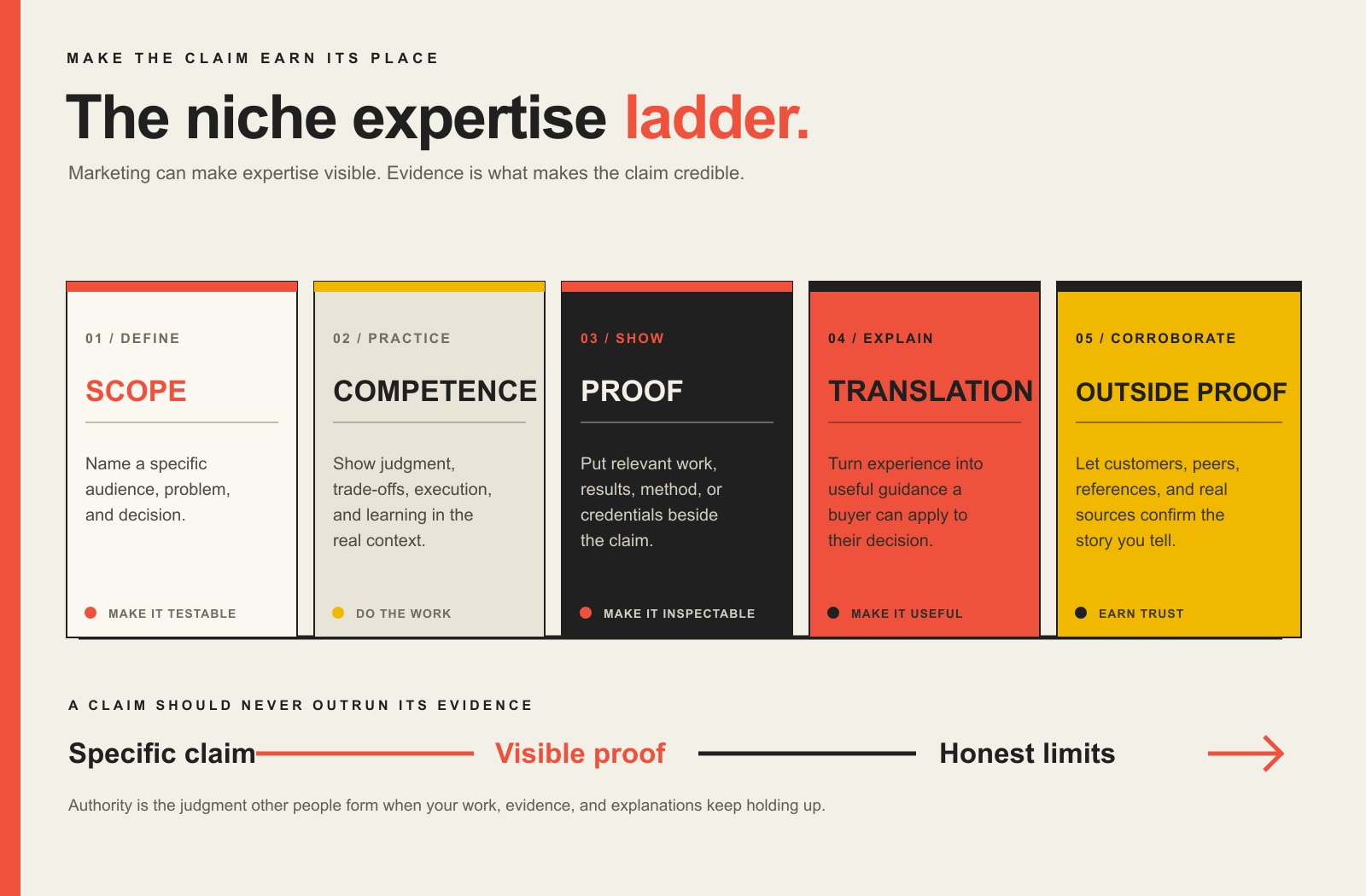
    We use a five-level ladder to think about what it takes to be the expert in your niche. You do not need every possible form of proof before you can be useful, but stronger claims should be supported by stronger evidence.

    1. Scope: define the problem narrowly enough to understand

    “Marketing,” “fitness,” “leadership,” and “technology” are not useful expertise claims by themselves. They are continents. A credible niche usually has a clearer audience, decision, constraint, or problem.

    Compare “I know digital marketing” with “I help local service businesses turn a confusing website and scattered campaigns into one measurable lead-generation system.” The second claim can be examined. It creates boundaries. It also tells you what you need to learn and what proof you need to collect.

    2. Competence: be able to do more than repeat the language

    Knowing the vocabulary of a niche is not the same as being useful inside it. Competence shows up in diagnosis, judgment, trade-offs, execution, and the ability to explain why one choice is more appropriate than another.

    Research matters here, especially when you are entering a new field. So do interviews, supervised work, experiments, project experience, formal training when the field requires it, and direct exposure to customer problems. The correct mix depends on the stakes and the work. A branding consultant and a structural engineer should not use the same standard for “qualified.”

    3. Proof: put evidence beside the claim

    Proof is where expertise becomes inspectable. It can include a relevant case example, a before-and-after with context, a demonstrated process, an annotated deliverable, a useful diagnostic, a result with honest scope, a client reference, a credential, or a clear explanation of a difficult decision.

    The form matters less than the fit. A giant wall of five-star reviews may be weaker than one detailed case study when the buyer is evaluating technical judgment. A certification may be essential in one field and nearly meaningless in another. Ask: What would a skeptical buyer need to see to believe this specific claim?

    4. Translation: make the expertise useful to someone else

    An expert who cannot explain the decision is difficult to evaluate. Translation means turning experience into useful guidance: a framework, comparison, checklist, teardown, FAQ, case analysis, demonstration, or article that helps the reader make a better decision.

    This is where content earns its place. Strong content marketing for a small business starts with something the business actually knows, then turns that knowledge into a durable asset. Content is evidence distribution, not an expertise generator.

    5. Corroboration: let other evidence confirm your story

    Authority becomes stronger when the evidence does not all come from you. Depending on the field, corroboration can include client testimonials, references, peer recognition, relevant credentials, citations, interviews, partnerships, repeat customers, independent reviews, or invitations to contribute your thinking.

    Corroboration should be real, attributable when appropriate, and no broader than the evidence supports. The Federal Trade Commission’s business guidance on advertising and marketing is a useful baseline for the marketing side of this: advertising claims should be truthful and evidence-based. Proof is not decoration.

    The five steps for earning an expertise claim: define a narrow scope, practice competence, show inspectable proof, explain it usefully, and earn corroboration.

    One rule runs through every level: honest boundaries. Say what you know. Show what supports it. Identify what is still uncertain. A precise claim is usually more credible—and more sellable—than a sweeping one.

    What counts as strong proof of expertise?

    Not every authority signal deserves the same weight. Here is a practical way to grade what you are showing prospects.

    SignalWhat it provesCommon weaknessHow to strengthen it
    “Expert” in a bioAlmost nothing by itselfSelf-awarded labelNarrow the claim and link to evidence
    Educational contentYou can explain the topicMay be derivative or untestedAdd original examples, decisions, sources, and limits
    Process or methodologyYou have a repeatable way to approach the workA process can sound polished without producing valueShow where it came from and when it does or does not apply
    Case exampleYou have applied judgment in a real situationCherry-picked or vague resultsState the starting point, intervention, outcome, timeframe, and constraints
    Testimonial or reviewA real person reports an experienceGeneric praise or unverifiable identityUse specific, attributable feedback and do not overgeneralize it
    Credential or third-party recognitionAn outside body validated a defined standard or contributionMay not match the buyer’s actual problemExplain why the credential or recognition is relevant

    The audit that changed this article

    There is a reason this revision is more skeptical of easy authority claims: this page had to pass its own test.

    When we audited the previous version in August 2026, GA4 showed no Organic Search landing sessions for this URL during the prior 12 complete months. Google Search Console returned no search-performance rows for the exact page and its URL Inspection report described the URL as unknown to Google. Bing recognized and crawled the page but reported zero clicks and zero impressions. Ubersuggest found no ranking-keyword data and no backlinks for the exact URL.

    Those numbers do not prove that search traffic equals expertise. They do not prove that every good expert should rank. They do show why “publish authority content” is incomplete advice. The old version was making big promises about expertise while providing little original evidence of its own.

    So we removed unsupported market-size figures, generic income ranges, claims that specialists universally command a particular premium, and timelines promising recognition or income growth. The stronger article is less certain about outcomes and much clearer about the work required to earn trust.

    How to build the next layer without pretending

    You do not have to wait until you feel omniscient. You do have to match the size of your claim to the evidence you have today.

    1. Write the narrowest useful expertise claim you can defend. Name the audience, problem, and kind of decision you help with.
    2. Inventory the evidence already available. Projects, examples, customer questions, data, methods, credentials, experiments, screenshots, outcomes, mistakes, and lessons all count when they are relevant and honestly described.
    3. Find the gaps. If the claim depends on experience you do not have, shrink the claim, collaborate with someone qualified, research it properly, or go earn the experience.
    4. Do one piece of work that creates new evidence. Run an audit, interview customers, document a project, compare options, build a diagnostic, or publish an annotated example.
    5. Turn the evidence into a useful explanation. Show your reasoning, not just the polished conclusion.
    6. Ask what a skeptic still cannot verify. That question determines the next proof asset.

    If your real situation is “I want to serve this market, but I am not yet the domain expert,” that is a market-entry problem, not an authority-copy problem. Start with the zero-experience niche framework and let stronger claims follow the evidence.

    How to make niche expertise visible on your website

    A prospect should not need to assemble your credibility from scattered clues. Put the proof near the decision it supports.

    • On a service page, place a relevant case example or process near the promise.
    • On an About page, explain the experience, qualifications, and point of view that matter to the work—not a life story that never connects back to the buyer.
    • On a case study, show the starting condition, the decision, what changed, and the limits of what can be concluded.
    • In articles, distinguish what comes from direct experience, what comes from research, and what is your recommendation.
    • In testimonials, favor specificity over adjectives.
    • In calls to action, make the next step proportional to the reader’s confidence. A useful diagnostic may be better than a hard sell when the purchase is complex.

    This is also why authority should sit inside a coherent small-business marketing system. Attention, offer, proof, conversion path, and follow-up have to support one another. More visibility cannot rescue a claim the buyer has no reason to believe.

    For the broader company-level version of this problem, see our guide to building brand authority as a body of proof. This article stays narrower: whether you have earned the right to make a specific expertise claim in a specific niche.

    Do you need credentials to be an expert?

    Sometimes. The wrong answer is “credentials never matter” or “credentials are always required.” The correct standard depends on the field, the risk, and the claim.

    If the work is licensed, regulated, safety-critical, medical, legal, financial, engineering-related, or otherwise high-stakes, formal qualifications and professional boundaries may be central to competence. In lower-risk advisory and creative fields, a portfolio of relevant work, judgment, results, and corroboration may tell a buyer more than a general certificate.

    Do not use marketing copy to blur that distinction. If a client needs a licensed or specialized professional, say so. Knowing where your expertise ends is part of being credible.

    Common mistakes that make “expert” positioning weaker

    • Making the niche too broad. The wider the claim, the more evidence it takes to support.
    • Confusing publishing volume with competence. Fifty derivative posts are still derivative.
    • Using vague social proof. “Amazing!” does not help a skeptical buyer understand what you actually solved.
    • Borrowing someone else’s authority. Citing experts is good research; implying their credentials are yours is not.
    • Hiding the limits. A useful caveat often increases trust because it shows you understand where the advice stops working.
    • Measuring fame instead of fit. A smaller audience of people with the exact problem may be more valuable than broad visibility with no buying context.

    Frequently asked questions about becoming the expert in your niche

    How does a person become an expert?

    For a business niche, expertise grows through focused learning, relevant application, feedback, evidence, and repeated judgment. The useful question is not “When may I call myself an expert?” but “What can I reliably help this audience understand or do, and what evidence supports that claim?”

    Does 10,000 hours make you an expert?

    There is no universal business rule that awards expertise after a fixed number of hours. Time can create exposure, but hours alone do not tell a client whether you practiced the relevant skill, received useful feedback, made sound decisions, or can solve this buyer’s problem. Use evidence that matches the claim instead of a stopwatch.

    How long does it take to become known as an expert in a niche?

    There is no honest universal timeline. Recognition depends on the starting level of competence, the size and competitiveness of the niche, the quality of the work, how much proof exists, how effectively that proof is distributed, and how often the right audience encounters it. Set evidence milestones instead of promising yourself a 30-, 60-, or 90-day authority finish line.

    What is the best proof of expertise for a consultant or service business?

    The best proof answers the buyer’s biggest doubt. That could be a detailed case example, a demonstrated process, a sample deliverable, relevant credentials, an annotated analysis, an outcome with context, or a specific testimonial. Use the evidence that helps the buyer judge this decision—not the evidence that is easiest to decorate a page with.

    Can content marketing make me an expert?

    No. Content can expose your thinking, organize what you have learned, demonstrate judgment, and distribute evidence. It can also help a serious researcher or newer practitioner become useful while learning. But publishing cannot substitute for the competence required by the work.

    Build a claim your evidence can carry

    You do not need to be famous to become the expert in your niche. You need a claim narrow enough to defend, competence relevant to the problem, proof a skeptical buyer can inspect, explanations that make your thinking useful, and corroboration that does not depend entirely on your own marketing.

    If your website or content says you are the expert but does not make the evidence easy to see, Scope Design can help you tighten the positioning, organize the proof, and connect it to a practical marketing system. The goal is not to make you look more authoritative than you are. It is to make the authority you have actually earned easier for the right buyer to recognize.