Tag: Blogging

  • How to Stand Out in a Saturated Blogging World: 7 Proven Differentiation Strategies

    How to Stand Out in a Saturated Blogging World: 7 Proven Differentiation Strategies

    How to make your blog stand out in a saturated market: stop trying to win by publishing more versions of the same advice. Build each important article around a specific reader decision, add evidence or experience competitors cannot access, take a useful position, show how you reached it, answer the next questions a serious buyer will have, distribute the asset where that buyer actually pays attention, and measure qualified outcomes instead of raw traffic alone.

    That sounds simple, but it is a different job from “write a good blog post.” In August 2026, our live search review for this topic found that Google could already summarize the standard advice—pick a niche, improve headlines, tell personal stories, use media, and promote the post—before a searcher ever needed to click a result. Repeating those basics more elegantly does not create much of an information advantage.

    Google’s current AI optimization guidance makes the same strategic point in plainer terms: create unique, non-commodity content and add a point of view instead of recycling material that other sites or generative AI can easily reproduce. That does not mean every post needs a groundbreaking study. It means the article needs something true and useful that did not come free with the topic.

    How to Make Your Blog Stand Out: Start With the Non-Commodity Test

    Before you add words, images, keywords, or another publishing day, ask one question:

    Could a generic AI system write this article correctly without access to our business?

    If the answer is yes, the draft probably does not contain enough business-specific evidence or judgment yet. “Access to the business” can mean access to customer questions, sales objections, tests, screenshots, internal data, subject-matter experts, implementation experience, failed attempts, constraints, or a recommendation your team can defend.

    This is a diagnostic, not an anti-AI slogan. A model can help organize material, compare sources, find gaps, or tighten a draft. The differentiating input still has to come from somewhere. If the only inputs are the same public pages everyone else can summarize, the output is easy to substitute.

    A worked example: we ran the test on this exact article

    Before rewriting this page, we audited its actual performance and technical state instead of assuming the old copy deserved to be protected because it already existed. For the 12 months ending August 19, 2026, the page had one Organic Search landing session in GA4 and zero key events. Google Search Console returned no page or query performance rows for the URL and currently reports that the URL is unknown to Google. Bing Webmaster Tools reports zero clicks and zero impressions.

    One organic session is far too small a sample to tell us how real readers behave. We are not going to turn it into a story about engagement, intent, or conversion. It is enough to support a narrower conclusion: the old article did not have a meaningful search or business-performance footprint that forced us to preserve weak copy.

    What we checkedPre-rewrite observationWhat we did with it
    GA4 organic landing traffic1 session; 0 key events in the last 12 monthsDid not infer behavior from a one-session sample. Treated the page as having no demonstrated business outcome to protect.
    Google Search ConsoleNo page/query rows; URL Inspection says the URL is unknown to GoogleRebuilt usefulness and internal ownership rather than preserving keywords that were not producing visibility.
    Bing Webmaster Tools0 clicks; 0 impressionsConfirmed there was no Bing performance footprint to protect.
    Live URLHTTP 200, index/follow, self-canonicalKept the established URL. A weak plugin score is not a reason to create migration and redirect risk.

    That audit became part of the new article. This is the kind of first-party evidence a competing generic post cannot truthfully copy.

    The Scope Design Content Differentiation Stack

    We use seven layers to move a business article from “competent summary” toward “useful source.” You do not need every layer to be dramatic. You need each layer to have a job.

    LayerQuestionWhat makes it harder to copy
    1. Own the decisionExactly who is deciding what?Audience and decision specificity
    2. Bring unique evidenceWhat can we show that a public summary cannot?Data, examples, customer language, tests, expert input
    3. Take a useful positionWhat do we recommend, reject, or qualify?Judgment and tradeoffs
    4. Show the workWhy should the reader trust the conclusion?Method, thresholds, failures, exceptions
    5. Cover the full decisionWhat does the reader need next?Decision completeness instead of filler
    6. Match format + distributionWhat form best proves the point, and where will the buyer encounter it?Evidence-fit presentation and channel strategy
    7. Measure qualified outcomesDid the article improve a useful business behavior?Feedback loops that make the asset better over time

    The order matters. A new chart cannot rescue a vague audience. A strong opinion cannot rescue a claim with no evidence. More distribution cannot rescue an article that gives a qualified reader no reason to trust it.

    1. Own a Narrower Audience Decision

    “Small-business owners interested in marketing” is an audience description. It is not yet an article job.

    A better starting point is a decision: “A local service business has ten older blog posts, limited time, and no meaningful organic conversions. Should it publish four new posts this month, update the strongest existing page, or stop blogging until the offer is clearer?” Now the article has constraints, alternatives, and an outcome.

    This is also why content differentiation belongs inside a broader small business marketing strategy. A blog is not an isolated publishing machine. Its job changes depending on the bottleneck. If the real problem is weak positioning, low demand, bad conversion, or the wrong audience, “publish more” may simply create more inventory around the wrong problem.

    Before outlining a post, write one sentence: This article helps [specific reader] decide [specific choice] under [important constraint]. If that sentence stays vague, the draft will usually stay vague too.

    2. Bring Evidence Competitors Cannot Access

    Originality is easier when you stop treating “research” as a synonym for “find three articles that already rank.” Start with the evidence your business touches every week.

    • Questions prospects ask before they buy.
    • Objections that repeatedly appear in sales calls or email.
    • Before-and-after examples from real work.
    • Tests that failed and what changed afterward.
    • Thresholds an experienced practitioner uses to choose one option over another.
    • Screenshots, process artifacts, checklists, calculations, or diagrams created for the work.
    • Small first-party datasets, clearly labeled with their limitations.
    • Interviews with the people who actually do the work.

    Google’s people-first content guidance explicitly asks creators to evaluate whether a page provides original information, reporting, research, or analysis; whether it adds substantial value beyond other results; whether sourcing is clear; and whether it demonstrates first-hand expertise. Those are useful editorial questions even if you ignore SEO entirely.

    Industry survey data provides some context for why this matters, but it should not be oversold. Orbit Media’s 2025 blogger survey included 808 respondents and reported that 49% published original research. Orbit also says its sample is heavily drawn from its author’s network and skews toward LinkedIn, B2B, and US marketers. That makes it useful directional evidence, not proof that original research causes better results for every business.

    The stronger reason to create original evidence is simpler: it gives the reader—and other writers, journalists, researchers, search systems, and AI tools—something concrete to attribute to you.

    3. Take a Useful Position and Name the Tradeoffs

    A post can contain accurate facts and still feel interchangeable because it never makes a decision. It says “it depends,” lists six options, and disappears before the reader has to choose.

    Expert content earns its keep by explaining what the choice depends on. A useful position has four parts:

    • Recommendation: what you would do in the described situation.
    • Reason: the evidence or constraint that makes that recommendation sensible.
    • Tradeoff: what the reader gives up by choosing it.
    • Exception: what would change your recommendation.

    For example, “publish consistently” is generic. “If you have ten weak pages and no proof that your offer converts, pause net-new blog production for a month, repair the pages closest to a buyer decision, and restart only when you can name the evidence each new post will contribute” is a position. Another expert may disagree, which is fine. The reader can inspect the reasoning.

    Do not manufacture controversy for attention. A contrarian headline without evidence is just another commodity format. The goal is not to sound different. The goal is to make your judgment legible.

    4. Show the Work, Not Just the Conclusion

    “We tested it” is a claim. Showing what you tested is evidence.

    When the method matters, include enough detail for a careful reader to understand how you arrived at the result. That may mean the date range, sample size, query, device, platform, measurement rule, decision threshold, screenshots, before/after state, or the assumptions you excluded.

    Notice how the pre-rewrite audit above is written. We did not say, “The old article failed because it only got one session.” We said one session is too small for behavior inference. Then we used the performance systems for the narrower conclusion they can support: there is no demonstrated search or conversion footprint forcing us to preserve the old copy unchanged.

    That restraint is part of differentiation. Anyone can turn a tiny number into a dramatic story. Showing what the evidence cannot prove tells the reader where your confidence ends.

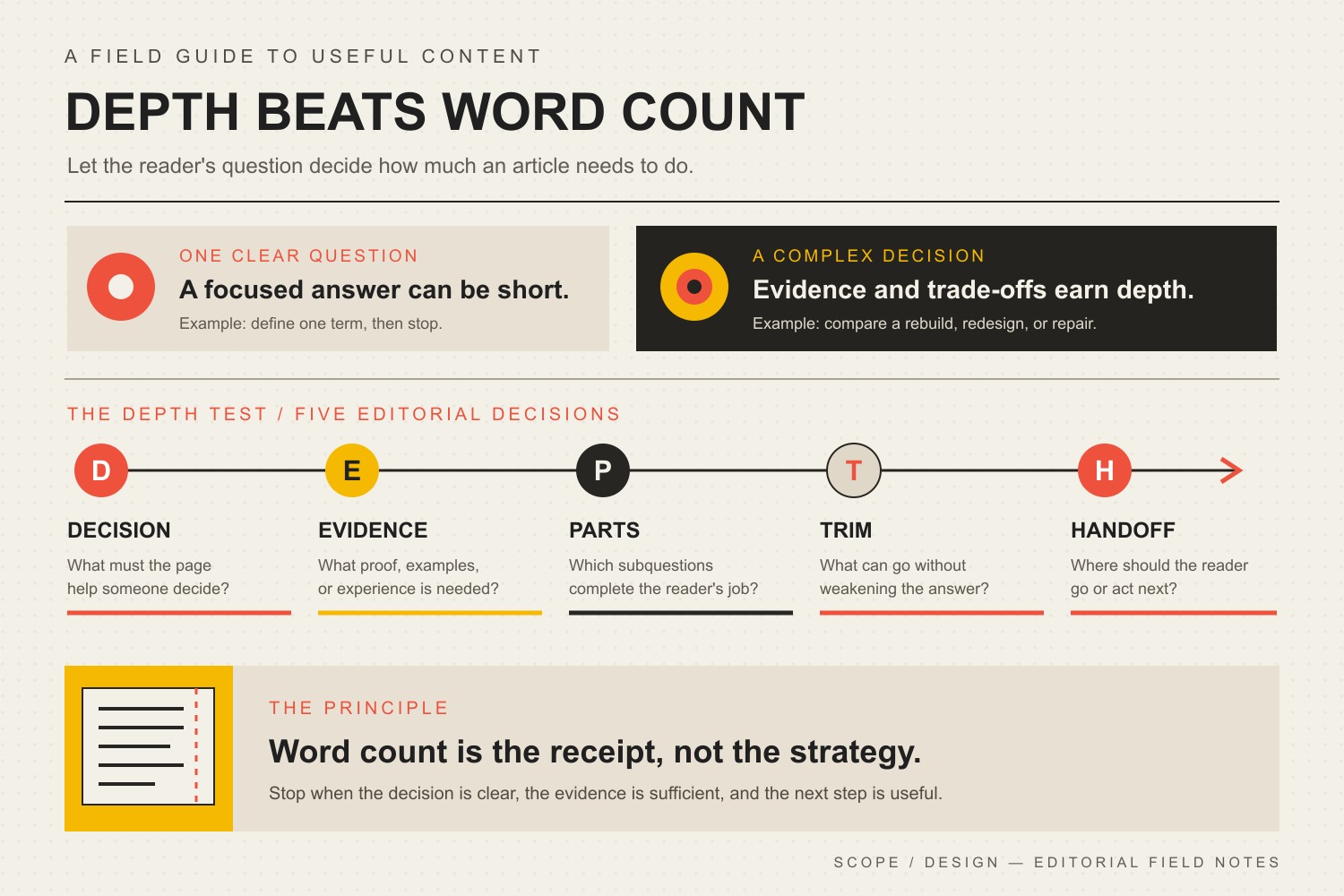
    5. Cover the Complete Decision, Not a Word-Count Target

    There is no magic length that makes a blog post authoritative. A 900-word answer can be complete. A 4,000-word article can be mostly throat-clearing.

    Use depth when the decision requires depth. After the first useful answer, ask what a qualified reader will need next:

    • What conditions make this advice apply?
    • What should the reader do first?
    • What evidence should they collect?
    • What alternatives should they compare?
    • What can go wrong?
    • What would change the recommendation?
    • How should they measure whether it worked?

    That is different from padding a draft until a plugin turns green. If you want the broader mechanics of headlines, readability, calls to action, visuals, and other blogging fundamentals, we cover those separately. This article’s job is narrower: give those fundamentals something worth presenting.

    Google’s people-first guidance asks whether a reader leaves feeling they learned enough to achieve their goal. That is a better editorial stopping rule than “our competitor wrote 2,300 words.”

    6. Match the Format and Distribution to the Evidence

    Differentiation does not have to live in prose. Sometimes the strongest proof is a diagram, a calculator, a decision table, a screenshot, a teardown, a short video, a downloadable template, or a side-by-side comparison.

    Choose the format after you know what you are trying to prove. A long narrative is a poor container for a three-variable decision. A tiny infographic is a poor container for a nuanced implementation. The evidence should choose the format, not the content calendar.

    Distribution works the same way. Do not automatically cross-post the same summary everywhere. Ask where the intended reader is likely to encounter the problem, what context they have in that channel, and what next action is realistic there.

    Once the source asset is strong, then repurpose the content into channel-native pieces. A customer-data table may become a LinkedIn chart. A process walkthrough may become a short video. A sales-objection section may become an email. Repurposing should distribute a differentiated source; it should not multiply a weak one.

    7. Measure Qualified Outcomes and Improve the Source Asset

    Traffic is useful diagnostic information. It is not the final verdict on a business article.

    A page written for a narrow, expensive decision may be valuable with modest traffic if it creates qualified inquiries, assists sales conversations, earns relevant links, gets cited, reduces repeated support questions, or helps the right visitor reach the next step with less friction. A high-traffic page can be a poor business asset if none of those things happen.

    Google’s guidance on succeeding in AI search similarly recommends looking beyond clicks to the value of visits and conversions. That is good marketing discipline regardless of where the visit came from.

    Define the useful behavior before you publish. Then use performance evidence to decide what to improve. If the page gets impressions but no clicks, inspect the promise and intent match. If it gets the right visits but no next action, inspect the offer and conversion path. If sales keeps sending the page because it answers a difficult objection, that is useful evidence even if search volume is small.

    The point of measurement is not to award a grade. It is to give the next revision better evidence than the first one had.

    How to Use AI Without Making Your Blog Sound Like Everyone Else

    AI is not the differentiation problem. Undifferentiated inputs are.

    Google’s guidance on generative AI content says generative tools can be useful for research and adding structure to original content. It also warns that generating many pages without adding value for users can run into its scaled-content-abuse policy.

    A practical division of labor looks like this:

    Use AI forKeep human/business ownership of
    Finding questions and gapsWhat matters to your actual customer
    Organizing interviews and notesThe experience inside those notes
    Comparing source claimsWhich sources you trust and why
    Generating structural optionsThe recommendation and tradeoffs
    Editing for clarityVoice, examples, caveats, and accountability
    Turning a strong source into derivative formatsThe source asset’s original evidence

    If the AI draft arrives before the evidence inventory, it tends to become the evidence inventory. Reverse the order. Gather the business-specific material first; then use the model to help make that material easier to understand.

    A 30-Minute Blog Differentiation Audit

    You do not need a month-long strategy project to find the first weakness. Pick one article that matters and run this audit.

    1. Write the reader decision. Who is deciding what, under which constraint?
    2. Search the topic. Note what the SERP, AI summaries, PAA, and leading pages already answer without your contribution.
    3. Highlight commodity sentences. Mark claims that could appear unchanged on ten competitor sites.
    4. Inventory inaccessible evidence. List customer questions, data, examples, screenshots, methods, expert input, failures, and constraints you can add.
    5. State the recommendation. Write what you would actually tell a qualified client in this situation.
    6. Name the tradeoff and exception. Say what the recommendation costs and what would make you change it.
    7. Check decision completeness. Add the next questions a serious reader must answer; delete filler that does not help the decision.
    8. Define one qualified outcome. Decide what useful action or signal you will inspect after the article is live.

    If you cannot complete steps four through six, do not solve the problem with a longer introduction. You have a research or positioning gap, not a writing gap.

    Blog Differentiation FAQ

    Is blogging too saturated in 2026?

    Blogging is saturated with substitutable explanations of common topics. That does not mean there is no room for useful business content. The opportunity is narrower: publish material with a specific audience job, first-hand evidence, clear judgment, and enough implementation detail that the reader gains something they could not get from a generic summary.

    Should I publish more often to make my blog more popular?

    Not automatically. More publishing helps when you already know which audience, decisions, evidence, and distribution channels deserve more coverage. If your existing pages are generic or disconnected from a business outcome, increasing cadence usually increases the amount of weak inventory you have to maintain.

    How long should a blog post be to stand out?

    Long enough to complete the reader’s decision and no longer. Use the topic’s complexity, evidence, alternatives, implementation needs, and risk to determine depth. Do not add sections only to match a competitor’s word count.

    What is the 80/20 rule for blogging?

    There is no single universal 80/20 blogging rule. Different marketers use “80/20” to describe different heuristics, such as spending more effort on promotion than creation or focusing on the minority of pages that drive most results. Treat it as a prompt to inspect concentration in your own data, not as a fixed publishing law.

    What is the fastest way to make a business blog less generic?

    Interview the person closest to the real work and ask for a recent example: What happened? What did you notice? What did you try? What failed? What threshold changed the decision? What would make you recommend something different next time? Those answers usually produce more differentiation than another hour of generic keyword expansion.

    Stand Out by Becoming More Useful, Not More Performative

    The saturated part of blogging is not the existence of millions of pages. It is the abundance of content that can be swapped for another result without changing the reader’s decision.

    If you want to make your blog stand out, narrow the job, add evidence that belongs to your business, state a recommendation, show your reasoning, answer the whole decision, choose formats and channels that fit the proof, and measure what qualified readers do next. Those seven layers make the article more useful to humans and more attributable to the source.

    If your company has real expertise but your content still reads like everyone else’s, Scope Design can help turn that expertise into a clearer content and marketing system. Start with the broader small business marketing strategy framework and diagnose the bottleneck before you buy or publish more attention.


  • 103 Blog Post Ideas & Brainstorming Prompts: The SPARK Ideation System

    103 Blog Post Ideas & Brainstorming Prompts: The SPARK Ideation System

    Good blog post ideas do not start with a blank document and a demand to “be creative.” They start with a real signal: a customer question, a sales objection, a search query, a repeated support problem, a useful piece of evidence, or something your team keeps explaining. Then you multiply that signal into angles and throw away the weak ones.

    This guide gives you 103 reusable brainstorming prompts, but the list is only half the job. Scope Design’s SPARK Loop turns those prompts into a repeatable ideation system: Start with a signal, Push it through prompts, Add useful angles, Reality-check the shortlist, and Keep the winners.

    TL;DR: generate more ideas without publishing more junk

    • Start with evidence of a real question. Do not ask a prompt generator to invent demand from thin air.
    • Use templates to multiply angles. One useful signal can produce many possible posts.
    • Let AI expand and regroup ideas. Do not let it invent customer research, expertise, statistics, or proof.
    • Reality-check the shortlist. Ask whether the idea helps a real reader, whether you can support the answer, and whether another page already owns the intent.
    • Schedule only the winners. A content calendar should contain decisions, not every thought that survived a brainstorming meeting.

    103 blog post ideas are useful when you start with a real signal

    Search results already have plenty of giant idea lists. In our U.S. research on August 20, 2026, Ubersuggest estimated roughly 390 monthly searches for “blog post ideas” and 260 for “blog topic ideas.” DataForSEO’s live Google results showed an AI Overview followed by pages offering 101, 52, 100, 82, and 75 ideas. People Also Ask immediately surfaced questions such as “What are some good topics for a blog post?” and “What should I write my blog post about?”

    Those numbers are third-party estimates and a search snapshot, not a forecast. The useful conclusion is simpler: people still want help getting unstuck, and the internet is not suffering from a shortage of raw lists. The better job is helping someone use the list without turning a content calendar into random-topic roulette.

    That distinction also keeps this page from duplicating our deeper guide to choosing business blog topics that attract buyers. This article owns brainstorming and angle expansion. That one owns the harder strategic question: which business topics deserve the investment.

    The Scope Design SPARK Loop for generating blog post ideas

    The SPARK Loop is deliberately simple. It separates idea generation from the decision to publish. That matters because brainstorming should be generous; editing should be ruthless.

    The five-stage SPARK loop: find a real signal, multiply it into angles, add expertise, reality-check the shortlist, and schedule only the winners.
    The Scope Design SPARK Loop turns a real signal into multiple angles, then forces a reality-check before anything earns a place on the calendar.

    S — Start with a signal

    A signal is evidence that a topic deserves attention. It can be qualitative or quantitative. The point is that it came from somewhere more useful than “we have not posted this week.”

    • A question prospects ask on sales calls
    • A support issue your team explains repeatedly
    • A confusing comparison buyers keep making
    • A Search Console query or People Also Ask question
    • A sales objection that stalls a good-fit buyer
    • A mistake you see before, during, or after a project
    • An internal process that would genuinely help the audience understand a decision
    • Original data, project evidence, or a strong expert observation you can actually support

    P — Push it through prompts

    Now use the 103 patterns below as angle multipliers. Do not treat every template as a command. A prompt containing “7 secrets” does not authorize you to invent seven secrets. A template promising a result in 14 days does not make that timeline true. The blank is a creative variable; the factual burden is still yours.

    A — Add useful angles

    Change one dimension at a time. The same core question can become content for a beginner, a buyer comparing options, an existing customer, a skeptical stakeholder, or an expert looking for implementation detail.

    AngleQuestion to askExample transformation
    AudienceWho needs the answer?“Website maintenance” → “Website maintenance for a two-person service business”
    StageWhat does the reader already know?Beginner guide → vendor-comparison checklist
    RiskWhat could go wrong?How-to → mistakes, warning signs, rollback plan
    EvidenceWhat can we show?Opinion → audit findings, examples, screenshots, first-party data
    DecisionWhat choice is the reader making?Definition → A vs. B comparison
    FormatWhat makes the answer easiest to use?Essay → checklist, table, FAQ, teardown, calculator, case example

    R — Reality-check the shortlist

    Before an idea becomes a brief, ask four questions: Is there a real audience signal? Can we support the answer with expertise or evidence? Does another page already own the same intent? Is there a useful next step after the reader gets the answer? If an idea fails two or three of those, it probably belongs in the parking lot rather than the publishing queue.

    This is where brainstorming hands off to strategy. If you are choosing among several business-focused candidates, use our business blog topic selection guide for the deeper buyer, demand, evidence, and business-value decision.

    K — Keep the winners

    For each winner, save the signal that created it, the intended reader, the question or query it owns, the evidence you expect to use, the next useful page or action, and the person responsible for the draft. That record is far more useful six weeks later than a spreadsheet cell that says “blog about SEO.”

    Where to find better starting signals

    If you only brainstorm from keywords, your content starts sounding like search results talking to themselves. If you only brainstorm from customer conversations, you can miss demand that has not reached your inbox yet. Use both.

    • Sales conversations: questions, objections, “why is this so expensive?” moments, and comparisons buyers keep making.
    • Support and service work: recurring problems, setup confusion, maintenance issues, and preventable mistakes.
    • Search evidence: Search Console queries, autocomplete, People Also Ask, related searches, and current SERP formats.
    • Internal expertise: what your team notices after doing the work dozens or hundreds of times.
    • Customer language: reviews, survey answers, interview notes, emails, and the exact phrasing people use when describing the problem.
    • Competitor gaps: not “what can we rewrite,” but “what important question, tradeoff, example, or limitation did everybody skip?”
    • Existing content: outdated sections, unanswered comments, thin FAQs, internal-search terms, and articles that deserve a deeper supporting page.

    Google’s current people-first content guidance is useful here because it asks whether content serves an intended audience, demonstrates first-hand expertise, adds original value, and leaves the reader feeling they learned enough to achieve a goal. That is a better publishing test than “the keyword tool had a number beside it.”

    103 blog brainstorming prompts you can reuse

    Pick one real signal and run it through ten prompts before you switch topics. You will usually get more useful variety by exploring one grounded question deeply than by generating 100 unrelated nouns.

    1. How doing ___ might make ___ better or worse
    2. 5 things you need to know before ___
    3. The most annoying ___ and what to do about it
    4. How to avoid 7 costly mistakes when ___
    5. Why ___ might be a bad idea
    6. 7 secrets of ___
    7. 3 simple ways to ___
    8. 2 lessons learned from ___
    9. The overlooked power of ___
    10. ___: 5 mistakes and how to avoid them
    11. My new favorite ___ and why
    12. The truth about ___
    13. 4½ lessons from a ___
    14. How to ___ like a pro
    15. The secret to ___ that actually ___
    16. ___ of the week
    17. The quick and easy way to ___
    18. 3 tips on ___ that ___
    19. ___ vs. ___: which is better?
    20. Why your ___ hates ___ and what to do about it
    21. 12 surprising ___ that cause ___
    22. What do ___ and ___ have in common?
    23. How to bring ___ to ___
    24. 8 things I would do differently when ___
    25. Why ___ makes ___
    26. 10 things I wish I had known about ___
    27. What is wrong with your ___?
    28. How to ___ faster without ___
    29. My 5 top tips for ___
    30. 7 things you can learn about ___ from ___
    31. Surprising ___ that actually work
    32. The surprising reason you may need ___
    33. 3 best ___ for ___
    34. How to avoid ___
    35. 7 ___ resources worth reading
    36. Unusual ways to ___
    37. How to get the most out of ___
    38. 5 ___ that will not drive you crazy
    39. How I ___
    40. What to do the next time ___ happens
    41. How to make ___
    42. 4 stupid mistakes I will never make again
    43. Should you get ___ or ___?
    44. The 3 best ___ and how to choose the right one
    45. How not to ___ ever again
    46. The rebel’s guide to ___
    47. 10 extreme ideas to ___
    48. Why I disagree with ___
    49. The worst ___ I ever experienced
    50. 7 lessons learned from the worst ___ ever
    51. An unexpected way to ___
    52. How I use ___ to ___
    53. Do this before you ___
    54. 4 ___ that actually work
    55. The ultimate guide to ___
    56. How to be a better ___
    57. 5 things I learned from ___
    58. ___: everything you need to know about ___
    59. Do you make these 10 mistakes when you ___?
    60. How to get more ___
    61. 6 ways to ___ in 14 days
    62. The ___ trap that can hurt your business
    63. 12 books on ___ worth reading
    64. The bootstrapper’s guide to ___
    65. What to look for when buying your next ___
    66. From ___ to ___ in 8 steps
    67. 10 uses for ___ you may not have considered
    68. Do you know how to ___? Take our quiz
    69. 4 ways to do ___ with only ___
    70. When it comes to ___, do this first
    71. Let’s talk about ___
    72. 7 habits that can improve ___
    73. New trends shaping ___ in [year]
    74. From ___ experts: 33 practical tips
    75. Create your own ___. No ___ required
    76. 5 strategies for ___
    77. What the best ___ know about ___ that you do not
    78. How ___ causes ___
    79. All ___ is not created equal: what to know
    80. 7 reasons to never ___
    81. The best ___ I have seen and why
    82. The ugly truth about ___
    83. Why ___ get ___ wrong
    84. 3 ways to finally stop ___
    85. How to prepare for ___
    86. 5 lies we tell ourselves about ___
    87. The ___ nobody wants to talk about
    88. Why I do not do ___ anymore
    89. 22 ___ experts or trends to watch in [year]
    90. 10 things experts do not tell you about ___
    91. The most surprising lesson from ___
    92. So you want to ___? 7 things to know first
    93. The ultimate ___ test
    94. 7 keys to ___
    95. How to build a killer ___
    96. The rise of ___ and what it means for you
    97. 33 ___ tips from 33 ___ experts
    98. The top 11 resources about ___
    99. How to learn ___
    100. What ___ taught me about ___
    101. 8 myths about ___ that are wrong
    102. The unexpected dangers of ___
    103. What to do after ___: your next-step checklist

    A few of those templates are intentionally aggressive because they force a different angle. Do not let the headline pattern outrun the evidence. If you do not have seven defensible reasons, use three. If there is no “secret,” call it a lesson. If you cannot support the timeline, delete the timeline. Headline theater is not information gain.

    How to use AI for blog post ideas without generating generic sludge

    AI is excellent at expansion. Give it one grounded signal plus context and it can produce alternative framings, group overlapping ideas, identify obvious missing comparisons, or apply the 103 patterns faster than you would manually. It is much worse at knowing which questions occur in your actual sales process, which evidence your company can defend, or which page already owns an intent unless you provide that context.

    A useful prompt sounds more like this: “Here is the customer question, the audience, the offer, the evidence we have, and the pages we already own. Generate 20 distinct angles using comparison, risk, beginner, objection, checklist, and case-example patterns. Flag any angle that would require evidence I have not supplied.”

    If you want the deeper prompting system, use our guide to writing ChatGPT prompts without getting generic slop. The important division of labor is the same: AI can expand the option set; a human still owns the reality.

    Reality-check your shortlist before you publish

    Once you have 20 or 50 candidates, stop generating. More options are no longer the bottleneck. Use a short pass/fail screen before you spend time on keyword research, interviews, graphics, or a draft.

    CheckPass when…Fail when…
    SignalYou can point to a real question, behavior, search surface, or business observation.The only reason is “we need something to post.”
    EvidenceYou have expertise, examples, data, documentation, or a credible research path.The headline requires invented certainty.
    OwnershipThe idea has a distinct job or clearly improves an existing owner.Another page already answers the same intent better.
    UsefulnessThe reader can make a clearer decision or take a sensible next step.The post exists mainly to target a phrase.
    FitThe topic belongs to the company’s real expertise, audience, or offer.The idea wandered in from a trend list with no strategic connection.

    For business content, take the survivors into the more rigorous topic-worthiness and qualified-demand process. Brainstorming should give that process better raw material, not replace it.

    Worked example: turn one customer question into a month of angles

    Suppose a prospect asks a web company, “Do we need a new website, or can we fix the one we have?” That single signal is already more valuable than “write something about websites.” Run it through different prompt types:

    1. Comparison: Website redesign vs. targeted repairs: which problem are you actually solving?
    2. Warning signs: 7 signs your website needs more than another patch.
    3. Cost: What makes repairing an old site more expensive than rebuilding it?
    4. Checklist: What to audit before approving a website redesign.
    5. Contrarian: Why a full redesign might be a bad idea right now.
    6. Experience: 5 things we check before telling a client to rebuild.
    7. Risk: The migration problems a redesign can create if nobody plans the handoff.
    8. Buyer question: What should be included in a website redesign proposal?
    9. Timeline: What actually determines how long a redesign takes?
    10. Next step: Fix, redesign, or maintain: a simple decision checklist.

    You probably should not publish all ten. A page-ownership review may reveal that three belong inside one strong guide, two already exist, one is better as a sales handout, and four deserve separate pages. That is success. The brainstorming session produced options; the editorial system prevented a small content farm from forming in the conference room.

    Move the winners into clusters and a content calendar

    A content calendar should answer “what is moving through the system and when?” It should not be asked to invent the strategy. Once the shortlist survives the reality-check, group related ideas around the page that owns the main decision, connect each article to the next useful context, and assign a realistic production cadence.

    Our editorial calendar guide goes deeper on turning approved ideas into a manageable pipeline. For the larger operating system around audience questions, evidence, distribution, and qualified outcomes, use our small-business content marketing system. And if content is only one part of a wider acquisition problem, step up another level to the small-business marketing strategy framework.

    Frequently asked questions about blog post ideas

    How do I come up with blog post ideas?

    Start with a real signal such as a customer question, search query, support issue, objection, project lesson, or piece of evidence. Then use prompt patterns to create multiple angles. Do not start by asking for 100 random topics with no audience, context, or business problem attached.

    What should I write my blog post about?

    Write about a question your intended reader genuinely needs answered and that you are qualified to answer well. The strongest candidates usually combine audience usefulness, evidence or experience, distinct page ownership, and a sensible next step.

    What are good topics for a blog?

    Good topics can include how-to explanations, comparisons, mistakes, checklists, buyer questions, myths, case examples, process breakdowns, trends, research, and expert commentary. The format is secondary. A good topic solves a real information problem for a specific audience.

    Can ChatGPT generate blog post ideas?

    Yes. ChatGPT and similar tools are useful for expanding, regrouping, and challenging ideas when you supply real context. They cannot independently know your customer conversations, unpublished evidence, business priorities, or existing content ownership. Use AI as an angle generator, not as proof that a topic matters.

    Are AI-generated blog ideas good for SEO?

    They can be, but the fact that AI suggested an idea has no special SEO value. What matters is whether the resulting page is useful, original, accessible, relevant to the query, and supported by credible evidence. Google’s guidance focuses on helpful, reliable, people-first content rather than granting a special exemption or penalty based on whether AI helped brainstorm it.

    Is blogging outdated in 2026?

    No, but “publish posts because blogs are good for SEO” is outdated thinking. A useful article can answer search questions, support sales, give AI and search systems clear source material, help customers self-educate, and become a durable asset for email, social, proposals, or support. A random publishing treadmill is much harder to defend.

    What is the 80/20 rule for blogging?

    There is no single official 80/20 law for blogging. People use the phrase for different ideas, including balancing helpful content and promotion or focusing effort on the minority of content that produces most results. Treat it as a heuristic, not a rule. Measure what your audience and business actually use.

    How many blog ideas should I brainstorm at once?

    Enough to create meaningful choice, but not so many that you spend the afternoon admiring a backlog. Ten to twenty angles around one grounded signal is often more useful than 100 unrelated ideas. Stop generating once the bottleneck becomes evaluation rather than creativity.

    How do I choose between several blog topic ideas?

    First eliminate ideas without a real audience signal, credible evidence path, distinct ownership, or useful outcome. Then compare the survivors by audience relevance, demand and intent, business usefulness, competition, production effort, and the strength of what you can uniquely add. That is the point where brainstorming becomes content strategy.

    Turn brainstorming into a content system

    If your team keeps running out of ideas, the problem may not be creativity. It may be that customer questions, search evidence, project knowledge, and editorial decisions live in separate places and never become a usable backlog.

    Start small: capture signals, run SPARK, keep only the defensible winners, and connect each winner to the right cluster and next step. If the broader marketing system is still fuzzy, use Scope Design’s small-business marketing strategy framework to decide what content is supposed to accomplish before you ask the calendar to manufacture more of it.

  • Blogging and Podcasting: Build One Sustainable Content System

    Blogging and Podcasting: Build One Sustainable Content System

    Blogging and podcasting can work together extremely well—but starting both at once is not automatically a better strategy. The right choice is the smallest content system that helps a specific audience solve a real problem, gives your business a useful way to earn trust, and can be maintained without turning every week into a production emergency.

    For many small businesses, consultants, and experts, that means starting with one durable source of truth and then adapting it into a blog post, podcast episode, email, video, or social post only when the second format adds something useful. The goal is not “more content.” The goal is more value from the same expertise.

    TL;DR: Start with the content job, not the channel

    • Start with a blog when the answer needs to be searchable, scannable, linked, cited, updated, or used as a durable reference.
    • Start with a podcast when conversation, interviews, voice, nuance, guest relationships, or listen-while-doing-something-else behavior are central to the value.
    • Use both when one research and evidence layer can support both formats and the second format improves the audience experience instead of merely multiplying production work.
    • Own the source. Keep the durable answer, calls to action, analytics, and audience-capture path on channels you control, then use platforms for discovery and distribution.
    • Measure the business system. Track production cost, discovery, attention, subscriber or inquiry growth, and qualified business outcomes—not traffic or downloads in isolation.

    Blogging and podcasting: should you start one or both?

    The practical answer is: start with the format that best serves the first audience decision you need to own. Add the second format when it has a distinct job and can share the same research, evidence, and editorial source.

    Start hereStrong fit when…Watch out for…
    BlogPeople search for the problem; the answer benefits from examples, links, screenshots, comparisons, updates, or reference value.Publishing pages without a distribution plan, evidence, internal links, or a clear next action.
    PodcastInterviews, conversation, personality, nuance, or access to guests is part of the value; your audience can consume audio naturally.Launching because podcasts feel prestigious, then discovering that editing, booking, show notes, promotion, and quality control exceed your capacity.
    BothThe same source question and evidence can create a useful written answer and a useful audio conversation without duplicating the whole production process.Turning every episode into a transcript dump or every article into a read-aloud recording and calling that repurposing.

    If you are mainly trying to improve your blog, use our small-business blogging guide. If the strategic decision is already made and your problem is the tool stack, our guide to business blogging tools owns that job. This page stays at the program level: how the formats fit together and when they should not.

    What auditing this exact article changed

    We did not preserve the old version merely because it had been online for years. Before revising it, we checked the exact URL across Scope Design’s analytics, Google Search Console, Bing Webmaster Tools, Ubersuggest, current search results, internal-link ownership, and technical crawl evidence.

    Signal checkedObservation before this revisionWhat it actually supports
    GA4, last 12 complete monthsNo Organic Search landing-page rows; only 2 Direct sessions across all channels, 0 engaged sessions, and 0 configured key events.The sample is far too small for behavior or conversion conclusions. There is no measured organic footprint forcing unsupported legacy claims to survive.
    Google Search ConsoleNo exact-page query/page rows in the current or prior 12-month period. URL Inspection reported “Crawled – currently not indexed,” while fetching, crawling, and indexing were allowed and Google/user canonicals matched.The page needs stronger ownership and usefulness, not a speculative URL migration.
    Bing Webmaster Tools0 clicks and 0 impressions for the exact URL.There is crawl history but no Bing traffic signal that justifies protecting weak claims.
    Ubersuggest0 page-ranking keywords, 0 backlinks, and 0 referring domains returned for the URL.Third-party evidence also shows little page-level equity requiring the old monetization promises or formulas to remain.

    That evidence does not prove blogging is dead, podcasting is ineffective, readers disliked the page, or this rewrite will rank. It supports a narrower editorial decision: preserve the established URL, remove claims we cannot defend, give the page one distinct job, and connect it to the right content cluster.

    Start with one audience problem and one business job

    A channel is not a strategy. Before choosing microphones, themes, podcast hosts, recording software, or publishing calendars, finish this sentence:

    For [specific audience] trying to [make a decision or solve a problem], this content should help them [useful outcome], and the business should be able to observe [meaningful signal].

    Good starting signals include sales questions, support problems, recurring objections, project lessons, customer language, Search Console queries, People Also Ask questions, and topics where your team has real experience. If you need a repeatable way to expand those signals into angles, use the SPARK blog-ideation process rather than starting from a random “100 profitable niches” list.

    This also prevents a common content failure: assigning a separate strategy to every channel. A topic can have one source of truth and several expressions. Your website may hold the durable answer. A podcast can add an interview, disagreement, story, or expert nuance. Email can carry the practical takeaway to people who asked to hear from you. Social can distribute a useful fragment and point back to the deeper source.

    Use the One-Source Content Loop

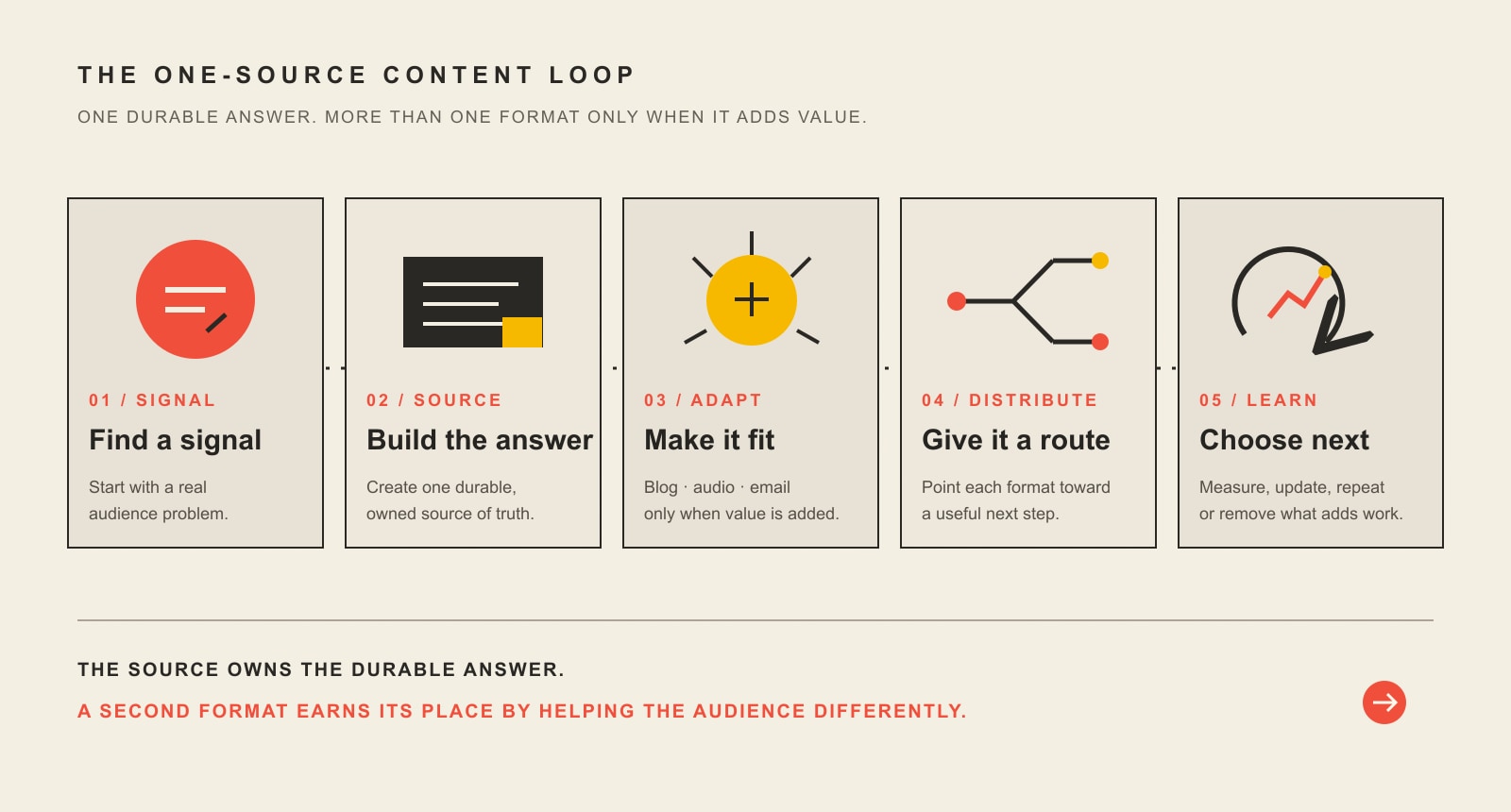
    The One-Source Content Loop is a simple operating model for deciding what deserves to become multiple formats. It is not a rule that every source must become a blog, podcast, video, and social campaign. The operating rule is the opposite: if a second format cannot reuse the source while adding a distinct audience benefit, do not add it yet.

    The five-stage One-Source Content Loop: find a real audience signal, build a durable source, adapt it only when another format adds value, distribute each version, and learn what deserves the next cycle.

    1. Signal: find a question worth owning

    Start with evidence that the question matters. Search demand can help, but so can a repeated sales objection, a support issue, a customer interview, a project mistake, or a pattern your team notices after doing the work repeatedly. The source should exist because somebody needs the answer—not because the calendar has an empty Tuesday.

    2. Source: build the durable answer

    Gather the evidence, examples, caveats, point of view, and next step in one place. For a business with a strong website, the source often belongs on the site because it can be linked, updated, cited, measured, and connected to the rest of the customer journey. Google’s current guidance similarly emphasizes helpful, reliable, people-first content that contributes original information or analysis rather than merely rewriting what already ranks. Google also explicitly says it does not have a preferred word count.

    3. Adapt: rebuild the idea for the format

    A good adaptation preserves the truth but changes the experience. The article may need the definitive checklist. The podcast may need a guest who can challenge assumptions. The email may need one sharp decision and a link to the source. The short video may need a visual demonstration. Our content repurposing workflow goes deeper on extracting knowledge units and rebuilding them for different audience moments.

    4. Distribute: give every format a route

    Publishing is a production event; distribution is how the work reaches people. Decide before production is finished which routes make sense: search, an email list, podcast directories, a guest’s audience, partners, social platforms, internal links, or a relevant YouTube channel. If YouTube is part of the plan, use it because video or YouTube discovery adds value—not because every audio file must automatically become a video. Our YouTube tools guide covers the native and paid layers separately.

    5. Learn: decide what deserves another cycle

    Look at the result in layers. Did the workflow consume more staff time than expected? Did search impressions, email subscribers, listeners, or qualified inquiries move? Did the source answer appear in sales conversations? Did one format attract attention but no useful next action? Use that information to update the source, improve distribution, keep the second format, or remove a step that is not earning its place.

    Build the minimum viable setup

    You do not need an enormous software stack to begin blogging and podcasting. You need the minimum set of systems that lets you create, publish, distribute, measure, and retain access to your work.

    1. An owned web destination. Use a site you control for durable articles, episode pages, show notes, calls to action, analytics, and the source material you expect to update over time.
    2. A permission-based audience path. Email is useful because a subscriber relationship is not dependent on a platform deciding to show your next post. This is one part of a broader small-business marketing system, not a reason to gate every article behind an email form.
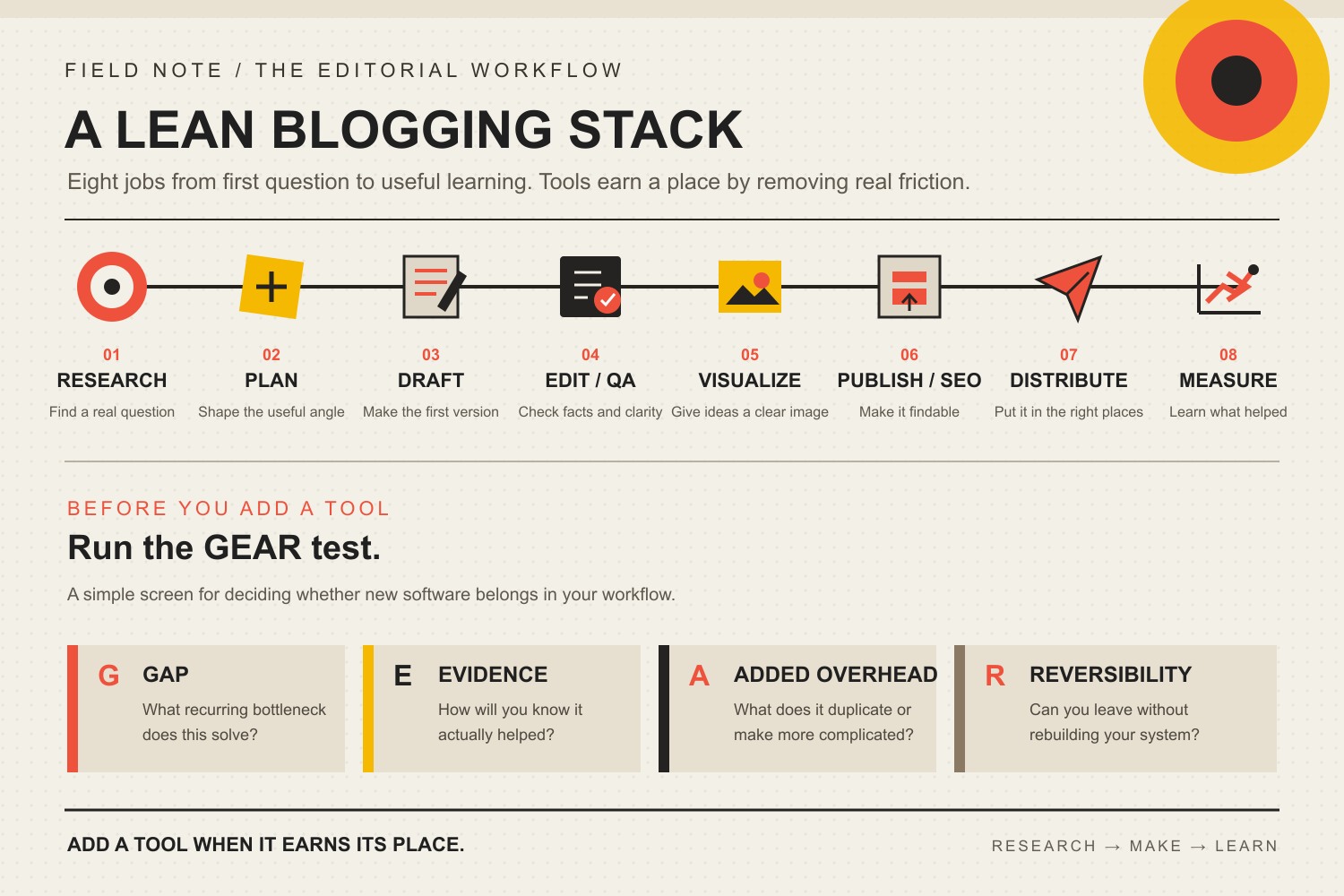
    3. A lean writing and publishing stack. Research, drafting, editing, visuals, publishing, SEO, distribution, and measurement are the jobs. Buy tools only when they remove a proven bottleneck.
    4. Recording and editing you can sustain. A microphone, quiet-enough recording environment, recording software, and an editing process are enough to test the format. Production quality should be understandable and professional; it does not need to imitate a major studio on day one.
    5. A podcast host or feed you can manage. Apple Podcasts documents that RSS-submitted shows can use a third-party-hosted feed or a self-generated feed. Its RSS requirements include required tags, at least one episode, and artwork. Apple also explains the submission and validation process. Treat directories as destinations that must be configured and managed, not as a magical automatic distribution layer.
    6. Measurement from the beginning. Set up analytics, Search Console where relevant, email metrics, and the platform analytics your podcast host or directory provides. Establish the baseline before you interpret movement.

    Run one source through multiple useful formats

    Imagine a web-design firm keeps hearing the question: “Should I redesign my website before investing in more marketing?” That is the signal.

    1. Source article: build the durable decision guide with diagnostic questions, examples, tradeoffs, internal links, and a clear next step.
    2. Podcast episode: invite a strategist or client-side operator to discuss cases where the answer was “redesign first” and cases where the real constraint was traffic, offer, follow-up, or measurement.
    3. Email: send the simplest diagnostic: “Before buying more traffic, identify the first broken handoff in the customer journey,” then link to the full source.
    4. Social: turn one counterintuitive finding or diagram into a native post, not a chopped-up paragraph with “link in bio” attached.
    5. Sales reuse: give the source to prospects asking the same question, then note which follow-up questions repeatedly appear.
    6. Learn: update the source with the best recurring question and decide whether the podcast format added enough useful nuance to repeat.

    That is much more efficient than inventing one blog topic, one unrelated podcast topic, five disconnected social posts, and an email newsletter from scratch every week. The same expertise creates multiple useful entry points while one source remains responsible for the durable answer.

    Make podcast content accessible and reusable

    A transcript is not automatically a good blog post, but equivalent text is important. W3C’s WCAG 2.2 guidance for prerecorded audio-only content calls for an alternative for time-based media that presents equivalent information. A reviewed transcript or equivalent text gives people who cannot fully hear the audio access to the information.

    Text also makes the episode easier to scan, quote internally, turn into show notes, identify follow-up questions from, and adapt into other formats. But do not mistake raw transcription for editorial work. Remove transcription errors, identify speakers, make links understandable, preserve important context, and build headings or summaries that help a reader navigate.

    If a transcript contains a strong original explanation, that explanation can feed the next source article. If it is merely a record of casual conversation, it may belong on the episode page as an accessibility resource without becoming a separate “SEO post.”

    Plan distribution before production is finished

    A strong content system separates source ownership from distribution reach. Your website and permission-based audience give you durable control. Search engines, podcast directories, YouTube, social platforms, guests, and partners can introduce the work to people who do not know you yet.

    That does not mean every source belongs on every platform. Choose distribution based on the audience and the job. A technical article may earn search traffic and backlinks over time. An interview can reach the guest’s network. An email can move a known reader back to the most useful source. A social post can test whether a framing resonates. The broader content marketing strategy should connect these routes instead of treating them as independent calendars.

    Measure the system, not just traffic and downloads

    Downloads can matter. Search traffic can matter. Neither one is the whole business case. Measure the program in layers so a healthy top-of-funnel number does not hide an expensive or unproductive system.

    LayerExamplesQuestion it answers
    WorkflowResearch hours, editing time, correction rate, turnaround time, episodes or articles actually completedCan we sustain this without hidden rework?
    DiscoverySearch impressions/clicks, directory discovery, referral traffic, email list growth, partner or guest referralsAre more relevant people finding the source?
    AttentionEngaged sessions, return visits, email replies/clicks, listening or viewing signals available from the platformAre people consuming enough to get value?
    Business effectQualified inquiries, booked calls, sales-assisted use, attributable purchases where measurement is credible, retained customers, useful subscriber growthDid the content contribute to a valuable relationship or decision?

    Do not declare success after one strong episode or one ranking jump. Establish a baseline, run enough cycles to expose workflow problems, and look for patterns. If the podcast creates useful sales conversations but modest downloads, it may still be doing a valuable job. If an article gets impressions but attracts the wrong inquiries, the traffic chart is not a victory by itself.

    Monetize after fit—not before it

    A blog or podcast can eventually support services, products, memberships, sponsorships, affiliate relationships, events, or paid content. But “monetize immediately” is a poor universal rule. First prove that the audience problem is real, the content is useful, the production system is sustainable, and the next business step makes sense.

    If you recommend products through affiliate relationships or accept sponsorships, treat disclosure as part of the publishing workflow. The Federal Trade Commission says material connections between endorsers and sellers must be disclosed, and advertising claims must be truthful and supportable. A disclosure is not a conversion obstacle to hide; it is part of maintaining the reader’s ability to judge the recommendation.

    There is no responsible universal answer to “How much will 10,000 podcast listeners earn?” or “How long until a blog makes $500 per month?” Those outcomes depend on the audience, offer, niche, geography, sponsorship or affiliate economics, pricing, conversion, costs, and what “make” means. Treat any single audience-to-income formula as a scenario, not a promise.

    A realistic first 90 days

    Days 1–30: prove the source workflow

    • Choose one audience and one recurring problem worth owning.
    • Decide whether blog or podcast is the better first expression.
    • Build the minimum publishing, measurement, and distribution setup.
    • Create one complete source asset with real evidence and a clear next action.
    • Record the production time and friction honestly.

    Days 31–60: repeat before expanding

    • Run two or more additional source cycles using the same workflow.
    • Improve the recurring bottleneck instead of buying tools at random.
    • Distribute each source through the routes that fit the audience.
    • If the second format has a clear job and the source can support it, pilot it on one piece.
    • Compare the second-format value with its actual production cost.

    Days 61–90: keep, change, or stop

    • Review workflow, discovery, attention, and qualified-outcome signals together.
    • Update the strongest source with questions you learned after release.
    • Keep the second format if it adds meaningful value; simplify or remove it if it mainly adds work.
    • Connect the most useful sources more deliberately through internal links, email, sales follow-up, and relevant platform distribution.
    • Choose the next 90-day constraint to improve. Do not add a new channel just because the calendar has room.

    Frequently asked questions about blogging and podcasting

    What is the difference between blogging and podcasting?

    Blogging is primarily a written, web-based format that is easy to scan, search, link, update, and reference. Podcasting is primarily an audio format that is well suited to conversation, interviews, voice, and listening while doing other activities. The best format depends on the problem, audience behavior, and what the content needs to communicate.

    Should a small business start a blog or a podcast first?

    Start with the format that best serves the first customer question you need to own and that your team can sustain. A blog is often the stronger first source when searchability, reference value, examples, or updates matter. A podcast can be the stronger first format when interviews, voice, relationships, or conversation are central to the value.

    Do I need both a blog and a podcast?

    No. Use both when one source of research and expertise can support two genuinely useful experiences without doubling the whole workflow. If the second format does not add a clear audience benefit, keep the system smaller.

    Is blogging dead?

    No. Written web content still performs useful jobs: answering search questions, explaining complex decisions, documenting expertise, supporting internal links, giving sales teams reference material, and creating an owned source that can be updated. Publishing generic articles without evidence, distribution, ownership, or a business job is the part worth retiring.

    How often should I publish?

    Use a cadence your real production bottleneck can support. One useful, well-researched source every two weeks can be better for a small expert team than promising three weekly pieces and shipping shallow work. Measure the process, then increase frequency only when quality control and distribution can keep up.

    Does a podcast transcript count as a blog post?

    Not automatically. A reviewed transcript can be an important accessibility resource and useful source material. A blog post should be structured for a reader’s job: clear answer, useful headings, examples, links, context, and a next step. Adapt the transcript when that creates a better written experience instead of publishing raw speech as an article.

    How long does it take for a blog or podcast to make money?

    There is no reliable universal timeline. Revenue depends on audience fit, what you sell, the buying cycle, traffic or listener quality, pricing, conversion, distribution, sponsorship or affiliate economics, and costs. Use early months to prove the audience problem and operating system before treating a revenue date as a commitment.

    Do I need expensive blogging or podcasting tools?

    No. Start with the native or low-cost tools that complete the actual jobs. Pay for a specialist tool when it saves recurring skilled time, provides evidence you cannot reasonably obtain another way, reduces meaningful risk, removes a proven handoff, or otherwise solves a bottleneck you have actually observed.

    Build the smallest system that can learn

    The best blogging and podcasting program is not the one with the most channels. It is the one that turns real customer questions and real expertise into durable answers, adapts those answers only where the format adds value, reaches people through deliberate distribution, and learns from outcomes that matter to the business.

    If your content operation is currently a collection of disconnected tools and calendars, Scope Design can help you map the website, content, search, email, and measurement pieces into a system your team can actually run.

  • 15 Blogging Tips for Small Businesses That Drive Real Results

    15 Blogging Tips for Small Businesses That Drive Real Results

    The best blogging tips for a small business are not really about blogging tricks. They are about giving every post a clear business job, answering a real customer question better than the alternatives, adding evidence only your business can provide, giving the answer a route to readers, and learning from what happens next.

    That is the difference between maintaining a blog and building a useful content asset. A post can be beautifully written and still do absolutely nothing if it targets the wrong question, has no distribution, connects to no next step, or teaches you nothing after it goes live.

    TL;DR: the blogging tips that matter most

    • Give every post one specific reader decision and one business job.
    • Research the question before you write the answer.
    • Lead with a useful answer instead of a ceremonial introduction.
    • Add first-hand evidence, examples, judgment, or analysis that a generic AI summary cannot supply.
    • Use AI to accelerate research and production, not to own accuracy or strategy.
    • Connect the post to related pages, a sensible next action, and an actual distribution plan.
    • Measure discovery, attention, and business effect separately, then update the content based on evidence.

    If blogging is one part of a larger acquisition problem, put it inside a coherent small business marketing strategy. A blog is a channel and a knowledge asset. It is not the entire marketing department wearing glasses.

    What this blogging page taught us before we rewrote it

    We audited this exact article before revising it. During the 12 complete months from August 20, 2025 through August 19, 2026, GA4 recorded zero Organic Search landing-page sessions for this URL. Search Console returned no page or query rows for the same URL, and Ubersuggest estimated zero ranking page keywords, zero backlinks, and zero referring domains. At the same time, the page itself returned HTTP 200, used a self-referencing canonical, and was set to index/follow.

    That does not prove blogging does not work. The sample is tiny, Search Console currently reports the URL as unknown to Google, and our analytics setup has known attribution and key-event limitations. It does prove something more modest and useful: publishing is not a distribution plan, and traffic is not a business outcome. The old version had plenty of tactics. What it lacked was a system.

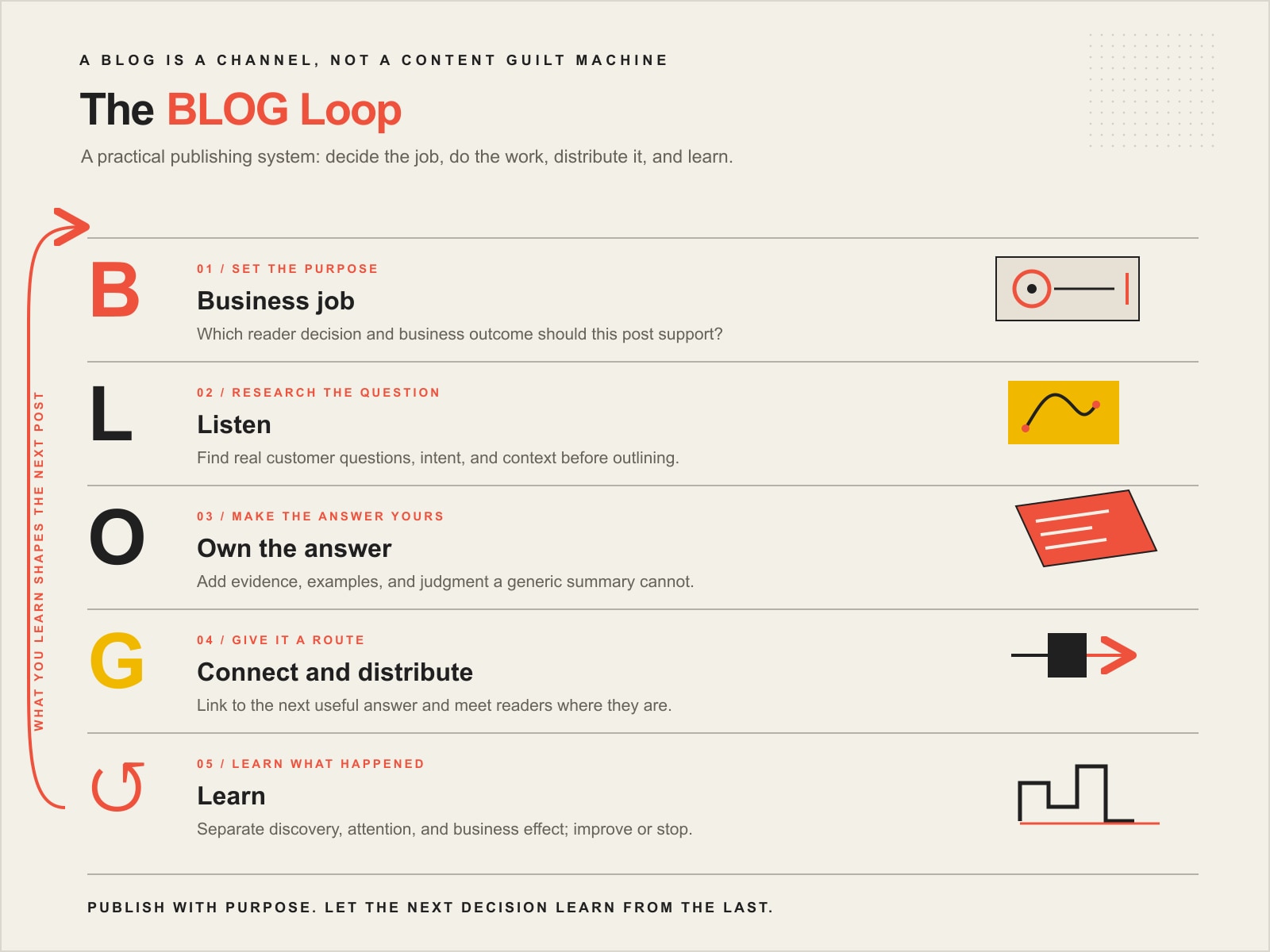
    The BLOG Loop behind these blogging tips

    We use the BLOG Loop to organize the work: Business job, Listen, Own, Give it a route, Learn. The point is not the acronym. The point is the sequence. Each stage prevents a different kind of waste.

    StageQuestionUseful output
    Business jobWhat reader decision and business outcome should this post support?A narrow page job and next action
    ListenWhat are customers and searchers actually asking?Question map, intent, SERP and PAA evidence
    OwnWhat can we add that is more useful than a generic summary?Direct answer, evidence, examples and judgment
    Give it a routeHow will people find the answer and where should they go next?Internal links, distribution, repurposing and CTA
    LearnWhat did the page teach us after it went live?Measurement, refresh, consolidation or stop decision
    The five-stage BLOG Loop for business publishing: choose a Business job, Listen to real questions, Own a useful answer, Give it a route through links and distribution, and Learn from outcomes.

    B — Business job: decide why the post should exist

    1. Give every post one business job

    Before choosing a title, decide what the post is supposed to help the business do. It might attract a problem-aware buyer, answer an objection before a sales call, explain a service, reduce repetitive support questions, earn links to an original resource, or help an existing customer make a better decision.

    “Get traffic” is too vague. Traffic from whom, for what question, leading toward what useful action? A page that brings 5,000 students researching a class project may be less valuable to a local service business than a page that brings 50 buyers comparing real options.

    Write the job in one sentence: This post helps [specific reader] decide [specific thing] so they can [useful outcome]. If that sentence is mush, the article usually becomes mush too.

    2. Define one specific reader decision

    Audience labels are not enough. “Small business owners” describes millions of people. A decision gives the article a shape.

    Compare “blogging ideas for small businesses” with “I run a local service company, have ten old posts, and can only invest four hours a month. Should I publish something new, update an existing page, or stop blogging until the offer is clearer?” The second version has constraints, alternatives, and a real consequence.

    If your problem is figuring out what deserves its own article, our guide to business blog topics that attract buyers owns that narrower question. If the topic is good but sounds like everybody else, the next problem is how to differentiate the article.

    3. Choose the next action before you write

    The next action should match the reader’s stage. Someone learning a concept may need another article, a calculator, a checklist, or an example. Someone comparing vendors may need pricing context, proof, scope, or a way to start a conversation.

    Do not bolt a giant “BUY NOW” button onto an informational article and call that conversion strategy. The content should earn the next step. If there is no useful next step, that is a strategy problem worth noticing before you spend six hours polishing the draft.

    L — Listen: research the question before writing the answer

    4. Start with questions customers actually ask

    Your best blog ideas are often hiding in sales calls, estimate requests, onboarding meetings, support tickets, proposals, customer emails, search queries, and the questions staff answer for the fifth time this week.

    Start there because those questions already carry context. You know who asked, why it mattered, what they misunderstood, and what happened after they got the answer. Search-volume tools can expand the opportunity, but they should not erase the business reality that made the question valuable in the first place.

    5. Choose keywords by intent and buyer fit, not volume alone

    For this revision, “blogging tips” had the strongest broad search demand in our research. “Small business blogging tips” was dramatically smaller. We still wrote for small businesses because audience fit matters more than winning the largest possible crowd.

    Use keyword volume as evidence of demand, not as a command. A keyword deserves the page when its intent matches the reader, the business has something credible to add, and the resulting page supports a useful customer journey. Chasing a high-volume phrase with the wrong audience is how you end up proudly reporting traffic that nobody in sales has ever heard of.

    6. Check Google, Bing, PAA, and AI answers before outlining

    Search results are a live description of what the query currently means. For “blogging tips,” Google showed general advice lists, an AI Overview, People Also Ask questions, video, and related searches. Bing leaned more heavily toward blogging platforms, definitions, starting a blog, and monetization. Same words, different emphasis.

    Look for the repeated questions, expected formats, dominant assumptions, and missing nuance. Then build something better. Do not trace the top three articles and swap synonyms. That produces a perfectly optimized photocopy.

    Google’s current guidance for its AI search experiences still comes back to unique, useful content for people plus a technically accessible page. There is no secret “AI citation” font size.

    O — Own: make the answer worth finding

    7. Lead with the answer

    Readers should not have to survive 400 words of throat-clearing before learning what you think. Put the answer near the top, then earn the deeper explanation.

    This helps humans scan, gives search systems a clear statement to understand, and makes the page more useful when someone lands on it with a specific question. Answer-first does not mean shallow. It means the reader gets orientation before nuance.

    8. Add evidence, examples, and judgment only your business can provide

    Generic information is cheap. Your advantage is what happened when you did the work.

    • Show the decision you made and why.
    • Explain a tradeoff that a beginner guide skips.
    • Use anonymized client patterns when confidentiality matters.
    • Publish a useful checklist, framework, calculation, screenshot, comparison, or failure analysis.
    • State what you would not recommend and under what conditions your advice changes.

    Google’s people-first content guidance asks whether a page offers original information, analysis, first-hand expertise, and substantial value beyond obvious summaries. That is a better editorial test than asking whether you used the keyword seven times.

    This is also where content marketing becomes an asset instead of a publishing treadmill: useful knowledge accumulates, connects, and becomes reusable across sales, search, email, social, and customer support.

    9. Use AI as an assistant, not the accountable author

    AI is useful for outlining, organizing research, finding gaps, generating questions, transforming formats, and helping a writer get from a blank page to something editable. It is terrible at being accountable for whether a statistic is real, whether the recommendation fits your customer, whether confidential information belongs in the prompt, or whether the final copy sounds like you.

    Google says generative AI can be useful for research and structure, while scaled generation that adds little value can run into its spam policies on scaled content abuse. Our rule is simpler: AI can accelerate the work; a human still owns strategy, evidence, accuracy, positioning, risk, and approval.

    If you want the deeper workflow, see our guide to using ChatGPT for marketing as an assistant rather than the department.

    10. Make the page easy to scan, crawl, and quote

    Good structure is not a gimmick. Use descriptive headings, short paragraphs where the idea allows it, useful lists, tables for real comparisons, and images that explain something the prose handles badly. Keep links crawlable and anchors descriptive. Google specifically recommends ordinary <a href> links and meaningful anchor text in its link best practices.

    Do not pad a post because somebody told you Google wants 2,000 words. Google explicitly says it has no preferred word count. Write enough to complete the reader’s job, then stop. If the page is technically discoverable but still struggles, our page-one readiness framework separates demand, eligibility, intent, evidence, experience, authority, and outcome so you can diagnose the right problem.

    G — Give it a route: links, distribution, and the next useful step

    11. Link to the next useful answer

    Internal links should behave like helpful directions, not SEO confetti. If a sentence naturally raises a question that another page answers better, link it. If the destination does not help the reader, leave it alone.

    A healthy content cluster has distinct page owners connected by contextual links. The broad page explains the big decision. Supporting pages answer narrower questions. Links clarify the relationship. That helps humans navigate and gives search systems a coherent set of crawlable relationships without turning the site into a keyword filing cabinet.

    12. Distribute where the audience already pays attention

    “We published it” describes where the file lives. It does not describe how a reader will find it.

    Choose distribution based on the audience and the post’s job. That may mean an email to existing customers, a salesperson using the article after a call, a useful answer in a relevant community, a social post built around one idea, paid promotion for a commercially important asset, a partner newsletter, or search discovery that compounds over time.

    The same rule applies to organic traffic: publication is not distribution, and more of the wrong visitor is just more server logs.

    13. Repurpose the idea for the channel instead of copy-pasting the post

    A useful article can become an email, a short video, a sales handout, a FAQ answer, a presentation slide, a social thread, a checklist, or a client conversation. But repurposing is not “paste the first paragraph into six apps.”

    Keep the core evidence and idea. Change the opening, length, format, context, and call to action for the channel. The reader on LinkedIn did not volunteer to read a 2,800-word blog post with the line breaks removed.

    Loop — Learn: measure what happened and decide what deserves another round

    14. Measure discovery, attention, and business effect separately

    Do not compress every signal into “traffic.” A practical blogging scorecard has at least three layers:

    LayerWhat it asksExamples
    DiscoveryCan the right people find the page?Indexing, impressions, rankings, referral exposure, email reach
    AttentionDid they actually use it?Engaged sessions, scroll/read behavior, return visits, replies, saves, sales-team use
    Business effectDid it help a useful customer action?Qualified inquiries, assisted journeys, purchases, booked calls, reduced support friction, better close conversations

    A page can be valuable before it ranks if the sales team uses it constantly. A page can rank and still be useless if it attracts the wrong intent. Measurement should tell you what kind of problem you have, not merely provide a prettier chart for the monthly meeting.

    15. Refresh, consolidate, or stop based on evidence and capacity

    Consistency matters only if the business can consistently produce something worth publishing. One strong article a month can be a better system than four rushed articles that repeat what already exists and never get distributed.

    Review older posts by job, accuracy, traffic, impressions, links, sales usefulness, overlap, and maintenance cost. Update an owner that still deserves to exist. Consolidate pages competing for the same intent. Preserve URLs with useful history. Remove content only when it has no meaningful role or equity. Calendar guilt is not a content strategy.

    A practical 30-day blogging reset

    If your blog has become a drawer full of old posts, do not begin by promising yourself three articles a week. Run one BLOG Loop.

    1. Week 1 — Business job and listening: collect ten real customer questions, review existing pages, and choose one decision worth owning.
    2. Week 2 — Own the answer: research search intent, current results, PAA and AI answer patterns; gather first-party examples and authoritative sources; draft the best answer you can actually defend.
    3. Week 3 — Give it a route: add the right internal links, a sensible CTA, an explanatory visual, and a distribution plan for the audiences that already know or need you.
    4. Week 4 — Learn: verify indexing and links, establish the baseline metrics, note sales or customer use, and decide when you will review the page again.

    Then repeat with the next question. That is slower than filling a calendar with titles. It is also much closer to how useful small-business content marketing compounds into a real knowledge asset.

    Frequently asked questions about business blogging

    Is blogging still worth it for small businesses?

    It can be, when customers need education, comparison, evidence, or answers before they buy. Blogging is a poor fit when the business has no useful questions to answer, no one will maintain or distribute the content, or a more immediate bottleneck such as a weak offer or broken conversion path deserves attention first.

    How often should a small business publish blog posts?

    Use the highest cadence you can sustain without sacrificing usefulness, evidence, distribution, or maintenance. For some businesses that is weekly. For others it is monthly or even less often. There is no prize for feeding the CMS more frequently than your audience needs.

    How long should a blog post be for SEO?

    Long enough to complete the reader’s job and no longer. Google explicitly says it does not have a preferred word count. A 900-word answer can beat a 3,000-word article when it matches the intent better; a complex comparison may genuinely need much more space. Depth should come from the problem, not a target number in a plugin.

    Can ChatGPT write business blog posts?

    It can help research, outline, draft, reorganize, critique, and repurpose content. A human should still own the source material, customer context, factual verification, examples, privacy boundaries, positioning, tone, and final approval. If the only thing your article adds is that an AI can summarize the same search results faster, you have not built much of an asset.

    What are the most common blogging mistakes?

    Common mistakes include choosing topics with no business job, writing before researching the question, targeting volume instead of intent, inventing or recycling statistics, burying the answer, publishing generic AI summaries, skipping internal links, having no distribution plan, forcing an irrelevant CTA, and never reviewing the page after publication.

    What is the 80/20 rule for blogging?

    There are several “80/20” blogging heuristics on the web, usually suggesting that a minority of effort or content drives most results, or that more time should be spent promoting than writing. Treat those as planning prompts, not laws or ranking factors. Your actual ratio should come from your audience, distribution channels, content quality, and business constraints.

    Should old blog posts be deleted?

    Not automatically. Review the page’s accuracy, intent, rankings, impressions, links, customer value, overlap, and maintenance cost. Update useful owners, consolidate competing pages, preserve valuable URLs, and remove only when the page has no meaningful purpose or equity. Our business blog topic guide goes deeper on deciding what deserves to exist.

    Build a blogging system, not a content guilt machine

    The useful version of blogging is not “publish because the calendar says Tuesday.” It is a repeatable way to turn real customer questions into owned answers, connect those answers into a coherent body of expertise, distribute them deliberately, and learn which ones create value.

    Start with one post and run the BLOG Loop all the way through. If the bottleneck is bigger than the article itself, Scope Design can help diagnose the broader marketing and content system so you know whether the next dollar belongs in content, search, distribution, conversion, or somewhere else entirely.

  • The Most Important Business Blogging Tools: Build a Lean Stack That Works

    The Most Important Business Blogging Tools: Build a Lean Stack That Works

    The most important business blogging tools are the ones that cover the jobs your content system actually has to do: research, planning, drafting, editing, visuals, publishing and SEO, distribution, and measurement. You do not need a 40-app shopping spree. You need a small stack that removes recurring friction without creating another system your team has to babysit.

    If you are still deciding how blogging fits into your business, start with our guide to building a blogging and podcasting program. If the program already exists, this guide helps you decide which tools deserve a place in it.

    TL;DR: Build the Minimum Viable Blogging Stack First

    • Research: start with search itself plus first-party search-performance data. Add a specialist keyword suite when research volume or competitive analysis becomes a real bottleneck.
    • Plan: use one source of truth for briefs, outlines, assignments, and evidence. The tool your team already uses is often better than a fashionable replacement.
    • Draft: use a reliable editor. AI can accelerate ideation and first passes, but strategy, expertise, facts, and final judgment still need an accountable human.
    • Edit and QA: build a repeatable review checklist for accuracy, voice, links, evidence, accessibility, and conversion intent.
    • Visualize: use one design workflow for featured images, diagrams, and useful screenshots. Do not decorate weak ideas with prettier pixels.
    • Publish and optimize: use a CMS plus one SEO layer. A plugin score is a diagnostic, not an editorial director.
    • Distribute: start with the channels you already own. Add scheduling and repurposing software only when manual handoffs are consistently wasting time.
    • Measure: combine search visibility, on-site behavior, and business outcomes. Traffic alone is not the finish line.

    Before you add a paid tool, run it through Scope Design’s GEAR Test: Gap, Evidence, Added overhead, Reversibility. If you cannot name the bottleneck, define the result, explain the new complexity, and leave cleanly later, keep the company card in your wallet.

    The Most Important Blogging Tools Cover Eight Jobs

    Most “best blogging tools” articles start with products. That is backwards. A tool is useful only because it performs a job inside a larger content workflow.

    At Scope Design, the durable sequence is closer to: understand the business job, research the audience and query, build the brief, draft, verify, publish, distribute, measure, and improve. That is also why a blogging stack belongs inside a broader content marketing strategy and a coherent small business marketing system. If the strategy is fuzzy, buying more software mostly lets you execute the fuzziness faster.

    This distinction matters because products change constantly. Free tiers shrink. AI features get bundled into tools you already pay for. A standalone feature becomes native six months later. A decision framework ages much better than a 2026 shopping list.

    Use the Scope Design GEAR Test Before Adding Another Tool

    The GEAR Test is a simple way to separate a real capability gap from software FOMO.

    Eight stages in a lean business blogging workflow, followed by the GEAR test: Gap, Evidence, Added overhead, and Reversibility.

    G — Gap: what recurring bottleneck does this solve?

    “It has AI” is not a gap. “Our editor spends three hours every week turning interview transcripts into structured briefs” is a gap. Name the job, the person who owns it, and the friction you are trying to remove.

    E — Evidence: how will you know it helped?

    Decide what should change before the trial starts: research time, revision cycles, publishing errors, content throughput, qualified impressions, assisted conversions, or another observable result. Hope is not an analytics strategy.

    A — Added overhead: what does it duplicate or complicate?

    Every app has a second price tag: setup, permissions, training, integrations, data cleanup, notifications, billing, and the “where the hell did we save that?” problem. If a new tool duplicates 80 percent of a system you already own, the last 20 percent needs to earn the mess.

    R — Reversibility: can you leave without rebuilding the company?

    Check exportability, content ownership, file formats, integrations, and what happens when the subscription ends. The best tool today can become an expensive hostage situation tomorrow if your data and process cannot move.

    The Eight Jobs Your Business Blogging Stack Needs to Cover

    1. Audience and keyword research tools

    Research tools should help you answer three questions: What is the customer actually asking? What page should own that intent? What evidence will make the answer useful?

    Start with Google Search, the questions and result formats you can observe directly, and Google Search Console performance data for pages you already own. Search Console is first-party evidence about how your pages and queries perform in Google Search, which makes it more useful for your own site than another generic “content score.”

    Specialist suites such as Ahrefs Keywords Explorer and Semrush keyword research tools can expand keyword discovery, competitive analysis, and prioritization. You do not automatically need both. Pay for deeper research when the volume of work, competitor analysis, or time saved makes the subscription cheaper than the bottleneck.

    Also separate topic selection from tool selection. Our business blogging practices guide covers the operating habits that make a blog useful. A keyword database cannot rescue a weak business question.

    2. Planning and source-of-truth tools

    Your planning layer needs to hold the brief, target audience, business goal, sources, outline, assignments, status, links, and next action. Google Docs, Microsoft 365, Notion, Trello, Asana, ClickUp, or a spreadsheet can all work. The brand matters less than whether the team knows where the truth lives.

    A second planning tool usually creates more drag than leverage. If sales keeps customer questions in one place, marketing keeps the calendar in another, and writers keep sources in private documents, fix the information flow before shopping for a shinier board.

    3. Drafting and AI-assisted writing tools

    A good drafting tool makes it easy to write, comment, compare revisions, preserve sources, and hand work to the next person. For many teams, the boring answer is still a collaborative document editor.

    AI tools can help with ideation, interview synthesis, outline options, first drafts, restructuring, and repurposing. They are much less trustworthy when you ask them to invent expertise, choose strategy without context, or produce factual claims without verification. If you want the deeper workflow, our ChatGPT for marketing guide focuses on defining the job, grounding the prompt, and evaluating the output instead of treating the model like a magic intern.

    The rule is simple: use AI to reduce mechanical effort, not accountability. Somebody still owns the argument, the evidence, the client voice, and the decision to publish.

    4. Editing and factual-QA tools

    Grammar and style assistants can catch friction. Commenting and version history can make collaboration less painful. Neither one proves the article is correct.

    Your real QA system should check the claim against its source, confirm dates and qualifiers, remove unsupported certainty, verify internal and external links, inspect headings and alt text, and ask whether the article does the business job defined in the brief. A polished hallucination is still a hallucination wearing a tie.

    5. Visual-content tools

    For many articles, one design tool can cover featured graphics, diagrams, social crops, and simple charts. Canva and Adobe Express are common choices. Screenshots are useful when they demonstrate a real interface or result. Custom design is worth the extra effort when the visual itself explains an original model, comparison, process, or piece of evidence.

    Do not add images because a checklist says “blog posts need images.” Add a visual when it improves comprehension. Decorative wallpaper is still wallpaper.

    6. Publishing and on-page SEO tools

    Your CMS should let you publish accessible, indexable, maintainable content without requiring a developer for every comma. If your business site already runs on WordPress, you usually do not need a second “blog platform” just because a roundup ranked one higher.

    Use one SEO layer for titles, descriptions, canonicals, robots settings, structured data, and basic content checks. Then keep the hierarchy straight. Google says its ranking systems are designed to surface helpful, reliable, people-first content. A green plugin light can expose a missed field; it cannot decide whether your explanation deserves to exist.

    7. Distribution and repurposing tools

    Publishing is not distribution. Your workflow still needs a path into email, social channels, sales conversations, customer support, and future derivative content.

    Start with the native scheduling and publishing capabilities of the channels you actually use. Add a cross-channel scheduler, transcription tool, clipping tool, or automation layer when the same handoff happens often enough to become expensive. Our RECAST content-repurposing workflow is built around adapting a strong source asset for a new audience or decision, not spraying the same paragraph everywhere and calling it omnichannel.

    8. Measurement and improvement tools

    A useful measurement stack separates three different questions: Can search engines find and understand the page? Are real people engaging with it? Does that attention contribute to a business outcome?

    Use Search Console for Google search-performance evidence, Google Analytics for event-based website behavior, and Bing Webmaster Tools as a separate first-party search signal. Then connect those systems to your actual inquiry, CRM, ecommerce, or sales process where possible.

    Do not assume analytics is a perfect lead ledger. Missing events, consent behavior, attribution rules, bot traffic, direct traffic, and handoffs into phone or email can distort the picture. Measure what the tools can support, disclose the gaps, and avoid making the dashboard sound smarter than it is.

    A Minimum Viable Business Blogging Tool Stack

    For a small business, the best blogging tool stack is often the one you can explain on a single screen. Use this as a starting architecture, not a mandatory vendor list.

    JobStart withPay for a specialist when…
    ResearchSearch + first-party search dataKeyword discovery, competitor analysis, or research volume repeatedly consumes expensive time.
    PlanningYour existing shared document/project systemHandoffs, approvals, ownership, or reporting are breaking at scale.
    DraftingCollaborative editor; AI optionalStructured production volume or specialized collaboration creates a proven gap.
    Edit + QAReview checklist + version historyEditorial volume, compliance, or multi-reviewer workflows make manual QA unreliable.
    VisualsOne design toolBrand control, complex data, custom illustration, or production volume requires more.
    Publish + SEOCMS + one SEO layerGovernance, technical SEO, integrations, or multi-site work exceed the native workflow.
    DistributionNative channelsRecurring cross-channel scheduling or repurposing is consuming measurable staff time.
    MeasurementSearch Console + GA4 + Bing Webmaster ToolsAttribution, CRM integration, dashboards, or multi-client reporting require a deeper layer.

    Notice what is missing: a requirement to buy three keyword platforms, two AI writers, four schedulers, and a productivity app whose main job is reminding you to use the productivity app.

    When Is a Paid Blogging Tool Actually Worth It?

    A paid tool earns its place when the value is concrete. Good reasons usually fall into five buckets.

    1. It saves recurring skilled time. Saving ten minutes once is not a business case. Saving four hours every month on a repeatable job might be.
    2. It gives you evidence you cannot reasonably get another way. Competitive keyword data, crawl diagnostics, brand monitoring, or specialized research can justify a paid layer.
    3. It reduces meaningful risk. Better approval, accessibility, security, backups, or compliance workflows can be worth more than raw speed.
    4. It connects systems that otherwise require manual rework. Integration is valuable when it removes a recurring handoff, not when it merely creates more synchronized clutter.
    5. It remains reversible. You can export the data, understand ownership, and leave without rebuilding the process from scratch.

    If you cannot tie the subscription to one of those outcomes, wait. Use the free or native capability until the constraint becomes obvious.

    What Our Audit of This Exact Article Taught Us

    We did not protect the old article just because it had been online for years. We audited the page the same way we would audit a client’s content before deciding what deserved to survive.

    Signal checkedObservation on August 20, 2026What it supports
    GA4, last 12 complete monthsNo Organic Search landing-page rows. Across all channels, 2 Direct sessions, 0 engaged sessions, 0 configured key events. Prior comparison returned no rows.The sample is far too small for behavior or conversion conclusions. There is no measured organic footprint forcing us to preserve unsupported copy.
    Google Search Console1 impression, 0 clicks for the exact page in the current 12-month period; no rows in the prior period. URL Inspection says the page is submitted and indexed with the established URL as canonical.Google knows the page, but demonstrated search equity is minimal. Keep the stable address and improve the page’s job instead of manufacturing a migration.
    Bing Webmaster Tools0 clicks and 0 impressions for the URL; Bing has known the page since 2024 and crawled it in July 2026. Site sitemaps report success.There is crawl history but no meaningful Bing traffic footprint to protect.
    UbersuggestNo ranking keywords or exact-URL backlinks were returned for the page.Third-party evidence also shows little page-level equity, so weak claims and a bloated tool catalog do not deserve preservation.

    That evidence does not prove blogging is worthless, that readers hated the page, or that this rewrite will rank. Scope’s analytics also has known attribution and key-event limitations. It supports a narrower editorial decision: preserve the established URL, remove claims we cannot substantiate, give the page one defensible job, and connect it to the right cluster.

    The old version included time-stamped “2025” trends, unsupported lead-generation percentages, a “most profitable niches” list, an unverified AI-adoption statistic, an arbitrary ideal word-count range, and universal “best” claims about products. Those are gone. A useful tool guide should make the decision easier, not make the copy sound certain.

    Frequently Asked Questions About Blogging Tools

    What is the best tool for blogging?

    There is no universal best tool because blogging is not one job. A CMS can publish but cannot decide the right topic. A keyword suite can research but cannot supply your expertise. An AI assistant can draft but cannot own the facts. Start by identifying the bottleneck, then choose the smallest tool that solves it.

    What blogging tools do beginners need?

    A beginner business stack can be very small: a CMS, a shared document or planning space, search and first-party search data, one design tool, one SEO layer, and basic analytics. Add specialized software after the workflow reveals a recurring constraint.

    Are free blogging tools enough for a small business?

    Often, yes, especially while the content program is small. Free and native tools can cover planning, writing, basic design, publishing, Google search reporting, Bing search reporting, and analytics. The reason to pay is not “professional bloggers pay for tools.” Pay when depth, scale, collaboration, automation, or risk reduction creates a measurable return.

    Do I need Ahrefs or Semrush for business blogging?

    No. Both are capable specialist research platforms, but neither is a prerequisite for publishing useful business content. A paid SEO suite becomes easier to justify when you perform regular keyword research, competitor analysis, backlink work, site audits, or multi-page planning and the extra data saves enough time or improves enough decisions to pay for itself.

    Should a small business use AI tools to write blog posts?

    AI can be useful for brainstorming, organizing research, drafting options, restructuring, and repetitive transformation. It should not be allowed to invent customer experience, case studies, statistics, sources, or technical certainty. Treat AI as an accelerator inside a controlled editorial workflow, not as the person accountable for the answer.

    What platform do most business bloggers use?

    The more useful question is which platform fits your existing website, ownership requirements, publishing workflow, integrations, and maintenance capacity. If your business website already has a capable CMS, splitting the blog onto another platform can create more SEO, analytics, branding, and governance work than it solves.

    How many blogging tools should a small business use?

    Use as few as possible while covering the eight jobs reliably. One product may cover several jobs. Two products may be justified for a job with different owners or requirements. The number is not the target; low friction, clear ownership, evidence, and reversibility are the target.

    How do I know whether a blogging tool is helping?

    Define the expected change before you buy it. Measure something the tool should actually influence: hours saved, errors reduced, approval cycles shortened, pages researched, qualified impressions gained, content reused, or attributable business actions. If you cannot connect the tool to a result after a reasonable trial, remove it or redefine the job.

    Your Tool Stack Should Get Smaller as the System Gets Clearer

    A mature content operation does not necessarily have more software. It has clearer ownership, cleaner evidence, better handoffs, and fewer mystery subscriptions. The best stack is boring in the right places.

    Start with the eight jobs. Run every new purchase through GEAR. Keep the systems that create evidence or remove recurring friction, and kill the ones that mostly create tabs.

    If the bottleneck is bigger than software — unclear topics, weak search ownership, inconsistent production, disconnected analytics, or no conversion path — Scope Design’s content and SEO work can help diagnose the system before you buy another tool to treat the symptom.

  • How Long Should a Blog Post Be for SEO? Depth Beats Word Count

    How Long Should a Blog Post Be for SEO? Depth Beats Word Count

    How long should a blog post be? Long enough to complete the reader’s job, and no longer. Google explicitly says it has no preferred word count, so a 3,000-word post does not earn SEO value merely by being long. Long-form content can still perform well when the topic genuinely needs depth, evidence, examples, and connected answers. The extra words are the byproduct, not the strategy.

    TL;DR: How long should a blog post be?

    • There is no magic SEO word count. Google says it does not have a preferred word count.
    • Long-form content helps only when the reader’s question actually requires depth.
    • Choose length by the decision, evidence, and subquestions the page needs, then trim anything that does not improve the answer.
    • Use internal links to connect the article to the rest of the reader’s journey instead of forcing every adjacent topic onto one page.
    • Measure visibility, engagement, and qualified outcomes separately. A bigger article is not automatically a better business asset.

    Our shorthand is simple: word count is the receipt, not the strategy. If a useful answer happens to take 700 words, publish 700 good words. If a complicated comparison needs 3,500, earn every one of them.

    Long-form content can help SEO, but not because it is long

    A lot of long-form SEO advice starts with a correlation and quietly turns it into a rule. Longer pages may cover more subtopics, attract links, answer more follow-up questions, or give a writer more room to demonstrate expertise. Those are real possibilities. None of them mean the word count itself caused the result.

    Google’s people-first content guidance is unusually clear here. It asks whether you are writing to a particular word count because you heard Google prefers one, then answers the premise directly: it does not. That should kill the idea of a universal “ideal blog length” as an SEO target.

    So what does “long-form” mean? We use it as a practical description, not a ranking threshold: a page is long-form when the reader’s problem genuinely requires multiple sections, supporting evidence, examples, comparisons, or follow-up answers. A detailed buying guide may need that. A definition of one term probably does not.

    Padding a thin idea to 2,000 words is not optimization. It is a short answer wearing a trench coat.

    How long should a blog post be for SEO? Use the DEPTH Test

    Before setting a target length, run the topic through Scope Design’s DEPTH Test. It forces the article to earn its depth instead of treating verbosity as a feature.

    The DEPTH test: define the Decision, gather Evidence, map necessary Parts, Trim what does not help, and plan the Handoff.
    DEPTH stepQuestion to askWhat it does to length
    D — DecisionWhat question or decision must this page resolve?Prevents a broad topic from swallowing three different articles.
    E — EvidenceWhat proof, examples, sources, or first-party experience does the answer need?Adds depth only where proof reduces uncertainty.
    P — PartsWhich subquestions are necessary to complete the reader’s job?Creates useful sections instead of keyword-shaped filler.
    T — TrimWhat can you remove without weakening the answer?Cuts repetition, tangents, and ceremonial introductions.
    H — HandoffWhat is the next useful page, action, or measurement?Lets internal links and next steps carry adjacent jobs instead of bloating this page.

    Imagine two topics. “What does a 301 redirect do?” may be answered well in a focused article under 1,000 words. “Should our company rebuild, redesign, or keep repairing a ten-year-old website?” may need technical tradeoffs, cost ranges, ownership questions, examples, and a decision model. The second answer is longer because the decision is harder, not because Google awarded bonus points at word 2,001.

    What our audit of this exact long-form article found

    We did not rewrite this page from theory alone. Before revising it, we checked the exact URL across GA4, Google Search Console, Bing Webmaster Tools, Ubersuggest, the current search results, and Scope Design’s content graph.

    Signal checkedObservation on August 20, 2026What it actually supports
    GA4, last 12 complete months15 landing sessions, all Direct; 2 engaged sessions; 0 configured key events; no Organic Search landing row.The sample is too small and attribution too uncertain for behavior conclusions. There is no measured organic footprint forcing us to preserve weak legacy copy.
    Google Search ConsoleNo exact-page query rows in the current or prior 12-month period. URL Inspection reports “Crawled – currently not indexed.” Indexing is allowed and Google selected the same canonical we declared.The page is technically crawlable, but public existence did not equal demonstrated search visibility.
    Bing Webmaster Tools0 clicks and 0 impressions for the exact URL. Bing recognizes the page and has crawl history.There is no meaningful Bing traffic footprint to protect.
    UbersuggestNo exact-page ranking keywords and no exact-URL backlinks returned.Third-party evidence also shows no strong page equity requiring the old angle or statistics to survive.
    Current query demandUbersuggest estimates 590 monthly U.S. searches for “how long should a blog post be.”The direct reader question is a clearer content job than the legacy “SEO juice” framing. The estimate is directional, not a traffic promise.

    The old article already had about 1,400 words. That word count did not magically create measurable organic visibility. This does not prove the topic is bad, that readers hated the page, or that this revision will rank. It proves something narrower and more useful: length by itself was not doing the job.

    We kept the established URL because it is a known, self-canonical address with crawl history. A weak SEO plugin warning is not a good reason to create redirect risk. We changed the page’s job instead: answer the length question directly, remove claims we cannot defend, and connect it to the right content system.

    When is longer content worth the cost?

    Longer content is worth producing when additional depth changes the reader’s ability to understand, compare, trust, or act. Four situations commonly justify the extra work.

    1. The reader is making a complex or expensive decision

    A high-stakes service comparison needs more than a definition. Readers may need costs, tradeoffs, implementation questions, ownership issues, risks, examples, and a way to evaluate fit. If leaving out one of those pieces creates a predictable sales objection, the section probably earns its place.

    2. The process has real steps, branches, or failure points

    A useful tutorial may need setup, prerequisites, screenshots, troubleshooting, edge cases, and a clear finish state. Compressing that into 500 words can make the page shorter while making the task harder.

    3. Evidence matters more than assertion

    When readers are skeptical, more evidence can be more useful than more persuasion. First-party measurements, transparent methodology, authoritative sources, examples, and limitations take space. That is productive length because it helps the claim survive inspection.

    4. The article is a durable source asset

    A deep article can become the source for a sales brief, social posts, FAQs, a presentation, an email sequence, or a short video. That only works when the source contains real knowledge worth transforming. Our content repurposing workflow treats the durable source as evidence to recast for different audience moments, not a pile of sentences to resize.

    When is short content better?

    Short content wins when the reader’s job is narrow. A single definition, a concise policy update, an event announcement, a specific support answer, or a tightly targeted landing page may become worse when you bolt on history lessons and twelve “related” questions.

    • One question, one clear answer: do not turn it into an encyclopedia.
    • Time-sensitive update: speed and accuracy may matter more than exhaustive context.
    • Transactional page: the job may be to remove friction and help someone act, not teach the whole category.
    • Existing cluster coverage: link to the article that already owns the adjacent topic instead of duplicating it.

    This is why the broader business blogging system and this article should remain separate. The broader guide owns the operating system. This page owns one decision inside it: how much depth a blog post actually needs.

    What actually gives deep content more SEO upside?

    Match the search intent completely

    The page should solve the question the searcher actually asked. That may require a direct answer, definitions, comparisons, objections, examples, and next steps. It does not require every related keyword a research tool can produce. Completeness is about the reader’s job, not semantic confetti.

    Add evidence and information another page cannot fake

    Original analysis, first-party data, implementation experience, a transparent framework, or a useful synthesis gives a long page a reason to exist. Rewriting the same ten search results with more adjectives does not.

    Make the answer easy to find

    Long does not have to mean slow. Put the direct answer near the top. Use descriptive headings that make sense out of context. Use a table when the reader is comparing a real relationship. Use an image when the visual reduces explanation. Then let people go deeper only when they need to.

    A useful cluster lets one article stay focused. This page does not need to teach the entire small business marketing strategy, the complete blogging process, organic acquisition, repurposing, and AI search optimization inside one monster page. It can explain its own decision well and link to the next useful owner.

    Make claims easy to verify in AI search too

    Google’s current guidance for AI search still emphasizes unique, valuable content for people, a good page experience, and technical accessibility. There is no special 2,000-word switch that makes a page citable. If AI visibility matters, focus on clear answers, explicit entities, original information, source-backed claims, and technical access. Our broader guide to AI search optimization and citation readiness covers that system in more depth.

    See Google’s current guidance directly: Top ways to ensure your content performs well in Google’s AI experiences on Search.

    How do you structure long-form content without turning it into sludge?

    1. Answer first. Do not make a reader survive 400 words of scene-setting before you tell them what you think.
    2. Give every section one job. A heading should answer a question, reduce uncertainty, provide evidence, expose a tradeoff, or move the decision forward.
    3. Use examples where abstraction gets slippery. One concrete example can replace three paragraphs of marketing fog.
    4. Make evidence visible. Link to original sources beside the claim and label your own measurements honestly.
    5. Use visuals to compress explanation. The DEPTH graphic above does more work than another page of prose about the framework.
    6. Trim repetition on purpose. If two sections make the same point with different keywords, merge them.
    7. Design the next step. Link to the page that owns the next question instead of expanding forever.

    That last step matters. A good article is part of a system, not a content guilt machine. If you need the complete workflow around research, publishing, distribution, refreshing, and measurement, use our small business blogging guide.

    Internal linking: depth needs a place in the content system

    Internal links are not decorations added five minutes before publishing. They are how you let pages specialize. This article can own the length-and-depth decision because other pages own adjacent jobs.

    • Use the small business marketing strategy pillar when the real question is where content fits in the larger acquisition system.
    • Use the business blogging guide when the problem is the ongoing blog workflow.
    • Keep visibility, engagement, action, and qualified outcomes as separate measurement layers so a ranking does not get mistaken for a business result.
    • Use the content repurposing guide when a strong long-form source should be transformed for another audience moment.

    That is better than stuffing all four topics into this page until “comprehensive” becomes another word for “unfocused.”

    How do you measure whether long-form content is working?

    Do not grade a long article by its length after publishing. Grade it by the job it was supposed to do.

    LayerUseful evidenceWhat it tells you
    Technical accessHTTP status, indexability, canonical, crawl/index statusWhether search systems can reasonably access and understand the page.
    VisibilityQueries, impressions, positions, citations, mentionsWhether the page is appearing for relevant questions.
    EngagementEngaged sessions, useful clicks, scroll behavior when availableWhether real visitors use the page rather than merely land on it.
    ActionRelevant CTA clicks, forms, calls, downloads, next-page visitsWhether the content moves the intended journey forward.
    Qualified outcomeQualified leads, pipeline, sales, appointments, retained customers, saved staff effortWhether the result mattered to the business.

    Traffic and rankings are useful diagnostic signals. They are not the finish line. Use qualified outcomes to decide whether the content deserves more investment.

    Frequently asked questions about blog post length and SEO

    How long should a blog post be for SEO?

    Long enough to answer the searcher’s question completely and no longer. Google says it has no preferred word count. For a simple question, that may be under 1,000 words. A complex guide or comparison may need several thousand. Use the reader’s decision and evidence needs to determine length, not a universal target.

    Is 2,000 words a lot for a blog post?

    It can be a lot for a narrow question and not nearly enough for a complicated topic. Two thousand words is a production number, not a quality diagnosis. If the page repeats itself to reach 2,000, it is too long. If readers still need critical evidence at 2,000, it may be too short.

    Is a 3,000-word blog post too long?

    No, not automatically. A 3,000-word post is appropriate when each section does useful work and the topic genuinely requires that depth. It is too long when the reader has the answer at 900 words and the remaining 2,100 exist to satisfy a template.

    Does Google prefer long-form content?

    Google does not publish a preferred word count. Its current guidance emphasizes helpful, reliable, people-first content. A longer page can be useful when it answers a more complex intent, but length itself should not be treated as a ranking factor or guarantee.

    Some industry studies have found correlations between longer pages and more links, but correlation is not a reason to pad an article. A page earns links because it contains something useful to reference: original data, a strong explanation, a tool, a framework, a source, or a distinctive example. Length may accompany those assets without causing the links.

    Can AI-generated long-form content rank?

    AI can assist research, outlining, drafting, and editing, but producing more machine-written words is not a strategy. Google’s guidance focuses on content quality and purpose rather than whether a tool helped create it. A human still needs to own the facts, experience, examples, positioning, source verification, and final judgment.

    Should every blog post be long-form?

    No. Different reader jobs require different formats. A narrow FAQ, announcement, definition, comparison, case note, checklist, or landing page can be short and excellent. Make the content as deep as the job requires, not as long as the calendar demands.

    Is blogging dead because of AI?

    No. Generic commodity articles are easier than ever to produce, which makes original evidence, experience, clear answers, and useful tools more important. Google’s AI-search guidance explicitly continues to encourage unique, valuable content that fulfills people’s needs.

    How often should long-form content be updated?

    Update it when the answer, evidence, product behavior, law, market, links, search intent, or business context has materially changed. Do not change the date just to make old content look fresh. A useful refresh should improve the page, not repaint the timestamp.

    The bottom line: depth beats word count

    Long-form blog content can translate into more SEO value when the extra depth helps a real person complete a real job. It can answer a complicated question more completely, support claims with evidence, connect related decisions, and create something worth referencing. None of that requires pretending Google hands out rankings by the pound.

    Use the DEPTH Test before you write: define the Decision, gather the Evidence, map the necessary Parts, Trim what does not help, and design the Handoff. Then stop when the reader has what they need.

    If your blog is full of old posts built around arbitrary word counts, unsupported statistics, and no clear place in the marketing system, the useful next step is not “write more.” Audit what each page is supposed to do, what evidence it can defend, and where it belongs. That is the kind of content strategy Scope Design builds into the broader small business marketing system.