Tag: AI search

  • How to Automate SEO and GEO Research Without Automating the Strategy

    How to Automate SEO and GEO Research Without Automating the Strategy

    AI SEO automation works best when it automates evidence collection and synthesis—not the strategy itself. Let software gather query variants, search demand, SERPs, People Also Ask questions, source candidates, competitor structures, internal-link opportunities, and monitoring data. Keep topic ownership, positioning, original contribution, factual verification, cannibalization decisions, and final editorial judgment with a person who understands the business.

    That gives a small team the useful part of automation without handing the steering wheel to whatever model happens to be generating the brief. The workflow becomes faster and more repeatable while the business still owns the strategy.

    TL;DR: Automate the research operations, keep the decisions human

    • Automate query collection, keyword metrics, SERP/PAA capture, source discovery, competitor summarization, link candidates, and monitoring.
    • Use AI to organize evidence into a first-pass research packet or brief.
    • Do not let AI decide which existing page owns the topic without checking the real content inventory.
    • Keep the company’s point of view, original examples, commercial priorities, and strategic tradeoffs human-owned.
    • Verify important claims against primary or first-party sources before drafting.
    • Use generative-search research as an extension of SEO research, not a separate magic discipline.
    • Google’s current guidance says foundational SEO still applies to its generative AI features and that there is no special AI-only schema or required content-chunking trick.
    • Monitor search and generative-AI visibility after publication, then feed the evidence back into the next research cycle.

    What AI SEO automation should actually automate

    The phrase “AI SEO automation” often gets sold as “the agent does SEO for you.” That collapses several different jobs into one promise.

    SEO research includes a large amount of repetitive evidence work: collecting queries, pulling metrics, checking SERPs, finding People Also Ask questions, gathering source material, identifying recurring competitor sections, comparing titles, checking internal links, and watching what changes after publication. Those jobs are good automation candidates because the output can be preserved and inspected.

    Strategy is different. Someone still has to decide what the business should be known for, which page deserves to own the query, what not to publish, which customer problem matters, what evidence is trustworthy, what the company can say that competitors cannot, and whether a page deserves to exist at all.

    That distinction fits our broader business technology philosophy: automate and integrate where the workflow is clear, but keep ownership and responsibility visible.

    A research pipeline for AI SEO automation

    Automated collection sorts search evidence into a research packet; a person sets strategy, and post-publication observations return to the next research cycle.
    Automate the evidence pipeline. Put explicit human gates around ownership, strategy, source quality, original contribution, and final judgment.

    1. Collect demand and query language automatically

    Start with the business problem or topic, then let tools collect nearby search language: keyword suggestions, classic search volume, related searches, Search Console queries, People Also Ask, forum phrasing, and realistic generative-search questions.

    Automation is useful here because the goal is recall. You want a broad evidence set before deciding which language actually matches the reader job.

    Do not automatically create a page for every variation. Google’s current generative-AI Search guidance specifically warns against producing many pages merely to capture query variations or fan-out phrases. Modern search systems can understand related wording. The strategy job is deciding which questions belong together and which represent genuinely different intent.

    2. Capture the SERP and People Also Ask evidence

    For each primary query, automatically record the current organic results, AI Overview or other generative features where present, PAA questions, videos, forums, related searches, and the types of pages ranking.

    The automation should preserve the evidence, not merely produce “competitors write about X, Y, and Z.” A useful packet keeps the actual URLs, titles, dates, result types, and questions so a human can see whether the interpretation is reasonable.

    3. Summarize competitor structure without copying the strategy

    AI is good at extracting repeated patterns from a result set: common definitions, comparison dimensions, objections, examples, tools, FAQs, and missing topics.

    That summary should answer questions such as:

    • What reader job do the top pages appear to serve?
    • What sections are nearly universal?
    • What evidence do they rely on?
    • Where are results mostly product pages versus educational pages?
    • Which questions are answered poorly or not at all?
    • What would be commodity if we simply repeated it?

    The human then decides whether Scope has something worth adding. Competitor consensus is evidence about the current result set; it is not a content brief by itself.

    Put a hard human gate around topic ownership

    Before drafting, compare the proposed reader job against the content you already own. This is one of the most important places not to automate blindly.

    A title search is not enough. A differently titled page may already contain a section that owns the exact question. That happened while building this AI-systems cluster: the original idea “What should a small business automate with AI first?” looked like a new article until the live Scope corpus showed that our existing AI Automation pillar already contained and owned that exact job. We narrowed the new article into pre-build AI automation prioritization instead of publishing a duplicate.

    The automation can surface likely overlaps, headings, links, and semantic matches. A person should make the ownership decision because the consequence is architectural: merge, update, support, redirect, narrow, or abandon.

    Automate source discovery; keep claim approval human

    AI can search for likely primary sources, collect documentation, flag dates, and map which source appears to support which claim. It should not silently convert a search snippet or AI-generated summary into factual authority.

    For material claims, prefer the organization that owns the fact: Google for Google Search behavior, NIST for its frameworks, WordPress for WordPress guidance, a regulator for a legal requirement, or your own measured data for your own results.

    Then preserve a simple claim ledger: claim, source, boundary, date reviewed, and what the source does not prove. That keeps a fast automated research workflow from turning into citation laundering.

    GEO research should not become a second strategy department

    Terms such as GEO, AEO, and AI SEO are useful shorthand, but Google’s current official guide to generative AI Search makes the relationship clear: for Google Search, foundational SEO remains the base.

    Google says its generative features rely on its Search index and quality systems, and it emphasizes crawlability, clear technical structure, useful page experience, and unique, valuable, non-commodity content. It also says there is no special schema.org markup required specifically for generative AI Search, no need to chop content into tiny “AI-readable” chunks, and no need to rewrite pages for every exact query variation.

    That means useful GEO research is mostly an expansion of the evidence set:

    • collect realistic conversational questions;
    • inspect AI Overviews, AI Mode, ChatGPT Search, Perplexity, or other relevant surfaces where practical;
    • record which sources and entities appear;
    • look for query fan-out and adjacent reader questions;
    • test whether your important claims are easy to extract and verify;
    • measure mentions, citations, referrals, and business outcomes separately.

    But do not build a parallel content factory that produces one page per chatbot phrasing. The strategy should still be one coherent content architecture serving real people.

    Let AI build the first-pass brief—then challenge it

    Once the evidence packet is assembled, AI can produce a useful first-pass brief containing:

    • primary reader question and search intent;
    • query map and demand evidence;
    • SERP/PAA and generative-search observations;
    • existing-site ownership and overlap notes;
    • authoritative source candidates;
    • claims that require evidence or qualification;
    • common competitor coverage;
    • gaps or opportunities for information gain;
    • possible internal links;
    • questions the article should answer.

    Then challenge the brief before anyone writes. Ask: Is the proposed thesis ours? Does it say something useful beyond the result set? Is a competitor section being copied merely because it is common? Are sources first-party? Is the page trying to steal a job from an existing Scope article? Is there a real example or decision framework we can contribute?

    After the research is solid, answer-first structure can make the resulting page easier to use. Our separate front-loading content for AI SEO guide owns that downstream editorial technique.

    Automate internal-link discovery, not link judgment

    A tool can compare the draft with the live content graph and surface exact passages where another Scope article may answer the next question. That is much better than manually remembering hundreds of URLs.

    But a high lexical similarity score does not automatically make a useful link. The final decision still asks whether the destination genuinely helps the reader, whether the anchor means what the destination owns, whether the page is live, and whether the article is becoming overlinked.

    Close the loop with monitoring

    Research should not end when the article is saved. Automate the collection of what happens next: rankings, impressions, Search Console queries, generative-AI visibility where available, referrals, link changes, content decay, and meaningful competitor shifts.

    Google announced dedicated generative-AI performance reporting in Search Console in June 2026, initially rolling it out to a subset of sites. Where that data is available, it belongs in the same measurement loop as ordinary Search performance rather than in a separate vanity dashboard.

    The automation’s job is to surface change. The human job is to decide whether the change means update the article, strengthen evidence, change positioning, merge content, build a supporting page, or do nothing.

    What not to automate in SEO and GEO

    • Do not automate topic ownership. Use tools to surface overlap; make the canonical decision deliberately.
    • Do not automate your point of view. A model can summarize the internet; it cannot manufacture the company’s lived experience.
    • Do not automate claim responsibility. A source must actually support the sentence you publish.
    • Do not automate every content decision from volume. Low-volume questions can be commercially important, and high-volume phrases can be irrelevant.
    • Do not automate publication merely because a draft passes a checklist. The article still needs a reader job, useful contribution, factual review, and owner.
    • Do not automate “GEO hacks.” If a tactic conflicts with current first-party guidance or exists only because an AI checklist said so, challenge it.

    AI SEO automation FAQ

    Can I use AI to do my SEO?

    Yes, but “use AI” should mean assisting research, analysis, drafting, QA, monitoring, and repetitive operations—not delegating the entire marketing strategy. Keep ownership, factual responsibility, and final judgment with accountable people.

    What SEO research is safest to automate?

    Query collection, keyword metrics, SERP/PAA capture, competitor-section extraction, source discovery, internal-link candidate discovery, brief assembly, and monitoring are strong candidates because their evidence can be stored and reviewed.

    Can AI choose my content strategy?

    AI can expose options and patterns, but the strategy depends on your business model, customers, existing content ownership, expertise, risk, and commercial priorities. Those are not generic search-result facts.

    Is GEO different from SEO?

    There are additional surfaces and measurements worth researching, but Google’s current position is that optimizing for its generative AI Search experiences remains grounded in ordinary SEO fundamentals. Treat GEO research as an expanded evidence set rather than permission to abandon technical SEO and useful content.

    Do I need special schema or an llms.txt file for Google AI Search?

    No special AI-only schema is required for Google’s generative AI Search features, and Google says it ignores llms.txt for Search visibility and rankings. Continue using accurate structured data where it supports normal Search features.

    Build a research system that makes better judgment possible

    The best AI SEO automation does not replace the strategist. It removes the repetitive work that keeps the strategist from seeing the evidence clearly.

    Automate collection. Preserve the sources. Summarize the patterns. Surface overlaps and opportunities. Then make the important decisions deliberately: what this business should own, what it can prove, what it can contribute, and what deserves to be published.

    If your SEO research is still a pile of browser tabs and one-off exports, Scope Design can help design a repeatable research and content workflow that uses AI for leverage without outsourcing the strategy.


  • How to Build a Future-Proof Website: 7 Durable Upgrades That Age Well

    How to Build a Future-Proof Website: 7 Durable Upgrades That Age Well

    A future-proof website is not a website that never changes. It is a website that can change without turning every update into a redesign, migration, emergency, or expensive dependency.

    If you want to future proof your website, do not start by collecting whatever features are fashionable this year. Start by making the site easier to use, faster on real devices, more accessible, safer to operate, easier to maintain, clearer to search systems, and easier to measure. Then add new technology only when it solves a defined customer or business problem.

    That distinction matters. Progressive Web Apps, AI chat, browser APIs, headless architecture, and the next wave of design tools can all be useful. None of them is a universal requirement for a small-business website. Future-proofing is about reducing the cost and risk of change, not predicting every change before it happens.

    Start With a Baseline Before You Modernize Anything

    Before changing the site, capture what is already working. Record the pages that bring useful traffic, the forms and calls that produce real inquiries, the URLs that have links, the search queries that already earn visibility, the customer-service information people rely on, and the technical problems that are actually getting in the way.

    This is the same principle we use in our website redesign readiness process: you cannot prove an improvement without a baseline, and you cannot protect value you never inventoried. A visual refresh is not automatically an improvement. A lower maintenance burden, fewer broken customer journeys, faster important pages, better qualified inquiries, or a measurable reduction in support friction is.

    What we found before revising this exact page

    We checked this article before rewriting it rather than assuming the old copy had earned protection. Google Search Console reported the established URL as submitted and indexed, successfully fetched on mobile, and self-canonical. But our exact-page Search Console queries returned no performance rows in the current or prior 12-month windows we checked. GA4 showed only nine Direct landing-page sessions in the current 12-month window and no Organic Search row. Bing reported zero clicks and zero impressions for the exact URL.

    That evidence does not prove the topic lacks value. It tells us something narrower: there was little measurable performance in the old copy worth defending, while the indexed URL itself was worth preserving. Google URL Inspection also reported a breadcrumb structured-data error—either name or item.name is missing—which is a useful reminder that content work and template-level technical QA are separate jobs.

    The 7-Part Future-Proof Website Stack

    For most small businesses, a durable modernization plan can be organized into seven layers. They reinforce one another: clearer customer tasks make measurement more meaningful; accessibility improves component quality; a leaner stack helps performance and security; and better structure helps both people and search systems understand the site.

    Seven connected website layers support durable change: customer tasks, mobile performance, accessibility, security and recovery, ownership, useful content, and measurement.
    Future-proofing is a system: customer tasks, performance, accessibility, security, ownership, useful content, and measurement.

    1. Design Around Customer Tasks, Not Visual Trends

    A website can look current and still be difficult to use. It can also look visually conservative and work extremely well. The durable question is not, “Does this look like the newest design gallery?” It is, “Can the right person understand what we do, trust the answer, and complete the next important task?”

    List the handful of jobs your website must support: request a quote, call the business, book an appointment, buy a product, find a location, compare a service, download a form, get support, or understand what happens next. Then review those paths on a phone with fresh eyes.

    • Can a new visitor identify the business and offer quickly?
    • Does navigation reflect how customers think, not the company org chart?
    • Are important calls to action specific and easy to find?
    • Do forms ask only for information the business can actually use?
    • Can someone complete the task without guessing what a label means?

    Design systems, components, and brand styling should support those jobs. They should not become the job. When a visual trend makes the next step harder to understand, the trend loses.

    2. Make Mobile Performance a Release Criterion

    Performance is not a one-time optimization project you complete at launch. Content changes, third-party scripts, new fonts, larger images, tracking tools, plugins, embeds, and hosting changes can all move a site backward. Treat speed and responsiveness as release criteria for ongoing work.

    Google’s current Core Web Vitals are Largest Contentful Paint (LCP), Interaction to Next Paint (INP), and Cumulative Layout Shift (CLS). Google’s published “good” targets are LCP within 2.5 seconds, INP under 200 milliseconds, and CLS under 0.1. Web.dev recommends evaluating these at the 75th percentile so you are looking at real-user experience for most visits, not one lucky laboratory run.

    If an old checklist still tells you to optimize First Input Delay (FID) as a current Core Web Vital, update the checklist. INP replaced FID in the current stable set.

    Then work from evidence. Oversized hero media may be the problem. It may be a slow server, a third-party widget, a page builder loading unused code, an analytics pileup, or JavaScript doing too much work on interaction. Test representative page types on mobile and desktop, use field data when available, and use lab tools to reproduce problems during development.

    Do not turn a performance score into the only business goal. A perfectly fast page with a confusing offer is still a bad page. The point is to remove avoidable friction from the customer journey and keep performance from quietly degrading as the site evolves.

    3. Build Accessibility Into Components and Content

    Accessibility is much easier to maintain when it is part of the way the site is built, not a cleanup sprint after every redesign. Use semantic HTML, real labels, visible focus states, useful alt text, sufficient contrast, keyboard-operable controls, understandable errors, and layouts that remain usable when text is enlarged or the viewport changes.

    The W3C encourages use of the latest WCAG version. WCAG 2.2 is the current Recommendation and adds criteria while remaining backward compatible with the earlier 2.1 and 2.0 requirements it carries forward. For many organizations, Level AA is a practical engineering target, but the legal requirements that apply to a specific business depend on jurisdiction and context. A standards checklist is not a substitute for legal advice.

    Automated scans are useful for finding certain classes of problem, but they cannot prove that a site is fully accessible. Pair them with keyboard testing, form testing, zoom/reflow checks, and manual review of important customer journeys. If an accessibility tool promises to “fix” the whole site by adding a widget, treat that as a claim to verify, not a solved requirement.

    4. Make Security, Privacy, and Recovery Routine

    A site is not future-proof if a routine update can break it with no rollback path, an old account can still access production, or a backup exists only in theory. Security and recovery need owners, schedules, and verification.

    At minimum, keep the CMS, extensions, server software, and dependencies maintained; remove what is no longer needed; use strong account controls; limit administrative access; monitor for failures; and keep recoverable backups outside the live site. CISA’s baseline guidance also emphasizes multifactor authentication and prompt software updates as basic security hygiene.

    Backups deserve a verb stronger than “have.” Test restores. A backup system that has never been restored is an assumption. For meaningful changes, establish a baseline, stage when appropriate, make the change, verify the important paths, and know how to reverse it.

    Privacy belongs in the same operating layer. Know which forms, analytics tools, ad platforms, chat tools, embeds, and integrations collect data. Remove collection you do not need, keep policies accurate, and review consent or disclosure requirements for the places where you operate. Do not bolt on more tracking simply because another dashboard offers it.

    5. Own a Lean, Maintainable Stack

    One of the easiest ways to make a website fragile is to create dependencies nobody owns. The business should know who controls the domain, DNS, hosting, CMS administrator accounts, analytics, search tools, email delivery, paid licenses, source assets, integrations, and backups.

    Maintainability does not mean “never use plugins” or “never write custom code.” It means every dependency should earn its place. A well-supported tool that clearly solves a problem can be safer than custom work. Custom work can be the right choice when it removes a real constraint. The warning sign is a stack that no one can explain, update, export, or recover without calling the one person who built it.

    • Keep account ownership in a business-controlled password manager.
    • Document critical integrations and who is responsible for them.
    • Retire unused themes, plugins, scripts, pixels, and services.
    • Know how to export important content and customer data.
    • Record a rollback path for risky changes.

    Boring infrastructure is often a feature. A stack that is well understood, supported, observable, and recoverable is easier to adapt when something genuinely new becomes valuable.

    6. Structure Useful Content for Search and AI Systems

    Search is changing, but the future-proof response is not to invent a second website “for AI.” Publish useful information in a form that people and machines can both understand: clear headings, descriptive links, important facts in text, deliberate internal linking, accurate business information, crawlable pages, and structured data that matches what the visitor can actually see.

    Google’s current guidance for AI Overviews and AI Mode is unusually helpful here: normal SEO fundamentals remain relevant, eligible supporting pages need to be indexed and able to appear with a snippet, and there are no additional technical requirements. Google also says you do not need a special AI text file or special schema.org markup just to appear in those features.

    That does not mean “do nothing.” It means do the durable work first. Answer real customer questions directly. Publish specific service, product, policy, pricing, process, compatibility, or location facts when they help someone make a decision. Show where information came from. Keep facts current. Use structured data when it accurately describes visible content. Build sensible internal links so important pages are not isolated.

    For deeper work on earning citations in generative answers without chasing made-up hacks, see our guide to AI search optimization and citation readiness.

    7. Measure Outcomes and Improve Incrementally

    Future-proofing is an operating habit. Measure the outcomes the website can reasonably influence, diagnose what is getting in the way, make the smallest responsible improvement, and verify what happened.

    Your measurement stack does not need hundreds of reports. For many small businesses, a useful monthly review can fit on one page:

    • Business outcomes: qualified forms, calls, bookings, purchases, applications, or other meaningful conversions.
    • Discovery: important landing pages, useful search queries, clicks, impressions, and referral sources.
    • Customer journey: form failures, device problems, confusing exits, support questions, and pages that assist decisions.
    • Technical health: indexation, crawl problems, Core Web Vitals, uptime, broken links, accessibility findings, and security/maintenance issues.

    Our broader SEO strategy and analytics framework uses the same idea: visibility is only one layer. The point is to connect technical health and search discovery to useful business outcomes instead of optimizing whatever number happens to be easiest to screenshot.

    When Is a Full Website Redesign Actually the Future-Proof Move?

    A redesign becomes credible when the current system materially prevents the business or its customers from doing something important and a smaller change cannot responsibly solve the problem.

    Examples include a structure that no longer matches the business, a platform that cannot support required operations, pervasive mobile or accessibility failures, a content model that makes useful publishing impractical, brittle integrations, conversion paths that need architectural change, or a brand and offer that have fundamentally changed.

    By contrast, one slow template, weak copy, a broken form, missing proof, neglected maintenance, a confusing service page, or a dated color palette does not automatically justify replacing the entire system. Fix the isolated constraint first. Custom work should earn its place.

    If a rebuild is the right intervention, protect what already works: inventory URLs and content, preserve valuable destinations where practical, map real migrations, update internal links, test forms and tracking, verify accessibility and performance, and plan rollback and monitoring before launch. The full website redesign checklist covers that process in depth.

    A Practical 90-Day Website Modernization Plan

    Days 1–30: Inventory and protect

    Confirm ownership of the domain, hosting, CMS, analytics, search tools, licenses, backups, and critical integrations. Record current business outcomes, important landing pages, crawl/index status, form delivery, mobile behavior, Core Web Vitals, accessibility issues, and obvious security or maintenance debt. Do not start with a redesign mockup.

    Days 31–60: Fix the highest-risk friction

    Repair broken forms and contact paths. Address critical update or backup gaps. Improve the slowest or most important page types. Fix recurring keyboard, focus, label, contrast, and mobile usability problems in reusable components. Remove scripts, plugins, and services that no longer earn their maintenance cost.

    Days 61–90: Improve information and measurement

    Update the pages that help customers make real decisions. Clarify services, products, policies, processes, pricing or pricing logic, proof, and next steps where appropriate. Improve internal links and structured data where they accurately support the visible content. Then verify analytics, search visibility, form delivery, technical health, and the business outcome you intended to improve.

    At the end of 90 days, decide what is still structurally blocked. That is a far stronger basis for a redesign budget than “the website feels old.”

    Frequently Asked Questions About Future-Proofing a Website

    How often should a business redesign its website?

    There is no responsible universal redesign schedule. Redesign when the existing system materially blocks important customer or business work and smaller changes cannot solve the underlying constraint. A site that is maintainable, accessible, fast enough, measurable, and aligned with the business can often be improved incrementally for years.

    What should I update first on an aging website?

    Start with anything that can cause real loss or blind decision-making: broken conversion paths, security/update risk, unreliable backups, missing analytics or form delivery, severe mobile problems, and high-impact accessibility failures. Then work through performance, maintainability, content clarity, search structure, and measurement based on evidence.

    Do I need a Progressive Web App to have a modern website?

    No. A PWA can be valuable when installability, offline behavior, push notifications, or app-like workflows solve a real user need. It is not a universal future-proofing requirement. If customers simply need to understand a service, call, book, buy, or submit a form, solve those jobs first.

    Do I need AI chat or an AI assistant on my website?

    Only if it improves a defined task enough to justify the added complexity, cost, privacy considerations, maintenance, and failure modes. A clear FAQ, good site search, better navigation, or better product/service information may solve the same problem more reliably. Treat AI as a tool, not a badge that proves the website is current.

    Does AI search require a special website redesign?

    Not by default. Google’s guidance says its AI search features rely on the same foundational Search requirements and do not require special AI files or special schema solely for AI Overviews or AI Mode. Make important content indexable, useful, textual, internally linked, accurate, and well structured before inventing an AI-only optimization layer.

    Is an old-looking website automatically outdated?

    No. Visual design affects trust and usability, but age is not a diagnosis. Judge the site by whether people can complete important tasks, whether the business can maintain it safely, whether it performs well on real devices, whether it is accessible, whether the information is current, and whether you can measure what matters.

    Future-Proof for Change, Not for Prediction

    The strongest website modernization strategy is deliberately unglamorous. Make important customer tasks clear. Keep mobile performance healthy. Build accessibility into the system. Treat security, privacy, backups, and recovery as ongoing operations. Own a maintainable stack. Publish useful, structured information. Measure outcomes and improve the real constraint.

    Then, when a genuinely valuable new capability arrives, you are not starting from a fragile pile of old decisions. You have a website that can absorb change without forcing the business to start over.

  • 5 Critical Google Developments Every Business Must Master Now

    5 Critical Google Developments Every Business Must Master Now

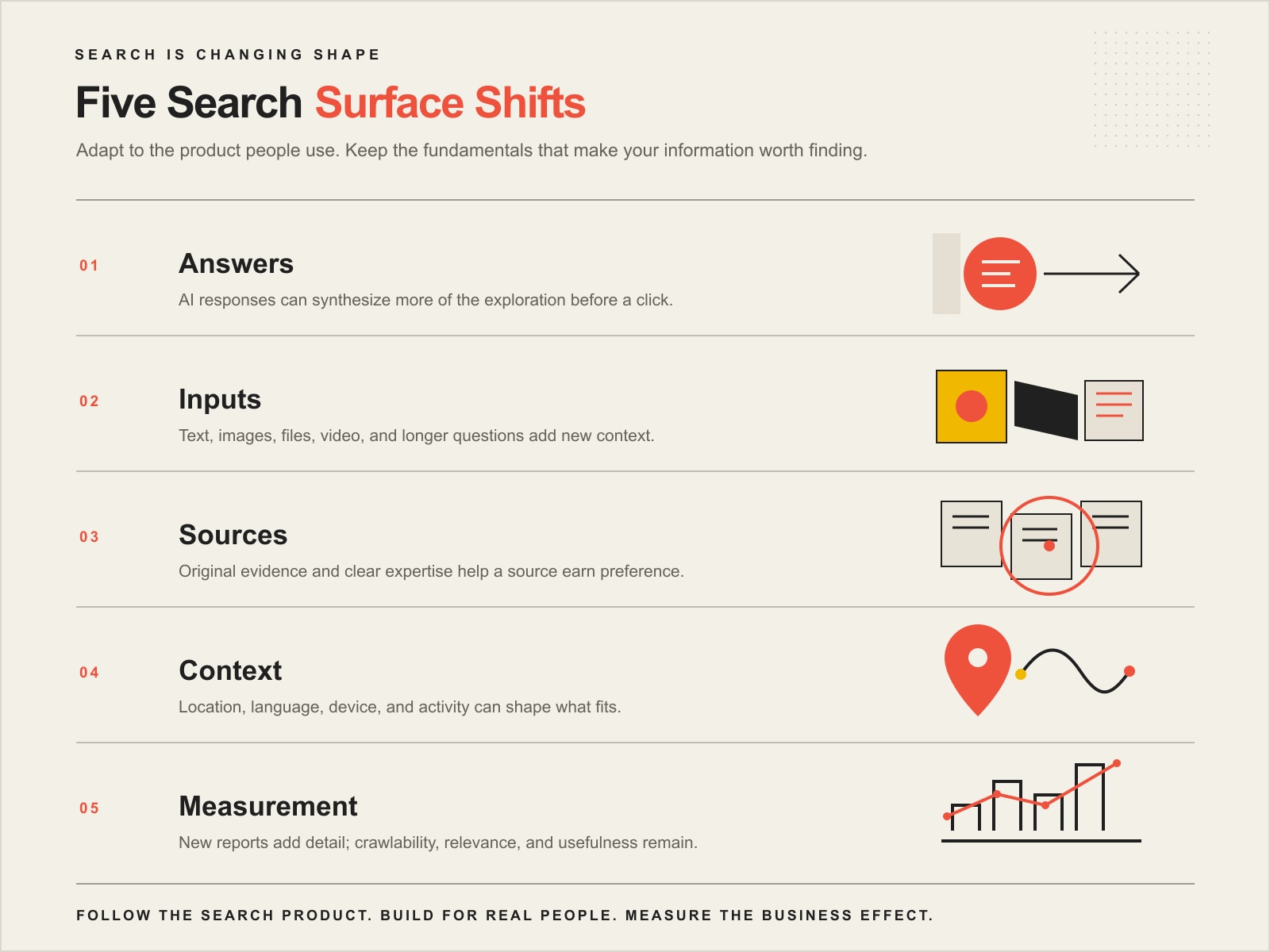
    Google search changes in 2026 are not just another algorithm update. Google is changing the search product people use to discover information: AI Overviews and AI Mode can synthesize answers and explore related subquestions, the search box can accept more than text, users can influence which sources they see, results can use more context, and Search Console is adding dedicated generative-AI visibility reporting.

    For a business, the response is not to bolt a pile of “GEO hacks” onto an old SEO checklist. Google’s own guidance says the familiar fundamentals still matter. Your job is to make your information eligible, understandable, useful, verifiable, and measurable across a search experience that now has more ways to answer, explore, and act.

    TL;DR: The five Google Search changes that matter to businesses

    • Answers: AI Overviews and AI Mode can assemble answers from multiple searches and sources, so shallow keyword matching is a weak strategy.
    • Inputs: Search is becoming conversational and multimodal, with text, images, files, video, and other context feeding the experience.
    • Sources: Preferred Sources and new treatments for original or highly cited material give users and Google more ways to surface sources worth returning to.
    • Context: Location, language, device, activity, and opt-in personalization can shape parts of the experience, making clear business facts and real expertise more important.
    • Measurement: Technical eligibility remains familiar while Google adds more specific reporting for generative-AI search visibility.
    Five changes in search: Answers synthesized by AI, richer Inputs such as images and files, trusted Sources with original evidence, personalized Context, and more specific Measurement.

    We call this the Scope Design Five Search Surface Shifts: Answers, Inputs, Sources, Context, and Measurement. It is a more useful way to respond than chasing every headline as if somebody at Google secretly moved a magic ranking dial.

    This is different from a Google algorithm update

    A product change changes how people search and what the interface can do. An algorithm update changes how Google evaluates, selects, or ranks results. Those problems can overlap, but they are not the same job.

    If your rankings or organic traffic dropped after a confirmed update, use our Google algorithm update diagnostic instead. That guide owns the ranking-change, diagnosis, and recovery problem. This article is about adapting your business to the search experience customers are increasingly using.

    1. AI Overviews and AI Mode change the answer surface

    Traditional search often looked like a simple exchange: type a query, scan links, choose a result. AI Overviews and AI Mode can do more of the exploration inside Google before a person decides whether to visit a website.

    Google’s current AI features guidance for website owners says AI Overviews and AI Mode may use query fan-out. Google can break a complicated question into related searches, explore multiple subtopics and data sources, and assemble a response with supporting links.

    That changes the content opportunity. A page does not need to repeat one exact keyword twelve different ways. It needs to solve a real question well enough to remain useful when the search expands into follow-ups.

    What should a business do?

    • Answer the main question early.
    • Cover the conditions, exceptions, comparisons, risks, and next questions a serious buyer will reasonably ask.
    • Use first-party examples, original analysis, photographs, process details, or evidence a generic summary cannot manufacture.
    • Keep important facts in readable page text even when video, images, or interactive elements add context.
    • Use descriptive headings and internal links so the subject and its relationships are easy to understand.

    There is no guaranteed formula for earning an AI citation. Our deeper AI search optimization guide explains how crawlability, relevance, evidence, authority, and measurement fit together without pretending a schema switch can force Google to quote you.

    2. Search is becoming conversational and multimodal

    The search box is becoming less like a blank field for ten blue links and more like an input layer for a research assistant. In its May 2026 “A new era for AI Search” announcement, Google described Search handling longer conversational questions plus images, files, video, and other context. Google also reported that AI Mode had passed one billion monthly users globally at that time. That is a Google-reported product metric, not a promise about traffic to any particular website.

    The same product direction includes agentic tasks. Depending on the experience and availability, Search can help gather information, compare options, shop, book, or contact businesses. Search is increasingly trying to help the user finish a task, not merely locate a document.

    What does multimodal search mean for your content?

    It does not mean every local plumber needs to become a film studio. Custom work should earn its cost. The practical question is whether the formats you already publish make the decision easier.

    • Text: State services, products, policies, prices or pricing logic, service areas, requirements, and next steps clearly.
    • Images: Use original, useful images where the visual itself answers something, with honest alt text and nearby context.
    • Video: Demonstrate processes, comparisons, installations, repairs, products, or expertise when motion genuinely clarifies the subject.
    • Documents: Keep PDFs and downloadable resources structured, current, and understandable.
    • Business data: Keep Business Profile, product feeds, hours, contact information, and other factual surfaces current where they apply.

    Imagine an appliance-repair company. A customer may type a model number, upload a photo of an error code, or ask a conversational question about whether a repair is worth the cost. A useful website can support that journey with readable troubleshooting context, original photos, clear service boundaries, and a sensible next step. The goal is not “optimize for cameras.” The goal is to provide evidence that remains useful when the input is no longer just a keyword.

    3. Preferred Sources and original evidence change source selection

    Google is giving people more influence over which publishers they want to see. In May 2026, Google announced that Preferred Sources would extend into AI Overviews and AI Mode, alongside additional ways to surface original and highly cited reporting.

    For a business, the important lesson is not “beg customers to favorite your domain.” Preferred Sources is one visible example of a broader shift: source identity matters. Search can show an answer, but people still need reasons to recognize, trust, choose, and return to a source.

    Build something worth preferring

    • Publish material rooted in real experience rather than paraphrasing the same five tips already everywhere.
    • Name the author or organization responsible for the advice when that context matters.
    • Cite primary evidence next to factual claims.
    • Maintain important evergreen pages so facts stay current and URLs remain stable.
    • Create useful recurring reasons to return, such as research, analysis, local expertise, a tool, a newsletter, a guide, or a strong body of related content.

    This is where brand authority stops being a vague branding exercise and becomes a body of proof. The cheapest content in the AI era is generic content. That does not make content useless. It makes interchangeable content easier to ignore.

    4. Personalization and entity clarity change the context

    Search results have never been perfectly identical for everyone. Current Google Search Help documentation explains that personalized recommendations can use account activity, while location, language, device type, and current search context can still affect relevance even when personalized recommendations are off. Google also makes clear that not all search results are personalized.

    Google is extending that contextual direction. Its 2026 AI Search announcements describe optional Personal Intelligence connections that can use information from selected Google services when a user chooses to connect them. The business implication is not that you need to reverse-engineer somebody’s inbox. It is that vague, context-free information may be a weaker fit when Search has a better understanding of what the user actually needs.

    Make your business easier to understand correctly

    • Keep business name, locations, service areas, hours, contact information, and core offerings consistent.
    • Explain relationships between services, products, industries, locations, and the people providing the expertise.
    • Use structured data only when it accurately matches visible page content.
    • Show first-hand experience with examples, case evidence, original images, process details, or named expertise where appropriate.
    • Fix stale bios, conflicting descriptions, abandoned location pages, and old claims that make the business harder to interpret.

    This is less glamorous than inventing a new acronym, which is exactly why it is useful. A search system cannot reliably connect facts you have never published, and a prospective customer cannot verify expertise you only imply.

    5. Measurement is changing while technical eligibility stays familiar

    One of the most important Google search changes is also one of the least dramatic: Google says you do not need special AI schema, a new AI text file, or a separate technical trick to become eligible for AI Overviews or AI Mode.

    Google’s Search Central guidance says a supporting page needs to be indexed and eligible to show a snippet. Crawlability, internal linking, readable text, useful page experience, accurate structured data, good images or video, and current business or product information remain the foundation. If the page cannot make it into normal Search, polishing an “AI optimization” checklist is expensive theater.

    The reporting surface is getting more specific

    In June 2026, Google announced dedicated Search Generative AI performance reports in Search Console. Google described Search and Discover views for visibility associated with AI Overviews and AI Mode, with availability rolling out rather than appearing identically for every property at once.

    Measure in layers: eligibility → visibility → referral and engagement → action → lead quality → business outcome. Our SEO metrics guide goes deeper on that hierarchy. Visibility is useful evidence. It is not the business outcome wearing a tiny hat.

    What auditing this exact article taught us

    Before rebuilding this article, we checked the established URL across the evidence sources available to Scope Design. Over the last 12 complete months, the exact page produced no Organic Search landing-page rows in our GA4 report. Google Search Console returned no page-query performance rows and its URL Inspection API reported the URL as unknown to Google. Bing Webmaster Tools reported zero clicks and zero impressions. Ubersuggest returned no ranking-keyword data and no exact-URL backlinks.

    That did not prove the topic was worthless. It proved the old page had no measurable search equity demanding protection. The more important discovery was editorial: another Scope Design article already owned Google algorithm-update diagnosis and recovery. Reactivating this page only made sense after giving it a materially different job: current Search product changes and business adaptation.

    We still preserved the established URL. There was no business benefit in changing it merely because the new primary query, google search changes, is not an exact phrase in the slug. Plugin warnings are lint. Migration risk is real.

    What should your business do first?

    Do not launch five disconnected projects because Google announced five features. Start with the constraint most likely to block useful visibility.

    Search surface shiftWhat changedBest first business actionWhat to measure
    AnswersAI Overviews and AI Mode can explore related questions and synthesize answers.Rewrite important pages around the real decision, follow-up questions, and original evidence.Relevant visibility, citations, qualified visits.
    InputsSearch can use conversational and multimodal information.Make core facts clear in text and add useful original images/video where they improve the decision.Discovery and engagement.
    SourcesPreferred Sources and original/highly cited treatments make source identity more visible.Build repeatable first-party expertise instead of commodity summaries.Returning audience, branded demand, legitimate references.
    ContextSearch can use more location, activity, device, and opt-in personal context.Clean up business facts, authorship, service relationships, and structured data.Correct discovery across relevant situations.
    MeasurementGenerative-AI reporting is becoming more explicit while basic eligibility remains familiar.Fix crawl/index/canonical issues first, then connect visibility to qualified outcomes.Eligibility → visibility → action → quality → outcome.

    If you need a broader system for deciding where SEO time belongs, start with our SEO strategy and analytics framework. Invest where the evidence says the bottleneck lives, not where the latest conference slide looks exciting.

    Frequently asked questions about Google search changes

    Is Google actually changing its search engine?

    Yes. Google’s 2026 Search announcements describe substantial product changes, including expanded AI Mode, a more conversational and multimodal search box, agentic capabilities, additional personalization options, source controls, and new reporting. That is different from saying traditional web results disappear or every query becomes fully personalized.

    What is the difference between AI Overviews and AI Mode?

    AI Overviews are generated summaries that can appear within Search results. AI Mode is a more conversational experience for longer, more complex exploration and follow-up questions. Both can surface supporting links, and Google says both can use query fan-out.

    Do I need GEO or AEO instead of SEO?

    No label changes the basic job. Google says existing SEO best practices remain relevant to its AI features and no special AI optimization is required. “GEO” or “AEO” can describe additional discovery surfaces, but the useful work is still eligibility, relevance, evidence, authority, and measurement.

    How can my website show up in Google AI search?

    Start by being eligible for normal Search. Google says a page needs to be indexed and eligible to show a snippet before it can be used as a supporting link in AI Overviews or AI Mode. Then make the page useful for the question, provide verifiable evidence, keep important facts readable, and earn legitimate authority. None of that guarantees a citation.

    Do I need special schema or an llms.txt file for Google AI results?

    No. Google says no special schema or new AI text file is required for its Search AI features. Use structured data when it accurately describes visible content and is supported for the page.

    Do Preferred Sources matter to a normal business?

    Potentially, but the broader lesson matters more than the feature. Search is creating more ways for people to express source preference and for original work to stand out. Focus on becoming a source worth recognizing and returning to: accurate information, real experience, useful evidence, and consistent publishing where the audience benefits.

    Does personalization mean everyone sees completely different Google results?

    No. Google can use location, language, device, current context, activity, and personalization settings to shape parts of the experience, but not every result is personalized. A single manual ranking check is therefore incomplete evidence about visibility.

    How should I measure AI search visibility?

    Confirm technical eligibility first. Then examine relevant impressions, generative-AI visibility where Search Console makes it available, citations or mentions, referral behavior, meaningful actions, lead quality, and the business outcome. A mention without a qualified next step may be interesting. It is not automatically valuable.

    Sources and methodology

    This article was researched and rebuilt through Scope Design’s monitored Content Studio workflow on August 21, 2026. We reviewed the existing article and cluster ownership; relevant Scope Design doctrine in Open Brain; the literal internal-link graph; U.S. Ubersuggest keyword and SERP evidence; DataForSEO Google/Bing SERPs, two-depth People Also Ask, AI keyword volume, and a bounded ChatGPT search-citation observation; exact-page GA4, Google Search Console, and Bing Webmaster Tools evidence; and current first-party Google documentation. Third-party search volumes are directional estimates, not promises of traffic. Google’s adoption metrics are identified as Google-reported product figures. We removed legacy percentages and causal claims when current evidence did not support them.

    Adapt to the search product, not the hype cycle

    The winning response to Google search changes is not to rename every SEO task and invoice it as magic. Make the site eligible. Make the answer useful. Make the evidence real. Make the business understandable. Then measure whether the visibility produces something worth having.

    If you are not sure which of the five shifts is actually constraining your visibility, Scope Design can help audit the search, content, technical, and measurement layers and prioritize the work by business impact. Hope is not an analytics strategy, and neither is doing all the things because somebody posted a scary screenshot on LinkedIn.

  • How to Build A Winning Business Marketing Strategy Online: Part V (Final) – Organic Traffic Generation in the AI Era

    How to Build A Winning Business Marketing Strategy Online: Part V (Final) – Organic Traffic Generation in the AI Era

    Organic traffic generation in the AI era is not a contest to produce the most pages or collect the most sessions. It is the work of making your business discoverable when the right buyer has a real question, giving that buyer a useful answer worth trusting, creating more than one route into that answer, and measuring whether the attention turns into a qualified next step.

    Search still matters. So do AI-generated answers, referrals, unpaid social reach, email, partners, communities, video, and people who remember your brand and come back directly. Your analytics may classify those visits into different channels, which is exactly why “organic traffic” can become a sloppy business objective. The better objective is organic acquisition: building unpaid and earned discovery around useful assets you control, then connecting discovery to an outcome the business actually values.

    This is the final installment of our five-part online marketing strategy series. If you need the earlier layers first, start with Part I: the strategy foundation, then continue through Part II, Part III, and Part IV on paid advertising. For the broader system that connects all of those decisions, use our small business marketing strategy guide.

    What organic traffic generation means in the AI era

    In the narrow search-marketing sense, organic traffic is traffic earned from unpaid search results rather than ads. In this guide, I am using organic acquisition as the wider business system around that traffic: search visibility, useful content, earned mentions, internal discovery paths, unpaid distribution, and repeat discovery that does not require buying every visit.

    That distinction matters because a business can improve its organic acquisition system without every gain appearing as “Organic Search” in a dashboard. Someone may discover your company in an AI answer, see you mentioned by a partner, read a useful article later through an email, and return directly when the problem becomes urgent. The path is messier than the channel report. Pretending otherwise makes the report tidy and the strategy stupid.

    AI search changes the shape of discovery, but it does not erase the basics. Google’s current guidance for AI Overviews and AI Mode says the same foundational SEO practices remain relevant and there are no additional technical requirements just to appear in those AI features. A page still needs to be accessible, indexable, eligible to appear with a snippet, relevant to the question, and worth surfacing.

    So the practical question is not, “What secret GEO hack will make the robots love us?” It is, “What useful thing should we become the best available source for, and how do we make sure the right people and systems can find it?”

    The CLEAR Organic Acquisition Loop

    Scope Design uses a constraint-first approach to marketing: Objective → Constraint → Positioning → Strategy → Tactics → Measurement. For organic traffic generation, that logic becomes a more specific five-stage loop:

    1. Constraint: find the real bottleneck before choosing a traffic tactic.
    2. Language: map the buyer’s real question and intent to one clear page or source asset.
    3. Evidence: publish an answer with enough expertise, proof, and usefulness to deserve discovery and citation.
    4. Amplification: connect and distribute the asset so publication is not the end of the job.
    5. Results: measure qualified action and business outcome, then use the evidence to identify the next constraint.

    That is CLEAR: Constraint, Language, Evidence, Amplification, Results. It is deliberately a loop. Organic acquisition is not a campaign you “finish.” You build an asset, observe how discovery and behavior change, improve the weak link, and compound what works.

    C — Constraint: find the bottleneck before choosing a traffic tactic

    A request for “more organic traffic” tells you what somebody wants to see in the dashboard. It does not tell you what is broken.

    Before you commission ten articles, hire a link builder, add a video channel, or sprinkle AI on the problem, identify the constraint. A low-traffic page can be suffering from very different failures: search systems cannot reliably access it; the topic has little relevant demand; the page targets the wrong intent; several pages compete for the same job; the answer is generic; the business has no distribution; the search result earns attention but the page does not move the buyer; or the leads are fine and the failure is actually follow-up.

    The correct tactic depends on which condition is true. If the page is not eligible to appear, writing another article is avoidance. If the right people already arrive but do not act, adding more traffic can simply deliver more people into the same leak. If the market barely searches for the problem, a brilliant SEO plan can still be a bad allocation of capacity.

    This is where the broader SEO strategy and analytics framework belongs. Part V is about organic acquisition execution; the SEO pillar owns the full visibility-to-business-outcome system.

    L — Language: own the buyer question, not a bag of keywords

    Keyword research is useful when it reveals how real people describe a problem, compare options, or look for a solution. It becomes cargo cult SEO when the output is a spreadsheet full of phrases that nobody has assigned to a specific page, buyer stage, or business decision.

    Give each important page one primary search job. A service page may own the commercial decision. A comparison may own “A vs. B.” A guide may own the problem and decision criteria. A case example may own proof. A FAQ section may resolve the objections that naturally belong on that page. You can cover related language, but the page should still have a coherent reason to exist.

    This reduces cannibalization and makes internal linking useful. Instead of five mediocre posts vaguely repeating “small business SEO,” you can build one strong canonical answer and let supporting pages handle distinct sub-decisions. Search systems get a clearer structure. Readers get fewer near-duplicate pages. Your editorial calendar stops behaving like a photocopier with anxiety.

    Language also needs to survive outside the ten-blue-links model. AI-assisted search often begins with longer, conversational questions and follow-ups. That does not mean chopping every article into context-free fragments. It means writing sections with descriptive headings, direct answers, clear entities, useful definitions, and enough surrounding explanation that the answer still makes sense when someone lands in the middle.

    E — Evidence: build a source asset worth finding and citing

    The easiest content to automate is also the easiest content to replace. A generic article that summarizes the same ten tips already ranking has very little reason to be chosen by a search engine, an AI system, a journalist, a partner, a prospect, or a human being with functioning pattern recognition.

    Build source assets instead. A source asset answers the question directly, then adds something defensible: firsthand experience, an original framework, a useful calculation, a process diagram, a before-and-after decision, screenshots, product or service constraints, a comparison, a failure mode, a checklist tied to real work, or a carefully sourced explanation.

    Google’s current guidance on helpful, reliable, people-first content explicitly asks whether a page provides original information or analysis, demonstrates first-hand expertise, makes sourcing and authorship trustworthy, and gives readers substantial value beyond other search results. That is a much more durable standard than “Did we mention the keyword 2.3% of the time?”

    Evidence does not mean turning every article into an academic paper. It means matching proof to the claim. If you make a technical claim, use current primary documentation. If you recommend a process, explain where it works and where it does not. If you claim a result, include the scope, conditions, timeframe, and permission to use it. If the answer is professional judgment, label it as judgment rather than laundering an opinion through a mystery statistic.

    For the full production side of this idea, our content marketing system for small businesses explains how to build durable assets instead of feeding a publishing treadmill.

    A — Amplification: publication is not distribution

    A good article with no route into it is a beautifully stocked store at the end of a road nobody built.

    Design distribution before you publish. Link the asset from pages that naturally establish context or pass readers to the next decision. Reference it from sales follow-up when it answers a recurring objection. Turn the strongest idea into an email, short video, social post, webinar segment, sales deck, or partner resource without pretending that resizing the same paragraph is a strategy. Share it where the intended audience already pays attention.

    Earned distribution matters too. Expert contributions, interviews, useful tools, original data, partnerships, community participation, and legitimate media mentions can create discovery and authority because somebody else decided the source was worth referencing.

    That is different from running a “guest post for backlinks” assembly line. Google’s current spam policies define link spam around links created primarily to manipulate rankings and specifically include paid or optimized links in articles and guest posts among the examples. Guest expertise can be good marketing. Manufacturing articles to smuggle ranking credit is a different job, and it is not one we recommend.

    The point of amplification is not to make every channel report “organic.” The point is to reduce dependence on a single distribution gatekeeper and give a useful asset more chances to meet the right buyer.

    R — Results: measure the qualified outcome

    Organic traffic is useful. It is not the finish line.

    Measure the system in layers. First, can the page be accessed, indexed, and understood? Then, does it appear for relevant questions or earn citations and mentions? Do the right visitors engage with the useful sections? Do they take the intended action? Are those actions from people the business can actually help? Does the outcome show up in pipeline, purchases, booked appointments, retention, saved staff effort, or another business result you chose before the campaign started?

    This hierarchy protects you from vanity reporting. Ten thousand irrelevant visits are not inherently better than five hundred visits from the exact audience evaluating a high-value service. A ranking improvement can be good diagnostic news without being revenue. An AI citation can expand visibility without proving that anyone became a customer. A form submission can be an action while still being a terrible lead.

    Our guide to SEO metrics that matter goes deeper on that measurement ladder. The operating rule here is simpler: use traffic and visibility to diagnose the system; use qualified outcomes to decide whether the system deserves more investment.

    What AI search actually changes—and what it does not

    AI-generated search experiences make it easier for a user to ask complicated questions, refine them conversationally, and sometimes get enough of an answer without following the classic search-result path. That increases the value of content that is clear, specific, well-supported, and easy to retrieve in context.

    What it does not do is create permission to ignore technical SEO, publish machine-written sludge at industrial scale, or install every new file format somebody on LinkedIn names after lunch.

    For Google specifically, the company says the same foundational SEO practices apply to AI features. That means the durable work is familiar: make important content accessible; use descriptive language; keep canonical page ownership clear; provide original value; use structured data only when it truthfully represents visible content; make the page experience usable; and maintain the underlying site well enough that crawlers and people can reach the answer.

    The new emphasis is editorial. A source that can answer a narrow question cleanly, support the answer, explain the exception, and identify who is speaking has more utility than a page that buries the answer under 900 words of throat-clearing. That helps humans even if no AI system ever cites the page.

    If AI-search citation work is a major objective, use our dedicated AI Search Optimization guide. It owns that job in depth. This article keeps AI in its proper place: one discovery surface inside the wider organic acquisition system.

    A practical 90-day organic acquisition plan

    Days 1–15: establish the objective and constraint

    Choose the business outcome first. For a professional service, that may be qualified opportunities. For a local appointment business, booked-and-attended appointments may matter more. For ecommerce, purchases and repeat behavior may be the relevant outcomes.

    Then verify the basics before judging content. Confirm that important pages are accessible and indexable, forms and calls are being recorded, the relevant market actually has demand, and current traffic can be segmented well enough to tell useful attention from noise. Inventory pages that already own important search jobs and identify obvious overlap.

    Days 16–30: repair ownership and buyer language

    Map the recurring buyer questions to the pages that should answer them. Strengthen one canonical owner before creating a new URL. Merge or reposition overlapping content when necessary. Improve titles and headings where they are vague, and make sure internal links connect prerequisites, evidence, comparisons, and next steps.

    Do not change established URLs just because a plugin wishes the keyword appeared in the slug. URL changes are migrations. Make them when the clarity or architecture benefit is worth the risk, not because a score turned orange.

    Days 31–60: build or upgrade one source asset

    Choose a question that matters to the buyer and that the business can answer with real expertise. Create the best available version you can defend: a direct answer, original framework or judgment, useful examples, corroborating primary sources, a visual where it helps, honest limitations, and a clear next action.

    One source asset that sales uses, partners reference, search systems surface, and prospects return to can be worth more than a month of content-calendar confetti.

    Days 61–90: amplify, observe, and choose the next constraint

    Distribute the asset intentionally. Add the relevant internal links. Send it to the audience segment that would actually benefit. Use it in follow-up. Give partners or industry contacts a reason to reference it. Repurpose the core idea when another format helps the audience consume it.

    Then review the measurement chain. If eligibility is weak, fix technical access. If visibility is weak, revisit intent, relevance, evidence, or authority. If traffic arrives but no qualified action follows, investigate the page, offer, next step, and sales handoff. The 90-day plan should end with a better diagnosis, not a victory slide full of arrows pointing up.

    Six organic-traffic habits to stop

    • Stop treating traffic volume as the objective. More of the wrong visitor is just more server logs.
    • Stop publishing generic AI summaries because a keyword has volume. If the page adds no judgment, evidence, or utility, it is competing on commodity supply.
    • Stop buying guest posts as a backlink quota. Pursue real audience access, credible mentions, partnerships, and expertise instead.
    • Stop changing established URLs for cosmetic SEO reasons. Preserve useful history unless the migration benefit is real and verified.
    • Stop calling publication a distribution plan. “We posted it on the blog” describes a location, not a route to an audience.
    • Stop forcing every unpaid touchpoint into one channel story. Search, AI discovery, referral, email, social, direct return, and sales-assisted content can work together without needing the same label in analytics.

    Frequently asked questions about organic traffic generation

    What is organic traffic in simple terms?

    Organic search traffic is website traffic that comes from unpaid search results rather than paid search ads. For business strategy, it is often more useful to think about the broader organic acquisition system: the owned assets and earned or unpaid discovery paths that help the right people find and return to your business without purchasing every visit.

    Is SEO dead now that AI can answer questions directly?

    No. Search behavior and result formats are changing, but Google’s current AI-search guidance says foundational SEO remains relevant to AI Overviews and AI Mode. The more useful adjustment is to make your content clearer, more original, better supported, technically accessible, and focused on the real buyer question instead of treating SEO as a keyword-placement exercise.

    Is organic traffic better than paid traffic?

    Not automatically. Paid media can create controlled reach quickly and is excellent when the economics, targeting, and conversion path support it. Organic acquisition can build durable assets and reduce dependence on paying for every exposure, but it takes expertise, production, maintenance, and time. The right mix depends on the objective and constraint. That is why Part IV covers paid advertising separately rather than pretending one channel wins every argument.

    Is organic traffic free?

    There is no media fee just to appear in an organic Google Search result, but the acquisition system is not free. Research, expert time, writing, design, development, technical maintenance, distribution, measurement, and opportunity cost are real costs. “Free traffic” is usually accounting with several columns hidden.

    How long does it take to increase organic traffic?

    There is no responsible universal timeline. Google notes that the effects of meaningful improvements can show up in days for some changes and take months for others, with no guaranteed ranking outcome. Your timeline also depends on crawlability, competition, demand, current authority, content quality, distribution, brand recognition, and whether the real bottleneck is even traffic. Use review windows and decision rules; do not buy a fixed ranking promise dressed up as a calendar.

    How should a business measure organic traffic?

    Start with eligibility and visibility, then move down the chain to engagement, action, lead or customer quality, and business outcome. Rankings, impressions, citations, sessions, and click-through rates are useful diagnostics. They become misleading when they are reported as if they were revenue, pipeline, retention, or qualified demand.

    Make organic discovery compound

    The durable version of organic traffic generation is not “publish more.” It is a system that makes your expertise easier to discover, easier to trust, easier to share, and easier to connect to a useful next step.

    Start with the constraint. Use the buyer’s language. Create evidence instead of filler. Build distribution into the asset. Measure the qualified outcome. Then run the loop again.

    If you need the broader channel and business framework around this work, return to our small business marketing strategy guide. If the problem is specifically search visibility and measurement, move into our SEO strategy and analytics system. The point is not to collect tactics. It is to fix the constraint that is keeping the right people from finding, trusting, and choosing you.

  • Are Websites Still Relevant? When Your Business Actually Needs One

    Are Websites Still Relevant? When Your Business Actually Needs One

    Are websites still relevant in 2026? Yes—but not every business needs a large or complicated one. The useful question is no longer “website or social media?” It is: Which business jobs require a destination you can control, change, measure, and connect to the rest of your operation?

    A website earns its place when it helps buyers verify your claims, take a useful next step, find durable answers, or complete tasks that a platform profile cannot handle well. If referrals, a Google Business Profile, a marketplace, social profiles, and a phone number already handle those jobs adequately, a profile-first presence—or a very small site—can be a rational choice for now.

    That is a different answer from “every serious business needs a 20-page website.” It is also different from declaring websites dead because discovery increasingly happens in search results, maps, social feeds, marketplaces, and AI-generated answers. Discovery and destination are separate jobs.

    Are websites still relevant in 2026?

    They are relevant when they do work the business actually needs. A website is not strategic merely because it exists. A forgotten brochure site with stale copy, no proof, no clear next step, and no useful connection to sales or operations does not become valuable by surviving another calendar year.

    At the same time, the argument that social media or AI has “replaced” websites confuses where a customer discovers a business with where the business can organize evidence, guide a decision, and complete a transaction or handoff. A buyer may first encounter you in Maps, a TikTok video, a referral text, a marketplace listing, an AI answer, or a search result. The website can still be the place where that scattered discovery becomes a coherent decision.

    Google itself makes the distinction visible. Its Business Profile guidance explains that eligible local businesses can appear in Search and Maps, show hours and contact information, collect reviews, and direct customers to a website, booking link, or other next step. In other words, basic local discovery does not always require a substantial website. That is exactly why the website has to justify its own job.

    Four jobs websites still do well

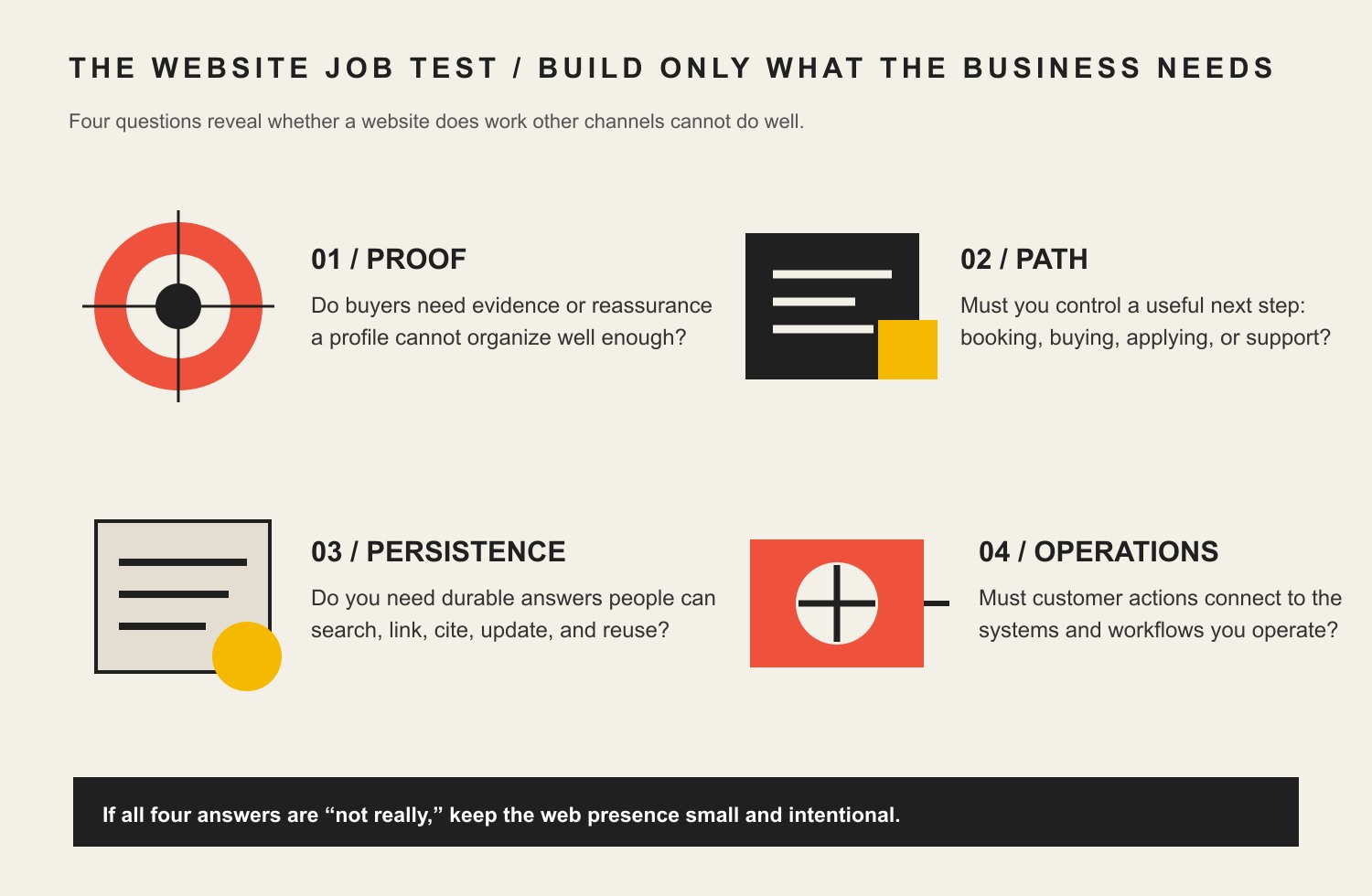
    At Scope Design, we use a simple decision model before talking about pages, templates, features, or redesigns. We call it the Website Job Test. A website becomes more valuable as it takes responsibility for one or more of four jobs.

    Four jobs to test before building a website: proof, a controlled customer path, durable discoverability, and operational integrations.

    1. Proof and authority

    Can a potential customer verify that you are credible, relevant, and capable of doing what you claim? A strong website can organize case studies, work examples, reviews, credentials, people, policies, process, pricing context, service boundaries, and answers to objections in one coherent system.

    Social profiles can provide excellent evidence, but they usually organize it according to the platform’s format and feed logic. A website lets the business decide which proof belongs next to which claim. That matters when the purchase is expensive, risky, technical, unfamiliar, or simply hard to evaluate. Our brand authority framework goes deeper into building a body of proof instead of decorating weak claims.

    2. A controlled conversion path

    Can the right visitor take the right next step without fighting the interface or guessing what happens next? That step might be a purchase, appointment, quote request, assessment, application, download, account login, support task, or detailed inquiry.

    This does not mean “put a form on every page.” It means designing the path around the customer decision and the business’s ability to respond. If your site sends every visitor to the same generic contact form, while nobody owns follow-up, the problem is not a shortage of buttons. If you are still deciding what the site should be accountable for, start with the purpose of the business website before buying more features.

    3. Durable discoverability

    Do customers ask questions that deserve stable, crawlable, linkable answers? A useful website gives those answers a durable address. Search engines can index them, people can bookmark or share them, salespeople can send them, newsletters can point to them, and other sites can cite them.

    That matters even as AI changes how search results are presented. Google’s current guidance for AI experiences in Search still tells site owners to make pages accessible, useful, technically eligible, and easy to use. A website can therefore be a source and a destination in AI-assisted discovery. It is not, however, a guarantee of ranking, indexing, mention, or citation.

    4. Operations and integrations

    Does the customer-facing experience need to connect to booking, ecommerce, CRM, email automation, inventory, support, payments, memberships, portals, documents, calculators, account data, or internal workflow? At that point the website is not merely “marketing.” It is part of how the business operates.

    This job is where the difference between a profile, a simple website, and a custom system becomes obvious. A restaurant that mainly needs hours, directions, a menu, and a reservation link has a different website problem from a manufacturer with specification libraries and distributor workflows, or a service company that must qualify leads across multiple locations and route them to the right team.

    The Website Job Test: do you actually need one?

    Before deciding how much website to buy, answer these questions without assuming the website is the solution.

    1. Proof: Do buyers need evidence, explanation, comparison, policies, or reassurance that a profile cannot organize well enough?
    2. Path: Do you need to control or improve a meaningful next step such as booking, buying, applying, requesting an estimate, or getting support?
    3. Persistence: Do you need durable pages that can be searched, linked, cited, updated, and reused outside a platform feed?
    4. Operations: Do customer actions need to connect reliably to business systems or workflows?

    If the honest answer is “not really” to all four, do not invent a 30-page website project because somebody said every business needs one. If two or three answers are clearly yes, a website is probably doing real work. If all four are essential and the workflows are complex, you are no longer choosing between “a website” and “social media.” You are designing part of the business system.

    This is the same diagnostic discipline behind Scope Design’s constraint-first website strategy: the deliverable somebody requests is evidence of dissatisfaction, not proof that the requested deliverable is the binding constraint.

    How much website do you need?

    Website levelUsually fits whenTypical jobsWarning sign
    Profile-first or minimalDemand is mostly referrals, local/maps, marketplace, or direct contact; offer is simpleBasic legitimacy, contact, location, one destinationYou are hiding real buyer questions because the profile cannot answer them
    Simple business siteBuyers need a clear offer, proof, FAQs, and direct next stepExplain, reassure, route, contactPages multiply without a distinct decision job
    Growth/marketing siteSearch, content, campaigns, lead quality, multiple services, or longer decisions matterDiscovery, evidence, segmentation, conversion, measurementTraffic is blamed for an offer, follow-up, or positioning problem
    Custom or app-like siteTransactions, portals, integrations, data, rules, account flows, or operational logic matterCommerce, self-service, workflow, automation, system integrationCustom development is purchased before the process is understood

    The point is not to graduate every business toward the bottom row. The point is to match the investment to the job. A simple site that does three important things reliably can be more valuable than a custom site full of features nobody uses.

    When a business can rationally start without a big website

    Some businesses can function well for a period with a verified local profile, marketplace presence, social account, direct messaging, phone, email, and a lightweight landing page—or even no substantial site. That can be rational when:

    • the offer is simple and low-risk;
    • most qualified demand already comes through referrals or one dominant marketplace;
    • customers mainly need hours, location, availability, a phone number, or a booking link;
    • the business is validating demand before investing in a larger system;
    • there is little unique information to publish yet; or
    • the operational constraint is somewhere else, such as slow response, capacity, pricing, sales follow-up, or fulfillment.

    The word yet matters. Platform-first can be a stage, not a doctrine. As the business accumulates proof, creates distinct intellectual property, serves more audiences, needs deeper qualification, invests in search/content, or integrates systems, the cost of squeezing everything through a profile often rises.

    Website vs. social media is the wrong comparison

    A website and social media usually solve different parts of the customer journey. Social platforms are excellent for native distribution, conversation, community, discovery, and repeated exposure. A website is better suited to organizing durable information, controlling information architecture, connecting proof to decisions, and integrating with systems.

    Use social media where people already spend attention. Use the website when the buyer needs depth, structure, persistence, or a controlled task. If you are deciding which social channels actually fit the business, our guide to which types of social media can benefit a business owns that platform-selection question.

    Also be precise about “ownership.” A business can usually control its domain, website content, information architecture, conversion paths, and integrations more directly than it can control a platform profile. That is valuable. But it is not absolute ownership of hosting infrastructure, analytics vendors, third-party software, search distribution, or every piece of customer data. Those systems still have contracts, technical dependencies, privacy obligations, and failure modes.

    What AI search changes—and what it does not

    AI answers can resolve simple questions before a person visits any website. That increases the pressure on weak pages whose only purpose was to restate generic information. It does not eliminate the need for original evidence, current facts, detailed proof, transactional destinations, account experiences, or operational tools.

    For website owners, the practical requirement is not a magical “AI SEO” file. Google says the ordinary technical requirements still matter across classic and AI Search experiences: the page needs to work, be accessible to Google, and contain indexable content. Helpful, unique content and a usable page experience still matter too. None of that guarantees an AI citation.

    That is why the safest AI-search strategy is also a sound website strategy: publish things worth finding. Document real expertise. Answer recurring customer questions clearly. Show evidence behind claims. Maintain important facts. Give each page a defined job. Then make sure the system can technically access the page.

    What auditing this exact page taught us

    We applied the same diagnostic rule to this article before rewriting it. The old version made confident claims about “digital dominance,” mixed in trend predictions about progressive apps, voice interfaces, augmented reality, blockchain, and serverless technology, and still did not answer the business decision with enough precision.

    The performance data was even more useful because it kept us from pretending. In the 12 months ending August 19, 2026, the exact URL recorded only 5 GA4 landing sessions, all Direct, with 0 engaged sessions and 0 key events. The prior comparison returned no row. Correct exact-page Search Console filters returned no query rows for either 12-month period, and URL Inspection currently reports the URL as unknown to Google. Bing recognizes the page historically but currently reports 0 clicks and 0 impressions. Ubersuggest found no ranking-keyword data and no discovered backlinks for the exact page.

    Those numbers do not prove nobody cares whether websites are still relevant. They prove this version of this page had almost no measurable search footprint. Separate keyword research still shows modest informational demand around “are websites still relevant” and “do I need a website for my business.” That distinction matters: low page performance is not the same thing as no audience demand.

    So we did not change the long-standing URL just to force the keyword into the slug. We changed the job of the article: direct answer, explicit exceptions, first-party framework, right-sizing guidance, current platform/search evidence, and links to the deeper pages that own website purpose and strategy.

    What should you do next?

    1. Write down the business outcome. What should become easier or more likely because the website exists?
    2. Run the Website Job Test. Identify whether proof, conversion, durable discoverability, or operations actually require a website.
    3. Choose the smallest useful level. Profile-first, simple, growth, or custom is a business decision—not a status symbol.
    4. Assign one leading purpose. If several jobs matter, decide which wins when priorities conflict.
    5. Measure the whole handoff. A form submission nobody answers is not website success.

    If you already have a site, do not assume a redesign is the first move. Use the Website Fitness Test to see whether the current site is actually failing its assigned job. If you are starting from scratch or the diagnosis is unclear, Scope Design can help define the job before pages and features turn into an expensive substitute for strategy.

    Frequently asked questions about whether websites are still relevant

    Do people need websites anymore?

    Not everyone needs a substantial website, but many businesses still benefit from one when buyers need organized proof, a controlled next step, durable searchable information, or integrations that profiles and feeds do not handle well.

    Do I need a website for my business?

    You probably need at least a simple website when customers regularly need more context than a profile provides, when you need to qualify or convert inquiries, when search/content is part of acquisition, or when customer actions connect to business systems. If none of those conditions applies yet, a profile-first approach may be sufficient temporarily.

    Can social media replace a website?

    It can replace some discovery and communication functions, especially for simple offers and early-stage businesses. It is weaker when you need structured proof, durable information architecture, controlled conversion paths, deep search content, or custom integrations. In most mature systems, social media and the website do different jobs.

    Is a Google Business Profile enough without a website?

    For some eligible local businesses, it can cover important basics such as discovery in Search and Maps, hours, location, phone, reviews, photos, and links to booking or other destinations. It becomes limiting when the buying decision needs deeper proof, unique information, qualification, content, or workflows the profile cannot own.

    Are websites obsolete because of AI?

    No. AI can answer more informational questions without a click, which makes generic pages less defensible. But AI systems still depend on sources, businesses still need destinations for proof and transactions, and many customer tasks cannot be completed inside an answer box. A website should contain useful evidence and functionality rather than exist as a ceremonial homepage.

    What is the minimum website a small business needs?

    The minimum is the smallest site that completes the jobs the business cannot reliably handle elsewhere. For one company that may be a single clear page with proof and contact information. For another it may require service pages, FAQs, case studies, booking, ecommerce, or an integrated application. Start with the job, not an arbitrary page count.