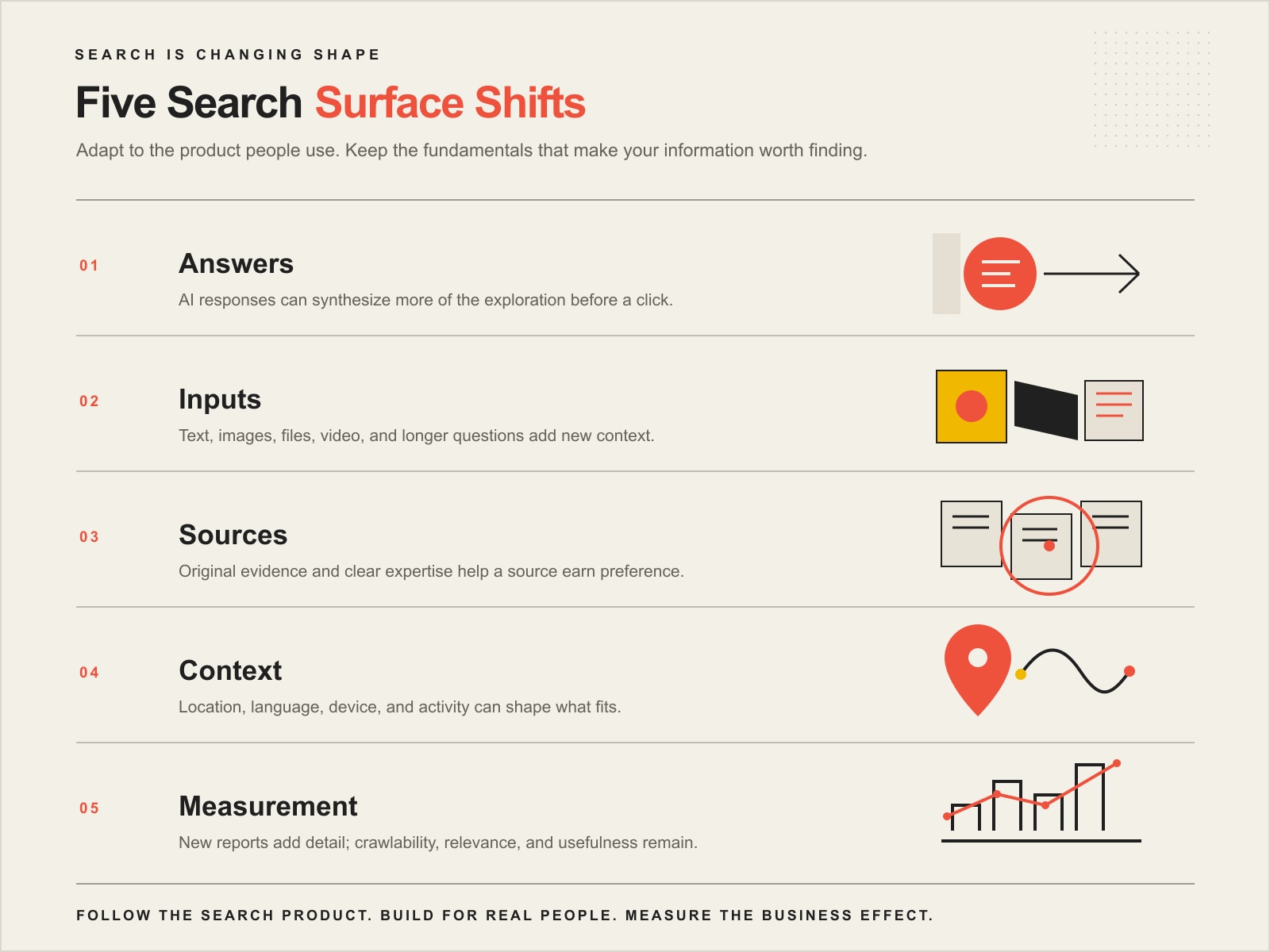
Google SERP features are the different result surfaces Google can assemble for a search—not just the familiar organic text links. In 2026, a results page may include AI Overviews, featured snippets, People Also Ask, local results, images, videos, products, discussions, news, entity information, and standard organic listings. The useful SEO question is no longer simply “How do I rank #1?” It is: Which surface does this query actually produce, can we qualify for it, and would earning visibility there help the business?
That distinction matters because you can do excellent work on the wrong format. A local contractor can polish a national blog post while the query is dominated by Maps. An ecommerce store can write another 3,000-word guide while Google is showing product results. A service company can obsess over schema while the real problem is that the page is not indexed or does not answer the searcher’s question.
TL;DR: Page 1 is a portfolio of search surfaces
- Inspect the live SERP before choosing a tactic. Google says result presentation can vary by query, device, country, and language.
- Match the surface to intent. Local, product, visual, timely, and explanatory searches often produce very different result layouts.
- Build eligibility before chasing selection. Indexing, page type, business information, product data, media, structured data, and policy compliance matter differently by surface.
- Separate inputs from promises. You can improve eligibility and usefulness. Google still chooses what it ranks, summarizes, cites, or displays.
- Measure the business consequence. A shiny SERP feature that attracts the wrong audience is not a win.
If you need the bigger system around this decision, start with our SEO strategy and analytics framework. This article owns a narrower job: choosing the right search surface for a query.
What are Google SERP features?
SERP means search engine results page. Google SERP features are the visual result types and modules that appear on that page beyond, around, or instead of a plain text listing. Google’s own visual-elements documentation describes text results, rich results, image results, video results, exploration features, and other elements. The exact mix is not fixed.
That is why “page 1” is a sloppy target by itself. Two people can search different queries and see completely different opportunities. Even the same query can produce a different arrangement based on location, device, language, or what Google believes best serves the search.
Our August 21, 2026 U.S. desktop research for google SERP features is a good example. The result page included an AI Overview, organic guides, a People Also Ask block, and related searches. Bing interpreted the same literal phrase much more like a Google-brand navigation query. Same words. Different engine. Different job.
Use the Scope Design SERP Surface Fit Test before you optimize anything
Most SERP-feature guides become a glossary: here is a map pack, here is a video carousel, here is a snippet. Useful for vocabulary. Not enough for a business decision.
We use five questions instead. Run them in order for the query you care about:
- Intent: Does this query naturally produce this surface?
- Eligibility: Can your page, product, business, or content type actually qualify?
- Evidence: Do you have the facts, assets, proof, media, or structured data the surface needs?
- Control: Which inputs can you improve, and which selection decisions remain Google’s?
- Outcome: Would winning this surface help a qualified visitor take the action you care about?
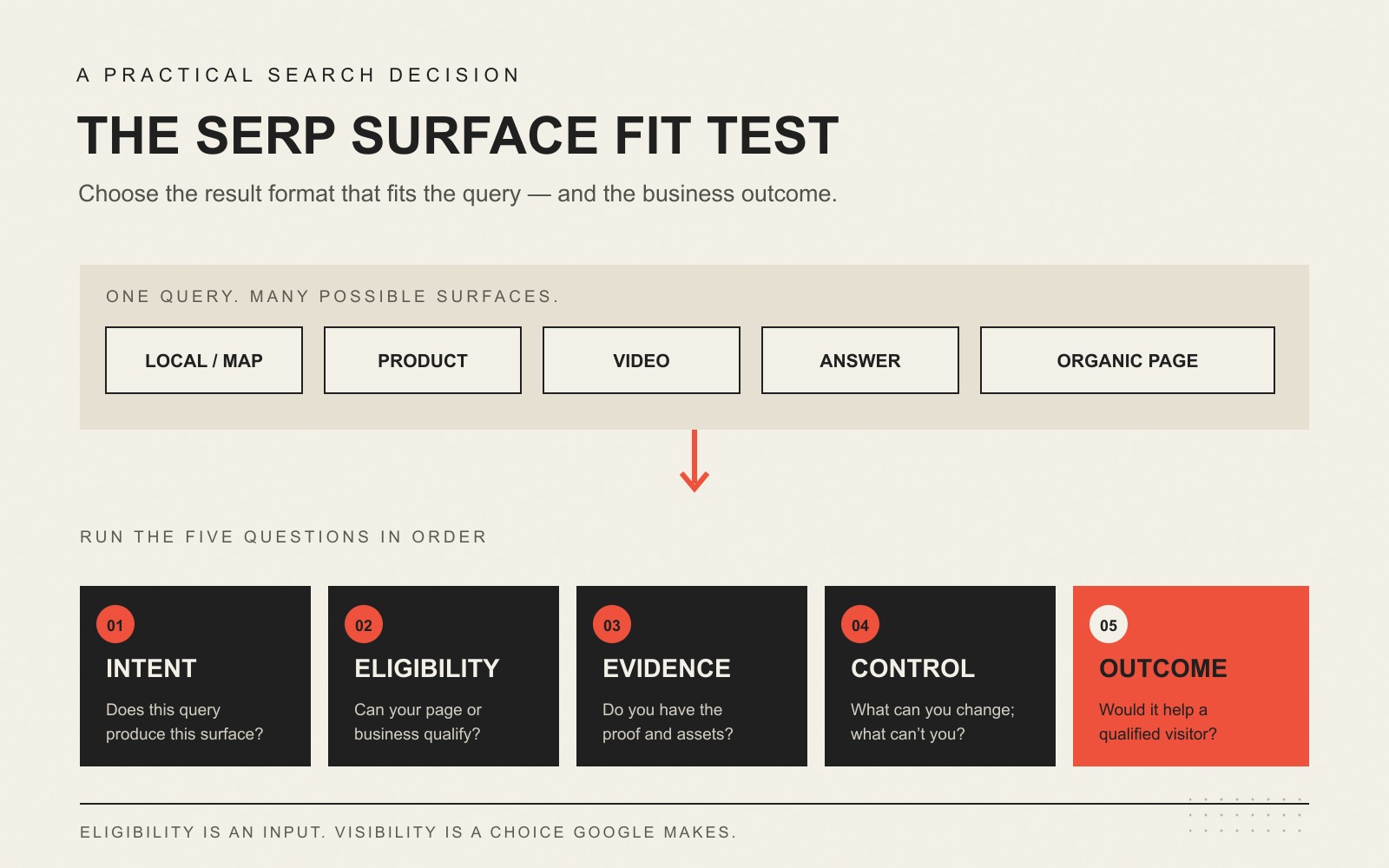
The framework keeps you from confusing “Google can show this” with “we should spend time pursuing it.” A plumber does not need a news strategy because Top Stories exists. A manufacturer may care deeply about images and product information even when a blog writer would not. A B2B firm may get more value from one precise organic result than from chasing every decorative module on the page.
11 Google search surfaces worth understanding in 2026
These are not eleven boxes every business must check. They are eleven distinct surfaces with different jobs, inputs, and limits.
1. Organic text results: the durable baseline
Standard organic results are still the broadest surface because almost any crawlable, indexable page can potentially compete when it matches a query. They are the natural target for service pages, guides, comparisons, category pages, policy pages, and other useful web documents.
Best fit: queries where the searcher wants a page to read, compare, evaluate, or act on. Eligibility: crawlable/indexable content with a clear canonical, useful visible text, and a page that actually serves the intent. Control: you can improve technical access, relevance, evidence, titles, internal links, and page usefulness; you cannot reserve a position.
Once you have chosen a normal organic page as the right surface, use the separate Scope Design Page-One Readiness Stack to diagnose why that page is not performing. That is post 3384’s job; this article deliberately does not duplicate it.
2. Featured snippets: answer a narrow question cleanly
A featured snippet is a prominent answer extracted from a web page and displayed in the search results. Google is explicit: its systems decide whether a page becomes a featured snippet. There is no “make me the snippet” setting.
Best fit: queries with a concise definition, ordered process, comparison, calculation, or direct factual question. Evidence: a self-contained answer followed by enough context to make it trustworthy. Control: structure the answer clearly, use descriptive headings, and keep the page useful beyond the extracted sentence. Do not mutilate the whole article into tiny robotic fragments hoping one gets picked.
DataForSEO measured featured snippet at 480 monthly U.S. searches in the keyword dataset we checked, and the buyer-style AI query “how do I get a featured snippet on Google” showed measurable AI search volume too. Demand exists, but selection remains Google’s.
3. People Also Ask: cover the adjacent decisions, not FAQ filler
People Also Ask exposes related questions around the original search. For our SERP-feature research, Google surfaced questions such as “What is SERP on Google?”, “What is SERP vs SEO?”, “What are the key features of a SERP?”, and “How does a SERP work?” Those questions are useful because they reveal what the searcher may need next.
Best fit: topics with clear follow-up questions, objections, definitions, comparisons, or implementation concerns. Control: answer the genuinely relevant subquestions in visible content. Do not: stuff twenty vaguely related questions onto the bottom of a page or assume FAQ schema creates a ranking boost. Useful coverage comes first; markup must match what visitors can actually see.
4. AI Overviews and AI Mode: make useful source material eligible
Google’s guidance for AI Overviews and AI Mode is refreshingly unmagical. The same foundational SEO practices still apply. Supporting pages generally need to be indexed and eligible to appear in Search with a snippet, and Google says there are no additional technical requirements or special AI markup required just to appear in these experiences.
Best fit: questions where the system needs to synthesize multiple facts, steps, perspectives, or sources. Evidence: explicit entities, original experience, verifiable claims, useful tables, clear explanations, and facts that are easy to retrieve in text. Control: improve source quality and technical eligibility; never promise an AI citation.
If AI visibility is strategically important, go deeper with our AI search optimization and citation-readiness guide. Same foundation, different presentation and measurement headache.
5. Local Pack and Maps: win the geographic decision
Local results are a different contest from a national organic article. Google says local ranking is mainly based on relevance, distance, and prominence, and that businesses cannot pay or request a better local ranking. That should kill a lot of silly “secret local ranking hack” pitches.
Best fit: searches where someone wants a nearby provider, store, restaurant, professional, or service area. Eligibility: accurate Google Business Profile information, a legitimate business/location model, useful website support, and real-world prominence/proof. Evidence: services, categories, hours, location/service-area facts, photos, reviews, and consistent business details.
For the deeper system, see our local SEO guide for small businesses. If the query is local, a generic blog-post ranking plan may be solving the wrong problem entirely.
6. Image results: compete when the answer is visual
Images can appear in Google Images and in visual modules inside regular Search. Google recommends high-quality images on useful pages, accessible image URLs, descriptive context, and image metadata that helps the system understand what the image depicts.
Best fit: products, design, before-and-after work, locations, diagrams, inspiration, visual troubleshooting, people, places, and anything where seeing beats reading. Evidence: original relevant media, honest alt text, useful captions/context, and a landing page worth visiting. Control: make the image discoverable and understandable. Do not rename stock photos with keywords and call it an image strategy.
7. Video results: use motion when motion teaches better
Google can surface videos in regular Search, Video mode, Images, and other discovery experiences. Video-specific metadata such as accurate VideoObject structured data can help Google understand a video’s details, but the page and video still need to deserve the result.
Best fit: demonstrations, walkthroughs, repairs, interviews, product use, tours, before-and-after sequences, and explanations that benefit from movement or voice. Evidence: a real watchable video, useful title/description, a strong page around it, and accessible thumbnail/media information.
If YouTube itself is part of the strategy, our guide to getting more qualified YouTube views covers the platform-specific side without pretending every view is a business result.
8. Shopping and product results: give Google clean commerce data
Product searches can produce product snippets, merchant listings, Shopping experiences, and other commerce presentations. Google documents separate requirements for product snippets and merchant listings, and Merchant Center has its own account and product eligibility rules for free listings.
Best fit: ecommerce and product-led queries. Evidence: accurate price, availability, product identifiers, images, offers, shipping/return information where required, and structured product data that matches the visible page. Control: provide accurate data and maintain eligibility. Structured data creates a chance to qualify; it does not guarantee the feature will appear.
Stores should treat this as a catalog and architecture problem, not just a paragraph-writing problem. Our ecommerce SEO guide covers categories, products, variants, facets, internal links, and crawl control in more depth.
9. Discussions and forums: first-hand participation is the asset
Google supports discussion and forum presentations for genuine community content. Its structured-data documentation includes profile and discussion markup designed to help Search understand real creators and conversations.
Best fit: questions where lived experience, troubleshooting, opinions, edge cases, or peer comparison matter. Eligibility: an actual community or discussion page with real participants and first-hand contributions. Control: make authorship and conversations understandable. Do not manufacture a fake forum section or slap discussion markup on an agency blog because the SERP contains Reddit.
10. Top Stories and news: only when you are actually doing news
Google Search can show a Top Stories carousel and a News tab for timely, newsworthy queries. Google says eligible news content is considered automatically; ranking remains automated and depends on the news context and policies.
Best fit: organizations with a legitimate publishing/news function, timely original reporting, announcements with real public interest, or subject-matter expertise tied to current events. Bad fit: rewriting press releases or turning routine company updates into “breaking news” because a carousel exists. Most small businesses should spend their effort somewhere else.
11. Knowledge and entity surfaces: make the business easy to understand
Some searches are about an entity more than a webpage: a company, person, place, product, or organization. Google may assemble entity information alongside ordinary results. This is not a slot you optimize like position three.
Best fit: branded and entity-oriented searches. Evidence: consistent organization/person information, accurate official profiles, clear About/contact details, visible authorship, and structured data that truthfully describes the entity. Control: reduce ambiguity and publish reliable facts. Google still decides what entity information to assemble and show.
Google SERP features compared by business job
| Surface | Best fit | Core eligibility or input | Useful measure |
|---|---|---|---|
| Organic text | Reading, comparing, evaluating, acting | Indexable page that matches intent | Relevant impressions, clicks, qualified actions |
| Featured snippet | Narrow answer, definition, steps | Clear answer on a useful eligible page | Snippet presence plus downstream clicks/actions |
| People Also Ask | Related questions and objections | Useful visible answers to real subquestions | Query coverage and qualified search visibility |
| AI Overviews / AI Mode | Synthesized, multi-part questions | Indexed, snippet-eligible, useful source material | Citations/mentions, referrals, qualified actions |
| Local Pack / Maps | Nearby service or place intent | Legitimate, accurate business/location data | Calls, directions, bookings, local leads |
| Images | Visual research and inspiration | Discoverable original/relevant media | Image impressions, clicks, assisted actions |
| Video | Demonstration and explanation | Indexable video/page and accurate metadata | Video visibility, watch quality, next actions |
| Shopping / product | Product research and purchase | Accurate product data and merchant eligibility | Product impressions, clicks, purchases |
| Discussions / forums | First-hand experience and peer advice | Real creators and genuine conversation | Relevant visibility, referral quality |
| Top Stories / news | Timely newsworthy topics | Original eligible news content | News visibility and relevant readership |
| Knowledge / entity | Brand and entity lookup | Clear, consistent, verifiable entity facts | Branded visibility and accurate information |
Five SERP-feature mistakes that waste time
Trying to optimize for every feature at once
If the query does not produce videos, a video campaign is not automatically the next SEO priority. If the business is not local, Maps is not the prize. If you do not sell products, Merchant Center is irrelevant. Surface fit comes before execution.
Treating schema as a magic visibility switch
Structured data can help Google understand eligible content and can enable supported search appearances. It does not guarantee a rich result, an AI citation, a featured snippet, or a ranking. Schema is machine-readable truth, not bribery written in JSON-LD.
Copying the current winner’s format without checking your evidence
A competitor may rank with a calculator, original dataset, community, product feed, or newsroom because they possess the underlying asset. Copying their headings will not manufacture that asset. Ask what evidence or capability makes the surface possible.
Assuming a ranking drop means the page got worse
The result page itself may have changed. A query can become more local, visual, product-heavy, discussion-heavy, or AI-heavy. Our Google search-change diagnostic separates demand, eligibility, intent, content value, and business outcome before anyone performs random surgery on a page.
Calling visibility the business outcome
An impression is not a lead. A citation is not a sale. A ranking is not automatically qualified traffic. Use our SEO measurement ladder to connect eligibility and visibility to engagement, qualified actions, and business results.
A 30-minute workflow for choosing the right SERP surface
- Pick one commercially meaningful query. Not fifty. Choose a question tied to a service, product, local need, comparison, or buying decision.
- Inspect the live results. Record the surfaces actually present. If location matters, check the relevant geography. Note ads too because they change how much visible space remains, even though paid placements are not an organic feature to “rank” in.
- Run the SERP Surface Fit Test. Score Intent, Eligibility, Evidence, Control, and Outcome. A surface that fails the first two questions is usually a lousy priority.
- Choose one primary and one supporting surface. For example: a service page plus local results; a product page plus shopping; an answer-led guide plus a featured snippet/AI source opportunity; a video page plus video search.
- Measure the chain. Track whether the page or entity is eligible, whether it earns visibility, whether the right people engage, and whether they take a qualified action. Improve the weak link rather than adding random content.
This process sounds less exciting than “11 secrets to dominate Google.” Good. It also gives you a much better chance of working on the actual constraint.
Frequently asked questions about Google SERP features
What is a SERP on Google?
A SERP is a search engine results page. On Google, that page can contain standard organic text results plus modules such as AI Overviews, featured snippets, People Also Ask, local results, images, videos, products, discussions, news, and entity information. The mix varies by query and context.
What is SERP vs SEO?
The SERP is the result page the search engine displays. SEO is the work of improving a site’s or entity’s technical eligibility, relevance, usefulness, clarity, authority, and measurement so it has a better opportunity to earn useful search visibility. One is the arena; the other is the work.
What are the most common Google SERP features?
Common surfaces include organic text results, featured snippets, People Also Ask, AI Overviews, local/Maps results, image and video results, product/shopping presentations, discussions/forums, news modules, and knowledge/entity information. Not every query shows every surface.
Can a small business appear in Google AI Overviews?
Yes, a small-business page can be used as a supporting source when Google’s systems select it. Google says the same foundational SEO practices apply to AI features and that supporting pages generally need to be indexed and eligible to show a snippet. There is no special AI schema that guarantees inclusion.
Can I optimize directly for a featured snippet?
You can make a page easier to use by answering the relevant question clearly and structuring the explanation well, but Google chooses featured snippets automatically. No setting or markup can force selection.
Does schema guarantee rich results?
No. Correct structured data can make eligible content understandable for supported rich-result features, but Google explicitly does not guarantee that a structured-data feature will appear. Use schema because it truthfully describes visible content, not because a plugin score wants another light to turn green.
How are local results different from organic results?
Local results are shaped by geographic intent and Google’s local-ranking systems, which it describes mainly in terms of relevance, distance, and prominence. Organic text results are web pages ranked for the broader query. A local business can appear in both, but the inputs and user actions are different.
Which SERP features matter most for local businesses and ecommerce stores?
Local businesses should usually evaluate normal organic results and the Local Pack/Maps first, then images, video, or AI surfaces when the query supports them. Ecommerce stores should usually evaluate product pages, category pages, shopping/product results, images, and video. The right choice still depends on the live query and business outcome.
Stop trying to “win Google.” Win the right search decision.
The useful lesson behind modern Google SERP features is not that you need eleven new tactics. It is that search visibility has become more specific. Different questions produce different result surfaces, and each surface rewards a different kind of eligibility, evidence, and business asset.
Inspect the result page. Choose the surface. Build the thing that deserves to appear there. Measure whether qualified people do something useful afterward. That is a strategy. “Rank #1 everywhere” is a wish wearing an SEO report.
If you want help turning that into a prioritized plan, use Scope Design’s SEO strategy and measurement system to connect search demand, technical eligibility, content, authority, and analytics to actual business value.
Sources and methodology
This article was researched on August 21, 2026 for the United States in English. We compared current Google and Bing result behavior, DataForSEO keyword/SERP/PAA evidence, Ubersuggest keyword and competitor evidence, Scope Design’s Content Studio link graph and Open Brain knowledge, and first-party Google documentation. Search-result layouts change, so treat any individual SERP snapshot as dated evidence rather than a permanent rule.
- Google Search Central: Visual Elements gallery
- Google Search Central: AI features and your website
- Google Search Central: Featured snippets
- Google Search Central: Google Images best practices
- Google Search Central: Video structured data
- Google Search Central: Product structured data
- Google Search Central: ProfilePage and discussion features
- Google Business Profile: Tips to improve local ranking