Tag: AI marketing

  • Master ChatGPT for Marketing: Complete Guide to AI-Powered Success

    Master ChatGPT for Marketing: Complete Guide to AI-Powered Success

    ChatGPT for marketing works best when it speeds up bounded work you already understand: research synthesis, idea development, first drafts, variations, analysis, repurposing, and marketing operations. It is not a marketing strategy, a substitute for customer knowledge, or a reliable final source of facts. The businesses that get useful results give it real context, define what a human must review, and measure whether the workflow improves something that matters.

    That is the central idea of this guide. We are not going to pretend one magic prompt turns ChatGPT into a tiny CMO living in your browser. We are going to show you where the tool earns its place, where it needs supervision, and how to use it without turning your marketing into polished beige sludge.

    TL;DR: Use ChatGPT for marketing as an assistant, not the department

    • Give it a specific marketing job. “Help with marketing” is not a job.
    • Supply approved context. Give it the audience, offer, evidence, brand rules, constraints, and source material it needs.
    • Define the review boundary. A human still owns facts, positioning, privacy, compliance, taste, and final approval.
    • Measure a real outcome. Time saved can matter, but so can error rate, campaign speed, qualified leads, pipeline, purchases, retention, or another result tied to the job.
    • Use specialist workflows when the problem gets deeper. Prompt engineering, SEO content, email marketing, repurposing, paid advertising, and customer-facing chatbots each deserve their own operating rules.

    In this ChatGPT marketing guide

    How ChatGPT for marketing should actually work

    Think of ChatGPT as a fast collaborator with broad pattern-recognition ability and no accountability. It can help you turn messy notes into a brief, compare several message directions, summarize a spreadsheet, rewrite a draft for a different audience, or challenge assumptions. What it cannot do is care whether your positioning is actually right, whether a statistic is fabricated, whether a promise creates legal risk, or whether the campaign deserves another dollar.

    OpenAI’s current marketing guidance describes use cases across writing, research, brainstorming, data analysis, campaign work, and adaptation, while still calling for human judgment on accuracy, nuance, and final approval. That division of labor is more useful than the old fantasy of “automating marketing.” If your overall marketing system is unclear, fix that first; our small business marketing strategy guide owns the broader channel-and-system decision.

    ChatGPT can help with A marketer still needs to own
    Organizing research and messy inputs Deciding what evidence is trustworthy and what matters
    Generating several directions quickly Choosing the positioning and creative direction
    Drafting and rewriting Truth, brand voice, proof, and final approval
    Summarizing campaign data Choosing the metric, interpreting causality, and deciding what to do
    Repurposing a strong idea across formats Adapting the experience to the destination and audience

    Use the Scope Design MARK Test before you ask ChatGPT to do marketing work

    The MARK Test is our four-part operating check for AI-assisted marketing. Run it before you spend time polishing prompts or automating a workflow. If one box is blank, the workflow is not ready.

    The Scope Design MARK Test keeps AI-assisted marketing tied to a real job, approved evidence, human review, and a measurable outcome.

    M — Marketing job

    Name the exact task or decision. “Create content” is still too vague. “Turn these five customer objections into three article angles for buyers comparing managed hosting options” is a job. “Review this campaign report and identify three anomalies worth investigating” is a job. The narrower the job, the easier it is to decide whether the output is useful.

    A — Approved context

    Give ChatGPT the material a competent teammate would need: who the audience is, what you sell, what you can prove, how the brand sounds, what constraints exist, and which source material is allowed. Context is not decoration. It is the difference between transforming your knowledge and asking the model to invent a plausible version of your business.

    R — Review boundary

    Decide what a person must check before the work moves forward. Common review boundaries include factual claims, citations, pricing, customer outcomes, regulated language, privacy, brand voice, positioning, and anything that creates a promise. OpenAI’s own accuracy guidance warns that ChatGPT can produce incorrect information and fabricated quotes, studies, citations, or references. Confidence is not proof.

    K — KPI or outcome

    Choose the evidence that would tell you the workflow helped. Sometimes the answer is efficiency: fewer drafting hours, a shorter campaign cycle, or fewer repetitive rewrites. Sometimes it is quality: fewer factual corrections, better message consistency, or more useful variations tested. Sometimes it is a downstream business result. If you cannot name the outcome, “we used AI more” is not a success metric.

    1. Use ChatGPT to organize research and sharpen planning

    Research is one of the strongest places to use ChatGPT because the model can help organize evidence without needing to be the evidence. Feed it customer interviews, support questions, reviews, sales-call notes, survey responses, analytics exports, competitor pages, or internal documents. Ask it to identify repeated themes, contradictions, unanswered questions, and assumptions that need validation.

    The important rule is simple: do not replace market contact with model output. If you have not talked to customers, inspected search behavior, checked analytics, or gathered first-party evidence, ChatGPT cannot magically manufacture that missing reality. Our small business market research guide goes deeper on gathering the evidence first.

    A useful research prompt is not “Who is my target customer?” Try: “Here are 40 customer questions from sales and support. Group them by decision stage, identify the language customers repeat, flag conflicting signals, and list five questions we still need to answer with real research.” Now the tool is reducing cognitive load without pretending it interviewed anyone.

    2. Create, repurpose, and improve content without manufacturing expertise

    ChatGPT is useful for outlines, first drafts, rewrites, variations, summaries, editing, and format changes. The strongest workflow starts with something the business actually knows: a customer question, a project lesson, a product decision, a sales objection, a process, a dataset, or an expert interview. Give the model that material and ask it to clarify, organize, challenge, or transform it.

    That is different from typing “write a 2,000-word thought-leadership article about AI marketing” and hoping expertise appears. Our AI content creation workflow covers the full research-to-review system. If the job is turning one proven source into multiple useful formats, use the content repurposing workflow instead of copying the same wording into every channel.

    Use ChatGPT for SEO thinking, not imaginary SEO data

    ChatGPT can help cluster a supplied keyword list, compare search-intent hypotheses, suggest questions, improve headings, draft metadata, identify gaps in an outline, or challenge whether a page actually answers the query. It should not be treated as the source of current search volume, rankings, backlink counts, crawl status, or Search Console performance unless it is connected to current tools and you verify the data.

    Google’s guidance on generative AI content does not ban AI-assisted work. It says generative AI can help with research and structure, while scaled content that adds little value can run into spam-policy problems; accuracy, quality, relevance, and usefulness still matter. If you want the full writing system, our SEO content writing guide owns that job.

    3. Adapt one strong idea for email, social media, and paid advertising

    One of ChatGPT’s practical advantages is transformation. A strong source idea can become an email, a short social post, an ad concept, a landing-page section, a video outline, or an FAQ. But adaptation should change the experience, not merely resize the words.

    Email marketing

    Give ChatGPT the offer, audience stage, objection, proof, desired action, and real examples of your voice. Ask for genuinely different approaches: direct, educational, proof-led, objection-led, or urgency-free. Then review each against the relationship you are trying to build. Our email marketing for small business guide covers the relationship system behind the copy.

    Social media

    Use ChatGPT to generate angles, turn long material into shorter formats, write alternate hooks, or adapt a point for different levels of audience awareness. Do not tell it to “make this viral.” Virality is not an instruction. Give it the audience, platform constraint, content job, and evidence; then judge the result like any other creative work.

    Paid advertising

    ChatGPT can help turn a campaign brief into ad variants, group messages by angle, rewrite copy to fit character limits, or analyze a supplied performance table for hypotheses. It cannot decide whether the channel economics make sense. Use your conversion data, margins, budget, targeting, and sales capacity. Our online advertising strategy guide covers that decision.

    4. Use ChatGPT for support analysis and marketing operations, with tighter boundaries for customer-facing automation

    Behind the scenes, ChatGPT can summarize recurring support issues, turn meeting notes into decisions and owners, standardize briefs, clean up campaign documentation, draft QA checklists, classify feedback, or explain a performance report in plain English. Those tasks are valuable because they reduce coordination work without pretending the AI owns the customer relationship.

    Customer-facing automation needs a stricter standard. A chatbot can be useful for bounded questions, routing, and retrieval, but it needs approved knowledge, escalation rules, logging, maintenance, and a clear definition of what it must never invent. If you are building that system, use our AI chatbots for business guide. A chat window is not automatically a customer-support strategy wearing a robot hat.

    A reusable ChatGPT marketing prompt built around MARK

    You do not need a 600-word incantation for every task. A reusable prompt should carry the information that changes the quality of the work.

    Marketing job: [What exact task or decision should this output improve?]
    Audience and offer: [Who is this for, and what are we trying to help them decide or do?]
    Approved context: [Paste the evidence, source material, brand guidance, constraints, and facts the model may use.]
    Review boundary: [What must be flagged, verified, or approved by a human?]
    Output: [Format, length, required sections, variants, or other constraints.]
    KPI / outcome: [What result would make this work useful?]
    
    If the evidence is missing or conflicting, say so instead of inventing an answer.

    That is enough for many everyday jobs. For reusable prompt systems, examples, source handling, and prompt testing, go to our ChatGPT prompt engineering guide. Prompt technique can improve execution; it cannot rescue a weak offer, missing evidence, or a marketing strategy nobody has decided.

    What marketers should not delegate to ChatGPT

    • Final positioning. The model can produce options. Someone accountable for the business has to choose the territory and tradeoffs.
    • Customer truth. AI can summarize interviews and behavior; it cannot replace actually observing the market.
    • Factual accountability. Verify claims, statistics, quotes, citations, product details, pricing, and competitor statements.
    • Brand taste. Competent is not the same as distinctive. Human judgment decides whether the work is worth attaching your name to.
    • Sensitive or regulated decisions. Do not make consequential decisions about people, eligibility, protected or vulnerable audiences, privacy, or regulated claims just because the output sounds confident.
    • Final approval. Someone with authority should know what is going public and why.

    For organizations using business data, plan settings matter. OpenAI says ChatGPT Business, Enterprise, Edu, and API organization data are not used to train its models by default. Personal workspaces have different data controls. Either way, your own governance rules still matter: decide what staff may paste into AI tools, what must be redacted, what requires approval, and what should stay out entirely. NIST’s Generative AI Profile is a useful cross-sector reference when the risk is larger than “this draft sounds weird.”

    How do you measure ROI from ChatGPT marketing work?

    Measure the job in layers. ChatGPT usage itself is not the KPI. Ten thousand prompts prove you typed a lot.

    Layer Example evidence What it tells you
    Efficiency Drafting hours, turnaround time, number of useful variants Whether the workflow reduced repetitive effort
    Quality Correction rate, factual errors, brand-edit passes, approval rate Whether speed created hidden rework
    Channel Engagement, CTR, reply rate, conversion rate, ranking or visibility changes Whether the marketing asset performed in its environment
    Qualified outcome Qualified leads, sales, pipeline, appointments, retention, saved staff capacity Whether the improvement mattered to the business

    Establish a baseline before changing the workflow. Then compare a reasonable sample rather than declaring victory after one good draft. If the AI version is faster but creates twice as many factual corrections, that time “saved” may be imaginary. If a campaign gets more clicks but worse leads, the marketing result did not improve just because the chart went up.

    This matters for Scope Design’s own page too. Before revising this article, we checked the exact URL across GA4, Google Search Console, Bing, Ubersuggest, public technical access, and live Google/Bing results. The existing page had almost no measurable landing-page traction, Google had crawled it but reported it as currently not indexed, Bing knew the URL but showed no current URL-level traffic, and third-party tools found no useful exact-page keyword or backlink evidence. That does not prove the topic is worthless. It proves the old version was not earning meaningful measurable visibility, while current query research showed a much clearer opportunity around “ChatGPT for marketing.”

    A 30-day plan for using ChatGPT in marketing without creating a mess

    Week 1: Choose two boring, bounded jobs

    Pick recurring tasks with clear inputs and review criteria: turning interview notes into themes, drafting first-pass campaign briefs, generating message variants from approved proof, summarizing a weekly report, or repurposing a finished article. Avoid starting with “run our whole marketing department.” Big demos are seductive. Small measurable jobs teach you where the tool actually helps.

    Week 2: Build the approved context

    Create the minimum reference pack the workflow needs: audience, offer, current messaging, approved proof, constraints, examples, and a short list of prohibited claims. Write the review boundary next to it. If staff are using business information, confirm the account type, data controls, and internal policy before the habit spreads.

    Week 3: Run repeated cycles and log failures

    Use the workflow five or ten times. Track what you fix. Did the model invent facts? Flatten the brand voice? Miss an important objection? Over-summarize? Produce variations that are not actually different? Your correction log is more valuable than a folder full of “best prompts” because it tells you how this workflow fails in your business.

    Week 4: Keep, revise, or stop

    Compare the baseline with the MARK outcome. Keep workflows that save useful time or improve useful quality without creating hidden risk. Revise workflows that are promising but sloppy. Stop workflows that create more review work than they remove. “We already built it” is not a reason to keep automation nobody trusts.

    Frequently asked questions about ChatGPT for marketing

    Is ChatGPT good for marketing?

    Yes, for bounded work such as research synthesis, brainstorming, drafts, variations, repurposing, analysis, and operations. It is less useful when the real problem is missing strategy, missing customer evidence, or a decision nobody wants to own.

    How can I use ChatGPT to promote my business?

    Start with real business material: customer questions, product information, proof, campaign goals, analytics, reviews, or existing content. Use ChatGPT to turn that material into useful angles and channel-ready drafts, then review the claims and test the result in the market. Promotion works better when AI distributes real expertise instead of manufacturing generic enthusiasm.

    What are good ChatGPT prompts for marketing?

    Good marketing prompts identify the job, audience, offer, approved evidence, constraints, review rules, output format, and desired outcome. “Write engaging social media content” is weak because the model has to invent half the brief. The MARK template above is a practical starting point.

    Which AI tool is best for marketing strategy?

    No tool removes the need to choose a strategy. The better question is which tool can work with the evidence and workflow you already have: research, documents, data, collaboration, analysis, drafting, or automation. ChatGPT can be a strong thought partner, but your customer evidence, economics, positioning, and organizational judgment still determine the strategy.

    Can ChatGPT replace a marketer?

    It can replace pieces of repetitive work. It cannot take responsibility for the market, brand, ethics, customer relationship, or business outcome. A stronger operating model is human strategy → AI exploration or execution → human review → market test → AI-assisted analysis → human decision.

    Does using ChatGPT for content hurt SEO?

    Not simply because AI assisted the work. Google’s current guidance focuses on accuracy, quality, relevance, originality, and people-first value. Using automation primarily to mass-produce low-value pages for rankings is the problem. AI can help research and structure content, but the finished page still has to earn its usefulness.

    Can I paste customer or company data into ChatGPT?

    Check the account type, current data controls, contracts, and your organization’s policy before sharing sensitive or proprietary material. OpenAI’s business offerings have different default training treatment from personal workspaces. “The AI needs context” does not mean “paste everything you have.” Use the minimum approved data needed for the job.

    How do I measure ROI from ChatGPT marketing efforts?

    Start with a baseline for the exact job. Measure efficiency and quality first, then the channel metric, then the qualified business outcome. Do not attribute every conversion change to ChatGPT simply because the tool touched the workflow.

    Do companies pay ChatGPT to advertise?

    That is a different question from using ChatGPT to do marketing work. Advertising products, eligibility, formats, and plan rules can change, so evaluate any advertising opportunity separately. The workflows in this guide are about using ChatGPT as a marketing assistant whether or not you buy media on any particular platform.

    Make the marketing system smarter before you make it faster

    ChatGPT can make a good marketing system faster. It can also help a confused team produce confusion at industrial speed. Start with one real job, feed it approved evidence, keep a human on the decisions that matter, and measure whether the result improved anything beyond prompt volume.

    If your bigger problem is the system itself—positioning, content ownership, SEO, email, paid campaigns, measurement, or how the pieces should work together—talk to Scope Design. We would rather help you build a marketing workflow that earns its automation than sell you a shiny pile of AI busywork.


  • Top 10 Marketing Tools We’re Grateful to Have in 2026

    Top 10 Marketing Tools We’re Grateful to Have in 2026

    The best marketing stack in 2026 is not the one with the most software. It is the one where every tool has a clear job, the team knows who owns it, and the output moves cleanly into the next step. That is the standard behind this list of the top marketing tools we are grateful to have available right now.

    This is deliberately different from our broader checklist of essential marketing tools. That article helps businesses think through the categories a complete stack may need. This one is a more opinionated shortlist: ten specific products that solve ten different marketing jobs well enough to deserve attention.

    If you only want the quick answer, our 2026 list is: ChatGPT for thinking and drafting, Google Analytics 4 for measurement, Gumloop for connected automation, Surfer SEO for search-content guidance, Canva for visual production, HubSpot for CRM-centered marketing, Klaviyo for lifecycle messaging, Metricool for social scheduling and reporting, Notion AI for marketing operations, and Crayo for short-form video production.

    How to choose the top marketing tools for your business

    We use a simple test before treating any app as part of the stack. A useful tool should answer four questions without hand-waving:

    • What job does it own? If two tools do the same job, decide which one is primary.
    • Who owns the output? A dashboard nobody reviews or an automation nobody maintains is not a system.
    • Where does the work go next? Good tools reduce handoff friction instead of creating another data island.
    • How will we know it is helping? Measure the business process it supports, not logins, AI credits, or feature count.

    That job-first approach matters more as AI gets embedded into almost every category of marketing software. AI can speed up research, drafting, analysis, classification, and routine execution. It does not remove the need for a strategy, clean source data, human judgment, or a definition of what success means.

    A person owns a tools output, hands work to the next process, and measures its useful business result

    1. ChatGPT for thinking, drafting, and analysis

    ChatGPT earns a place because it can work across several early-stage marketing tasks without forcing every task into a separate application. It is useful for brainstorming campaign angles, turning rough notes into a first draft, summarizing source material, analyzing uploaded data, building outlines, comparing alternatives, and helping a marketer get from a blank page to something worth reviewing.

    Best fit: teams that already have real subject-matter knowledge, customer information, research, or performance data and want a faster way to reason through it and turn it into usable drafts.

    Watch-out: speed can make weak inputs look polished. Treat generated copy as a draft, verify factual claims against sources, and keep a human responsible for the final position, promise, and tone.

    2. Google Analytics 4 for measurement

    Google Analytics 4 is still valuable because it gives website and app teams a common measurement layer for traffic, acquisition, user activity, and events. It is the place to answer basic questions such as which channels are bringing people in, what landing pages they reach, what actions are being recorded, and where further investigation is needed.

    Google also offers predictive metrics for properties that meet its eligibility and modeling requirements. That is useful when available, but it should not distract from the fundamentals. Most businesses get more value by first making sure the right events are tracked, campaigns are tagged consistently, and reports connect to decisions. Our broader guide to SEO strategy and analytics explains how measurement should connect search visibility to business value.

    Best fit: virtually any organization with a website that needs a shared view of acquisition and on-site behavior.

    Watch-out: analytics is evidence, not an answer generator. A traffic spike can be good, bad, or irrelevant depending on who arrived and what they did. That is why we also distinguish traffic from actual business growth.

    3. Gumloop for connected AI workflows

    Gumloop is interesting because it treats AI as part of a workflow instead of a separate chat window. Its marketing use cases center on connected agents and automations that can move information among research, content, CRM, analytics, search, and collaboration tools.

    The useful question is not “what can we automate?” It is “which repeated handoff is specific enough to automate safely?” Good candidates are narrow, frequent tasks with clear inputs and a predictable review step: sorting research, assembling a brief, routing a lead, enriching a record, preparing a report, or moving approved information between systems.

    Best fit: teams that already understand their process and want to remove repetitive connective work between tools.

    Watch-out: automation scales mistakes too. Keep permissions narrow, make important actions reviewable, and do not automate a broken process just because a connector exists.

    4. Surfer SEO for search-content guidance

    Surfer SEO earns its place as a research and optimization aid. Its Content Editor analyzes search-result patterns and gives real-time guidance about content structure, relevant terms, and optimization coverage while a writer works.

    That can be useful for spotting obvious gaps, but the score is not the strategy. A page still needs a reason to exist, a clear search intent, original experience or evidence, accurate claims, useful internal links, and copy that sounds like the business rather than an average of competing pages.

    Best fit: content teams that already have a real editorial process and want a structured search-informed quality check.

    Watch-out: do not flatten distinctive expertise just to satisfy an optimization score. Search guidance is one input to editorial judgment.

    5. Canva for faster visual production

    Canva helps marketing teams turn repeatable visual work into a system. Templates, brand assets, resizing tools, image editing, presentations, social formats, and newer AI-assisted creation features make it easier to produce variations without rebuilding every asset from scratch.

    That is especially useful when a designer has already established the brand system and the marketing team needs to create recurring, lower-risk assets within it. A template library can remove production bottlenecks while still protecting fonts, colors, logo treatment, spacing, and common layouts.

    Best fit: teams producing recurring social graphics, simple campaign assets, presentations, handouts, or resized versions of approved creative.

    Watch-out: easy production is not the same as good design. Templates need governance, and important brand or campaign work still benefits from design judgment rather than endless variations.

    6. HubSpot for CRM-centered marketing operations

    HubSpot is useful when the marketing system needs to stay close to the customer record. Its marketing tools sit alongside CRM data and support campaigns, forms, email, lead management, workflows, and reporting in the same broader platform.

    The advantage is less about having every possible feature and more about reducing the distance between a campaign and what happens to the contact afterward. When sales and marketing share the same record, it is easier to define lifecycle stages, route leads, see follow-up, and build automations around real customer status instead of separate spreadsheets.

    Best fit: businesses that need marketing and sales to work from a shared contact system and are ready to maintain the data and process that make a CRM useful.

    Watch-out: a broad platform can become expensive or overbuilt if the business only needs a few simple jobs. Define the workflow before buying the feature set.

    7. Klaviyo for lifecycle email and segmentation

    Klaviyo is strongest when customer behavior and purchase data should shape lifecycle messaging. Its email platform supports detailed segmentation, behavior-triggered flows, product recommendations, and cross-channel messaging tied to customer profiles.

    That makes it particularly relevant to ecommerce and other businesses with enough customer activity to justify richer segmentation. Instead of sending every subscriber the same newsletter, the system can support different messages for prospects, first-time buyers, repeat customers, inactive customers, or people who took a specific action.

    Best fit: commerce and lifecycle-heavy businesses with meaningful customer-event or purchase data.

    Watch-out: sophisticated segmentation is only useful when the data is trustworthy and the message is worth receiving. More flows do not automatically create a better customer experience.

    8. Metricool for social scheduling and reporting

    Metricool concentrates several everyday social-media jobs in one place: planning, scheduling, publishing, measuring, and reporting across channels. That makes it useful for marketers who are tired of bouncing among native platform interfaces just to maintain a publishing calendar and compare performance.

    The bigger benefit is operational consistency. A shared calendar makes it easier to see what is going out, keep campaign timing aligned, and review results across channels using one reporting routine.

    Best fit: small teams or agencies managing multiple active social channels and needing a repeatable planning/reporting workflow.

    Watch-out: scheduling software can help you publish consistently; it cannot decide whether a post deserves to exist. Channel choice, message quality, community response, and creative judgment still matter.

    9. Notion AI for the operating layer

    Notion AI is less a campaign channel than an operating layer. Notion combines documents, databases, projects, tasks, and team knowledge; its AI features can work inside that context to help summarize, draft, search, organize, and automate parts of the work.

    For a marketing team, that can mean one home for campaign briefs, content calendars, research, meeting notes, SOPs, launch checklists, decisions, and post-campaign learnings. The more important benefit is continuity: the work does not have to disappear into chat history or one person’s memory after the campaign ends.

    Best fit: teams that need a shared source of truth for marketing operations and are willing to maintain a simple information structure.

    Watch-out: no knowledge tool can rescue a workspace where nobody agrees what is authoritative. Decide where final briefs, decisions, and current status live before adding AI on top.

    10. Crayo for short-form video production

    Crayo focuses on clipping and editing short-form video. Its current toolkit includes video cutting, subtitles, AI voiceovers, background and speech tools, and workflows for turning source material into formats used by short-video channels.

    That is useful when the bottleneck is production mechanics rather than the idea itself. A marketer can spend less time on repetitive captioning, clipping, and formatting and more time deciding which source material is worth turning into a short video.

    Best fit: teams that already have a repeatable source of video, interviews, demos, podcasts, or talking-head content and need a faster clipping/editing workflow.

    Watch-out: no editor can promise reach or virality. Short-form content still needs a useful idea, a strong opening, appropriate rights to source material, and a reason for the audience to care.

    How to build a lean marketing stack without tool sprawl

    You do not need all ten tools. Most small businesses should build from the bottleneck outward, not from a list inward.

    1. Choose the business outcome first. More qualified leads, better follow-up, faster content production, clearer attribution, more consistent publishing, or something else.
    2. Give each job one primary home. Pick the system of record for contacts, analytics, content status, assets, and campaign decisions.
    3. Define the handoff. Be explicit about what enters the tool, what leaves it, who reviews the output, and what happens next.
    4. Measure the process around the tool. Look for less manual rework, better data quality, faster cycle time, stronger follow-up, or improved business outcomes—not whether the team opened the app more often.
    5. Add complexity only after the current process is used consistently. Automation and AI compound good systems. They also compound confusion.

    A useful starting point for many teams is measurement first, then the production bottleneck. If you cannot tell where leads and customers are coming from, fix analytics before buying another creation tool. If you can measure demand but cannot publish consistently, address content operations. If good leads are being lost between inquiry and follow-up, the CRM and lifecycle layer probably matters more than another social platform.

    A practical starting stack by business need

    Business need Tool to evaluate first Add the next layer when…
    Understand website acquisition and behavior Google Analytics 4 Tracking is trustworthy and you need deeper strategy or channel analysis.
    Turn expertise into drafts and analysis faster ChatGPT You have a repeatable review process and reliable source material.
    Create repeatable visual assets Canva Your brand system and templates are defined.
    Connect sales and marketing follow-up HubSpot Your lifecycle stages and CRM ownership are clear.
    Run behavior-driven lifecycle messaging Klaviyo You have enough customer data and events to segment meaningfully.
    Manage multiple social channels Metricool Your channel strategy and publishing cadence already exist.
    Automate repeated cross-tool handoffs Gumloop The manual workflow is stable enough to describe and review.
    Add search-informed content checks Surfer SEO You already have real expertise, evidence, and an editorial owner.
    Centralize briefs, SOPs, and campaign knowledge Notion AI Your team agrees what information is authoritative.
    Produce more short-form clips Crayo You already have worthwhile source footage and a distribution plan.

    The tool is not the strategy

    The biggest change since this article first appeared is not that marketers suddenly have access to more apps. It is that many tools can now draft, analyze, classify, generate, and automate parts of the work. That makes system design more important, not less.

    Pick fewer tools. Give each one a job. Decide what information is authoritative. Keep important decisions reviewable. Measure what happens before and after the tool touches the process. When a product clearly removes a real bottleneck, keep it. When it becomes another place to check, another subscription to justify, or another source of conflicting data, simplify.

    If you want help deciding which marketing technology actually belongs in your business—and how the website, analytics, content, automation, and follow-up should fit together—contact Scope Design. We can help you design the system around the outcome instead of buying software first and figuring out the process later.

  • How to Elevate Your Social Media Marketing Strategy | Proven Best Practices That Drive Results

    How to Elevate Your Social Media Marketing Strategy | Proven Best Practices That Drive Results

    The bottom line: The highest-impact social media marketing best practices do not begin with a posting schedule, a hashtag count, or the latest algorithm rumor. They begin with a connected system: reach the right people on a channel that has a clear job, publish useful material based on real expertise, create meaningful interaction, route attention to a measurable next step, and learn from qualified business outcomes.

    If you already post consistently but cannot explain what the activity is doing for the business, more content is rarely the first fix. Social media works best as one part of a broader marketing system that connects attention to business value. This guide focuses on improving that system after social media has earned a place in it. If you are still building the plan from scratch, our social media strategy guide owns that broader decision.

    Social Media Marketing Best Practices: What Actually Elevates a Strategy?

    An elevated social media strategy is easier to operate and easier to judge. Every active channel has a reason to exist. Every content type has a job. Every call to action leads somewhere proportionate to the buyer’s intent. Measurement continues beyond platform dashboards. And the team knows what it will change when the evidence is weak.

    Weak habit Elevated practice Evidence that matters
    Be everywhere Choose channels from audience behavior and operating capacity Relevant audience, response quality, cost to operate
    Post because the calendar says so Publish content with a defined job Useful interaction, qualified attention, repeatable production
    Copy the same post everywhere Adapt the idea to the channel’s native behavior Whether the format helps the audience understand or act
    Celebrate reach by itself Connect attention to a measurable handoff Tagged visits, useful DMs, bookings, qualified leads, revenue
    Change five things at once Run one bounded test at a time A result you can interpret and use for the next decision

    The important difference is causality. A viral post may be interesting, but it is not automatically useful. A small post that reaches the right twenty people, answers a buying question, and creates two qualified conversations may be much more valuable. Your social media marketing strategy should make that difference visible.

    The Scope Design ELEVATE Social Media Operating Loop

    We use ELEVATE as an operating loop for improving an existing social program: Evidence, Limit, Expertise, Value, Arrange, Test, Evaluate. It is not an industry standard or an algorithm formula. It is a practical way to keep seven connected decisions from collapsing into “post more.”

    Evidence, channel focus, useful expertise, valuable conversation, handoff, testing, and qualified outcomes form a learning loop

    E — Evidence before platform habits

    Start with the audience behavior and business outcome you can actually observe. “Everyone is on Instagram” is not evidence that your buyers use Instagram for the job you need it to perform. Look at customer interviews, sales questions, referral patterns, website behavior, existing social conversations, and real channel capacity.

    Pew Research Center’s current U.S. social media fact sheet is a useful reminder that platform usage varies across demographic groups. That still does not choose a platform for your business; it tells you why the choice should be evidence-led. For the deeper channel decision, use our guide to choosing the right types of social media for your business.

    L — Limit each channel to one primary job

    A channel can do several things, but your team should know the primary job that earns its operating cost. One network might support local discovery. Another might help demonstrate expertise to a long-consideration B2B buyer. Another may be useful for customer support or recruiting.

    This does not mean a Facebook page can never recruit or a LinkedIn post can never create a lead. It means the channel has a main reason to exist, so the team knows what to produce, what to measure, and what would justify reducing or retiring the work. Two identical feeds with no distinct job are usually duplication, not diversification.

    E — Turn expertise into native content

    Your best source material is usually not a trend calendar. It is what the business already knows: customer questions, demonstrations, before-and-after evidence, objections, comparisons, process decisions, mistakes, field notes, case-study lessons, and subject-matter expertise.

    Then adapt the idea to the channel. The same truth can become a short demonstration, a carousel, a concise point of view, a Q&A, or a longer explanation without becoming five photocopies of the same post. If you need the production system behind that work, our social media content strategy guide owns content planning, source assets, calendars, and repeatable production in more depth.

    V — Create value-bearing conversation

    Engagement is not valuable merely because a dashboard counts it. Ask whether the interaction teaches you something, helps the audience make a decision, exposes a real question, strengthens trust, or moves the conversation toward a useful next step.

    That changes how you respond. A thoughtful question may deserve a useful answer, not a heart emoji. A repeated objection may deserve a new article or video. A customer story may reveal the language future buyers use. Our deeper guide to social media engagement covers the conversation system; this article keeps the focus on how engagement connects to the rest of the marketing loop.

    A — Arrange the handoff

    Social platforms are excellent places to earn attention and interaction, but most businesses eventually need a handoff. That could be a useful page, a booking flow, a product, a store visit, a phone call, a qualified DM, an email signup, or another next step the business can actually observe and serve.

    The handoff should match intent. Someone watching an early-stage educational video may not be ready for “book a sales call.” Someone asking for pricing may not need another awareness post. Scope’s guide to what people often miss about social media marketing goes deeper on why the system needs a destination beyond the feed.

    T — Test one meaningful variable at a time

    Optimization requires interpretable changes. If you change the audience, channel, content format, hook, offer, posting time, landing page, and follow-up process at once, a better result still may not tell you why it improved.

    Choose the weakest link you can defend with evidence and change one meaningful factor. You might test whether demonstrations outperform abstract tips for a particular audience, whether a stronger proof asset improves qualified visits, or whether a lower-friction next step creates better conversations. Keep the rest stable enough that the result can teach you something.

    E — Evaluate qualified outcomes

    The final question is not “Did reach go up?” It is “Did the social system create enough useful business value to justify what it cost to operate?” Reach, views, comments, saves, and shares can help diagnose behavior. They do not prove value by themselves.

    Evaluate outcomes such as qualified conversations, relevant website visits, appointments, lead quality, revenue, retention signals, recruiting quality, or another result tied to the channel’s job. Then make a decision: keep the system, improve a weak link, change the channel’s job, or stop doing work that cannot earn its place.

    Platform-Specific Best Practices Without Algorithm Ghost-Chasing

    Platform differences matter. Native formats, audience expectations, moderation tools, discovery behavior, and shopping or messaging features can all change how an idea should be delivered. But durable social media marketing best practices should survive the next minor product update.

    • Adapt the vehicle, not the truth. Keep the core point consistent while changing the format to fit the channel.
    • Use current platform documentation for mechanics. Dimensions, feature availability, ad requirements, and account capabilities can change.
    • Avoid universal timing rules. Your audience and operating cadence matter more than somebody else’s “best hour.”
    • Avoid fixed hashtag or emoji counts. Use them only when they improve meaning, discovery, or community context for the specific channel.
    • Do not confuse reach with fit. A platform can produce views while producing poor-quality traffic, weak conversations, or expensive operational load.

    Instagram and TikTok make this distinction easy to see. If Instagram already has a valid job, our guide to increasing Instagram engagement without chasing algorithm ghosts goes deeper on that network. If TikTok is still a channel-choice question, use the STOP Before You TikTok test before committing staff time to a new content treadmill.

    Where AI and Automation Help—and Where They Should Stop

    AI can make a social media workflow faster, especially around stable, reviewable tasks. It can help cluster customer questions, summarize research, transform source material into draft variations, prepare captions for human review, flag recurring themes, organize calendars, and generate first-pass performance summaries.

    The best boundary is not “AI or no AI.” It is automation where the work is stable; human judgment where trust is the value. Public replies, sensitive customer issues, crisis communication, factual claims, legal or reputational risk, and nuanced editorial judgment deserve accountable human review. The International Chamber of Commerce’s responsible-AI guidance for marketing similarly emphasizes applying existing standards of transparency and accountability when AI is used.

    A practical rule: never automate a public interaction you would be uncomfortable having attributed directly to the company. Efficiency is useful only when the system still produces truthful, context-aware communication.

    Build a Measurement Ladder From Platform Signals to Business Outcomes

    Among the most useful social media marketing best practices is separating signals by job instead of asking one metric to do every job. Use a measurement ladder. Each level answers a different question, and the lower levels only matter when they help explain movement toward the higher ones.

    Measurement level Question Useful examples
    Operating evidence Can we run this consistently without wasting capacity? Staff time, production cost, approval delay, response load
    Distribution signals Did the right people have a reasonable chance to see it? Relevant reach, qualified views, audience mix
    Interaction signals Did the content create useful behavior? Meaningful replies, questions, saves/shares when relevant, profile visits
    Handoff signals Did attention move to a next step we can observe? Tagged website visits, DMs, calls, form starts, bookings, store actions
    Business outcomes Did the handoff create value? Qualified leads, revenue, retention, recruiting quality, assisted outcomes

    When social traffic leaves a platform for your website, preserve as much context as practical. Use consistent UTM parameters for source, medium, and campaign so the handoff can be analyzed later. Keep the naming convention simple enough that your team will actually follow it; a perfect taxonomy nobody follows is worse than a simple one used consistently.

    Do not overclaim attribution. A social post may influence a later branded search, referral, call, or offline conversation. Platform-reported conversions and last-click analytics are evidence, not omniscience. Combine tagged traffic, CRM or lead-quality data, sales feedback, customer self-reporting, and operating cost when the decision matters.

    Run Focused Optimization Cycles, Not Constant Reinvention

    The point of these social media marketing best practices is not constant reinvention. A social media strategy improves when the team has a repeatable way to decide what deserves another round. Pick an observation window long enough to collect meaningful evidence for your cadence and volume; there is no universal number of days that works for every business.

    1. Name the channel’s primary job. If the team cannot agree, stop and fix that first.
    2. Choose the decision metric. Decide what evidence would make you keep, change, or stop the current approach.
    3. Find the weakest link. Audience fit? Content usefulness? Conversation quality? Handoff? Measurement?
    4. Change one meaningful variable. Keep enough else stable that the result can teach you.
    5. Review qualified outcomes and operating cost. Do not reward a prettier dashboard if the business result got worse.
    6. Record the next decision. Keep, improve, change the job, or retire the work.

    If the same system continues failing after you repair obvious weak links, move from optimization to diagnosis. Our guide to why a social media marketing strategy fails owns that troubleshooting job in more depth.

    What Auditing This Exact Article Taught Us

    We applied the same evidence discipline to this revision instead of preserving old claims because they were already on the page. On August 21, 2026, we checked the exact URL across Scope Design’s configured analytics, search tools, third-party keyword/backlink data, and the internal content graph.

    Signal checked Observation before this revision What it actually supports
    GA4, latest complete 12 months and prior comparison No exact page-path rows returned in either 12-month window Not enough page-level behavior data to make conversion claims; no demonstrated analytics equity forcing weak legacy statistics to survive
    Google Search Console No exact-page query rows; URL Inspection reported “Discovered – currently not indexed” The page needed clearer ownership, usefulness, and internal support; it did not justify a cosmetic URL change
    Bing Webmaster Tools Bing recognized the page and had crawl history, but exact URL traffic was 0 clicks and 0 impressions Crawl history existed, but there was no meaningful Bing traffic footprint to protect
    Ubersuggest 0 estimated exact-page traffic, 0 ranking keywords, 0 backlinks, and 0 referring domains; the query “social media marketing best practices” showed about 170 U.S. monthly searches The topic still has demand, but the page itself had no strong third-party footprint requiring the old angle or unsupported numbers

    That evidence does not prove the old article never helped anyone, that social media does not work, or that this revision will rank. It supports a narrower editorial decision: keep the established URL, remove brittle statistics and platform formulas we could not defend, give the page one distinct job, add original information gain, and connect it to the right specialist owners.

    Frequently Asked Questions About Social Media Marketing Best Practices

    What are five high-impact social media marketing best practices?

    Five high-impact practices are: choose channels from audience evidence; give each channel a clear business job; publish useful material based on real expertise; create a measurable handoff beyond the feed; and evaluate qualified outcomes instead of vanity metrics. Those five are the compressed version of the ELEVATE loop.

    What is the 5-5-5 rule for social media?

    There is no single universal 5-5-5 social media standard. The phrase is used for different posting, engagement, and networking heuristics. Before following one, ask what behavior the rule is trying to improve and whether that behavior matters for your audience and channel job. Use formulas as prompts when they help; do not mistake them for platform-independent laws.

    What are the 7 C’s of social media marketing?

    Different authors use different “7 C” sets, so there is no single authoritative list every business must follow. Scope Design uses ELEVATE instead because it maps the operating chain we want a business to inspect: Evidence, Limit, Expertise, Value, Arrange, Test, and Evaluate. It is our working framework, not an industry standard.

    What is the 5-3-1 rule for social media?

    The 5-3-1 label is another memorable formula that can refer to a content or engagement mix depending on the source. Treat the underlying intent—avoid nonstop self-promotion, participate in the community, and publish useful material—as a hypothesis to test. Your actual mix should follow the channel’s job and the audience response.

    How often should a business post on social media?

    Often enough to perform the channel’s job consistently without sacrificing usefulness or creating an operating burden the team cannot sustain. There is no universal posting frequency that fits every platform, audience, format, and business. Choose a cadence you can run, collect evidence, and adjust from actual response.

    Which social media platform is best for a small business?

    The best platform is the one where the relevant audience exhibits behavior connected to a business job your team can support. A large platform with poor buyer fit or no measurable handoff can be worse than a smaller channel with higher relevance. Start with platform selection based on business fit, then apply the optimization practices in this guide.

    Should AI manage a company’s social media?

    AI can assist with stable tasks such as research organization, draft variations, repurposing, scheduling preparation, and first-pass analysis. Human review should remain accountable for factual claims, sensitive interactions, crisis response, public judgment calls, and anything where context or trust is the value.

    How should a business measure social media success?

    Measure in layers: operating cost, relevant distribution, useful interaction, measurable handoff, and qualified business outcomes. Platform metrics can diagnose what happened in the feed, but tagged traffic, lead quality, sales evidence, customer feedback, and operating cost are usually needed to judge business value.

    Can social media best practices guarantee leads or ROI?

    No. Best practices improve the quality of decisions and make the system easier to evaluate; they cannot guarantee demand, reach, leads, or revenue. Audience fit, offer quality, competition, creative quality, sales follow-up, website experience, budget, and operating capacity all affect the outcome.

    Sources and Methodology

    This revision was completed August 21, 2026. We reviewed the exact article URL in GA4, Google Search Console, Bing Webmaster Tools, and Ubersuggest; compared the topic against the current U.S. SERP and People Also Ask; ran a bounded DataForSEO AI-search observation; inspected Scope Design’s Content Studio link graph and neighboring article ownership; and retrieved relevant Scope Design doctrine from Open Brain. We removed legacy claims that lacked a defensible current source chain rather than preserving them because they sounded precise.

    The most durable social media marketing best practices make the system easier to understand and improve. Social media gets easier to improve when it has one clear job inside the business system. Start with evidence, constrain the work, build from real expertise, connect attention to a useful next step, and keep only what earns another round. That is more durable than memorizing somebody else’s posting formula—and more useful when the platforms change again.

  • Social Media Strategy Guide – What Works and Doesn’t in 2025

    Social Media Strategy Guide – What Works and Doesn’t in 2025

    Bottom line: A social media strategy is not a posting calendar. It is a decision system for choosing where to show up, what job each channel should do, how your team will create and respond, where attention should go next, and what evidence will make you scale, revise, or stop.

    Updated August 2026: This guide revisits the tactics businesses were told would work in 2025 and keeps the parts that still hold up: audience fit, useful content, real conversation, disciplined measurement, and human judgment. It removes brittle rules about exact posting volume, hashtag counts, and “must-use” platform features that change faster than a durable strategy should.

    What Is a Social Media Strategy?

    A social media strategy is the set of decisions that connects social activity to a business outcome. It answers five questions for every active channel: What is this channel supposed to accomplish? Who are we trying to reach? What operating system can we sustain? What happens after someone pays attention? What results would justify continuing?

    That definition matters because a content calendar can be perfectly full while the strategy is empty. You can publish every day, gain followers, and still have no clear path from activity to trust, leads, sales, repeat business, recruiting, referrals, or another result that matters.

    If you need help deciding which networks deserve attention in the first place, start with our deeper guide to choosing social media platforms for your business. This article stays one level higher: it gives you the operating framework for managing whichever channels earn a place in the plan.

    The Five-Part Social Channel Operating Test

    At Scope Design, we use a simple five-part test to turn “we should do more on social” into a strategy someone can actually run. Apply the same test to Facebook, Instagram, LinkedIn, TikTok, YouTube, Reddit, or any new network before you commit time and budget.

    A small team defines a business goal, listens to customers, creates a repeatable content workflow, routes attention to a useful next step, and reviews results to choose what to change.

    1. Job: What business outcome should this channel influence?

    Give each channel one primary job and, at most, a small number of secondary jobs. A local service company might use Facebook to stay visible with homeowners and generate estimate requests. A B2B consultant might use LinkedIn to demonstrate expertise and start qualified conversations. A retailer might use Instagram to support product discovery and move interested shoppers to product pages or email.

    “Grow followers” is not a business job. It is an intermediate signal. The same is true of reach, views, and likes. Those numbers can be useful, but only after you know what they are supposed to lead toward.

    2. Audience: Are the right people here for this decision?

    Choose platforms from audience evidence, not platform hype. Pew Research Center’s 2025 U.S. adult survey is a useful reminder that “popular” does not mean “equally useful for everyone.” For example, 80% of adults ages 18–29 reported using Instagram, compared with 19% of adults 65 and older. Pew’s platform-use data also shows meaningful differences across age, education, gender, and other groups.

    For the narrower question of age-inclusive messaging, channel choice, accessibility, and transaction support, use our guide to marketing to senior customers rather than turning age into a stereotype.

    General demographic data is only a starting point. Your best evidence is closer to the buying decision: customer interviews, referral sources, sales conversations, existing analytics, competitor activity, community behavior, and the questions prospects already ask your team.

    3. System: Can your team publish and respond without quality collapsing?

    A sustainable system beats an impressive calendar nobody can maintain. Define a few repeatable content categories—such as education, proof, product or service usefulness, customer questions, and behind-the-scenes context—then decide how those ideas become platform-native posts. Our social media content strategy guide goes deeper into building that content engine.

    Cadence should follow capacity and evidence. Start with a rhythm your team can execute well, measure what happens, and adjust. If you are stuck between “post constantly” and “only post when it is perfect,” see our guide to quality versus quantity in social media posting.

    4. Handoff: Where does attention go next?

    Social platforms are rented attention. A strategy needs a next step that moves the relationship somewhere more useful: a relevant page, email signup, appointment, product, event registration, quote request, phone call, or qualified direct-message conversation.

    Not every post needs a hard call to action. But the channel as a whole needs a conversion path. If you want the deeper mechanics, our guides to turning social traffic into business results and moving followers toward customers cover that handoff in detail.

    5. Decision: What will make you scale, revise, or stop?

    Every active channel should have a review rule. At a defined interval, ask whether the channel is reaching the intended audience, producing useful engagement, sending qualified traffic or conversations, and contributing to the outcome you assigned in step one.

    If the audience is right but the content is weak, revise the system. If engagement is healthy but the handoff is broken, fix the conversion path. If months of disciplined testing produce activity but no useful downstream signal, reducing effort or leaving the channel may be the strategic choice. More activity is not automatically better strategy.

    How to Build a Social Media Strategy Step by Step

    Step 1: Write one outcome statement

    Start with one sentence: “We use [channel] to help [audience] move from [current state] to [business-relevant next step].” That forces clarity before tactics. “We use LinkedIn to help operations leaders discover our expertise and start qualified sales conversations” is much stronger than “We need to post more on LinkedIn.”

    Step 2: Choose evidence, not assumptions

    Collect enough evidence to justify the channel. Look at current customer behavior, platform demographics, search and site analytics, sales notes, referral sources, competitor presence, and conversations in relevant communities. You do not need perfect certainty; you need a better reason than “everyone says we should be there.”

    Step 3: Define three to five content categories

    Categories prevent every week from becoming a blank-page problem. A service business might rotate among helpful education, proof of work, common objections, process transparency, and people or community stories. A product brand might use education, demonstrations, customer examples, comparisons, and product-use ideas.

    Categories are not rigid quotas. They are a way to make your expertise reusable and your feed more balanced. One strong idea can also become several formats—a short video, carousel, text post, FAQ answer, email, or blog section—when the adaptation fits the platform.

    Step 4: Define the engagement operating procedure

    Decide who watches comments and direct messages, what response time is realistic, when an issue should move out of public comments, who can answer pricing or policy questions, and what gets escalated. Social media is not only publishing; it is a live customer-facing surface.

    For deeper engagement tactics, see our social media engagement strategy guide. The important point here is operational: engagement has to be owned by someone, not left as an afterthought.

    Step 5: Build the handoff and measurement layer

    Decide what you want an interested person to do next and make that step easy. Then label the traffic consistently. Google Analytics supports manual campaign tagging with parameters such as utm_source, utm_medium, and utm_campaign, which lets you identify manually tagged traffic in reporting. Google’s Analytics documentation explains the tagging model.

    UTM tags improve labeling; they do not prove that one social post caused a sale. Use them alongside lead-source questions, CRM notes, platform analytics, assisted-conversion context, and qualitative sales feedback. The goal is a better decision, not a mathematically perfect story about every touchpoint.

    Step 6: Set the first review date before you start

    Choose a review window long enough to run a real experiment but short enough to prevent zombie channels. At review time, compare results with the channel’s assigned job. Keep what is creating useful signals, revise what is plausible but underperforming, and stop what no longer earns its cost.

    What Works in Social Media Strategy Now

    • Fewer channels with clearer jobs. A focused presence makes it easier to learn what your audience responds to and to maintain meaningful interaction.
    • Content built from real expertise. Customer questions, sales objections, examples, processes, original observations, and useful demonstrations create more defensible material than generic trend summaries.
    • Platform-native adaptation. Reuse the underlying idea, not the exact same post everywhere. A good LinkedIn explanation may become a visual Instagram carousel or a concise short-form video.
    • Real conversation. Thoughtful replies, useful direct-message handling, and participation in relevant conversations turn social media from a broadcast feed into a relationship channel.
    • Bounded experiments. Test one meaningful variable at a time—hook, format, topic, offer, landing page, or audience—and decide in advance what you will learn from the result.
    • A visible handoff. Social attention should connect to an owned asset or business process rather than ending at the platform metric.
    • Human-led AI assistance. AI is useful for repurposing source material, generating variants, organizing ideas, summarizing comment themes, and drafting options. Human review should still own claims, nuance, customer-sensitive replies, brand judgment, and reputation risk.

    What Does Not Work—and Why

    Weak approachWhy it failsBetter decision
    Being on every platformSpreads attention before you know where the right audience and business value are.Choose channels that pass the audience and job tests.
    Following an arbitrary posting quotaOptimizes output volume instead of useful learning or business impact.Use a sustainable cadence and review downstream signals.
    Copying every trendMakes the brand reactive and often disconnects content from customer needs.Use trends only when they serve the audience, message, or format.
    Publishing the same post everywhereIgnores platform context and audience expectations.Keep the idea; adapt the execution.
    Judging success by followers and likes aloneVanity metrics can grow without creating qualified traffic, leads, or revenue.Measure a ladder from attention to handoff to outcome.
    Turning AI loose without reviewCreates generic voice, factual risk, awkward replies, and reputation problems.Automate low-risk production; keep humans in judgment-sensitive loops.
    Never defining a stop ruleOld channels stay alive because activity is easier to see than opportunity cost.Set review dates and scale, revise, or stop deliberately.

    If your current program is active but not producing results, our specialist guide on why social media strategies fail to produce ROI provides a deeper diagnostic. If the issue is an abandoned account rather than an active one, use the dormant social media revival guide.

    Measure a Ladder, Not a Single Metric

    Social media measurement gets easier when every metric has a place in a ladder. A top-of-funnel number is not useless; it is simply incomplete until you connect it to the next level.

    1. Attention: reach, impressions, views, profile visits.
    2. Useful engagement: meaningful replies, saves, shares, qualified direct messages, repeat interaction.
    3. Handoff: link clicks, landing-page sessions, calls, email signups, appointment starts, product-page visits.
    4. Business outcome: qualified leads, booked meetings, purchases, revenue, repeat purchases, applicants, event registrations, or another result tied to the channel job.
    5. Efficiency: team time, production cost, paid spend, cost per useful outcome, and opportunity cost versus other channels.

    The ladder prevents two common mistakes. First, it stops you from declaring victory because a post got attention. Second, it stops you from dismissing an awareness channel merely because every person did not convert immediately. Evaluate each channel against the job you assigned it.

    Where AI Belongs in a Social Media Strategy

    AI is most useful when it reduces friction around work your team already understands. It is least useful when it is asked to make brand, legal, customer-service, or reputation decisions without context.

    Risk levelGood AI usesHuman responsibility
    LowerBrainstorming angles, repurposing first-party source material, caption variants, content categorization, draft outlines.Confirm source accuracy, voice, relevance, and final wording.
    MediumSummarizing comment themes, drafting routine replies, identifying recurring questions, comparing content performance.Review context and exceptions before acting.
    HighCrisis responses, complaints, sensitive customer situations, regulated claims, legal statements, public disputes.Human decision and approval should lead.

    The practical rule is simple: automate repetition, not accountability. AI should help your team move faster without making it harder to tell who is responsible for the message.

    Add a Disclosure Checkpoint for Creators and Endorsements

    If your social media strategy includes influencers, affiliates, employees, free products, discounts, sponsorships, or other endorsements, disclosure cannot be an afterthought. The Federal Trade Commission’s current endorsement and influencer guidance explains that material connections should be disclosed clearly and conspicuously.

    Build that requirement into the operating system: who determines whether a material connection exists, what approved disclosure language is available, who reviews higher-risk campaigns, and where documentation lives. A good strategy reduces compliance surprises by making the process routine.

    A 30-Day Social Media Strategy Example

    Imagine a local home-service company that has been posting inconsistently on Facebook and Instagram. Instead of “post more,” the team creates a 30-day learning cycle.

    • Job: build local trust and generate qualified estimate requests.
    • Audience: homeowners inside the service area who regularly ask about cost, timing, quality, and what the process looks like.
    • System: rotate among three content categories—before/after proof, common customer questions, and behind-the-scenes process—with a cadence the team can reliably produce for four weeks.
    • Handoff: relevant posts point to the correct service page or estimate request; profile links use consistent campaign tags.
    • Decision: at day 30, compare useful engagement, qualified site visits, estimate requests, and team effort. Keep the strongest categories, revise weak hooks or handoffs, and reconsider any channel that produces no meaningful signal.

    A local business that specifically wants to connect social activity to store visits or in-person demand can also use our guide to driving local foot traffic with social media.

    The Scale, Revise, or Stop Rule

    What you seeWhat it probably meansNext move
    Right audience + useful handoff + improving outcomesThe channel has strategic fit.Scale carefully: increase proven formats, distribution, or budget while watching efficiency.
    Right audience + engagement, but weak handoffContent may be working while conversion is not.Revise the offer, landing page, CTA, tracking, or follow-up.
    Weak audience fit despite disciplined testingThe channel may be structurally wrong for the job.Stop or reduce effort and reallocate resources.
    Good results but unsustainable team effortThe system is the constraint.Revise workflow, formats, reuse, or production support before adding volume.
    High reach with no meaningful downstream signalAttention is not translating into business value yet.Revise audience, message, or handoff before celebrating the reach.

    Social Media Strategy Checklist

    • Each active channel has a defined business job.
    • You can explain why the intended audience belongs on that platform.
    • Your team has repeatable content categories instead of a blank calendar.
    • Someone owns comments, direct messages, escalations, and sensitive replies.
    • Posts and profiles have a sensible path to an owned next step.
    • Campaign tagging and lead-source capture are consistent enough to support decisions.
    • AI use is bounded by risk and human review.
    • Creator or endorsement campaigns include a disclosure process.
    • A review date and scale/revise/stop rule are set before activity becomes habit.

    Frequently Asked Questions About Social Media Strategy

    How many social media platforms should a small business use?

    Use as many as your evidence and operating capacity justify—no more. For many small teams, one or two well-run channels are more useful than five neglected profiles. Add another platform only when it has a clear audience, job, owner, content system, and measurement plan.

    How often should a business post on social media?

    There is no durable universal posting number. Choose a cadence your team can sustain with useful content and real engagement, then test whether increasing or decreasing frequency improves the signals tied to your goal. Avoid treating a platform-specific recommendation as a permanent law.

    What should a social media strategy include?

    At minimum: the job of each channel, target audience and platform rationale, content categories and production workflow, engagement responsibilities, a next-step or conversion path, measurement rules, and a review process for scaling, revising, or stopping.

    What is the difference between a social media strategy and a content calendar?

    The strategy decides why the channel exists, who it serves, what system will run it, how attention becomes business value, and how success is judged. The calendar schedules the specific posts used to execute that strategy.

    Which social media metrics matter most?

    The most useful metrics are the ones closest to the channel’s assigned job. Track attention and engagement as diagnostic signals, but connect them to handoff metrics such as qualified site visits or conversations and then to business outcomes such as leads, appointments, purchases, or another meaningful result.

    Should AI write all of a company’s social media content?

    No. AI can accelerate ideation, repurposing, drafting, categorization, and analysis, but a person should own accuracy, brand judgment, customer-sensitive replies, claims, exceptions, and reputation risk. Use AI to reduce repetitive work, not to remove accountability.

    Build a Social Media Strategy You Can Actually Run

    The strongest social media strategy is not the one with the most platforms, the most posts, or the newest tool. It is the one that makes good decisions repeatable: choose the right audience and channel, publish useful material your team can sustain, respond like a real business, create a sensible next step, and review evidence often enough to change course.

    If your team has plenty of social activity but no clear operating system, Scope Design can help connect channel strategy, content, measurement, and conversion into a plan that fits the way your business actually sells. Contact Scope Design to start with the business outcome—not another pile of posts.

  • 15 Blogging Tips for Small Businesses That Drive Real Results

    15 Blogging Tips for Small Businesses That Drive Real Results

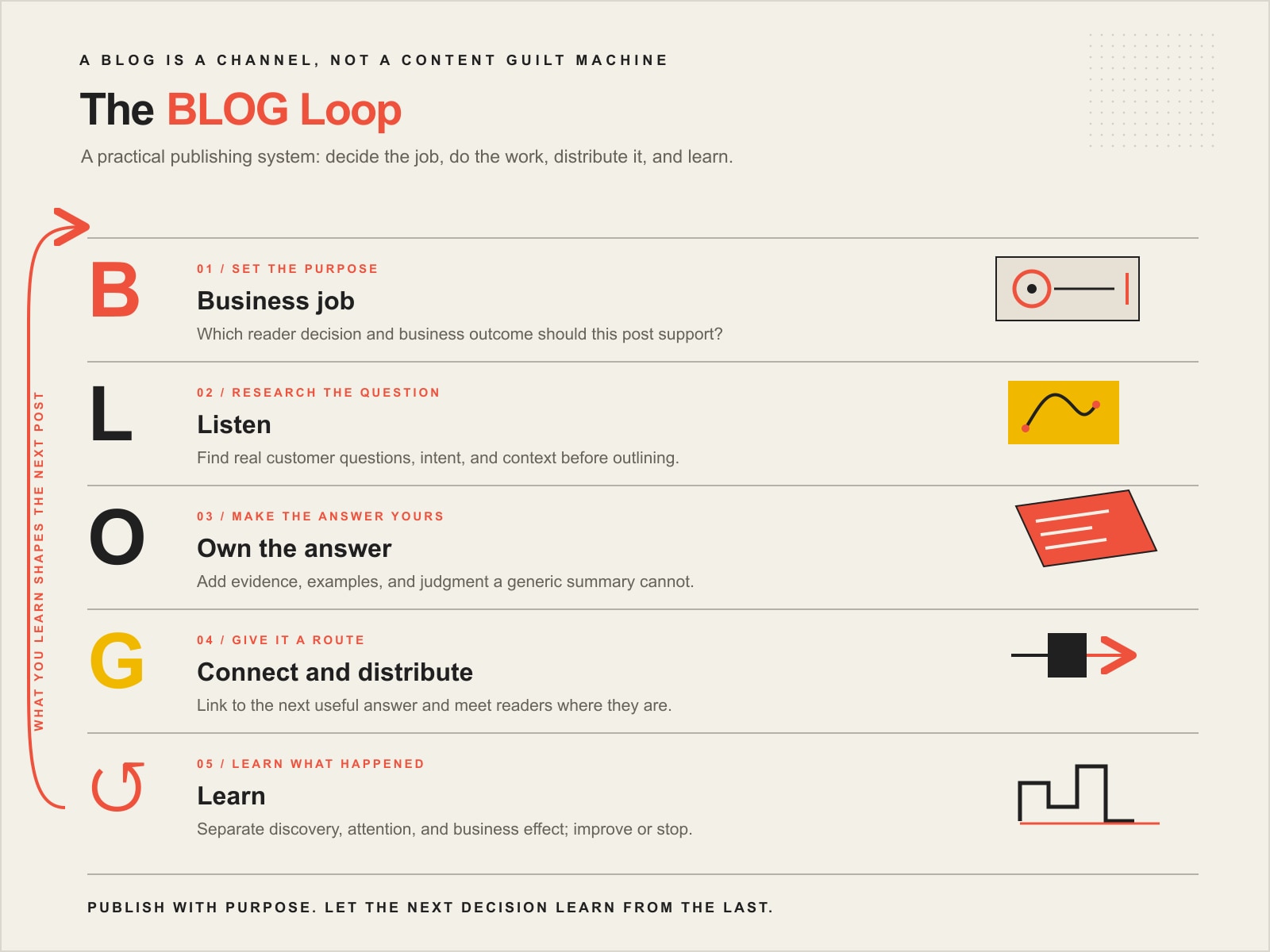
    The best blogging tips for a small business are not really about blogging tricks. They are about giving every post a clear business job, answering a real customer question better than the alternatives, adding evidence only your business can provide, giving the answer a route to readers, and learning from what happens next.

    That is the difference between maintaining a blog and building a useful content asset. A post can be beautifully written and still do absolutely nothing if it targets the wrong question, has no distribution, connects to no next step, or teaches you nothing after it goes live.

    TL;DR: the blogging tips that matter most

    • Give every post one specific reader decision and one business job.
    • Research the question before you write the answer.
    • Lead with a useful answer instead of a ceremonial introduction.
    • Add first-hand evidence, examples, judgment, or analysis that a generic AI summary cannot supply.
    • Use AI to accelerate research and production, not to own accuracy or strategy.
    • Connect the post to related pages, a sensible next action, and an actual distribution plan.
    • Measure discovery, attention, and business effect separately, then update the content based on evidence.

    If blogging is one part of a larger acquisition problem, put it inside a coherent small business marketing strategy. A blog is a channel and a knowledge asset. It is not the entire marketing department wearing glasses.

    What this blogging page taught us before we rewrote it

    We audited this exact article before revising it. During the 12 complete months from August 20, 2025 through August 19, 2026, GA4 recorded zero Organic Search landing-page sessions for this URL. Search Console returned no page or query rows for the same URL, and Ubersuggest estimated zero ranking page keywords, zero backlinks, and zero referring domains. At the same time, the page itself returned HTTP 200, used a self-referencing canonical, and was set to index/follow.

    That does not prove blogging does not work. The sample is tiny, Search Console currently reports the URL as unknown to Google, and our analytics setup has known attribution and key-event limitations. It does prove something more modest and useful: publishing is not a distribution plan, and traffic is not a business outcome. The old version had plenty of tactics. What it lacked was a system.

    The BLOG Loop behind these blogging tips

    We use the BLOG Loop to organize the work: Business job, Listen, Own, Give it a route, Learn. The point is not the acronym. The point is the sequence. Each stage prevents a different kind of waste.

    StageQuestionUseful output
    Business jobWhat reader decision and business outcome should this post support?A narrow page job and next action
    ListenWhat are customers and searchers actually asking?Question map, intent, SERP and PAA evidence
    OwnWhat can we add that is more useful than a generic summary?Direct answer, evidence, examples and judgment
    Give it a routeHow will people find the answer and where should they go next?Internal links, distribution, repurposing and CTA
    LearnWhat did the page teach us after it went live?Measurement, refresh, consolidation or stop decision
    The five-stage BLOG Loop for business publishing: choose a Business job, Listen to real questions, Own a useful answer, Give it a route through links and distribution, and Learn from outcomes.

    B — Business job: decide why the post should exist

    1. Give every post one business job

    Before choosing a title, decide what the post is supposed to help the business do. It might attract a problem-aware buyer, answer an objection before a sales call, explain a service, reduce repetitive support questions, earn links to an original resource, or help an existing customer make a better decision.

    “Get traffic” is too vague. Traffic from whom, for what question, leading toward what useful action? A page that brings 5,000 students researching a class project may be less valuable to a local service business than a page that brings 50 buyers comparing real options.

    Write the job in one sentence: This post helps [specific reader] decide [specific thing] so they can [useful outcome]. If that sentence is mush, the article usually becomes mush too.

    2. Define one specific reader decision

    Audience labels are not enough. “Small business owners” describes millions of people. A decision gives the article a shape.

    Compare “blogging ideas for small businesses” with “I run a local service company, have ten old posts, and can only invest four hours a month. Should I publish something new, update an existing page, or stop blogging until the offer is clearer?” The second version has constraints, alternatives, and a real consequence.

    If your problem is figuring out what deserves its own article, our guide to business blog topics that attract buyers owns that narrower question. If the topic is good but sounds like everybody else, the next problem is how to differentiate the article.

    3. Choose the next action before you write

    The next action should match the reader’s stage. Someone learning a concept may need another article, a calculator, a checklist, or an example. Someone comparing vendors may need pricing context, proof, scope, or a way to start a conversation.

    Do not bolt a giant “BUY NOW” button onto an informational article and call that conversion strategy. The content should earn the next step. If there is no useful next step, that is a strategy problem worth noticing before you spend six hours polishing the draft.

    L — Listen: research the question before writing the answer

    4. Start with questions customers actually ask

    Your best blog ideas are often hiding in sales calls, estimate requests, onboarding meetings, support tickets, proposals, customer emails, search queries, and the questions staff answer for the fifth time this week.

    Start there because those questions already carry context. You know who asked, why it mattered, what they misunderstood, and what happened after they got the answer. Search-volume tools can expand the opportunity, but they should not erase the business reality that made the question valuable in the first place.

    5. Choose keywords by intent and buyer fit, not volume alone

    For this revision, “blogging tips” had the strongest broad search demand in our research. “Small business blogging tips” was dramatically smaller. We still wrote for small businesses because audience fit matters more than winning the largest possible crowd.

    Use keyword volume as evidence of demand, not as a command. A keyword deserves the page when its intent matches the reader, the business has something credible to add, and the resulting page supports a useful customer journey. Chasing a high-volume phrase with the wrong audience is how you end up proudly reporting traffic that nobody in sales has ever heard of.

    6. Check Google, Bing, PAA, and AI answers before outlining

    Search results are a live description of what the query currently means. For “blogging tips,” Google showed general advice lists, an AI Overview, People Also Ask questions, video, and related searches. Bing leaned more heavily toward blogging platforms, definitions, starting a blog, and monetization. Same words, different emphasis.

    Look for the repeated questions, expected formats, dominant assumptions, and missing nuance. Then build something better. Do not trace the top three articles and swap synonyms. That produces a perfectly optimized photocopy.

    Google’s current guidance for its AI search experiences still comes back to unique, useful content for people plus a technically accessible page. There is no secret “AI citation” font size.

    O — Own: make the answer worth finding

    7. Lead with the answer

    Readers should not have to survive 400 words of throat-clearing before learning what you think. Put the answer near the top, then earn the deeper explanation.

    This helps humans scan, gives search systems a clear statement to understand, and makes the page more useful when someone lands on it with a specific question. Answer-first does not mean shallow. It means the reader gets orientation before nuance.

    8. Add evidence, examples, and judgment only your business can provide

    Generic information is cheap. Your advantage is what happened when you did the work.

    • Show the decision you made and why.
    • Explain a tradeoff that a beginner guide skips.
    • Use anonymized client patterns when confidentiality matters.
    • Publish a useful checklist, framework, calculation, screenshot, comparison, or failure analysis.
    • State what you would not recommend and under what conditions your advice changes.

    Google’s people-first content guidance asks whether a page offers original information, analysis, first-hand expertise, and substantial value beyond obvious summaries. That is a better editorial test than asking whether you used the keyword seven times.

    This is also where content marketing becomes an asset instead of a publishing treadmill: useful knowledge accumulates, connects, and becomes reusable across sales, search, email, social, and customer support.

    9. Use AI as an assistant, not the accountable author

    AI is useful for outlining, organizing research, finding gaps, generating questions, transforming formats, and helping a writer get from a blank page to something editable. It is terrible at being accountable for whether a statistic is real, whether the recommendation fits your customer, whether confidential information belongs in the prompt, or whether the final copy sounds like you.

    Google says generative AI can be useful for research and structure, while scaled generation that adds little value can run into its spam policies on scaled content abuse. Our rule is simpler: AI can accelerate the work; a human still owns strategy, evidence, accuracy, positioning, risk, and approval.

    If you want the deeper workflow, see our guide to using ChatGPT for marketing as an assistant rather than the department.

    10. Make the page easy to scan, crawl, and quote

    Good structure is not a gimmick. Use descriptive headings, short paragraphs where the idea allows it, useful lists, tables for real comparisons, and images that explain something the prose handles badly. Keep links crawlable and anchors descriptive. Google specifically recommends ordinary <a href> links and meaningful anchor text in its link best practices.

    Do not pad a post because somebody told you Google wants 2,000 words. Google explicitly says it has no preferred word count. Write enough to complete the reader’s job, then stop. If the page is technically discoverable but still struggles, our page-one readiness framework separates demand, eligibility, intent, evidence, experience, authority, and outcome so you can diagnose the right problem.

    G — Give it a route: links, distribution, and the next useful step

    11. Link to the next useful answer

    Internal links should behave like helpful directions, not SEO confetti. If a sentence naturally raises a question that another page answers better, link it. If the destination does not help the reader, leave it alone.

    A healthy content cluster has distinct page owners connected by contextual links. The broad page explains the big decision. Supporting pages answer narrower questions. Links clarify the relationship. That helps humans navigate and gives search systems a coherent set of crawlable relationships without turning the site into a keyword filing cabinet.

    12. Distribute where the audience already pays attention

    “We published it” describes where the file lives. It does not describe how a reader will find it.

    Choose distribution based on the audience and the post’s job. That may mean an email to existing customers, a salesperson using the article after a call, a useful answer in a relevant community, a social post built around one idea, paid promotion for a commercially important asset, a partner newsletter, or search discovery that compounds over time.

    The same rule applies to organic traffic: publication is not distribution, and more of the wrong visitor is just more server logs.

    13. Repurpose the idea for the channel instead of copy-pasting the post

    A useful article can become an email, a short video, a sales handout, a FAQ answer, a presentation slide, a social thread, a checklist, or a client conversation. But repurposing is not “paste the first paragraph into six apps.”

    Keep the core evidence and idea. Change the opening, length, format, context, and call to action for the channel. The reader on LinkedIn did not volunteer to read a 2,800-word blog post with the line breaks removed.

    Loop — Learn: measure what happened and decide what deserves another round

    14. Measure discovery, attention, and business effect separately

    Do not compress every signal into “traffic.” A practical blogging scorecard has at least three layers:

    LayerWhat it asksExamples
    DiscoveryCan the right people find the page?Indexing, impressions, rankings, referral exposure, email reach
    AttentionDid they actually use it?Engaged sessions, scroll/read behavior, return visits, replies, saves, sales-team use
    Business effectDid it help a useful customer action?Qualified inquiries, assisted journeys, purchases, booked calls, reduced support friction, better close conversations

    A page can be valuable before it ranks if the sales team uses it constantly. A page can rank and still be useless if it attracts the wrong intent. Measurement should tell you what kind of problem you have, not merely provide a prettier chart for the monthly meeting.

    15. Refresh, consolidate, or stop based on evidence and capacity

    Consistency matters only if the business can consistently produce something worth publishing. One strong article a month can be a better system than four rushed articles that repeat what already exists and never get distributed.

    Review older posts by job, accuracy, traffic, impressions, links, sales usefulness, overlap, and maintenance cost. Update an owner that still deserves to exist. Consolidate pages competing for the same intent. Preserve URLs with useful history. Remove content only when it has no meaningful role or equity. Calendar guilt is not a content strategy.

    A practical 30-day blogging reset

    If your blog has become a drawer full of old posts, do not begin by promising yourself three articles a week. Run one BLOG Loop.

    1. Week 1 — Business job and listening: collect ten real customer questions, review existing pages, and choose one decision worth owning.
    2. Week 2 — Own the answer: research search intent, current results, PAA and AI answer patterns; gather first-party examples and authoritative sources; draft the best answer you can actually defend.
    3. Week 3 — Give it a route: add the right internal links, a sensible CTA, an explanatory visual, and a distribution plan for the audiences that already know or need you.
    4. Week 4 — Learn: verify indexing and links, establish the baseline metrics, note sales or customer use, and decide when you will review the page again.

    Then repeat with the next question. That is slower than filling a calendar with titles. It is also much closer to how useful small-business content marketing compounds into a real knowledge asset.

    Frequently asked questions about business blogging

    Is blogging still worth it for small businesses?

    It can be, when customers need education, comparison, evidence, or answers before they buy. Blogging is a poor fit when the business has no useful questions to answer, no one will maintain or distribute the content, or a more immediate bottleneck such as a weak offer or broken conversion path deserves attention first.

    How often should a small business publish blog posts?

    Use the highest cadence you can sustain without sacrificing usefulness, evidence, distribution, or maintenance. For some businesses that is weekly. For others it is monthly or even less often. There is no prize for feeding the CMS more frequently than your audience needs.

    How long should a blog post be for SEO?

    Long enough to complete the reader’s job and no longer. Google explicitly says it does not have a preferred word count. A 900-word answer can beat a 3,000-word article when it matches the intent better; a complex comparison may genuinely need much more space. Depth should come from the problem, not a target number in a plugin.

    Can ChatGPT write business blog posts?

    It can help research, outline, draft, reorganize, critique, and repurpose content. A human should still own the source material, customer context, factual verification, examples, privacy boundaries, positioning, tone, and final approval. If the only thing your article adds is that an AI can summarize the same search results faster, you have not built much of an asset.

    What are the most common blogging mistakes?

    Common mistakes include choosing topics with no business job, writing before researching the question, targeting volume instead of intent, inventing or recycling statistics, burying the answer, publishing generic AI summaries, skipping internal links, having no distribution plan, forcing an irrelevant CTA, and never reviewing the page after publication.

    What is the 80/20 rule for blogging?

    There are several “80/20” blogging heuristics on the web, usually suggesting that a minority of effort or content drives most results, or that more time should be spent promoting than writing. Treat those as planning prompts, not laws or ranking factors. Your actual ratio should come from your audience, distribution channels, content quality, and business constraints.

    Should old blog posts be deleted?

    Not automatically. Review the page’s accuracy, intent, rankings, impressions, links, customer value, overlap, and maintenance cost. Update useful owners, consolidate competing pages, preserve valuable URLs, and remove only when the page has no meaningful purpose or equity. Our business blog topic guide goes deeper on deciding what deserves to exist.

    Build a blogging system, not a content guilt machine

    The useful version of blogging is not “publish because the calendar says Tuesday.” It is a repeatable way to turn real customer questions into owned answers, connect those answers into a coherent body of expertise, distribute them deliberately, and learn which ones create value.

    Start with one post and run the BLOG Loop all the way through. If the bottleneck is bigger than the article itself, Scope Design can help diagnose the broader marketing and content system so you know whether the next dollar belongs in content, search, distribution, conversion, or somewhere else entirely.

  • AI-Powered Re-Engagement Email: Turn Dormant Subscribers Into Revenue

    AI-Powered Re-Engagement Email: Turn Dormant Subscribers Into Revenue

    A re-engagement email is a targeted message or short sequence for people who previously had a legitimate relationship with your email program but have stopped taking the actions you reasonably expect. The useful goal is not to force an open. It is to get one meaningful signal that tells you whether to restore the relationship, change the message, or stop sending.

    AI can make that process faster, but only when it works inside clear rules. Use it to segment, prioritize, generate controlled variations, and analyze results. Do not let it invent why somebody disappeared, manufacture consent, or keep hammering a cold list because the automation has nowhere else to go.

    TL;DR:

    • Define “inactive” from your real buying cycle and meaningful behavior, not a universal 30-, 60-, or 90-day rule.
    • Do not rely on opens alone. Clicks, replies, purchases, logins, preference changes, and other first-party actions are usually more useful signals.
    • Run a bounded re-engagement sequence with a job for each email: restore value, diagnose the mismatch, then ask for a clear stay-or-go decision.
    • Use AI for classification, prioritization, variants, and analysis. Keep permission, legal rules, suppression, and acceptable risk human-owned.
    • Measure reactivation and business outcomes. If nobody responds, suppression can be a successful result because you learned who no longer belongs in the active send pool.

    What Is a Re-Engagement Email?

    A re-engagement email is sent to a subscriber, lead, or customer whose expected interaction has gone quiet. Depending on the business, that may mean they stopped clicking useful content, replying to sales follow-ups, logging in, booking, renewing, buying, or visiting a resource they once used.

    That is different from a normal newsletter, which speaks to the active audience, and it is narrower than a full email customer retention strategy, which can include onboarding, adoption, service recovery, renewal, and customer win-back. This article owns one specific job: deciding what to do with people who have gone quiet and using AI without turning that decision into automated guesswork.

    The “previous relationship” part matters. HubSpot’s current re-engagement guidance is explicit that a re-engagement campaign should confirm or restore a relationship with contacts who previously gave verifiable permission, not create permission where it never existed. If the address came from a purchased list, scraped directory, mystery spreadsheet, or some other source you cannot defend, “AI-powered re-engagement” is just a shinier label for a bad idea.

    Define Inactive Before You Automate Anything

    The biggest mistake is treating inactivity as a timer. A coffee subscription, seasonal landscaping service, annual insurance renewal, B2B equipment purchase, and one-time website project do not share the same healthy purchase cycle. “No purchase in 60 days” could mean churn in one business and completely normal behavior in another.

    Start with the behavior that would reasonably indicate the relationship is still alive. Then define how long that behavior can disappear before the contact deserves a different message.

    Signal typeExamplesHow much should it influence inactivity?
    Strong positive signalPurchase, qualified reply, booking, login, preference update, meaningful link clickHigh. These usually show real intent or continued use.
    Weak or noisy signalEmail open by itself, passive page view, old demographic fieldLow. Use supporting context before making a decision.
    Negative signalHard bounce, spam complaint, unsubscribe, explicit “stop” requestVery high. These can require immediate suppression or other handling.
    Business-cycle contextSeasonality, renewal date, product life, completed project, expected reorder intervalHigh. This keeps a normal customer from being mislabeled as dormant.

    Open data deserves special skepticism. Apple Mail Privacy Protection prevents senders from seeing whether protected users opened a message. That does not make every open-rate trend useless, but it does make “has not opened in 60 days” a weak definition of a dead relationship. Mailchimp makes a similar practical distinction between inactive contacts and stale addresses and warns that people who look inactive in email may still be interacting with a brand elsewhere.

    The Scope Design REACT Framework for Email Re-Engagement

    Scope Design’s REACT framework treats re-engagement as a decision loop instead of a canned autoresponder. It keeps the useful parts of automation while making the exit condition explicit.

    The REACT email re-engagement loop: read the relationship, establish permission and risk boundaries, assign one next action, calibrate with AI, and track outcomes with a clear stop rule.

    R – Read the relationship

    Do not start with copy. Start with what this person used to do and what changed. Separate at least four states when your data allows it: people who subscribed but never really activated, formerly engaged subscribers, past customers whose normal buying cycle has lapsed, and high-value relationships that may deserve a human check-in instead of another automated email.

    This is where first-party data matters. A click on a pricing page, a completed purchase, a support interaction, a product category, or a previous service can give the next message a legitimate reason to exist. “AI says this person has an 83% chance of returning” means nothing if the model is scoring bad inputs and nobody can explain what success looks like.

    E – Establish permission and risk

    Before you send a win-back message, remove the people who should not receive it. Hard bounces, unsubscribes, complaints, legal suppressions, and contacts without a defensible permission history do not belong in a “maybe AI can save them” segment.

    If you send significant volume to Gmail, review Google’s current email sender guidelines. Google recommends keeping user-reported spam below 0.1% and preventing it from reaching 0.3% or higher for bulk-sender traffic, and covered marketing messages need one-click unsubscribe. In the U.S., the FTC’s CAN-SPAM guidance requires commercial-email opt-out requests to be honored within 10 business days. Platform rules can be stricter than the legal floor, so “technically allowed” is not the same thing as “smart to send.”

    A – Assign one useful next action

    Each email needs one job. Ask the subscriber to read one useful update, choose a preference, reply with what changed, return to a product, book a conversation, or confirm that they still want the emails. Five buttons, three offers, a survey, a coupon, and a social follow all crammed into one message is not generosity. It is decision fog.

    The lowest-friction action is often best first. A click to a genuinely useful resource may be enough to prove the relationship is alive. A preference update can tell you that the problem was frequency or topic, not the subscriber. A reply can reveal context no predictive score would have guessed.

    C – Calibrate with AI

    Now AI earns its keep. It can rank contacts by observable behavior, cluster likely reasons for inactivity, generate subject-line and body variants from approved facts, recommend which content or product category to show, and summarize experiment results. Those are useful jobs because they reduce repetitive analysis without changing the rules of the relationship.

    Keep the automation governed. Scope Design’s broader AI automation framework uses the same principle: an automation that touches customer data or public communication needs ownership, monitoring, override, and a safe way to stop. Do not let an LLM invent a customer problem, imply it knows why somebody left, create fake scarcity, or override a suppression rule because the predicted conversion score looks tempting.

    T – Track the outcome and terminate when appropriate

    Define “reactivated” before you launch. It might mean a qualified reply, a preference confirmation, a product return, a booking, a purchase, or a meaningful click followed by renewed behavior. An open alone is rarely strong enough to carry the decision.

    Then define the exit. If a bounded re-engagement effort produces no meaningful signal, suppressing that contact can be the right outcome. You are not “losing the list.” You are reducing the active pool to people who still have a reason to hear from you.

    A Three-Email Re-Engagement Sequence That Earns Each Send

    You do not need a universal six-email marathon. For many businesses, three messages are enough to learn what you need without turning a cold segment into an inbox endurance test. Timing should follow your normal send cadence and buying cycle, not somebody else’s template.

    Email 1: Restore value

    Remind the subscriber why the relationship existed without shaming them for going quiet. Lead with something useful that has changed: a new guide, solved problem, improved service, product update, relevant resource, or timely reason to return.

    Possible subject: “Still useful? Here’s what changed.”
    Primary action: View the update, resource, product, or service that matches prior interest.

    Email 2: Diagnose the mismatch

    If the first message produces no meaningful action, ask for a preference rather than shouting louder. Frequency, topic, timing, role changes, finished projects, budget, or a different need may explain the silence. Give the person a simple way to tell you.

    Possible subject: “Want fewer emails instead?”
    Primary action: Update frequency/topics or answer one short question.

    Email 3: Ask for the decision

    The final message should make staying and leaving equally clear. Do not hide the unsubscribe link in six-point gray type and call that retention. Tell the subscriber what they will continue receiving, give them one obvious way to stay, and make the exit easy.

    Possible subject: “Still want these emails?”
    Primary action: Confirm continued interest, change preferences, or unsubscribe.

    If someone re-engages, route them back into the appropriate active journey. If the relationship is actually a customer-retention problem, move them into the right customer win-back path. If they stay silent, honor the exit rule you decided before the campaign started.

    Re-Engagement Email Examples by Job

    The best re-engagement email example is not the cleverest “we miss you” joke. It is the message that matches why the contact might reasonably come back.

    Message jobExample subject lineUseful next actionBest fit
    Restore valueStill useful? Here’s what changed.Read one relevant updateSubscribers who once clicked or consumed content
    Reset preferencesWant fewer emails instead?Choose topics or frequencyNewsletter subscribers with declining engagement
    Replenishment or returnReady for your next [product/service]?Reorder, book, or review optionsBusinesses with a defensible repeat cycle
    Resolved problemWe fixed the thing that used to be annoying.See the changeFormer users affected by a known product/service issue
    Human check-inHas your need changed?ReplyHigh-value B2B leads or past clients
    Final choiceStill want these emails?Confirm, change preferences, or unsubscribeContacts who ignored the bounded sequence

    Discounts are optional. They make sense when price is a legitimate barrier and margin can support the offer. They are a lousy default when the real problem is irrelevant content, a completed buying cycle, poor service, or no current need. Train every dormant contact to expect a coupon and you may reactivate bargain hunting rather than a healthy relationship.

    What AI Should Automate – and What It Should Not

    AI is most useful when it compresses analysis and production work while leaving policy decisions explicit.

    Good AI jobWhy it helpsHuman-owned boundary
    Score or cluster contacts from approved first-party behaviorFinds patterns across more records than a human will review manuallyDefine which data is allowed and what the score may trigger
    Generate controlled subject/body variantsSpeeds testing and reduces repetitive draftingApprove facts, tone, offers, claims, and prohibited language
    Recommend content or product categories from known historyMakes the message more relevantDo not infer sensitive facts or pretend to know why the person disappeared
    Analyze replies and experiment resultsSurfaces recurring objections and useful segmentsReview edge cases and anything that changes customer status
    Suggest send timing from observed behaviorReduces manual scheduling workRespect frequency caps, quiet periods, suppression, and campaign limits

    If you already use a welcome email series, the same principle applies at the other end of the lifecycle: automation should deliver a clear promise and respond to behavior. The difference is that re-engagement also needs a clean stop condition.

    Protect Deliverability While You Wake Up a Cold Segment

    A dormant list is not free inventory. It is a deliverability risk if you wake everybody at once, especially when some addresses are stale, permission is unclear, or recipients barely remember the brand.

    • Start with permission and list quality. Exclude hard bounces, complaints, unsubscribes, and contacts you cannot legitimately defend.
    • Segment before sending. Formerly engaged subscribers deserve a different treatment from stale addresses that have not heard from you in years.
    • Use meaningful engagement signals. Apple privacy protections make open-only logic weak; clicks, replies, purchases, logins, and preference updates are stronger evidence.
    • Make leaving easy. A hidden unsubscribe does not save the relationship. It increases the chance that a frustrated recipient uses the spam button instead.
    • Watch complaints and bounces during the test. Stop or narrow the campaign when the risk signal is rising. “The workflow was scheduled” is not a defense.

    This is also why an email unsubscribe rate is not automatically a failure metric. A re-engagement campaign that helps uninterested people leave cleanly can improve the quality of the active audience. Mailchimp’s guidance similarly recommends re-engaging inactive contacts and then archiving or unsubscribing the people who remain inactive.

    Measure Re-Engagement Like a Business Outcome

    Do not end the report at open rate. Measure the chain from eligible inactive contact to meaningful action and, when the business has the data, to revenue or retained value.

    • Eligible inactive contacts: the people who passed your permission, data-quality, and lifecycle rules.
    • Delivered messages: the actual denominator after bounces and send exclusions.
    • Meaningful response rate: clicks, replies, preference changes, logins, bookings, purchases, or another pre-defined reactivation signal.
    • Reactivated contacts: people who resume the behavior that matters after the campaign.
    • Incremental revenue or gross margin: revenue attributable to reactivated contacts when your tracking supports that conclusion.
    • List-health outcome: unsubscribes, suppressions, complaints, and bounces that reduce future waste or risk.

    When your list is large enough, keep a small holdout group so you can compare what happened without the re-engagement sequence. That is much stronger evidence than claiming every purchase after an email was “recovered revenue.” If you use customer lifetime value in the business case, use a defensible model rather than multiplying one reactivated purchase by a fantasy retention number.

    Mailchimp says its most successful re-engagement emails typically reactivate about 10% of inactive subscribers. Treat that as a platform benchmark, not a promise. Your definition of inactive, audience source, buying cycle, brand recognition, offer, deliverability, and measurement window can move the result dramatically.

    Re-Engagement Campaign Implementation Checklist

    1. Define the business behavior that means a relationship is active.
    2. Choose an inactivity threshold that matches the real buying or engagement cycle.
    3. Exclude bounces, complaints, unsubscribes, unsupported permission, and other suppression states.
    4. Separate never-activated contacts from formerly engaged subscribers and lapsed customers.
    5. Choose one meaningful reactivation action for each segment.
    6. Build a bounded sequence, usually two or three messages before the decision point.
    7. Give AI only approved data and explicit instructions about what it may personalize.
    8. Review every generated claim, offer, subject line, and inferred reason before launch.
    9. Verify authentication, unsubscribe handling, frequency caps, and deliverability monitoring.
    10. Track meaningful reactivation, revenue where defensible, and list-health outcomes.
    11. Suppress or reroute nonresponders according to the rule you set before the campaign started.
    12. Save what you learned so the next re-engagement campaign starts smarter instead of from another template.

    Frequently Asked Questions About Re-Engagement Email Campaigns

    How long should a subscriber be inactive before a re-engagement email?

    There is no universal number. Match the threshold to normal send frequency, buying cycle, seasonality, renewal timing, and meaningful customer behavior. A weekly newsletter may need a different threshold from an annual service or seasonal product.

    How many re-engagement emails should I send?

    Use the smallest sequence that can answer the decision. Two or three messages are often enough for value reminder, preference/diagnosis, and final confirmation. High-value B2B relationships may deserve a human follow-up instead of more automation.

    What is a good re-engagement rate?

    A universal “good” rate is misleading because the denominator and definition of reactivated vary. Mailchimp says its most successful re-engagement emails typically re-engage about 10% of inactive subscribers. Use your own baseline and a consistent definition of meaningful reactivation, then compare segments and, when possible, a holdout group.

    Should a re-engagement email include a discount?

    Only when price is a plausible barrier and the economics make sense. A relevant update, resolved problem, preference choice, useful resource, replenishment reminder, or direct human check-in may be stronger. Discounting every dormant contact can train people to wait for a coupon.

    Can AI write re-engagement email subject lines?

    Yes. AI is useful for generating variants from a clearly defined message job and approved facts. It should not invent urgency, claim to know why a subscriber disappeared, or personalize from data you would not be comfortable explaining to the recipient.

    When should I remove or suppress inactive subscribers?

    Immediately honor bounces, complaints, opt-outs, and other mandatory suppression states. For valid but inactive subscribers, run a bounded re-engagement or preference-confirmation effort when the relationship still has a legitimate reason to continue. If there is still no meaningful signal, suppression is often the cleanest decision.

    Does CAN-SPAM require an unsubscribe option in re-engagement emails?

    In the United States, commercial email is subject to CAN-SPAM requirements, including a clear opt-out mechanism and honoring opt-out requests within 10 business days. Platform sender rules may be stricter. This article is general marketing guidance, not individualized legal advice.

    Turn a Dormant List Into a Decision, Not a Guess

    A dormant email list is not automatically hidden revenue. It is unresolved information. Some people still want what you send. Some need a different message. Some finished the relationship successfully. Some forgot who you are. Some should never receive another marketing email.

    The job of a good re-engagement system is to tell those states apart with as little friction and risk as possible. AI can help you do that at scale, but the value comes from the rules, evidence, and decisions around the model.

    If your list is large enough to matter but messy enough that nobody trusts the segments, triggers, attribution, or suppression rules, talk to Scope Design. We can help audit the email and automation system, decide what should be automated, and build a workflow that knows when to send, when to change course, and when to stop.