Tag: AI Content

  • Content Marketing Strategy: A Comprehensive Guide to Modern Digital Success

    Content Marketing Strategy: A Comprehensive Guide to Modern Digital Success

    A content marketing strategy is the system a business uses to turn audience questions into useful, evidence-backed content, distribute that content where it can help, guide readers toward an appropriate next step, and learn from what happens afterward. The point is not to publish more. The point is to make each useful asset do a clear job.

    That definition is deliberately practical. The Content Marketing Institute describes content marketing as a strategic approach built around valuable, relevant, consistent content for a defined audience and profitable customer action. The important word is strategic. A blog, video, newsletter, podcast, guide, or social post is only a format. Strategy decides why the content exists, what evidence it needs, where it should travel, what the reader should be able to do next, and how the team will judge whether it helped.

    This guide gives that system a concrete shape. It also draws a line between strategy and the narrower jobs already covered elsewhere in the Scope Design library. If you need the broader marketing context around content, channels, attention, and owned assets, start with our small business marketing strategy guide. This article stays focused on the content system itself.

    What Is a Content Marketing Strategy?

    A content marketing strategy is a set of decisions about who you are helping, which problems or decisions deserve content, what evidence makes your answer worth trusting, which formats and channels fit the job, what next step makes sense, and how the content will be measured and maintained.

    A calendar is useful, but it is not the strategy. A keyword list is useful, but it is not the strategy. A pile of AI-generated drafts is not the strategy either. Those are inputs or production tools. The strategy is the logic that connects a real audience need to a useful business outcome.

    • Audience: Who is making a decision, solving a problem, or trying to make progress?
    • Question: What do they need to understand before they can move forward?
    • Evidence: What can your business contribute that is specific, credible, and difficult to replace with a generic summary?
    • Asset: What is the best durable home for that answer?
    • Distribution: Which channels can put that answer in front of the right people?
    • Handoff: What is the most useful next action for a reader at this stage?
    • Learning: What signal will tell you whether to improve, repurpose, scale, or retire the asset?

    The Question-to-Outcome Content System

    At Scope Design, we find it more useful to think of content marketing as a question-to-outcome system than as a publishing treadmill. The system has six connected stages:

    1. Question or friction: Start with something a real customer, prospect, salesperson, support person, or searcher needs to resolve.
    2. Evidence and expertise: Add first-party knowledge, examples, process details, limitations, and trustworthy outside sources where they improve the answer.
    3. Source asset: Build one durable, canonical answer worth linking to, updating, and reusing.
    4. Distribution: Adapt that source to channels with a defined job instead of copying the same post everywhere.
    5. Next step: Give the reader a useful action matched to readiness, from reading a related guide to comparing options or starting a conversation.
    6. Learning and governance: Measure useful signals, then refresh, repurpose, scale, consolidate, or retire the asset.

    A continuous learning loop connects customer questions, research and evidence, a source asset, distribution, a useful reader action, and team learning.
    Scope Design’s Question-to-Outcome Content System: content works as a learning loop, not a one-way publishing schedule.

    The loop matters because content keeps producing information after it is published. Search queries reveal wording. Sales conversations expose objections. Email replies reveal confusion. Analytics show which paths people take. A strategy gives the team a way to feed those observations back into the next useful asset.

    1. Start With Audience Questions, Not a Topic List

    Good topic research starts closer to the customer than a keyword tool. Search demand can help prioritize, but the strongest content opportunities often appear first as repeated friction inside the business.

    Look for questions your team answers repeatedly, comparisons prospects keep making, mistakes new customers make, implementation steps that cause confusion, objections that stall sales, support issues that consume time, and decisions where your team has learned something the hard way. Those are not merely “ideas.” They are evidence that useful content could reduce friction.

    A simple discovery prompt is: Who is this for, what are they trying to decide, what is getting in the way, what do we know that would help, and what should they be able to do after reading?

    Search data still matters. Use it to learn the language people use, the intent around a problem, and the competing answers already available. But do not let keyword volume erase better first-party evidence. If you need a larger idea-generation process after you have defined the audience and business job, our SPARK content ideation system goes deeper on finding useful topics without filling a calendar with random prompts.

    2. Build Evidence Into a Durable Source Asset

    The web already has plenty of summaries. Your advantage is not the ability to restate what everyone else says faster. It is the ability to combine a clear answer with evidence that comes from your work, your customers, your process, or authoritative sources.

    A strong source asset can include:

    • a direct answer near the top;
    • first-party experience, process knowledge, examples, screenshots, diagrams, or decision criteria;
    • credible external documentation for claims that are not yours to make from experience alone;
    • limitations and exceptions that keep advice from becoming absolute;
    • links to narrower resources when a subtopic deserves its own owner;
    • a useful next action that follows naturally from the reader’s problem.

    This is also increasingly important for AI-mediated discovery. Google’s guidance for its AI search experiences continues to emphasize unique, valuable, non-commodity content that people can actually use, along with ordinary technical access so systems can crawl and understand the page. There is no special “AI content” shortcut that replaces a worthwhile source.

    Think of the source asset as the place where your best answer lives. That could be an article, a research page, a case study, a product comparison, a video with a useful transcript, a downloadable tool, or a documented process. The format should follow the job.

    3. Give Every Format and Channel a Job

    Content types are not a leaderboard. A short video is not inherently “better” than a detailed article; an email is not inherently “better” than a webinar. Each format is useful when it fits the decision and the audience.

    Job Useful formats Typical destinations
    Explain Guide, article, demo, video, FAQ Website, search, sales follow-up
    Compare Comparison page, checklist, decision table Website, email, sales
    Prove Case study, example, benchmark, testimonial Website, proposal, nurture sequence
    Enable Template, calculator, worksheet, tutorial Website, email, customer onboarding
    Remind Short post, clip, newsletter note Social, email, community

    If you are choosing formats, our guide to content marketing types shows how to match formats to a business job rather than chasing whatever format happens to be fashionable.

    Apply the same discipline to channels. Your website is usually the durable home for owned answers. Email is strong for permission-based follow-up. Social can distribute ideas and start conversations. Sales teams can use content to answer objections at exactly the right moment. Paid promotion can accelerate proven assets. The right mix depends on audience access, economics, capacity, and the job each channel is expected to do.

    4. Design the Next Step Before You Publish

    A content marketing strategy fails when the content and the offer live in separate worlds. An educational article can be excellent and still create no business value if the reader reaches the end and has no sensible path forward.

    The fix is not to turn every paragraph into a sales pitch. It is to design a next step that matches the reader’s readiness.

    • Early awareness: offer a related guide, example, checklist, or explanation.
    • Active comparison: offer criteria, pricing context, implementation details, or a case study.
    • High intent: offer a consultation, estimate, demo, audit, or other clear commercial action.
    • Existing customer: offer onboarding help, support content, documentation, or the next useful service.

    The closer the next step is to the job of the content, the less it feels like an interruption. Our deeper guide to the content-to-offer handoff covers that transition in detail.

    5. Use AI as an Accelerator, Not the Authority

    Generative AI is useful inside a content operation, especially for research assistance, clustering notes, creating structure, transforming a source asset into alternate formats, checking for gaps, and accelerating repetitive editorial tasks. It is much less useful when the team asks it to manufacture authority the business has not earned.

    Google’s current guidance on generative AI content makes a similar distinction: AI can help with research and structure, while generating large amounts of content without adding user value can run into spam-policy problems. The practical standard is not “human versus AI.” It is whether the finished work is accurate, relevant, useful, original enough to deserve attention, and appropriately reviewed.

    A useful division of labor looks like this:

    • AI can accelerate: transcription, summarization, outline variations, research organization, first-pass transformations, metadata drafts, pattern detection, and quality-control checklists.
    • Humans should own: the audience diagnosis, original point of view, evidence selection, factual verification, tradeoffs, brand judgment, examples, claims, and final editorial responsibility.

    This also improves citation readiness. A model can summarize generic material from thousands of pages. It has more reason to reference your page when the page contains a clear answer, specific evidence, an original framework, a useful visual, and identifiable source material that adds information rather than merely rephrasing consensus.

    6. Distribute and Repurpose From the Source

    Distribution should be designed when the source asset is planned, not added as a frantic checklist after publication. Ask where the relevant audience already receives information and what adaptation would make the source useful in that context.

    A source article about a recurring sales objection might become a sales email, a short comparison chart, a social post built around one misconception, a video explanation, and a customer FAQ. The evidence stays consistent, but each version performs a different job.

    That distinction is why repurposing works best when the source contains substance. You cannot get five strong derivative assets from one thin generic paragraph without adding new value. Our content repurposing guide goes deeper on recasting good evidence without multiplying generic slop.

    Keep the source of truth clear. When facts, screenshots, positioning, product details, or recommendations change, update the canonical source first and then revise derivatives that still matter. This reduces contradictory messaging and makes governance possible.

    7. Measure the Job Content Was Hired to Do

    Traffic is a signal, not a universal score. A content asset built to answer a sales objection may be valuable with very little search traffic if the sales team uses it repeatedly and it improves qualified conversations. A broad educational guide may need a different set of signals.

    Use a measurement ladder:

    • Discovery signals: impressions, qualified visits, search queries, distribution reach.
    • Usefulness signals: engaged reading, video completion, downloads, return visits, replies, saves, shares, or sales-team reuse.
    • Progress signals: related-page visits, email subscriptions, product exploration, consultation starts, demo requests, or other readiness indicators.
    • Business outcomes: qualified leads, booked calls, proposals, purchases, retained customers, reduced support burden, or shortened sales friction.
    • Learning signals: new questions, objections, drop-off points, misunderstood language, and evidence gaps that should shape the next revision.

    Do not pretend attribution is cleaner than it is. Google Analytics’ attribution settings documentation explains that the reporting attribution model determines how conversion credit is calculated in reports. A reader may encounter social content, search for the brand later, read a guide, return through email, and finally convert. “The last page got the sale” is often too simplistic to guide content decisions.

    For low-volume content, define a bounded learning window and a small number of meaningful signals before you publish. Then make one decision: keep, improve, repurpose, consolidate, promote, or retire. Measurement should reduce uncertainty, not create a dashboard nobody acts on.

    8. Govern, Refresh, and Improve the System

    A mature content operation treats publishing as the midpoint, not the finish line. Every asset needs an owner, a reason to exist, and a review condition.

    Your content calendar should therefore contain more than titles and dates. It should help the team answer: Why are we making this? What evidence is required? Who owns it? Where will it live? How will it be distributed? What is the next step? When will we review the result? Our editorial calendar guide covers that operating layer in detail.

    A practical governance review can classify an asset into five actions:

    • Keep: still accurate, useful, differentiated, and doing its job.
    • Refresh: the core answer is valuable but examples, screenshots, facts, links, or recommendations are stale.
    • Repurpose: the evidence is strong and another format or channel can use it.
    • Consolidate: multiple thin pages compete for the same job and would be better as one stronger owner.
    • Retire: the page no longer serves a real audience need or business purpose.

    This is how a content library becomes more valuable over time instead of becoming a museum of old campaigns. Governance protects strong assets, removes contradictions, and creates room for genuinely new information.

    A Leaner Version for Small Teams

    You do not need a full editorial department to use this content marketing strategy. A small team can run the same logic at a smaller scale: choose one meaningful buyer question, create one strong source asset, distribute it through the few channels you can maintain, connect it to one sensible next step, and schedule one review.

    The constraint is usually not a lack of possible ideas. It is capacity. Fewer strong assets with clear jobs are easier to maintain, easier to measure, and easier for sales or customers to reuse than a high-volume calendar of disposable posts.

    For the implementation version of this system, see Content Marketing for Small Business: Build Assets, Not a Publishing Treadmill. That guide owns the lean operating plan and 90-day execution model; this page stays focused on the broader strategy architecture.

    Content Marketing Strategy FAQ

    What is content marketing in simple words?

    Content marketing means helping a defined audience with useful information so they can understand a problem, make a decision, or make progress—and giving the business a responsible way to turn that usefulness into a relationship or commercial outcome.

    How do I start content marketing?

    Start with one recurring customer or buyer question, not a demand to “post more.” Write down the reader, the decision, the evidence you have, the best durable format, the distribution path, the next step, and the signal you will review. Build one complete loop before expanding the calendar.

    What are examples of content marketing?

    Examples include educational articles, comparison guides, videos, case studies, email series, calculators, templates, webinars, research reports, podcasts, FAQs, customer stories, and useful social content. The format becomes content marketing when it serves a defined audience need inside a strategy, rather than existing simply because a brand wanted to publish something.

    What are the main types of content marketing?

    There is no magic number. It is more useful to group content by the job it performs: explaining, comparing, proving, enabling, or reminding. A format can serve more than one job, and the best choice depends on the audience, decision, evidence, channel, and resources.

    What metrics should I use to measure content marketing?

    Use metrics that match the content’s job. Start with discovery and usefulness signals, then look for progress toward the next meaningful action and the eventual business outcome. For a sales-enablement asset, repeated sales-team use and better qualified conversations may matter more than pageviews. For a search-driven educational guide, qualified organic visits and assisted actions may matter more.

    How often should content be updated or repurposed?

    Review content when the underlying facts, product, audience, search landscape, business priority, or performance signal changes—not because a generic calendar says every page expires after a fixed number of months. High-risk or fast-changing topics need tighter review cycles. Durable evergreen guidance can be reviewed less often if it remains accurate and useful.

    Build a Content System Your Team Can Run

    The strongest content marketing strategy is not the one with the most channels, the most posts, or the biggest software stack. It is the one your team can operate repeatedly: real question, credible evidence, durable asset, intentional distribution, useful next step, measurable learning.

    If your content feels disconnected from your website, SEO, offers, analytics, or sales process, the problem may be the system rather than the writing. Talk with Scope Design about the constraint you are trying to fix. We can help map the content job, strengthen the owned platform underneath it, and build a practical execution path around the resources you actually have.


  • How to Stand Out in a Saturated Blogging World: 7 Proven Differentiation Strategies

    How to Stand Out in a Saturated Blogging World: 7 Proven Differentiation Strategies

    How to make your blog stand out in a saturated market: stop trying to win by publishing more versions of the same advice. Build each important article around a specific reader decision, add evidence or experience competitors cannot access, take a useful position, show how you reached it, answer the next questions a serious buyer will have, distribute the asset where that buyer actually pays attention, and measure qualified outcomes instead of raw traffic alone.

    That sounds simple, but it is a different job from “write a good blog post.” In August 2026, our live search review for this topic found that Google could already summarize the standard advice—pick a niche, improve headlines, tell personal stories, use media, and promote the post—before a searcher ever needed to click a result. Repeating those basics more elegantly does not create much of an information advantage.

    Google’s current AI optimization guidance makes the same strategic point in plainer terms: create unique, non-commodity content and add a point of view instead of recycling material that other sites or generative AI can easily reproduce. That does not mean every post needs a groundbreaking study. It means the article needs something true and useful that did not come free with the topic.

    How to Make Your Blog Stand Out: Start With the Non-Commodity Test

    Before you add words, images, keywords, or another publishing day, ask one question:

    Could a generic AI system write this article correctly without access to our business?

    If the answer is yes, the draft probably does not contain enough business-specific evidence or judgment yet. “Access to the business” can mean access to customer questions, sales objections, tests, screenshots, internal data, subject-matter experts, implementation experience, failed attempts, constraints, or a recommendation your team can defend.

    This is a diagnostic, not an anti-AI slogan. A model can help organize material, compare sources, find gaps, or tighten a draft. The differentiating input still has to come from somewhere. If the only inputs are the same public pages everyone else can summarize, the output is easy to substitute.

    A worked example: we ran the test on this exact article

    Before rewriting this page, we audited its actual performance and technical state instead of assuming the old copy deserved to be protected because it already existed. For the 12 months ending August 19, 2026, the page had one Organic Search landing session in GA4 and zero key events. Google Search Console returned no page or query performance rows for the URL and currently reports that the URL is unknown to Google. Bing Webmaster Tools reports zero clicks and zero impressions.

    One organic session is far too small a sample to tell us how real readers behave. We are not going to turn it into a story about engagement, intent, or conversion. It is enough to support a narrower conclusion: the old article did not have a meaningful search or business-performance footprint that forced us to preserve weak copy.

    What we checkedPre-rewrite observationWhat we did with it
    GA4 organic landing traffic1 session; 0 key events in the last 12 monthsDid not infer behavior from a one-session sample. Treated the page as having no demonstrated business outcome to protect.
    Google Search ConsoleNo page/query rows; URL Inspection says the URL is unknown to GoogleRebuilt usefulness and internal ownership rather than preserving keywords that were not producing visibility.
    Bing Webmaster Tools0 clicks; 0 impressionsConfirmed there was no Bing performance footprint to protect.
    Live URLHTTP 200, index/follow, self-canonicalKept the established URL. A weak plugin score is not a reason to create migration and redirect risk.

    That audit became part of the new article. This is the kind of first-party evidence a competing generic post cannot truthfully copy.

    The Scope Design Content Differentiation Stack

    We use seven layers to move a business article from “competent summary” toward “useful source.” You do not need every layer to be dramatic. You need each layer to have a job.

    LayerQuestionWhat makes it harder to copy
    1. Own the decisionExactly who is deciding what?Audience and decision specificity
    2. Bring unique evidenceWhat can we show that a public summary cannot?Data, examples, customer language, tests, expert input
    3. Take a useful positionWhat do we recommend, reject, or qualify?Judgment and tradeoffs
    4. Show the workWhy should the reader trust the conclusion?Method, thresholds, failures, exceptions
    5. Cover the full decisionWhat does the reader need next?Decision completeness instead of filler
    6. Match format + distributionWhat form best proves the point, and where will the buyer encounter it?Evidence-fit presentation and channel strategy
    7. Measure qualified outcomesDid the article improve a useful business behavior?Feedback loops that make the asset better over time

    The order matters. A new chart cannot rescue a vague audience. A strong opinion cannot rescue a claim with no evidence. More distribution cannot rescue an article that gives a qualified reader no reason to trust it.

    1. Own a Narrower Audience Decision

    “Small-business owners interested in marketing” is an audience description. It is not yet an article job.

    A better starting point is a decision: “A local service business has ten older blog posts, limited time, and no meaningful organic conversions. Should it publish four new posts this month, update the strongest existing page, or stop blogging until the offer is clearer?” Now the article has constraints, alternatives, and an outcome.

    This is also why content differentiation belongs inside a broader small business marketing strategy. A blog is not an isolated publishing machine. Its job changes depending on the bottleneck. If the real problem is weak positioning, low demand, bad conversion, or the wrong audience, “publish more” may simply create more inventory around the wrong problem.

    Before outlining a post, write one sentence: This article helps [specific reader] decide [specific choice] under [important constraint]. If that sentence stays vague, the draft will usually stay vague too.

    2. Bring Evidence Competitors Cannot Access

    Originality is easier when you stop treating “research” as a synonym for “find three articles that already rank.” Start with the evidence your business touches every week.

    • Questions prospects ask before they buy.
    • Objections that repeatedly appear in sales calls or email.
    • Before-and-after examples from real work.
    • Tests that failed and what changed afterward.
    • Thresholds an experienced practitioner uses to choose one option over another.
    • Screenshots, process artifacts, checklists, calculations, or diagrams created for the work.
    • Small first-party datasets, clearly labeled with their limitations.
    • Interviews with the people who actually do the work.

    Google’s people-first content guidance explicitly asks creators to evaluate whether a page provides original information, reporting, research, or analysis; whether it adds substantial value beyond other results; whether sourcing is clear; and whether it demonstrates first-hand expertise. Those are useful editorial questions even if you ignore SEO entirely.

    Industry survey data provides some context for why this matters, but it should not be oversold. Orbit Media’s 2025 blogger survey included 808 respondents and reported that 49% published original research. Orbit also says its sample is heavily drawn from its author’s network and skews toward LinkedIn, B2B, and US marketers. That makes it useful directional evidence, not proof that original research causes better results for every business.

    The stronger reason to create original evidence is simpler: it gives the reader—and other writers, journalists, researchers, search systems, and AI tools—something concrete to attribute to you.

    3. Take a Useful Position and Name the Tradeoffs

    A post can contain accurate facts and still feel interchangeable because it never makes a decision. It says “it depends,” lists six options, and disappears before the reader has to choose.

    Expert content earns its keep by explaining what the choice depends on. A useful position has four parts:

    • Recommendation: what you would do in the described situation.
    • Reason: the evidence or constraint that makes that recommendation sensible.
    • Tradeoff: what the reader gives up by choosing it.
    • Exception: what would change your recommendation.

    For example, “publish consistently” is generic. “If you have ten weak pages and no proof that your offer converts, pause net-new blog production for a month, repair the pages closest to a buyer decision, and restart only when you can name the evidence each new post will contribute” is a position. Another expert may disagree, which is fine. The reader can inspect the reasoning.

    Do not manufacture controversy for attention. A contrarian headline without evidence is just another commodity format. The goal is not to sound different. The goal is to make your judgment legible.

    4. Show the Work, Not Just the Conclusion

    “We tested it” is a claim. Showing what you tested is evidence.

    When the method matters, include enough detail for a careful reader to understand how you arrived at the result. That may mean the date range, sample size, query, device, platform, measurement rule, decision threshold, screenshots, before/after state, or the assumptions you excluded.

    Notice how the pre-rewrite audit above is written. We did not say, “The old article failed because it only got one session.” We said one session is too small for behavior inference. Then we used the performance systems for the narrower conclusion they can support: there is no demonstrated search or conversion footprint forcing us to preserve the old copy unchanged.

    That restraint is part of differentiation. Anyone can turn a tiny number into a dramatic story. Showing what the evidence cannot prove tells the reader where your confidence ends.

    5. Cover the Complete Decision, Not a Word-Count Target

    There is no magic length that makes a blog post authoritative. A 900-word answer can be complete. A 4,000-word article can be mostly throat-clearing.

    Use depth when the decision requires depth. After the first useful answer, ask what a qualified reader will need next:

    • What conditions make this advice apply?
    • What should the reader do first?
    • What evidence should they collect?
    • What alternatives should they compare?
    • What can go wrong?
    • What would change the recommendation?
    • How should they measure whether it worked?

    That is different from padding a draft until a plugin turns green. If you want the broader mechanics of headlines, readability, calls to action, visuals, and other blogging fundamentals, we cover those separately. This article’s job is narrower: give those fundamentals something worth presenting.

    Google’s people-first guidance asks whether a reader leaves feeling they learned enough to achieve their goal. That is a better editorial stopping rule than “our competitor wrote 2,300 words.”

    6. Match the Format and Distribution to the Evidence

    Differentiation does not have to live in prose. Sometimes the strongest proof is a diagram, a calculator, a decision table, a screenshot, a teardown, a short video, a downloadable template, or a side-by-side comparison.

    Choose the format after you know what you are trying to prove. A long narrative is a poor container for a three-variable decision. A tiny infographic is a poor container for a nuanced implementation. The evidence should choose the format, not the content calendar.

    Distribution works the same way. Do not automatically cross-post the same summary everywhere. Ask where the intended reader is likely to encounter the problem, what context they have in that channel, and what next action is realistic there.

    Once the source asset is strong, then repurpose the content into channel-native pieces. A customer-data table may become a LinkedIn chart. A process walkthrough may become a short video. A sales-objection section may become an email. Repurposing should distribute a differentiated source; it should not multiply a weak one.

    7. Measure Qualified Outcomes and Improve the Source Asset

    Traffic is useful diagnostic information. It is not the final verdict on a business article.

    A page written for a narrow, expensive decision may be valuable with modest traffic if it creates qualified inquiries, assists sales conversations, earns relevant links, gets cited, reduces repeated support questions, or helps the right visitor reach the next step with less friction. A high-traffic page can be a poor business asset if none of those things happen.

    Google’s guidance on succeeding in AI search similarly recommends looking beyond clicks to the value of visits and conversions. That is good marketing discipline regardless of where the visit came from.

    Define the useful behavior before you publish. Then use performance evidence to decide what to improve. If the page gets impressions but no clicks, inspect the promise and intent match. If it gets the right visits but no next action, inspect the offer and conversion path. If sales keeps sending the page because it answers a difficult objection, that is useful evidence even if search volume is small.

    The point of measurement is not to award a grade. It is to give the next revision better evidence than the first one had.

    How to Use AI Without Making Your Blog Sound Like Everyone Else

    AI is not the differentiation problem. Undifferentiated inputs are.

    Google’s guidance on generative AI content says generative tools can be useful for research and adding structure to original content. It also warns that generating many pages without adding value for users can run into its scaled-content-abuse policy.

    A practical division of labor looks like this:

    Use AI forKeep human/business ownership of
    Finding questions and gapsWhat matters to your actual customer
    Organizing interviews and notesThe experience inside those notes
    Comparing source claimsWhich sources you trust and why
    Generating structural optionsThe recommendation and tradeoffs
    Editing for clarityVoice, examples, caveats, and accountability
    Turning a strong source into derivative formatsThe source asset’s original evidence

    If the AI draft arrives before the evidence inventory, it tends to become the evidence inventory. Reverse the order. Gather the business-specific material first; then use the model to help make that material easier to understand.

    A 30-Minute Blog Differentiation Audit

    You do not need a month-long strategy project to find the first weakness. Pick one article that matters and run this audit.

    1. Write the reader decision. Who is deciding what, under which constraint?
    2. Search the topic. Note what the SERP, AI summaries, PAA, and leading pages already answer without your contribution.
    3. Highlight commodity sentences. Mark claims that could appear unchanged on ten competitor sites.
    4. Inventory inaccessible evidence. List customer questions, data, examples, screenshots, methods, expert input, failures, and constraints you can add.
    5. State the recommendation. Write what you would actually tell a qualified client in this situation.
    6. Name the tradeoff and exception. Say what the recommendation costs and what would make you change it.
    7. Check decision completeness. Add the next questions a serious reader must answer; delete filler that does not help the decision.
    8. Define one qualified outcome. Decide what useful action or signal you will inspect after the article is live.

    If you cannot complete steps four through six, do not solve the problem with a longer introduction. You have a research or positioning gap, not a writing gap.

    Blog Differentiation FAQ

    Is blogging too saturated in 2026?

    Blogging is saturated with substitutable explanations of common topics. That does not mean there is no room for useful business content. The opportunity is narrower: publish material with a specific audience job, first-hand evidence, clear judgment, and enough implementation detail that the reader gains something they could not get from a generic summary.

    Should I publish more often to make my blog more popular?

    Not automatically. More publishing helps when you already know which audience, decisions, evidence, and distribution channels deserve more coverage. If your existing pages are generic or disconnected from a business outcome, increasing cadence usually increases the amount of weak inventory you have to maintain.

    How long should a blog post be to stand out?

    Long enough to complete the reader’s decision and no longer. Use the topic’s complexity, evidence, alternatives, implementation needs, and risk to determine depth. Do not add sections only to match a competitor’s word count.

    What is the 80/20 rule for blogging?

    There is no single universal 80/20 blogging rule. Different marketers use “80/20” to describe different heuristics, such as spending more effort on promotion than creation or focusing on the minority of pages that drive most results. Treat it as a prompt to inspect concentration in your own data, not as a fixed publishing law.

    What is the fastest way to make a business blog less generic?

    Interview the person closest to the real work and ask for a recent example: What happened? What did you notice? What did you try? What failed? What threshold changed the decision? What would make you recommend something different next time? Those answers usually produce more differentiation than another hour of generic keyword expansion.

    Stand Out by Becoming More Useful, Not More Performative

    The saturated part of blogging is not the existence of millions of pages. It is the abundance of content that can be swapped for another result without changing the reader’s decision.

    If you want to make your blog stand out, narrow the job, add evidence that belongs to your business, state a recommendation, show your reasoning, answer the whole decision, choose formats and channels that fit the proof, and measure what qualified readers do next. Those seven layers make the article more useful to humans and more attributable to the source.

    If your company has real expertise but your content still reads like everyone else’s, Scope Design can help turn that expertise into a clearer content and marketing system. Start with the broader small business marketing strategy framework and diagnose the bottleneck before you buy or publish more attention.

  • SEO Content Writing: Rank Without Producing Generic Crap

    SEO Content Writing: Rank Without Producing Generic Crap

    Short answer: SEO content writing means creating a page that answers a real searcher’s question, helps them make a decision, demonstrates knowledge worth trusting, and supports a measurable business job. Research the intent, gather evidence before drafting, answer directly, structure the explanation clearly, optimize the page without stuffing it, connect it to the rest of the website, and measure what happens after the click.

    It is not regular writing with a keyword shoved into every available crevice. It is also not feeding a prompt to ChatGPT, asking Rank Math whether the light turned green, and declaring yourself an authority before lunch.

    TL;DR: How do you write SEO content that actually works?

    Use this sequence:

    1. Define the business outcome the page should support.
    2. Identify the reader’s actual question and stage of decision-making.
    3. Gather first-hand expertise, examples, proof, and primary sources.
    4. Research the language people use and inspect the live search results.
    5. Build one coherent page around one primary search job.
    6. Draft the direct answer first, then add useful depth and honest limitations.
    7. Optimize titles, headings, links, media, metadata, and schema truthfully.
    8. Publish, measure qualified outcomes, and improve the weak section instead of rewriting the whole damn thing on instinct.

    That is the Scope Design Search-to-Outcome Content System. Keywords matter. The customer matters more. The business outcome is why the article exists at all.

    What is SEO content writing?

    SEO content writing is the process of planning, researching, writing, and maintaining web content so people and search systems can find it, understand it, trust it, and use it. Effective SEO writing combines audience research, search intent, subject-matter expertise, clear communication, on-page optimization, internal linking, and measurement.

    The definition matters because “SEO content” is often treated as a cheap production category: select a keyword, fill 1,500 words, add a stock photo of someone pointing at a graph, and wait for Google to become overwhelmed by your commitment.

    That is content-shaped inventory. It is not a strategy.

    Google says its systems are designed to prioritize helpful, reliable information created to benefit people rather than manipulate rankings. Bing says content that is discoverable, accurate, well structured, and made for users supports eligibility across search and AI-grounding experiences. Neither platform publishes a recipe where a certain word count, keyword density, plugin score, or schema type forces a ranking.

    Our SEO basics guide explains the larger visibility system. This guide focuses on the editorial work: turning a business problem and real expertise into a page worth finding.

    SEO content writing versus SEO copywriting

    The terms overlap, but the jobs are not identical.

    DisciplinePrimary jobTypical pagesSuccess evidence
    SEO content writingEarn discovery, educate, explain, and build topical understandingGuides, articles, FAQs, comparisons, resource pagesRelevant visibility, qualified visits, assisted actions, citations, links
    SEO copywritingPersuade the right visitor to take a commercial actionService pages, product pages, landing pages, offer pagesQualified inquiries, purchases, bookings, pipeline, revenue

    A strong article still needs persuasive clarity. A strong service page still needs search relevance. The difference is emphasis, not a concrete wall.

    Problems begin when the wrong measurement is attached to the page. An educational guide should not be judged only by immediate form submissions. A commercial service page should not receive a standing ovation because people spent six minutes reading and then left.

    Why most SEO content fails before anyone writes it

    The failure usually starts with the brief.

    “Write a 2,000-word article about website strategy and use the keyword twelve times” is not a useful brief. It specifies production without establishing the reader, decision, evidence, business purpose, or distinct point of view.

    Common pre-writing failures include:

    • choosing a topic only because a tool reports volume;
    • targeting several different intents with one muddled page;
    • commissioning content before interviewing the expert;
    • assuming the writer can invent the missing business position;
    • copying the headings from the top-ranking pages and calling that research;
    • creating another article when an existing URL should be updated;
    • planning traffic without deciding what a qualified visitor should do next.

    Scope Design’s Analytics & SEO position is blunt: traffic is evidence of attention, not evidence of value. A thousand irrelevant visits can create more reporting and no business. The page must connect search demand to a decision the business is qualified to help with.

    The Scope Design Search-to-Outcome Content System

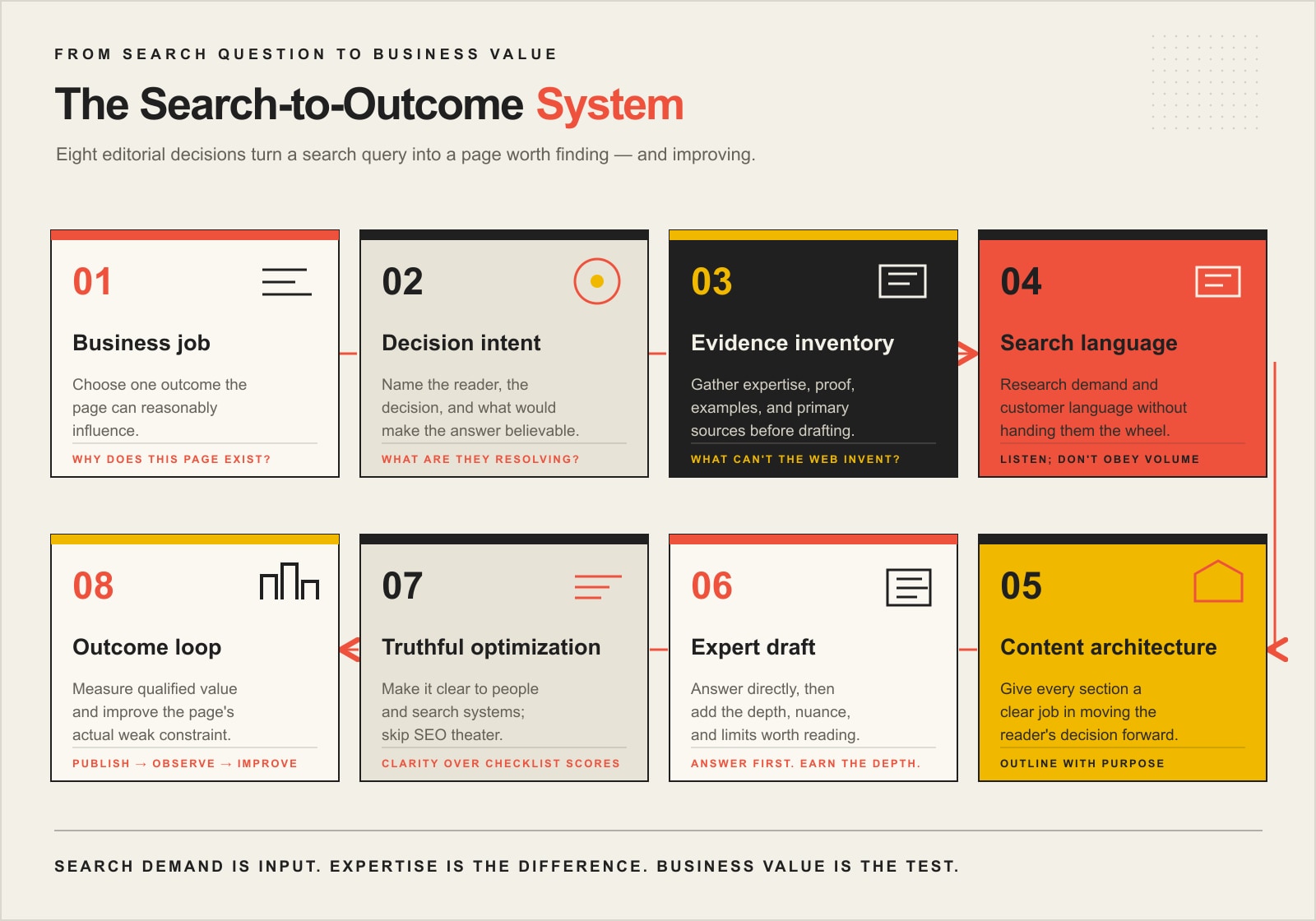
    Eight steps in the Search-to-Outcome Content System: define the business job, understand decision intent, inventory evidence, research search language, structure the content, draft with expertise, optimize truthfully, and measure outcomes.

    The eight layers below turn SEO writing from a word-production task into a controlled business process.

    1. Business job: decide why the page exists

    Start with the outcome closest to money that the page can reasonably influence.

    Possible jobs include:

    • attract a qualified buyer researching a service;
    • answer an objection before a sales conversation;
    • explain pricing or process transparently;
    • support a central service or pillar page;
    • earn relevant links or citations;
    • reduce repetitive support questions;
    • help an existing customer complete a task;
    • qualify or repel prospects before they contact the business.

    Choose one primary job. A page may support secondary outcomes, but five co-equal goals usually produce one incoherent article.

    Then define the next step. It might be another guide, a comparison, a service page, a calculator, a consultation, or no immediate sale at all. The CTA should match the reader’s stage rather than mugging every visitor with “BOOK A CALL” before they know what you do.

    2. Decision intent: identify what the reader is trying to resolve

    Search intent is more useful when described as a decision rather than a generic label.

    “Informational” tells us very little. These are all informational searches with different jobs:

    • What is SEO content writing?
    • How do I write an SEO article?
    • Can AI write SEO content?
    • How much should SEO content cost?
    • Should I update an old post or write a new one?
    • Why is my content indexed but not ranking?

    For each page, write down:

    • who is searching;
    • what happened immediately before the search;
    • what they already understand;
    • what they are comparing;
    • what would make the answer believable;
    • what they need to know next.

    Then inspect the live Google and Bing results. Look at page types, result features, videos, forums, People Also Ask questions, and the dominant interpretation of the query. You are not copying the winners. You are checking whether the page you plan to write belongs in that result at all.

    Our Google ranking diagnostic explains why intent and evidence must be diagnosed before rewriting a page that does not rank.

    3. Evidence inventory: gather what the internet cannot make up for you

    Do not ask a writer or AI model to “add expertise” after the draft. Expertise is an input.

    Create an evidence inventory before outlining:

    • subject-matter expert answers;
    • first-hand processes and decision rules;
    • client examples you have permission to use;
    • original data and calculations;
    • screenshots, demonstrations, or artifacts;
    • common sales and support questions;
    • known trade-offs, exceptions, and failure modes;
    • primary sources for factual claims;
    • claims the business cannot substantiate and should not make.

    This is where Scope Design’s process deliberately keeps Greg in the loop. Research can identify what people ask. It cannot manufacture Greg’s experience, thresholds, objections, or opinion. The expert interview is what turns a technically competent summary into Scope Design content.

    The test is simple:

    If a generic AI model could produce the entire article without access to the business, the article probably does not contain enough of the business.

    4. Search language: research demand without handing it the steering wheel

    Keyword research helps identify how people describe a problem, how much observable demand exists, and which related questions belong together.

    Research should include:

    • a primary topic phrase;
    • close variants and synonyms;
    • problem, cost, comparison, and implementation questions;
    • modifiers showing audience, industry, location, or constraint;
    • People Also Ask and related searches;
    • Search Console queries for pages that already exist;
    • sales-call language and customer emails;
    • AI-query testing to expose follow-up questions and unsupported assumptions.

    Volume is not the deciding vote. A low-volume question can be commercially valuable when it signals a serious buyer. A high-volume term can be a useless crowd.

    In our August 2026 Ubersuggest check, estimated monthly US search volume was about 1,300 for “SEO content writing,” 4,400 for “content writing for SEO,” 1,300 for “SEO writing,” 1,000 for “SEO copywriting,” and 210 for “how to write SEO content.” Those figures help size the language. They do not tell Scope Design what to believe or guarantee this page will rank.

    If the hard part is deciding which phrases deserve their own page, our SEO keywords guide goes deeper on query intent, page ownership, and choosing language without chasing volume alone.

    5. Content architecture: give every section a job

    Build the outline after intent and evidence are clear.

    A practical structure may include:

    1. a direct answer;
    2. a definition and boundaries;
    3. why the problem occurs;
    4. the original process or framework;
    5. examples and evidence;
    6. trade-offs and myths;
    7. implementation steps;
    8. measurement;
    9. relevant FAQs;
    10. the next useful action.

    Each section should answer a question or move the decision forward. If a heading exists only because every competing article has it, delete it or make it earn its place.

    Use paragraphs for explanation. Lists are useful for sequences, options, and checklists; they are not a substitute for thinking. Open Brain’s Content Engine SOP specifically calls for paragraph-first drafting because a wall of bullets can look organized while saying almost nothing.

    Internal links belong in the blueprint, not sprinkled in during a final panic. Link to the pages that explain prerequisites, evidence, related decisions, and commercial next steps. Our SEO strategy and analytics pillar is the hub for this entire topic cluster.

    6. Expert draft: answer first, then earn the depth

    Open with the answer the reader came for. Do not make them survive six throat-clearing paragraphs about how “in today’s rapidly evolving digital landscape, content is king.” The king has been overthrown. He was mostly filler.

    Then add the depth that makes the answer useful:

    • explain why;
    • define conditions and exceptions;
    • show a real example;
    • distinguish similar concepts;
    • state what is unknown;
    • tell the reader what to do next.

    Write in the language of a competent human helping another human. Use industry terminology when it improves precision, not because jargon feels expensive.

    AI can help assemble research, organize notes, challenge an outline, generate alternatives, and produce a first draft. Scope Design’s rule is that a competent human must be able to inspect the sources, recognize errors, and remain accountable for publication. Fluency is not verification.

    7. Truthful optimization: make the page clear without performing SEO theater

    Once the draft is useful, optimize the page so people and search systems can interpret it.

    Check:

    • one descriptive visible H1;
    • a concise, accurate SEO title;
    • a useful meta description;
    • logical H2 and H3 headings;
    • natural use of the main topic and related language;
    • descriptive internal-link anchors;
    • credible external sources where claims require them;
    • high-quality original media near relevant text;
    • descriptive alternative text;
    • a canonical URL;
    • accurate author and review information;
    • supported schema that matches visible content;
    • mobile readability and accessibility;
    • no arbitrary line breaks or formatting debris.

    Schema is machine-readable truth. It is not a bottle of ranking cologne. Google also says no special structured data is required for its AI features.

    Rank Math and similar tools are useful lint. They can catch a missing description, absent keyword, or formatting problem. Their score is not a Google or Bing score. Protect pages that perform even when a plugin dislikes them, and do not damage natural writing to satisfy a checklist.

    8. Outcome loop: publish, observe, and improve the actual constraint

    Measure the page in layers:

    1. Eligibility: Is it crawlable, indexed, and canonicalized correctly?
    2. Visibility: What relevant queries produce impressions, rankings, citations, and mentions?
    3. Engagement: Do visitors reach the useful sections and follow relevant paths?
    4. Action: Do they call, submit, purchase, subscribe, or use the intended resource?
    5. Quality: Are those actions from the right people?
    6. Outcome: Can the business connect the page to pipeline, revenue, retention, or saved staff effort?

    Google Search Console, Bing Webmaster Tools, analytics, call tracking, and CRM data answer different pieces of that chain. No single dashboard owns the truth.

    Review the evidence before rewriting. If the page earns impressions but few clicks, the title or result fit may be weak. If visitors arrive and leave immediately, intent or clarity may be wrong. If qualified people read but never act, the offer or next step may be the constraint. Our SEO metrics guide explains the hierarchy in detail.

    Update the weak section. Do not burn down a useful URL because a calendar reminder says “refresh content.”

    The SEO writing myths that waste the most time

    Myth 1: Google prefers a specific word count

    Google explicitly says it does not have a preferred word count. The right length is the amount required to satisfy the page’s job without padding it like a high-school essay due tomorrow.

    A 600-word answer can be complete. A 4,000-word guide can be thin if it repeats itself for 3,400 words.

    Myth 2: Keyword density should hit a fixed percentage

    Google publishes no target keyword-density percentage. It warns against keyword stuffing. Use the language required to make the topic clear, then edit for humans with functioning ears.

    Myth 3: E-E-A-T is a score you can optimize

    Google describes experience, expertise, authoritativeness, and trustworthiness as concepts its systems seek to recognize through many signals. It explicitly says E-E-A-T itself is not a specific ranking factor. There is no public E-E-A-T score sitting beside your page waiting to turn green.

    Make the author, evidence, process, purpose, and accountability legible because they help people assess trust—not because you are feeding a mythical meter.

    Myth 4: Google automatically penalizes AI-written content

    Google’s concern is quality and purpose, not whether a particular tool helped create the prose. Automation used primarily to manipulate rankings can violate spam policies. AI-assisted content that is accurate, useful, reviewed, and accountable is not automatically penalized.

    The practical problem is not that AI touched the draft. It is that many AI drafts are commodity summaries with fabricated details and nobody qualified to catch them.

    Myth 5: Bounce rate and time on page directly control rankings

    Search engines do not publish a simple universal formula where a particular bounce rate or dwell time moves a page up three positions. Treat engagement metrics as diagnostic evidence about the visitor experience, not a disclosed ranking dial.

    Sometimes a short visit means the page answered the question immediately. Sometimes a long visit means the reader is hopelessly lost. Context is inconvenient like that.

    Myth 6: FAQ schema creates a ranking boost

    Visible FAQs can help readers and answer relevant follow-up questions. Accurate FAQPage markup can describe that content, but it does not create a ranking boost. Google stopped showing FAQ rich results in Search in May 2026 and removed its FAQ rich-result documentation the following month.

    Use an FAQ because the questions matter. Add schema only when it accurately represents the visible page.

    Myth 7: A green plugin score means the article is ready

    A plugin checks rules chosen by the plugin company. Search engines do not receive the score. A green light cannot verify the source, judge the business strategy, confirm the expert’s claim, or tell whether the visitor became a customer.

    Use the lint. Do not worship the dashboard.

    A transparent example: what we changed in this article

    This URL previously carried a year-dependent title and a short article containing claims we could not responsibly support.

    The old version said content with three or more citations ranked 67% higher. It presented time on page, bounce rate, and similar behavior metrics as direct ranking inputs. It treated E-E-A-T more like a checklist than a trust framework. Its Rank Math focus field contained a sprawling pile of loosely related terms.

    We did not preserve those claims just because they sounded precise.

    The replacement process was:

    1. inspect the live post, revisions, internal links, categories, and metadata;
    2. check GA4, Search Console, Bing, Ubersuggest, and backlink evidence;
    3. compare overlapping Scope Design articles before choosing the page’s job;
    4. research current keyword demand, SERP features, and People Also Ask questions;
    5. ground the position in Greg’s expert interview and two Open Brain process notes;
    6. verify disputed claims against current Google and Microsoft documentation;
    7. build an original framework and graphic;
    8. preserve the established URL while removing the year from the visible title;
    9. preserve a recoverable Gutenberg revision before handoff;
    10. measure the new version without promising a result we do not control.

    That is what evidence-led content maintenance looks like. It is less glamorous than changing the publication date and more useful than pretending an old article became fresh through calendar cosplay.

    How to use AI without publishing beige sludge

    AI is strongest when the work can be reviewed:

    • extracting questions from interview notes;
    • clustering related queries;
    • comparing outlines;
    • identifying unsupported claims;
    • transforming source material into a first draft;
    • checking consistency, gaps, and repetition;
    • creating alternative explanations;
    • preparing metadata and formatting.

    Keep human judgment for:

    • the business position;
    • expert claims;
    • evidence permissions;
    • regulated or high-consequence advice;
    • editorial taste and voice;
    • final fact-checking;
    • publication approval.

    The winning AI workflow is not “one prompt, one post.” It is source gathering, expert input, structured drafting, skeptical review, and accountable publication.

    Our AI search optimization guide explains the difference between making a page crawlable and making it worth citing.

    SEO content writing checklist

    Before writing

    • Define one primary business job.
    • Name the audience and decision.
    • Check whether an existing URL already owns the intent.
    • Interview the expert.
    • Build an evidence and permissions ledger.
    • Research keywords, live SERPs, PAA questions, and customer language.
    • Decide the page’s next useful action.

    During writing

    • Put the direct answer near the top.
    • Give every section a purpose.
    • Use paragraphs for reasoning and lists for true lists.
    • Add first-hand detail, examples, trade-offs, and limitations.
    • Cite primary sources for changing or consequential facts.
    • Keep the Scope Design voice without obscuring the answer.
    • Remove arbitrary line breaks and formatting debris.

    Before publishing

    • Verify every factual claim.
    • Confirm the title, H1, description, canonical, robots, and schema.
    • Add relevant internal and external links.
    • Check media, alt text, mobile layout, and accessibility.
    • Test every CTA and form.
    • Preserve a recoverable revision or backup.
    • Record the review date and evidence source.

    After publishing

    • Confirm live rendering and structured data.
    • Submit or notify search systems when appropriate.
    • Monitor indexation, relevant queries, citations, and referrals.
    • Connect actions to qualified outcomes.
    • Refresh facts that moved.
    • Improve diagnosed weak sections rather than rewriting blindly.

    Frequently asked questions about SEO content writing

    What is SEO in content writing?

    SEO in content writing means researching how people look for an answer, matching the page to that intent, making the topic and relationships clear, demonstrating trustworthy expertise, and optimizing titles, headings, links, media, and metadata so search systems can understand the page.

    How do I start SEO content writing?

    Start with the business outcome and reader’s decision. Research the live search results and customer language, interview the subject-matter expert, gather evidence, create an outline with one job per section, and only then draft the answer.

    Can I do SEO content writing myself?

    Yes, when you understand the subject, can research the search intent, and have time to verify and maintain the page. Get specialist help when the topic is unfamiliar, regulated, technically complex, strategically important, or when nobody internally owns research and quality control.

    Can ChatGPT write SEO content?

    ChatGPT can help research, organize, transform, and draft source material. It cannot supply missing first-hand expertise or accept accountability for false claims. A qualified human should provide the position, verify evidence, edit the voice, and approve publication.

    How long should SEO content be?

    Long enough to satisfy the reader’s decision and no longer. Google says it does not have a preferred word count. Match depth to the problem, evidence, and competitive context rather than an arbitrary quota.

    What keyword density is best for SEO writing?

    There is no documented ideal percentage. Use the primary topic and related language naturally where they help people understand the page. Repetition that makes the writing awkward is not optimization; it is keyword stuffing with paperwork.

    Is E-E-A-T a Google ranking score?

    No. Google says E-E-A-T itself is not a specific ranking factor. It is a framework for thinking about experience, expertise, authoritativeness, and trust, which ranking systems may recognize through many signals.

    Does Google penalize AI-generated content?

    Not automatically. Google focuses on quality, usefulness, and purpose. Scaled or automated content created primarily to manipulate rankings can violate spam policies regardless of the tool used.

    Does FAQ schema help SEO content rank?

    No. FAQ schema can describe visible FAQs, but it does not create a ranking boost. Google stopped showing FAQ rich results in Search in May 2026, so use FAQs for readers and structured data only when it truthfully describes the page.

    How often should SEO content be updated?

    Update it when facts, products, prices, sources, search intent, or business positioning change, or when performance evidence identifies a fixable weakness. Do not change dates merely to manufacture freshness.

    Can SEO content guarantee rankings or AI citations?

    No. Good research, technical eligibility, original evidence, and authority improve the opportunity. The final ranking and citation systems belong to Google, Microsoft, OpenAI, and other platforms—not the writer or agency.

    Write something worth finding

    SEO content writing is not about pleasing a crawler at the expense of the reader. It is the discipline of making a useful business answer discoverable, understandable, trustworthy, connected, and measurable.

    Start with the job. Interview the expert. Research the decision. Gather the proof. Write the answer. Optimize the truth. Measure what happens next.

    If your current content is thin, overlapping, unsupported, invisible, or attracting the wrong crowd, explore Scope Design’s SEO services or contact us. We will diagnose the content system before prescribing another monthly pile of words.

    Primary sources

  • The Most Important Business Blogging Tools: Build a Lean Stack That Works

    The Most Important Business Blogging Tools: Build a Lean Stack That Works

    The most important business blogging tools are the ones that cover the jobs your content system actually has to do: research, planning, drafting, editing, visuals, publishing and SEO, distribution, and measurement. You do not need a 40-app shopping spree. You need a small stack that removes recurring friction without creating another system your team has to babysit.

    If you are still deciding how blogging fits into your business, start with our guide to building a blogging and podcasting program. If the program already exists, this guide helps you decide which tools deserve a place in it.

    TL;DR: Build the Minimum Viable Blogging Stack First

    • Research: start with search itself plus first-party search-performance data. Add a specialist keyword suite when research volume or competitive analysis becomes a real bottleneck.
    • Plan: use one source of truth for briefs, outlines, assignments, and evidence. The tool your team already uses is often better than a fashionable replacement.
    • Draft: use a reliable editor. AI can accelerate ideation and first passes, but strategy, expertise, facts, and final judgment still need an accountable human.
    • Edit and QA: build a repeatable review checklist for accuracy, voice, links, evidence, accessibility, and conversion intent.
    • Visualize: use one design workflow for featured images, diagrams, and useful screenshots. Do not decorate weak ideas with prettier pixels.
    • Publish and optimize: use a CMS plus one SEO layer. A plugin score is a diagnostic, not an editorial director.
    • Distribute: start with the channels you already own. Add scheduling and repurposing software only when manual handoffs are consistently wasting time.
    • Measure: combine search visibility, on-site behavior, and business outcomes. Traffic alone is not the finish line.

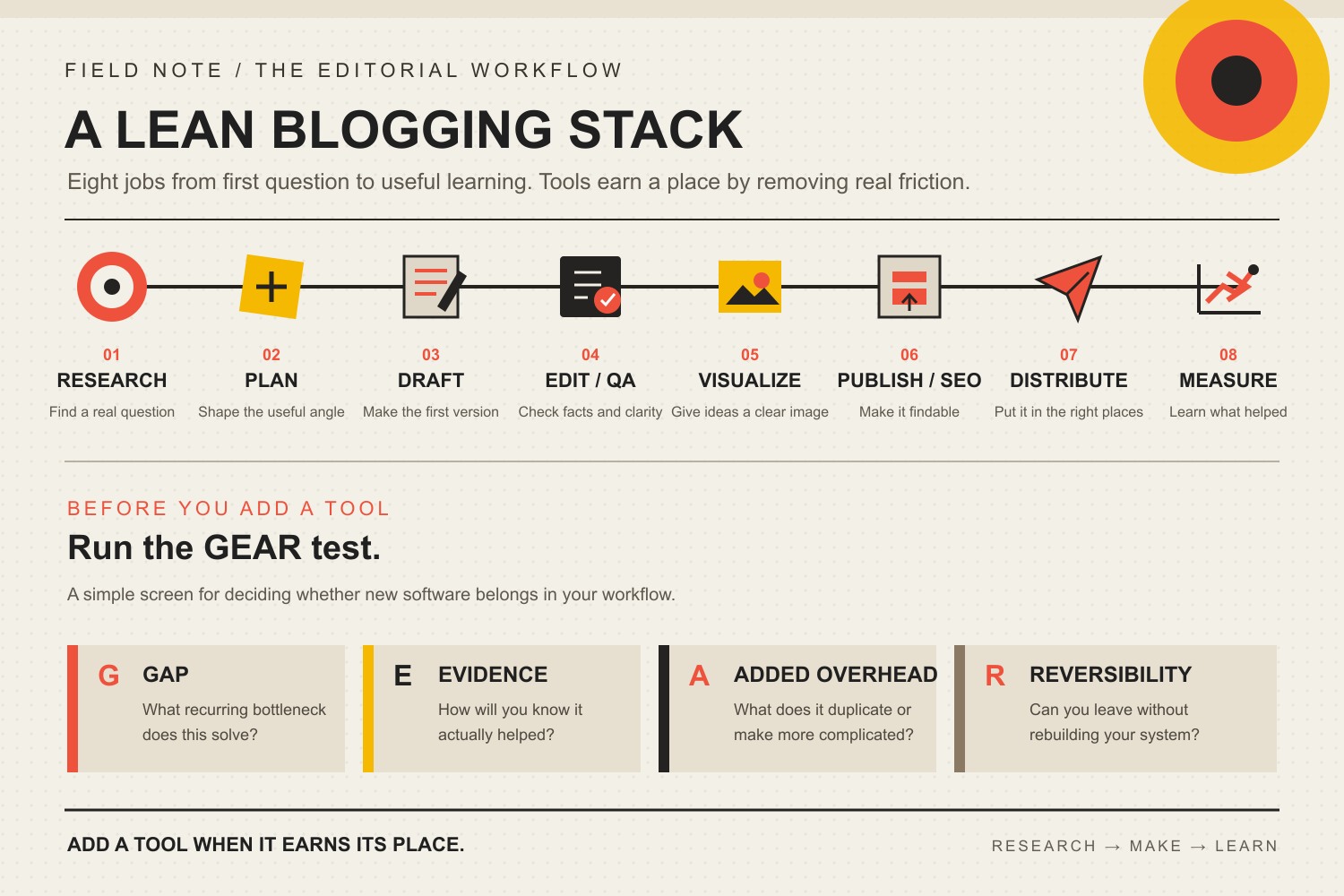
    Before you add a paid tool, run it through Scope Design’s GEAR Test: Gap, Evidence, Added overhead, Reversibility. If you cannot name the bottleneck, define the result, explain the new complexity, and leave cleanly later, keep the company card in your wallet.

    The Most Important Blogging Tools Cover Eight Jobs

    Most “best blogging tools” articles start with products. That is backwards. A tool is useful only because it performs a job inside a larger content workflow.

    At Scope Design, the durable sequence is closer to: understand the business job, research the audience and query, build the brief, draft, verify, publish, distribute, measure, and improve. That is also why a blogging stack belongs inside a broader content marketing strategy and a coherent small business marketing system. If the strategy is fuzzy, buying more software mostly lets you execute the fuzziness faster.

    This distinction matters because products change constantly. Free tiers shrink. AI features get bundled into tools you already pay for. A standalone feature becomes native six months later. A decision framework ages much better than a 2026 shopping list.

    Use the Scope Design GEAR Test Before Adding Another Tool

    The GEAR Test is a simple way to separate a real capability gap from software FOMO.

    Eight stages in a lean business blogging workflow, followed by the GEAR test: Gap, Evidence, Added overhead, and Reversibility.

    G — Gap: what recurring bottleneck does this solve?

    “It has AI” is not a gap. “Our editor spends three hours every week turning interview transcripts into structured briefs” is a gap. Name the job, the person who owns it, and the friction you are trying to remove.

    E — Evidence: how will you know it helped?

    Decide what should change before the trial starts: research time, revision cycles, publishing errors, content throughput, qualified impressions, assisted conversions, or another observable result. Hope is not an analytics strategy.

    A — Added overhead: what does it duplicate or complicate?

    Every app has a second price tag: setup, permissions, training, integrations, data cleanup, notifications, billing, and the “where the hell did we save that?” problem. If a new tool duplicates 80 percent of a system you already own, the last 20 percent needs to earn the mess.

    R — Reversibility: can you leave without rebuilding the company?

    Check exportability, content ownership, file formats, integrations, and what happens when the subscription ends. The best tool today can become an expensive hostage situation tomorrow if your data and process cannot move.

    The Eight Jobs Your Business Blogging Stack Needs to Cover

    1. Audience and keyword research tools

    Research tools should help you answer three questions: What is the customer actually asking? What page should own that intent? What evidence will make the answer useful?

    Start with Google Search, the questions and result formats you can observe directly, and Google Search Console performance data for pages you already own. Search Console is first-party evidence about how your pages and queries perform in Google Search, which makes it more useful for your own site than another generic “content score.”

    Specialist suites such as Ahrefs Keywords Explorer and Semrush keyword research tools can expand keyword discovery, competitive analysis, and prioritization. You do not automatically need both. Pay for deeper research when the volume of work, competitor analysis, or time saved makes the subscription cheaper than the bottleneck.

    Also separate topic selection from tool selection. Our business blogging practices guide covers the operating habits that make a blog useful. A keyword database cannot rescue a weak business question.

    2. Planning and source-of-truth tools

    Your planning layer needs to hold the brief, target audience, business goal, sources, outline, assignments, status, links, and next action. Google Docs, Microsoft 365, Notion, Trello, Asana, ClickUp, or a spreadsheet can all work. The brand matters less than whether the team knows where the truth lives.

    A second planning tool usually creates more drag than leverage. If sales keeps customer questions in one place, marketing keeps the calendar in another, and writers keep sources in private documents, fix the information flow before shopping for a shinier board.

    3. Drafting and AI-assisted writing tools

    A good drafting tool makes it easy to write, comment, compare revisions, preserve sources, and hand work to the next person. For many teams, the boring answer is still a collaborative document editor.

    AI tools can help with ideation, interview synthesis, outline options, first drafts, restructuring, and repurposing. They are much less trustworthy when you ask them to invent expertise, choose strategy without context, or produce factual claims without verification. If you want the deeper workflow, our ChatGPT for marketing guide focuses on defining the job, grounding the prompt, and evaluating the output instead of treating the model like a magic intern.

    The rule is simple: use AI to reduce mechanical effort, not accountability. Somebody still owns the argument, the evidence, the client voice, and the decision to publish.

    4. Editing and factual-QA tools

    Grammar and style assistants can catch friction. Commenting and version history can make collaboration less painful. Neither one proves the article is correct.

    Your real QA system should check the claim against its source, confirm dates and qualifiers, remove unsupported certainty, verify internal and external links, inspect headings and alt text, and ask whether the article does the business job defined in the brief. A polished hallucination is still a hallucination wearing a tie.

    5. Visual-content tools

    For many articles, one design tool can cover featured graphics, diagrams, social crops, and simple charts. Canva and Adobe Express are common choices. Screenshots are useful when they demonstrate a real interface or result. Custom design is worth the extra effort when the visual itself explains an original model, comparison, process, or piece of evidence.

    Do not add images because a checklist says “blog posts need images.” Add a visual when it improves comprehension. Decorative wallpaper is still wallpaper.

    6. Publishing and on-page SEO tools

    Your CMS should let you publish accessible, indexable, maintainable content without requiring a developer for every comma. If your business site already runs on WordPress, you usually do not need a second “blog platform” just because a roundup ranked one higher.

    Use one SEO layer for titles, descriptions, canonicals, robots settings, structured data, and basic content checks. Then keep the hierarchy straight. Google says its ranking systems are designed to surface helpful, reliable, people-first content. A green plugin light can expose a missed field; it cannot decide whether your explanation deserves to exist.

    7. Distribution and repurposing tools

    Publishing is not distribution. Your workflow still needs a path into email, social channels, sales conversations, customer support, and future derivative content.

    Start with the native scheduling and publishing capabilities of the channels you actually use. Add a cross-channel scheduler, transcription tool, clipping tool, or automation layer when the same handoff happens often enough to become expensive. Our RECAST content-repurposing workflow is built around adapting a strong source asset for a new audience or decision, not spraying the same paragraph everywhere and calling it omnichannel.

    8. Measurement and improvement tools

    A useful measurement stack separates three different questions: Can search engines find and understand the page? Are real people engaging with it? Does that attention contribute to a business outcome?

    Use Search Console for Google search-performance evidence, Google Analytics for event-based website behavior, and Bing Webmaster Tools as a separate first-party search signal. Then connect those systems to your actual inquiry, CRM, ecommerce, or sales process where possible.

    Do not assume analytics is a perfect lead ledger. Missing events, consent behavior, attribution rules, bot traffic, direct traffic, and handoffs into phone or email can distort the picture. Measure what the tools can support, disclose the gaps, and avoid making the dashboard sound smarter than it is.

    A Minimum Viable Business Blogging Tool Stack

    For a small business, the best blogging tool stack is often the one you can explain on a single screen. Use this as a starting architecture, not a mandatory vendor list.

    JobStart withPay for a specialist when…
    ResearchSearch + first-party search dataKeyword discovery, competitor analysis, or research volume repeatedly consumes expensive time.
    PlanningYour existing shared document/project systemHandoffs, approvals, ownership, or reporting are breaking at scale.
    DraftingCollaborative editor; AI optionalStructured production volume or specialized collaboration creates a proven gap.
    Edit + QAReview checklist + version historyEditorial volume, compliance, or multi-reviewer workflows make manual QA unreliable.
    VisualsOne design toolBrand control, complex data, custom illustration, or production volume requires more.
    Publish + SEOCMS + one SEO layerGovernance, technical SEO, integrations, or multi-site work exceed the native workflow.
    DistributionNative channelsRecurring cross-channel scheduling or repurposing is consuming measurable staff time.
    MeasurementSearch Console + GA4 + Bing Webmaster ToolsAttribution, CRM integration, dashboards, or multi-client reporting require a deeper layer.

    Notice what is missing: a requirement to buy three keyword platforms, two AI writers, four schedulers, and a productivity app whose main job is reminding you to use the productivity app.

    When Is a Paid Blogging Tool Actually Worth It?

    A paid tool earns its place when the value is concrete. Good reasons usually fall into five buckets.

    1. It saves recurring skilled time. Saving ten minutes once is not a business case. Saving four hours every month on a repeatable job might be.
    2. It gives you evidence you cannot reasonably get another way. Competitive keyword data, crawl diagnostics, brand monitoring, or specialized research can justify a paid layer.
    3. It reduces meaningful risk. Better approval, accessibility, security, backups, or compliance workflows can be worth more than raw speed.
    4. It connects systems that otherwise require manual rework. Integration is valuable when it removes a recurring handoff, not when it merely creates more synchronized clutter.
    5. It remains reversible. You can export the data, understand ownership, and leave without rebuilding the process from scratch.

    If you cannot tie the subscription to one of those outcomes, wait. Use the free or native capability until the constraint becomes obvious.

    What Our Audit of This Exact Article Taught Us

    We did not protect the old article just because it had been online for years. We audited the page the same way we would audit a client’s content before deciding what deserved to survive.

    Signal checkedObservation on August 20, 2026What it supports
    GA4, last 12 complete monthsNo Organic Search landing-page rows. Across all channels, 2 Direct sessions, 0 engaged sessions, 0 configured key events. Prior comparison returned no rows.The sample is far too small for behavior or conversion conclusions. There is no measured organic footprint forcing us to preserve unsupported copy.
    Google Search Console1 impression, 0 clicks for the exact page in the current 12-month period; no rows in the prior period. URL Inspection says the page is submitted and indexed with the established URL as canonical.Google knows the page, but demonstrated search equity is minimal. Keep the stable address and improve the page’s job instead of manufacturing a migration.
    Bing Webmaster Tools0 clicks and 0 impressions for the URL; Bing has known the page since 2024 and crawled it in July 2026. Site sitemaps report success.There is crawl history but no meaningful Bing traffic footprint to protect.
    UbersuggestNo ranking keywords or exact-URL backlinks were returned for the page.Third-party evidence also shows little page-level equity, so weak claims and a bloated tool catalog do not deserve preservation.

    That evidence does not prove blogging is worthless, that readers hated the page, or that this rewrite will rank. Scope’s analytics also has known attribution and key-event limitations. It supports a narrower editorial decision: preserve the established URL, remove claims we cannot substantiate, give the page one defensible job, and connect it to the right cluster.

    The old version included time-stamped “2025” trends, unsupported lead-generation percentages, a “most profitable niches” list, an unverified AI-adoption statistic, an arbitrary ideal word-count range, and universal “best” claims about products. Those are gone. A useful tool guide should make the decision easier, not make the copy sound certain.

    Frequently Asked Questions About Blogging Tools

    What is the best tool for blogging?

    There is no universal best tool because blogging is not one job. A CMS can publish but cannot decide the right topic. A keyword suite can research but cannot supply your expertise. An AI assistant can draft but cannot own the facts. Start by identifying the bottleneck, then choose the smallest tool that solves it.

    What blogging tools do beginners need?

    A beginner business stack can be very small: a CMS, a shared document or planning space, search and first-party search data, one design tool, one SEO layer, and basic analytics. Add specialized software after the workflow reveals a recurring constraint.

    Are free blogging tools enough for a small business?

    Often, yes, especially while the content program is small. Free and native tools can cover planning, writing, basic design, publishing, Google search reporting, Bing search reporting, and analytics. The reason to pay is not “professional bloggers pay for tools.” Pay when depth, scale, collaboration, automation, or risk reduction creates a measurable return.

    Do I need Ahrefs or Semrush for business blogging?

    No. Both are capable specialist research platforms, but neither is a prerequisite for publishing useful business content. A paid SEO suite becomes easier to justify when you perform regular keyword research, competitor analysis, backlink work, site audits, or multi-page planning and the extra data saves enough time or improves enough decisions to pay for itself.

    Should a small business use AI tools to write blog posts?

    AI can be useful for brainstorming, organizing research, drafting options, restructuring, and repetitive transformation. It should not be allowed to invent customer experience, case studies, statistics, sources, or technical certainty. Treat AI as an accelerator inside a controlled editorial workflow, not as the person accountable for the answer.

    What platform do most business bloggers use?

    The more useful question is which platform fits your existing website, ownership requirements, publishing workflow, integrations, and maintenance capacity. If your business website already has a capable CMS, splitting the blog onto another platform can create more SEO, analytics, branding, and governance work than it solves.

    How many blogging tools should a small business use?

    Use as few as possible while covering the eight jobs reliably. One product may cover several jobs. Two products may be justified for a job with different owners or requirements. The number is not the target; low friction, clear ownership, evidence, and reversibility are the target.

    How do I know whether a blogging tool is helping?

    Define the expected change before you buy it. Measure something the tool should actually influence: hours saved, errors reduced, approval cycles shortened, pages researched, qualified impressions gained, content reused, or attributable business actions. If you cannot connect the tool to a result after a reasonable trial, remove it or redefine the job.

    Your Tool Stack Should Get Smaller as the System Gets Clearer

    A mature content operation does not necessarily have more software. It has clearer ownership, cleaner evidence, better handoffs, and fewer mystery subscriptions. The best stack is boring in the right places.

    Start with the eight jobs. Run every new purchase through GEAR. Keep the systems that create evidence or remove recurring friction, and kill the ones that mostly create tabs.

    If the bottleneck is bigger than software — unclear topics, weak search ownership, inconsistent production, disconnected analytics, or no conversion path — Scope Design’s content and SEO work can help diagnose the system before you buy another tool to treat the symptom.