Referral marketing vs affiliate marketing is not a contest with one universal winner. Referral programs are usually the better first channel when you already have satisfied customers whose trust can open the right doors. Affiliate marketing is usually the better first channel when your bottleneck is distribution and outside creators, publishers, or partners already reach the buyers you need. If the margins or operating system cannot support the program, neither channel wins.
Referral Marketing vs Affiliate Marketing: The Short Answer
- Referral marketing is a relationship engine. It turns earned customer trust into appropriate introductions or recommendations.
- Affiliate marketing is a distribution engine. It compensates partners for promoting an offer to an audience they already reach.
- Do not choose from generic conversion-rate charts. Choose from your relationship strength, audience access, margin, and operating capacity.
- Using both can work, but “best of both worlds” is not a strategy. Give each program a different job, separate the tracking, and make sure both can earn their cost.
In other words, the referral marketing vs affiliate marketing choice is a constraint decision before it is a channel decision. At Scope Design, we use a simple model for that choice: the RAMP Channel Fit Test. RAMP stands for Relationship, Audience, Margin, and Program burden. The first two tell you where your acquisition advantage lives. The last two tell you whether you can afford and operate it.
Referral Programs and Affiliate Programs Are Not the Same Thing
A customer referral program gives existing customers or trusted contacts a repeatable way to introduce or recommend a right-fit prospect. A reward can be part of the system, but it is not what makes something a referral. The defining asset is the relationship and the trust moving through it.
An affiliate program recruits publishers, creators, businesses, or other promoters and compensates them for an attributable action such as a sale or qualified lead. The defining asset is access to an audience or distribution channel.
The categories can overlap. A happy customer can also become an affiliate. A business partner can make a warm referral one day and publish a commissionable review the next. The useful question is not what the software calls the person. It is what job the relationship is doing in this transaction.
If you decide referrals are the right first move, our customer referral program strategy guide owns the implementation details: timing, incentives, handoffs, fraud controls, and measurement. This page stays focused on the channel choice.
| Decision factor | Referral program | Affiliate program |
|---|---|---|
| Primary asset | Existing trust and customer relationships | External audience and distribution |
| Typical promoter | Customer, client, member, trusted contact | Creator, publisher, partner, comparison site, specialist promoter |
| Typical reward | None, recognition, credit, receiver benefit, or a structured reward | Usually performance-based compensation tied to a tracked action |
| Best first fit | Relationship-rich businesses with credible advocates | Reach-constrained businesses with recruitable relevant partners |
| Main scaling limit | Size and fit of the customer or relationship network | Partner recruitment, economics, governance, and audience quality |
| Main risk | Buying low-quality introductions or damaging trust | Bad-fit traffic, misleading promotion, margin leakage, partner concentration |
| What to measure | Qualified introductions, customers, contribution, retention, relationship quality | Productive partners, attributed customers, contribution, refunds, downstream customer quality |
Use the Scope Design RAMP Channel Fit Test
A useful referral marketing vs affiliate marketing comparison does not start by asking which channel converts better. That is backwards. A channel with a wonderful conversion rate is useless if it cannot reach enough right-fit people. A channel with enormous reach is useless if every sale loses money or creates support hell.

R — Relationship: Where does earned trust already exist?
Start with the customer relationships you actually have, not the ones your marketing plan wishes existed. Do customers renew, praise the work, send unsolicited introductions, or know other people with the same problem? If yes, a referral program may be amplifying behavior that is already credible.
This matters especially in trust-heavy services, local businesses, professional relationships, and higher-risk B2B purchases. A warm introduction can carry context that a tracking link cannot. But trust is not infinitely monetizable. If the reward makes the recommendation feel purchased, the program can degrade the very asset it was supposed to use.
A — Audience: Who already reaches the buyers you cannot reach efficiently?
If your current customers are happy but do not know many right-fit prospects, referral volume may hit a ceiling quickly. Affiliate marketing becomes more interesting when creators, publishers, consultants, integration partners, educators, or niche communities already have the audience you need.
The key word is relevant. A partner with a smaller, well-matched audience can be more useful than a giant account whose followers do not buy your category. “Has followers” is not a partner-selection strategy wearing a clever hat.
M — Margin: What is left after the channel gets paid?
Do not compare a referral reward with an affiliate commission in isolation. Compare the customer contribution after acquisition.
Acquisition contribution = collected revenue − delivery or product cost − reward or commission − refunds and chargebacks − variable platform and program cost.
Then follow the cohort long enough to see whether the customer repeats, renews, churns, refunds, expands, or creates unusual support cost. A cheaper first order can create a worse customer. A more expensive acquisition can be excellent if the customer stays and contributes more. The spreadsheet needs the whole relationship, not just the celebratory screenshot from day one.
P — Program Burden: Can you operate the thing you are designing?
Referral programs need rules, good timing, clean handoffs, reward support when rewards exist, attribution, fraud controls, and a competent response when someone sends you a lead. Affiliate programs add partner recruiting, approval, creative guidance, terms, commission logic, disclosures, payment administration, link or code tracking, partner monitoring, and often more fraud risk.
The channel that looks scalable on a slide can become an expensive collection of exceptions if nobody owns it. Program burden is not “overhead after launch.” It is part of the acquisition cost.
When Referral Marketing Is the Better First Channel
Start with referrals when you have evidence of customer satisfaction, the buying decision benefits from personal trust, and your customers or professional network naturally know people with similar needs.
- You have repeat customers, strong retention, enthusiastic feedback, or unsolicited introductions.
- Your service requires judgment, trust, access, or a meaningful relationship before purchase.
- Your best customers know other right-fit buyers in the same industry, community, role, or life stage.
- You can respond quickly and professionally when someone makes an introduction.
- You care more about qualified fit and downstream customer quality than raw traffic volume.
There is credible evidence that referred customers can differ economically, but it should be used carefully. A 2011 Journal of Marketing study followed roughly 10,000 customers of a German bank for almost three years. In that specific setting, referred customers were more loyal and more valuable on average than comparable nonreferred customers, with at least a 16% average value difference. The researchers also found that the size of the difference varied by segment.
That is useful evidence for a hypothesis, not permission to paste “16% higher value” into every referral proposal until the sun burns out. Your category, customer mix, reward design, sales process, and retention economics can behave differently.
When Affiliate Marketing Is the Better First Channel
Start with affiliate marketing when the primary constraint is access to an audience, relevant partners already exist, and the unit economics can support performance compensation plus the real cost of operating the program.
- Your customer base is still too small to produce meaningful referral reach.
- People already learn about your category through reviews, tutorials, newsletters, comparison content, communities, or specialist creators.
- Your offer is understandable enough that a qualified partner can explain it honestly.
- You can define a profitable commission ceiling from margin and target acquisition cost rather than copying a competitor percentage.
- You have someone who can recruit, support, monitor, and pay partners reliably.
In the referral marketing vs affiliate marketing decision, affiliate becomes attractive because it can solve a reach problem, not because somebody promised “SEO backlinks.” Google Search Central’s current outbound-link documentation says affiliate links should be marked with rel="sponsored" and paid placements should use the sponsored value, with nofollow remaining acceptable. Affiliate marketing can be a distribution channel. It is not a respectable excuse to buy link equity.
When a Hybrid Referral and Affiliate Program Actually Makes Sense
A hybrid can work when referrals and affiliates solve different constraints. For example, customer referrals might create warm introductions in a trust-heavy service while a small affiliate program reaches a new professional audience through educators or industry partners.
A referral marketing vs affiliate marketing hybrid only earns its complexity when each side has a separate job. What does not work is launching two programs from zero because a comparison article said “use both.” Sometimes the hybrid strategy is just two half-managed programs sharing a login.
- Define a separate job for each program.
- Use separate partner or referral identifiers so credit does not become a wrestling match.
- Define what happens when the same person touches both programs.
- Prevent double rewards or double commission unless that is an intentional part of the economics.
- Compare downstream customer quality by source, not just attributed orders.
Compare the Economics Without Borrowing Somebody Else’s Benchmarks
For referral marketing vs affiliate marketing, the fair comparison is customer contribution after acquisition, not somebody else’s commission or reward percentage. There is no universal “good” referral reward or affiliate commission. The maximum sustainable incentive depends on your contribution margin, target acquisition cost, refund or cancellation behavior, repeat purchase or renewal value, program labor, and how much incremental demand the channel actually creates.
| Measure | Referral program | Affiliate program |
|---|---|---|
| Supply | Eligible customers and credible advocates | Recruitable relevant partners |
| Early signal | Accepted introductions or referred visits | Productive partners, qualified clicks or leads |
| Business outcome | Qualified customers and collected contribution | Attributed customers and collected contribution |
| Channel cost | Rewards, software, labor, support, fraud or abuse | Commissions, network or platform costs, recruiting, management, creative, refunds, fraud |
| Quality guardrail | Fit, sales-cycle length, retention, complaints | Refunds, cancellations, retention, new-customer quality, partner concentration |
| Decision question | Did trust produce profitable right-fit customers without degrading the relationship? | Did borrowed distribution produce profitable incremental customers at a manageable operating cost? |
This is the same discipline we use in our broader growth marketing framework: follow the affected cohort far enough to see the real outcome. A channel does not become good because its first metric moved.
Disclosure, Link Qualification, and Attribution Are Part of the Program
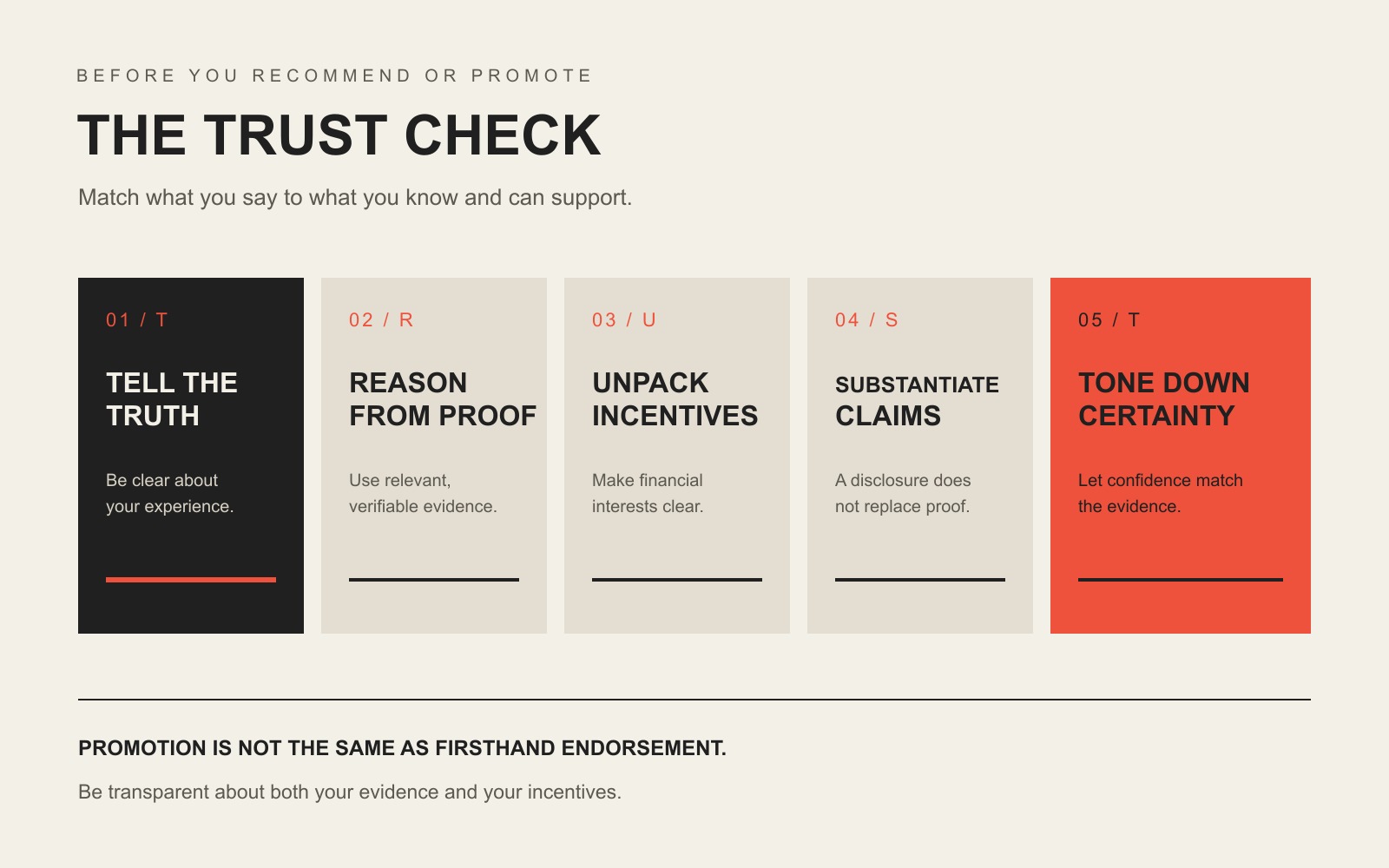
The referral marketing vs affiliate marketing decision also changes the governance burden. Compensation changes how a recommendation can be perceived. In the United States, the FTC Endorsement Guides FAQ says endorsements must be honest and not misleading, and unexpected material connections that could affect how consumers evaluate an endorsement should be disclosed clearly and conspicuously. The FTC’s affiliate guidance specifically says a commission relationship should be disclosed clearly, with the disclosure close enough to the recommendation or link for readers to understand it.
That does not mean every private customer introduction requires the same disclosure language as a public affiliate review. Context matters. If a customer is publicly endorsing your business and receives a reward that could affect how people evaluate the recommendation, the material connection can matter. Professional services may also have employer, procurement, licensing, contractual, or industry-specific rules. This article is general U.S. business guidance, not legal advice.
Google’s Campaign URL Builder exposes campaign source, medium, name, term, and content fields for tagged URLs. Use campaign parameters with referral codes, affiliate IDs, ecommerce data, CRM source fields, or whatever operational system actually records the customer.
But do not confuse attribution with incrementality. A tracking system can tell you which link received credit. It cannot automatically tell you whether the customer would have purchased anyway. Hope is not attribution, and attribution is not causation.
What Auditing This Exact Page Changed
This revision started as a “2025 data” comparison packed with exact conversion rates, market-size forecasts, software costs, commission ranges, mobile percentages, and ROI claims. The problem was not that every number was necessarily false. The problem was that the article did not preserve durable primary-source evidence for most of them.
We checked the page itself before deciding how much to preserve. In the 12 complete months from August 20, 2025 through August 19, 2026, GA4 recorded only eight landing-page sessions on this exact URL: five Direct and three Referral. There were no Organic Search landing sessions and zero configured key events. The previous 12-month comparison returned no rows for this exact landing page.
Google Search Console returned no page/query rows for the URL over that same 12-month window and currently reports it as Discovered – currently not indexed. Bing knows and has crawled the page, but its live exact-URL traffic record showed zero clicks and zero impressions when we checked. Ubersuggest returned no ranking keywords or URL-level backlinks.
That tiny sample does not prove the topic is bad or that nobody ever found business value here. Scope Design’s current analytics setup has known attribution and key-event limitations. It does support a narrower editorial decision: we did not have enough performance equity to justify protecting unsupported copy.
The query itself is still defensible. On August 20, 2026, both DataForSEO Google Ads data and Ubersuggest measured “referral marketing vs affiliate marketing” at about 70 U.S. searches per month. DataForSEO measured “referral program vs affiliate program” at about 30. Those are estimates, not a promise of traffic, but they match the page’s real job: help a business owner choose between two acquisition mechanisms.
We also removed the stale year from the visible title while preserving the established URL. There was no reader benefit in creating a migration just to make an SEO plugin happier.
Run a Low-Risk Channel Test Before Building a Machine
If RAMP gives you a clear first choice, test the mechanism before buying a giant platform or recruiting a hundred people.
- Write the constraint. Is the problem trust, reach, margin, or operating capacity?
- Define one business outcome. Use qualified customers and contribution, not raw referrals, clicks, or partner signups.
- Define the eligible cohort. Which customers can credibly refer, or which partners have the right audience?
- Run a bounded pilot. Keep the first version simple enough that you can inspect every handoff and learn what breaks.
- Track the whole path. Source, contact, qualification, customer, collected revenue, variable cost, refund or churn, and any relationship problem.
- Review after the outcome window is mature enough. Decide whether to expand, change the incentive, change the partner mix, fix the handoff, or stop.
If referrals win the test, move into the deeper referral-program implementation process. If affiliates win, document partner eligibility, claims, disclosures, commission logic, tracking, and payment rules before scale creates expensive ambiguity.
Frequently Asked Questions
Which drives more sales: referral marketing or affiliate marketing?
The referral marketing vs affiliate marketing choice has no universal winner. Referral marketing tends to fit businesses with earned customer trust and right-fit networks. Affiliate marketing tends to fit businesses that need external distribution and can support partner economics and operations. Use the RAMP test, then compare customer contribution and downstream quality in your own data.
Is a referral program the same as an affiliate program?
No. Referral programs usually activate an existing customer or trusted relationship. Affiliate programs usually compensate external promoters for attributable actions. A person can play both roles, but the source of influence, audience relationship, expectations, and governance are different.
Which is cheaper: referral marketing or affiliate marketing?
It depends on the business. Compare rewards or commissions plus software, labor, creative, partner recruitment, refunds, support, fraud, and the quality of customers acquired. A low commission does not make a channel cheap if it produces poor-fit customers or eats management time.
How much should a business pay affiliates?
Do not start from a universal percentage. Work backward from contribution margin, target acquisition cost, refund or cancellation behavior, repeat value, and the effort required from a good partner. The right ceiling is the amount that keeps the acquired customer economically worthwhile while still making the partnership worth operating.
Are referral programs worth it for small businesses?
They can be, especially when the business has satisfied customers, trust matters in the purchase, and customers know other right-fit prospects. They are a poor fit when the customer base is tiny, satisfaction is weak, the ask feels forced, or nobody can follow up on introductions properly.
Is referral marketing legal?
Referral marketing is widely used, but incentives and endorsements can create disclosure or industry-specific obligations. In the U.S., review current FTC guidance when a reward or other material connection could affect how consumers interpret an endorsement. Professional relationships may also be subject to employer, procurement, licensing, contractual, or industry rules.
Can a small business use referral marketing and affiliate marketing together?
Yes, when they have different jobs. For example, referrals can handle warm customer introductions while affiliates open a new audience. Keep partner definitions, incentives, attribution, and economics separate enough that you can tell whether each program is actually working.
Do affiliate links help SEO?
Do not build an affiliate program as a paid-link SEO tactic. Google asks sites to qualify affiliate links with rel="sponsored". The business case for affiliate marketing should be relevant distribution and profitable customer acquisition, not purchased link equity.
How should referral and affiliate programs be tracked?
Use referral codes or partner IDs plus campaign parameters, ecommerce or sales data, and CRM source fields where appropriate. Then follow each cohort beyond the first click or order. Compare qualification, collected contribution, refunds, retention or renewal, and the real cost of operating the channel.
Choose the Constraint Before You Choose the Channel
The referral marketing vs affiliate marketing decision gets simpler when you name the constraint. If your best customers already know the next right-fit customer, build a referral system that protects the trust being transferred. If relevant outsiders control access to an audience you cannot reach efficiently, affiliate marketing deserves a serious look. If the margin or program burden fails RAMP, fix that before adding another acquisition machine.
Need help deciding which marketing channel actually fits the business problem? Scope Design’s marketing strategy and advertising work starts with the constraint, the economics, and the customer path so you are not paying to scale the wrong thing.