Category: Sales & Customer Success

  • Customer Lifetime Value: Calculate It Without Lying to Yourself

    Customer Lifetime Value: Calculate It Without Lying to Yourself

    Customer lifetime value (CLV) is the expected economic value a customer will create across a defined relationship window. For business decisions, calculate it from gross profit or contribution after the costs of serving that customer, not just revenue, and analyze it by cohort or customer segment. If the number does not change a decision, it is not strategy. It is spreadsheet cosplay with a dollar sign.

    TL;DR: Customer lifetime value should answer a specific question: how much can we afford to acquire this type of customer, which relationships deserve retention effort, what should we improve, or where are we losing margin? Use Scope Design’s VALUE Decision Test: Verify the definition, Account for costs, Limit the cohort and time window, Use it for a named decision, and Evaluate the forecast against actual results. Do not treat every customer as equally valuable, every dollar of revenue as profit, or a generic 3:1 CLV-to-CAC ratio as holy scripture.

    What is customer lifetime value?

    Customer lifetime value estimates the value of the future economic relationship between a business and a customer. You will also see it called CLV, customer LTV, CLTV, or simply LTV. In most business conversations, those labels point to the same family of ideas.

    The important distinction is not CLV versus LTV. It is revenue versus economic value.

    A revenue-based calculation asks how much the customer may buy. A profit-based calculation asks how much value remains after the costs required to deliver those purchases. Those are not the same number, especially for a service business.

    Academic customer-valuation research defines customer value around expected, discounted future earnings. The Journal of Marketing Research paper “Valuing Customers” used discounted future earnings to connect customer economics to firm value. Peter Fader and Bruce Hardie’s work also shows why customer heterogeneity and changing retention patterns matter: applying one aggregate retention rate to everybody can bias the estimate. Their paper, “Customer-Base Valuation in a Contractual Setting: The Perils of Ignoring Heterogeneity,” is a useful antidote to the fantasy that one tidy average describes a whole customer base.

    In plain English: different customers behave differently, cost different amounts to serve, and remain customers for different lengths of time. Your model should admit that before it starts issuing confident decimals.

    What is the customer lifetime value formula?

    There is no single universal CLV formula because businesses do not all earn money the same way. A coffee shop, subscription platform, project-based consultancy, managed-service provider, and equipment dealer have different purchase patterns, costs, and definitions of an active customer.

    Use the simplest model that is defensible for the decision.

    Simple revenue CLV formula

    For a repeat-purchase business:

    Revenue CLV = Average purchase value × Purchase frequency × Average customer lifespan

    This is easy to calculate and useful as a first look. It is also dangerously flattering because it counts revenue as though fulfillment were free.

    Gross-margin CLV formula

    A better planning estimate is:

    Gross-margin CLV = Average revenue per period × Gross margin percentage × Expected customer lifespan

    For a stable subscription business, a common shortcut is:

    Gross-margin CLV ≈ Average revenue per period × Gross margin percentage ÷ Revenue churn rate

    That shortcut assumes relatively stable revenue, margin, and churn. If those assumptions are nonsense for your business, the answer will be polished nonsense.

    Contribution-based CLV formula for service businesses

    For many service businesses, use:

    Contribution CLV = Sum of expected customer revenue − incremental delivery and service costs over the chosen window

    Customer-specific costs may include:

    • delivery labor;
    • materials and subcontractors;
    • payment processing;
    • travel;
    • customer-specific software or licensing;
    • onboarding and support labor;
    • account-management time;
    • refunds, credits, and revenue reversals.

    Then keep acquisition cost visible:

    Net customer value = Contribution CLV − Customer acquisition cost

    Do not dump every fixed overhead expense into a customer model just because accounting owns a large bucket. Do include costs that meaningfully rise when you acquire or serve that type of customer. The goal is a decision-quality number, not a theological debate between spreadsheet tabs.

    Revenue CLV versus profit CLV: a simple example

    Suppose two hypothetical service customers each produce $24,000 in revenue over two years.

    CustomerTwo-year revenueDelivery and support costContribution before CAC
    Customer A$24,000$9,000$15,000
    Customer B$24,000$18,000$6,000

    A revenue-only dashboard declares a tie. The business experiences two radically different relationships.

    Customer B may require excessive customization, repeated rework, more senior labor, slow approvals, and constant rescue. Customer A may follow the process, provide useful inputs, buy the right solution, and achieve a better outcome with less friction.

    This does not mean “fire every demanding customer.” It means do not confuse billing with value. A customer can produce impressive revenue while consuming margin, capacity, attention, and the team’s will to live.

    That is why the Scope Design customer lifecycle framework tracks fit, handoffs, outcomes, retention, and expansion as one operating system. Lifetime value is downstream of how the relationship actually works.

    The Scope Design VALUE Decision Test

    Before you use a CLV number, make it pass five gates.

    • V: Verify the value definition. State whether the model measures revenue, gross profit, contribution, or discounted future profit. Do not call all four “lifetime value” in the same meeting.
    • A: Account for acquisition and service costs. Include the costs that change with the customer relationship. Keep CAC separate enough to compare channels and offers.
    • L: Limit the cohort, segment, and time window. Define which customers the number describes and how far into the future you are willing to forecast.
    • U: Use it for a named decision. Write the decision before running the calculation: acquisition budget, retention effort, pricing, service design, segmentation, or forecasting.
    • E: Evaluate prediction against actual results. Compare forecast CLV with realized cohort contribution and update the model. A model that is never checked is a story wearing business-casual clothing.
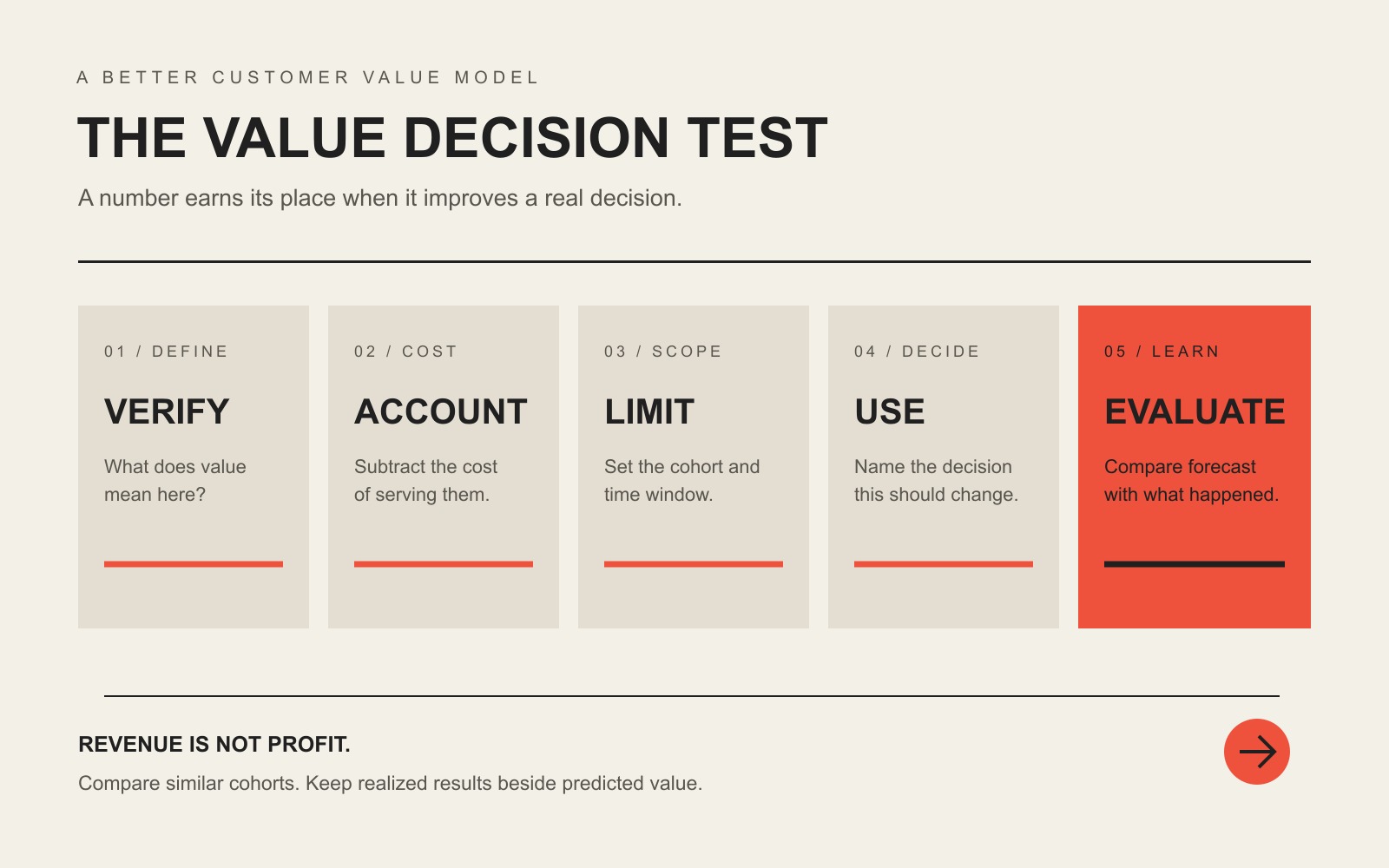
    The VALUE Decision Test: Verify the definition, Account for serving costs, Limit the cohort and time window, Use the measure for a named decision, and Evaluate forecasts against actual results.
    The Scope Design VALUE Decision Test: Verify, Account, Limit, Use, and Evaluate

    Verify: What does “value” mean in this model?

    Put the definition at the top of the dashboard.

    Bad:

    CLV: $18,420

    Better:

    Predicted 24-month gross-margin CLV for U.S. managed-service customers acquired through referrals, before CAC: $18,420.

    The second version tells a decision-maker what the number includes, whom it describes, how long it looks forward, and whether acquisition cost has been deducted. It is less sexy and vastly more useful.

    Account: Which costs change because this customer exists?

    List the costs required to win, onboard, deliver, support, retain, and expand the relationship. For service businesses, labor is often the missing monster under the bed.

    If a $10,000 account requires $7,500 in labor, subcontractors, travel, credits, and support, its economic value is not $10,000. If a $7,000 account requires $1,500 in variable cost and produces a clean referral, the smaller account may be the stronger relationship.

    Referrals can matter, but do not casually add the imagined value of every friend a customer might someday mention. Track referred customers as their own acquisition source. Credit influence only when you can observe it.

    Limit: Which customers and what time period?

    An all-customer average can hide the decisions you need to make. Segment by factors that plausibly change economics:

    • acquisition source;
    • first product or service;
    • customer type or industry;
    • project size;
    • geography;
    • onboarding path;
    • contract structure;
    • start month or quarter;
    • service tier;
    • right-fit versus exception-heavy work.

    Use a time window your data can support. A 12-month realized contribution figure can be more useful than a five-year prediction built from nine months of history and several heroic assumptions.

    Use: What decision will change?

    Name the decision and its rule.

    Examples:

    • Increase paid acquisition only when the lower-bound contribution estimate covers CAC and required payback.
    • Invest in onboarding for cohorts whose early service cost is high but later retention and margin are strong.
    • Stop promoting an offer that produces revenue but attracts exception-heavy, low-margin customers.
    • Create a higher service tier when a defined segment needs more support and will pay for the capacity required.
    • Build a retention intervention for profitable customers showing an observable risk signal.

    “Put CLV on the dashboard” is not a decision. It is interior decorating for analytics.

    Evaluate: Was the forecast remotely right?

    At a fixed interval, compare predicted and realized results by cohort:

    • revenue;
    • contribution;
    • retention or repeat purchase;
    • service hours and cost;
    • refunds or credits;
    • expansion;
    • acquisition cost;
    • forecast error.

    Then change the model or change the business. Do not keep a flattering formula merely because leadership already put it in a slide deck.

    Realized CLV versus predicted CLV

    Realized customer value is what a customer or cohort has actually produced so far. Predicted customer lifetime value estimates future contribution that has not happened yet.

    Both matter. They answer different questions.

    • Use realized value to audit performance, compare cohorts, and calibrate assumptions.
    • Use predicted value to make forward-looking acquisition, capacity, and retention decisions.
    • Never present predicted value with the certainty of booked revenue.

    Show a range when uncertainty is material. A base case, lower case, and upper case are more honest than a single number calculated to the cent. The further into the future you forecast, the more opportunity reality has to kick your assumptions in the shins.

    For noncontractual businesses, the challenge is even sharper because customers do not formally cancel. They simply stop buying, and you may not know whether they are gone or merely quiet. Fader and Hardie’s RFM and CLV research explains why recency, frequency, and monetary behavior can help forecast future value while distinguishing future-looking CLV from backward-looking customer profitability.

    Why cohort CLV beats one company-wide average

    A cohort is a group of customers sharing a meaningful starting point, source, offer, or characteristic. Cohorts let you compare relationships that began under different conditions.

    Imagine these hypothetical 12-month results:

    Acquisition cohortCustomersAverage revenueAverage contribution before CACAverage CACNet value after CAC
    Referral20$9,000$5,400$500$4,900
    Paid search45$8,400$3,200$1,400$1,800
    Discount promotion70$6,900$1,500$650$850

    These numbers are illustrative, not Scope Design performance claims. Their job is to show why a blended average can obscure the acquisition source, offer, or customer type driving the economics.

    The discount cohort produces the most customers and could make a lead-volume dashboard look busy and important. It also produces the weakest net value. If support capacity is tight, buying more of that volume may make the business worse faster.

    How to calculate customer lifetime value with limited data

    You do not need a data-science department or a machine-learning model that refers to itself as a platform.

    Start with a 12-month realized cohort table.

    Step 1: Choose the decision

    Example: Should we increase spending on paid search for Service A?

    Step 2: Define the cohort

    Customers whose first purchase of Service A came from paid search during the same quarter.

    Step 3: Collect actual revenue and direct relationship costs

    Track revenue collected, refunds, delivery labor, subcontractors, materials, customer-specific software, support, and acquisition cost.

    Step 4: Calculate realized contribution

    Realized contribution = Revenue collected − refunds − incremental delivery and service costs

    Step 5: Compare cohorts and months

    Look for retention, repeat purchase, expansion, margin, and service-cost patterns. Do not rely on one unusually good or catastrophic customer.

    Step 6: Build a conservative forecast range

    Use observed behavior to estimate the next period. Document the assumptions. Include a lower case that assumes weaker retention or higher service cost.

    Step 7: Set the decision rule

    Example: increase spend only if the lower-case 12-month contribution covers CAC, the payback period fits cash flow, lead quality remains acceptable, and delivery has capacity.

    That final sentence is the strategy. The formula supports it.

    What is a good customer lifetime value?

    There is no universally good CLV dollar amount. A good result depends on:

    • customer acquisition cost;
    • gross margin or contribution margin;
    • cash timing and payback period;
    • delivery capacity;
    • retention risk;
    • capital requirements;
    • customer concentration;
    • the reliability of the forecast;
    • the customer’s actual outcome.

    A $50,000 CLV can be bad if it costs $55,000 to acquire and serve the relationship, arrives years later, or depends on miserable delivery. A $5,000 CLV can be excellent if it requires $500 of CAC, pays back quickly, fits the team’s capacity, and produces a strong customer outcome.

    Compare like with like. Revenue CLV should not be divided by CAC and then compared with somebody else’s gross-profit ratio. That is not benchmarking. It is two unrelated fractions wearing matching name tags.

    What is a good CLV-to-CAC ratio?

    The CLV-to-CAC ratio compares expected customer value with the cost to acquire the customer:

    CLV:CAC = Customer lifetime value ÷ Customer acquisition cost

    You will often hear 3:1 described as healthy. Treat it as a rough screening heuristic, not a natural law.

    The ratio is only interpretable when:

    • CLV uses a clear profit or contribution definition;
    • CAC includes the relevant acquisition cost;
    • both numbers describe the same cohort;
    • the time horizon is explicit;
    • payback timing is acceptable;
    • the model accounts for uncertainty;
    • delivery capacity and customer outcomes remain healthy.

    A high ratio is not automatically good. It may mean the business is underinvesting in acquisition, overstating future retention, ignoring service cost, or serving a small set of customers while calling the constraint “efficiency.” A lower ratio may be entirely rational for fast payback, high-confidence retention, or strategically important growth.

    Also track CAC payback period. A promising lifetime ratio does not pay this month’s payroll if the contribution arrives three years from now.

    Five decisions customer lifetime value should improve

    1. Acquisition

    Compare net contribution and payback by source, campaign, offer, and customer type. Do not optimize ads for cheap leads that become expensive customers.

    2. Onboarding and customer success

    Find where early service cost, confusion, or failure predicts poor retention. Improve the handoff and initial outcome. The Scope Design customer-success metric system helps assign an outcome, window, evidence source, owner, and response rule rather than collecting decorative KPIs.

    3. Retention

    Spend retention effort where there is a credible risk signal, meaningful value at stake, and something the business can fix. Do not bribe every customer to stay. A bad-fit customer with negative contribution does not become strategic because the word “retention” sounds wholesome.

    Use the Scope Design loyalty strategy to distinguish earned loyalty from indiscriminate rewards. When the business caused a failure, use the service-recovery process rather than pretending a coupon repairs trust.

    4. Expansion

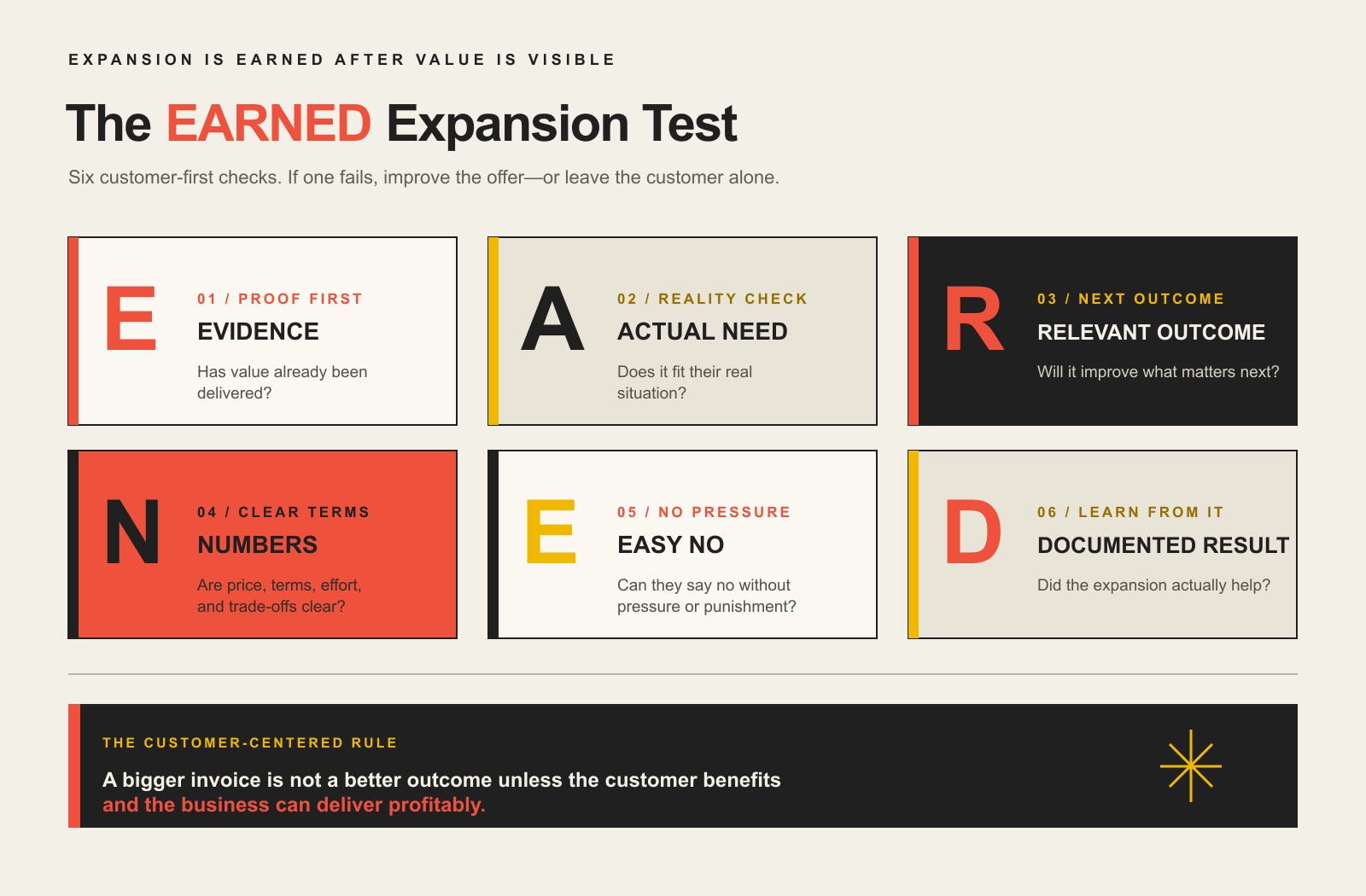
    Identify customers whose needs and outcomes justify more scope, capacity, or sophistication. Then use the EARNED Expansion Test so the recommendation is based on delivered value, actual need, relevance, transparent numbers, an easy no, and a documented result.

    CLV is not permission to extract the maximum possible invoice from a human being. The customer must receive value too.

    5. Pricing and service design

    If one customer segment consistently requires more support, customization, or risk, change the offer, process, qualification, price, or service boundary. Do not hide structural delivery problems inside an average margin and call the relationship valuable.

    When customer lifetime value is the wrong metric

    Do not force CLV into decisions it cannot support.

    CLV may be premature or misleading when:

    • there are too few customers or too little history;
    • the offer, pricing, or customer definition recently changed;
    • purchases are genuinely one-time and referrals cannot be measured;
    • customer-level revenue cannot be joined to service cost;
    • the business has a technical, traffic, offer, or sales-follow-up failure upstream;
    • one customer dominates the average;
    • the forecast window extends far beyond credible evidence;
    • the decision is primarily constrained by cash, capacity, regulation, or concentration risk.

    In those cases, use simpler evidence: 12-month realized contribution, project margin, repeat-purchase rate, cohort retention, CAC payback, qualified pipeline, or service hours per account.

    The best metric is the one closest to the business outcome that the team can actually influence. The website may create a qualified conversation; it cannot force a prospect to become a profitable five-year customer while the sales and delivery systems take the afternoon off.

    Common customer lifetime value mistakes

    Counting revenue as profit

    This is the classic mistake. It makes high-service, high-refund, or heavily discounted customers look more attractive than they are.

    Using one average for everybody

    Different cohorts have different acquisition costs, margins, retention patterns, and service needs. Segment before acting.

    Treating a forecast as an invoice

    Predicted future value is uncertain. Use ranges, state assumptions, and compare predictions with realized results.

    Adding hypothetical referral value

    Track real referrals and their economics. Do not assign every cheerful customer an imaginary downstream empire.

    Ignoring the time value of money

    For longer horizons or material amounts, discount future contribution. Money received later is not economically identical to money received now.

    Worshipping the 3:1 ratio

    The ratio can be a useful warning light. It cannot replace payback, cash flow, margin, capacity, fit, concentration, or forecast quality.

    Retaining customers at any cost

    Some relationships should be repaired. Some should be redesigned. Some should end cleanly. Lifetime value is not an instruction to keep every account forever.

    Measuring without assigning a response

    If a change in CLV produces no action, owner, or decision rule, stop spending hours polishing it.

    A practical CLV dashboard

    Keep the first version boring enough to trust.

    For each cohort, show:

    • cohort definition and start date;
    • number of customers;
    • realized revenue;
    • refunds and credits;
    • delivery and support cost;
    • realized contribution;
    • acquisition cost;
    • net value after CAC;
    • repeat-purchase or retention rate;
    • forecast window and assumptions;
    • predicted contribution range;
    • payback period;
    • forecast error when the period closes;
    • owner and decision rule.

    Review the model on a schedule that matches the buying cycle. Weekly analysis is absurd for a business whose customers purchase once a year. Annual review is equally useless for a monthly subscription hemorrhaging customers now.

    The bottom line

    Customer lifetime value is not the total amount you can squeeze from a customer before they escape. It is a model for understanding the economics of creating and sustaining a useful customer relationship.

    Calculate contribution, not fantasy revenue. Compare cohorts, not a vague company average. Use an explicit time window. Name the decision. Audit the prediction. Protect customer outcomes, delivery capacity, and cash flow while you do it.

    If your CLV model cannot tell you what to do differently on Monday, it is not intelligence. It is arithmetic wearing a lanyard.

    If you need help connecting acquisition, website behavior, sales handoffs, delivery cost, retention, and customer value into one operating model, Scope Design’s Impact Consulting starts with the constraint and the business decision, not a preselected deliverable.

    Frequently asked questions about customer lifetime value

    What is meant by customer lifetime value?

    Customer lifetime value is the expected economic value a customer will create over a defined relationship period. A useful CLV model states whether value means revenue, gross profit, contribution, or discounted future profit and identifies the customer cohort it describes.

    How do you calculate customer lifetime value?

    For repeat purchases, a basic formula is average purchase value multiplied by purchase frequency and customer lifespan. For business decisions, improve it by using gross margin or contribution after service costs, defining a time window, segmenting customers into cohorts, and comparing the forecast with realized results.

    What is the formula for customer lifetime value?

    A common revenue formula is average purchase value × purchase frequency × average lifespan. A common gross-margin formula is average revenue per period × gross margin percentage × expected lifespan. Service businesses often need a contribution model that subtracts incremental delivery and support costs from expected revenue.

    Are CLV and LTV the same thing?

    Usually. CLV, CLTV, customer LTV, and LTV are often used interchangeably. The more important question is what the calculation includes: revenue, gross profit, contribution, acquisition cost, discounting, cohort, and time horizon.

    What is a good customer lifetime value?

    There is no universal good dollar amount. CLV is good only relative to acquisition cost, margin, payback timing, cash flow, delivery capacity, forecast confidence, and the customer outcome. Compare similar customer cohorts using the same definition.

    What is a good CLV-to-CAC ratio?

    A 3:1 ratio is a common rough heuristic, not a universal standard. The ratio is meaningful only when CLV is profit-based, CAC is complete, both numbers describe the same cohort and time horizon, and payback, capacity, and uncertainty are acceptable.

    Should customer lifetime value use revenue or profit?

    Use revenue CLV only for a simple descriptive view. Use gross profit or contribution CLV for acquisition, retention, pricing, and service decisions because revenue ignores the cost required to create it.

    Should customer acquisition cost be included in CLV?

    Keep a pre-CAC contribution CLV and CAC visible separately so you can compare acquisition sources. You can then calculate net customer value by subtracting CAC. Whatever approach you use, label it clearly and do not compare ratios built from different definitions.

    How do you calculate CLV when there is no subscription?

    Use customer purchase history to model recency, frequency, monetary value, repeat-purchase probability, margin, and a defined forecast window. Because noncontractual customers do not formally cancel, use conservative ranges and compare predicted value with realized cohort results.

    Can a high-revenue customer have low lifetime value?

    Yes. Heavy support, customization, discounts, refunds, slow payment, rework, travel, and senior labor can consume the apparent value. Revenue-based CLV can make two customers look equal even when their contribution is dramatically different.

    How often should CLV be recalculated?

    Recalculate on a cadence that matches the buying cycle and whenever pricing, service delivery, acquisition channels, or customer behavior materially change. Always compare prior predictions with actual cohort results before updating the model.

    What is realized customer lifetime value?

    Realized value is the revenue or contribution a customer or cohort has actually produced to date. It is historical evidence. Predicted CLV estimates future value. Use realized results to calibrate and challenge the prediction.

    Why should CLV be calculated by cohort?

    Cohorts reveal differences hidden by one company-wide average. Customers acquired through different sources, offers, periods, or service tiers can have different margins, retention patterns, support costs, and payback periods.

    When should a business not use CLV?

    Do not rely on CLV when data is too thin, the business model recently changed, customer costs are unavailable, one customer dominates the average, or the forecast is more speculative than useful. Start with realized contribution, project margin, repeat purchase, retention, or CAC payback instead.


  • AI for Sales: 7 Practical Ways to Improve Sales Performance

    AI for Sales: 7 Practical Ways to Improve Sales Performance

    AI for sales works best as a decision-support and workflow layer around a sales team—not as a substitute for human judgment. Used well, it can research accounts, summarize conversations, suggest priorities, draft follow-ups, keep CRM records current, surface pipeline risk, and handle bounded inbound questions. The practical goal is not to make an AI “close deals.” It is to remove friction so people can spend more time diagnosing needs, making good promises, and building trust.

    That distinction matters because AI can scale a bad sales process just as efficiently as a good one. If nobody owns the lead, the CRM is unreliable, qualification rules are vague, or follow-up disappears into memory, adding another AI tool may simply make the mess move faster.

    Current sales platforms reflect this shift. Salesforce’s sales AI and HubSpot Sales Hub now describe features for research, summaries, lead or deal scoring, forecasting, meeting preparation, follow-up, and conversation intelligence. Those capabilities are useful—but the tool should come after the process decision.

    What Is AI for Sales?

    AI for sales is the use of artificial intelligence to help a sales team understand opportunities, reduce repetitive work, preserve customer context, and make better-informed next-step decisions. Depending on the workflow, that may include generative AI for writing and summarization, machine-learning models for scoring or forecasting, conversation intelligence for call analysis, or conversational AI for answering and routing inbound questions.

    The useful question is not, “Where can we add AI?” It is, “Where is the sales process losing time, context, consistency, or opportunities?” Scope Design uses the same constraint-first logic we recommend for broader marketing and growth decisions: diagnose the bottleneck before choosing the tactic.

    Use the Scope Design SCOPE AI Sales Test First

    Before automating a sales task, run it through five questions. We call this the SCOPE AI Sales Test. It is an operating framework, not a promise that every business needs the same software or the same level of automation.

    • S — Sales constraint: What bottleneck are we actually trying to fix?
    • C — Clean context: What data is trustworthy, current, and permitted for the AI to use?
    • O — Owner + override: Who reviews exceptions and can reverse or reject the AI’s recommendation?
    • P — Pipeline proof: Which downstream sales outcome will tell us whether the workflow helped?
    • E — Escalation boundary: When must the AI stop and hand the situation to a person?

    This test keeps the implementation grounded. If the sales constraint is slow follow-up, a sophisticated forecasting model is not the first project. If the CRM contains duplicate companies, stale stages, and missing next steps, feeding that data into AI does not make it clean. And if nobody can explain when the AI should defer to a human, the automation is not ready.

    For the broader workflow-design side of this problem, our guide to AI automation for business goes deeper on when automation earns its place and how to build around the real process instead of the demo.

    7 Practical Ways to Use AI for Sales

    1. Prioritize Leads and Deals Without Letting AI Make the Final Call

    Lead and opportunity prioritization is one of the clearest uses of AI for sales. A system can combine known fit criteria, recent activity, CRM history, stage age, engagement signals, and other approved data to help a rep decide what deserves attention first.

    The important word is prioritize, not reject. A score should help a person inspect the pipeline, not become an invisible rule that automatically discards unusual opportunities. Historical sales data can contain the habits and blind spots of the old process. If yesterday’s team systematically ignored a good segment, a model trained on yesterday may learn to ignore it too.

    • Useful inputs: explicit fit criteria, lifecycle stage, recency, buying signals, account history, and known next steps.
    • Human boundary: require review before disqualifying high-value, unusual, sensitive, or strategically important opportunities.
    • Measure: qualification-to-opportunity movement, false-negative reviews, rep response patterns, and whether good opportunities spend less time unattended.

    2. Research Accounts and Prepare Better Sales Conversations

    Sales research is a strong AI use case because the output is preparation, not the customer-facing promise itself. AI can summarize a prospect’s website, CRM history, prior emails, open support issues, public announcements, and previous meeting notes into a brief that helps the rep enter the conversation with context.

    At Scope Design, our sales notes keep returning to the same principle: educate and listen before trying to close. Better preparation should produce better questions—What made this a priority now? What happens after someone contacts you? What would make this project worth the investment?—not a longer monologue about the seller’s tools.

    A practical AI research brief might contain the company’s apparent business model, relevant services, recent interactions, known stakeholders, unresolved questions, likely risks, and five discovery questions. The rep should verify time-sensitive facts before using them. AI-generated research is a starting point for attention, not a substitute for reading the source.

    • Useful inputs: prospect URL, approved CRM data, previous conversations, proposals, and account notes.
    • Human boundary: verify claims, contacts, pricing, organizational changes, and anything that could materially affect the conversation.
    • Measure: prep time, discovery completeness, useful notes captured, and whether the next step becomes clearer after the call.

    3. Draft More Relevant Outreach and Follow-Up

    AI can draft prospecting emails, recap calls, suggest follow-up language, and adapt a reusable message structure to the actual account context. This is much more useful than “personalization” that merely inserts a first name and a scraped compliment.

    A good follow-up adds something: a clarified next step, an answer, a screenshot, a comparison, a relevant resource, or a reminder tied to the prospect’s stated timing. Scope Design’s working rule is simple: every real opportunity should have a next follow-up date. AI can help create the draft and the task; a person still owns the reason for reaching out.

    Human review is especially important for higher-value outreach. HubSpot’s current AI prospecting agent, for example, includes a review-before-send option. That is a useful design pattern even if you use a different platform: let AI reduce writing friction without giving it unlimited permission to speak for the business.

    Also design the handoff after the response. Our guide to marketing assets and sales handoffs treats routing, qualification questions, CRM ownership, response templates, follow-up rules, and closed-won/closed-lost reasons as part of the same operating system. A polished email does not matter much if the reply has nowhere dependable to go.

    • Useful inputs: the prospect’s stated problem, prior messages, relevant proof, next-step rules, and approved messaging.
    • Human boundary: review pricing, commitments, guarantees, scope, legal claims, and sensitive situations before sending.
    • Measure: qualified replies, meetings held, opportunities advanced, follow-up completion, and opt-outs—not open rate alone.

    4. Automate CRM Cleanup and Sales Admin Without Automating Judgment

    CRM administration is exactly the kind of friction AI should reduce. After a meeting, a sales assistant can summarize the call, identify stakeholders, suggest fields to update, create a follow-up task, attach notes to the right company, and flag missing information. It can also surface records that have no owner or no next action.

    But do not let the automation silently rewrite the meaning of the pipeline. A deal should not move from “discovery” to “proposal” just because a transcript contained the word “budget.” Stage definitions, qualification criteria, and required evidence still belong to the sales process.

    Data permission matters too. The Federal Trade Commission has warned AI companies and businesses to honor privacy and confidentiality commitments, including when customers provide internal or user data. Before connecting email, CRM, call recordings, proposals, or customer records to an AI system, understand what the provider retains, how the data may be used, who can access it, and how it can be removed.

    • Useful inputs: calls, emails, calendar events, contact records, account records, and explicit stage rules.
    • Human boundary: approve stage changes, material record merges, commitments, disqualification, and exceptions.
    • Measure: percentage of active opportunities with an owner and next step, correction rate, overdue follow-ups, and admin time.

    5. Analyze Sales Conversations for Patterns and Coaching

    Conversation intelligence can turn calls and meetings into searchable summaries. A team can use AI to extract questions, objections, commitments, competitors mentioned, follow-up items, and recurring themes across conversations. That creates a useful feedback loop between sales, marketing, service, and product decisions.

    The safest use is evidence retrieval and pattern finding—not pretending a model can read someone’s mind. Treat “sentiment,” “intent,” or personality-style labels as uncertain signals, especially when the model cannot show how it reached them. For recording and transcription, follow applicable consent, employment, privacy, and industry requirements.

    NIST’s Generative AI Profile for the AI Risk Management Framework emphasizes governance practices such as human review, documentation, monitoring, and management oversight where the context warrants them. In a sales workflow, that translates into a practical rule: keep the evidence available, let people inspect the output, and name the person accountable for decisions made from it.

    • Useful inputs: approved recordings/transcripts, CRM outcomes, objection tags, call notes, and coaching criteria.
    • Human boundary: do not treat inferred emotion, sensitive traits, or automated coaching scores as unquestionable truth.
    • Measure: follow-up completeness, recurring objections resolved, coaching actions completed, and whether call notes become more usable downstream.

    6. Forecast Pipeline and Surface Risk Earlier

    AI can help a sales manager inspect the pipeline by highlighting deals with missing next steps, unusual stage age, weak activity, changing stakeholders, unresolved objections, or gaps between the CRM record and recent conversations. It can also summarize why a forecast changed instead of leaving the manager to compare rows manually.

    The mistake is turning a forecast into an oracle. A prediction is only as useful as the stage definitions, historical data, business conditions, and inputs behind it. New offers, seasonal work, a new territory, a major pricing change, or an unusual account can all make historical patterns less informative.

    Use AI to make risk visible and reviewable. Ask it to show the missing evidence, explain the factors behind a flag, and help a manager decide what needs inspection. Keep the actual forecast accountable to a named person.

    • Useful inputs: stage history, next actions, activity recency, amount, close-date changes, stakeholder activity, and outcome history.
    • Human boundary: managers own commit decisions, exceptions, strategic accounts, and any override of the model.
    • Measure: forecast error over time, stale-stage rate, missing-next-step rate, and whether identified risks are acted on.

    7. Qualify Inbound Conversations and Hand Them to the Right Person

    Conversational AI can earn its keep when the job is narrow: answer approved questions, collect the reason for contact, capture basic fit information, schedule a meeting, route the request, and preserve the conversation context for the human who takes over.

    The handoff is the important part. A warm handoff transfers the person, their question, the context already collected, what the AI attempted, and the next expected action. A cold handoff dumps the visitor onto a generic inbox and makes them repeat everything.

    Our AI chatbot guide goes deeper on approved knowledge, permissions, escalation triggers, and human escape paths. The broader customer lifecycle management guide explains why ownership and context must survive the transition from inquiry to qualification, sales, onboarding, and ongoing service.

    • Useful inputs: approved FAQs, service area, fit questions, scheduling rules, contact data, and routing rules.
    • Human boundary: escalate when the customer requests a person, the answer is uncertain, the issue is sensitive, or the requested commitment exceeds the AI’s authority.
    • Measure: qualified handoffs, successful bookings, abandonment, escalation quality, repeated questions, and corrections—not conversation volume alone.

    How to Choose AI Sales Tools Without Buying a Tool Pile

    There is no single “best AI for sales” because sales teams do different jobs with different systems, data, risks, and volumes. Choose the workflow first, then evaluate tools against the job.

    QuestionWhy it matters
    What exact sales job does the tool perform?“AI assistant” is too broad. Name the task: research, note capture, follow-up, scoring, forecasting, routing, or another defined job.
    What data does it need?You need to know which CRM objects, emails, calls, files, calendars, or web sources become inputs.
    Can a person review and override the output?Approval, edit history, confidence signals, and clear exception handling matter when the AI can affect customers or pipeline decisions.
    What happens to your data?Check retention, model-training terms, access controls, permissions, deletion, export, and contractual commitments.
    Does it preserve evidence?A useful system should let you inspect the source, transcript, record, or reasoning context behind important recommendations.
    Does it fit the CRM and workflow you already use?Copying context between disconnected tools can create more work and more data drift.
    How will you measure the result?Decide the baseline, outcome, guardrail, and stop rule before the pilot becomes permanent.

    The product name matters less than whether the workflow remains auditable. That is the same principle we use when evaluating AI for market research: accuracy, traceability, privacy, exportability, and access to the underlying evidence matter more than a flashy demo.

    A 30-Day AI for Sales Pilot

    Do not start by “transforming sales with AI.” Start with one bounded workflow that can produce useful evidence in a month.

    Week 1: Baseline One Sales Constraint

    • Pick one bottleneck: slow follow-up, incomplete CRM notes, inconsistent call preparation, stale deals, weak handoffs, or another observable problem.
    • Document the current process and owner.
    • Choose one primary outcome plus one or two guardrails.
    • Identify which data is allowed and reliable enough to use.

    Week 2: Configure the Smallest Useful Workflow

    • Connect only the systems the use case actually requires.
    • Define what the AI may read, suggest, create, or change.
    • Create the human review and escalation path.
    • Test ordinary cases, edge cases, wrong data, missing data, and ambiguous requests.

    Week 3: Run a Bounded Live Pilot

    • Use a limited group of reps, accounts, lead sources, or activities.
    • Log edits, overrides, failures, and escalations instead of hiding them.
    • Keep the old process available when the new workflow fails.
    • Collect qualitative feedback from the people doing the work.

    Week 4: Compare, Correct, Expand—or Stop

    • Compare the pilot outcome with the baseline.
    • Check downstream effects, not just activity inside the AI tool.
    • Review errors, customer friction, data-quality problems, and staff workarounds.
    • Expand only if the workflow improved the real sales constraint without creating unacceptable risk or hidden work.

    A Worked Example: AI-Assisted Sales for a Service Business

    Consider a hypothetical commercial cleaning company. A facilities manager submits an inquiry because the current vendor has recurring service and communication problems. The company wants to improve response and preparation without letting AI quote complex work or decide whether the prospect is a fit.

    • Inquiry: the website form captures location, facility type, approximate scope, timing, and the reason for considering a change.
    • AI preparation: the system creates the CRM record, summarizes the request, checks approved public account information, and proposes discovery questions.
    • Human qualification: the sales owner reviews service area, scope, timing, operational capacity, and the prospect’s real concern.
    • Follow-up: AI drafts a concise recap around switching risk, access coordination, and next steps; the rep edits and sends it.
    • Next action: the CRM receives an owner, due date, walkthrough task, and the reason the opportunity did or did not advance.
    • Boundary: AI does not invent pricing, promise staffing, guarantee service outcomes, or automatically disqualify an unusual facility.

    The value comes from context moving cleanly through the system. The rep still diagnoses the need and makes the promise. AI helps make sure the research, notes, follow-up, and next action do not disappear between tools.

    How to Measure Whether AI Is Improving Sales

    AI sales ROI should be measured against the bottleneck the pilot was designed to fix. Do not call the project a success because the AI generated more emails, summaries, scores, or chatbot conversations. Activity is useful only when it improves the sales system downstream.

    Metric layerExamplesWhat it tells you
    OperationalTime to first useful response, prep time, admin time, follow-up completionWhether the workflow removes friction
    Data qualityOpportunities with an owner and next step, missing fields, correction rateWhether AI improves or pollutes the system of record
    QualificationQualified-to-opportunity movement, meetings held, disqualification reasonsWhether attention is reaching better-fit work
    Sales outcomeSales cycle, win rate, margin, revenue from affected opportunitiesWhether operational improvements eventually reach business results
    Risk and trustOverrides, escalations, incorrect drafts, complaints, opt-outsWhether automation creates hidden customer or governance costs

    For small sales volumes, do not demand fake statistical certainty. Use a sensible baseline, inspect individual cases, compare affected opportunities where possible, and combine quantitative outcomes with rep and customer evidence. If a workflow saves minutes but creates inaccurate promises, it is not an improvement.

    AI for Sales FAQ

    Can you use AI for sales?

    Yes. AI can support sales research, prioritization, follow-up, CRM administration, call analysis, forecasting, and bounded inbound qualification. The strongest implementations give AI a narrow job, reliable context, a human owner, a measurable outcome, and a clear escalation path.

    Which AI is best for salespeople?

    The best AI depends on the sales job and the systems you already use. A team that needs CRM cleanup should evaluate a different workflow than a team that needs call analysis or account research. Prioritize fit with your CRM, data controls, review/override features, source traceability, exportability, and measurement—not a generic “best AI” ranking.

    Can AI replace sales reps?

    AI can replace pieces of repetitive sales work, but it should not be treated as a universal replacement for discovery, judgment, negotiation, accountability, or relationship management. In complex service sales, the buyer often needs someone who can interpret context, make a responsible promise, handle exceptions, and coordinate the next step.

    What sales task should a small business automate first?

    Start with a frequent, low-risk task tied to an observable bottleneck. Good candidates include call summaries, research briefs, follow-up task creation, CRM field suggestions, meeting recaps, or approved FAQ routing. Avoid starting with autonomous pricing, automatic disqualification, or customer-facing promises.

    What data does AI sales software need?

    It depends on the use case. Common inputs include CRM records, account activity, emails, meetings, transcripts, website or public account information, stage history, and approved knowledge. Use the minimum data needed for the job, check provider retention and training terms, and keep access permissions appropriate to the sensitivity of the information.

    How do you measure AI sales ROI?

    Compare the cost and effort of the workflow with the bottleneck it was designed to improve. Track operational changes such as response time or admin work, then follow the affected opportunities into qualification, sales cycle, win/loss, margin, and revenue where the sample is meaningful. Include correction, escalation, and customer-friction costs so the ROI calculation does not ignore the downside.

    What should you not automate in sales?

    Do not automate judgment merely because a model can produce an answer. High-stakes commitments, unusual exceptions, sensitive decisions, unverified claims, relationship recovery, pricing outside clear rules, or anything with meaningful legal, financial, privacy, or reputational consequences should have an explicit human decision owner.

    Put AI Around the Sales Process—Not in Charge of It

    The most useful AI for sales is often less dramatic than the demo. It prepares the rep. It remembers the next action. It cleans the record. It turns a call into usable context. It spots a stalled opportunity. It hands an inbound conversation to the right person without making the customer start over.

    Start with the sales constraint, not the subscription. Give the AI clean context, a human owner, a downstream metric, and an escalation boundary. Then automate the smallest useful step, measure what happens, and expand only when the evidence earns it.

    If your sales problem crosses the website, forms, CRM, follow-up, automation, and customer handoffs, Scope Design can help map the operating workflow before another disconnected tool gets added to the pile.

  • 15+ Advanced Testimonial Strategies That Drive Sales – Video & Social Proof Mastery

    15+ Advanced Testimonial Strategies That Drive Sales – Video & Social Proof Mastery

    Testimonial marketing works when customer proof answers a specific buyer doubt at the moment that doubt matters. It works a lot less well when you dump fifteen glowing quotes on a page, call it “social proof,” and hope the visitor connects the dots.

    The advanced move is to treat testimonials as a routed evidence system: capture a real customer story, verify what it actually proves, match it to the right objection, place it in the right format, and measure what happens next. That is the difference between a testimonial library and a sales asset.

    TL;DR: Stop Collecting Praise. Start Routing Proof.

    • Build a Proof Card for every testimonial so you know the customer, context, claim, evidence, permission/disclosure status, usable formats, best-fit objections, and review date.
    • Put proof near the decision it supports: price proof near pricing, risk proof near forms, implementation proof near process explanations, and outcome proof near calls to action.
    • Create one strong source interview or video, then cut it into the formats each channel actually needs.
    • Keep testimonials truthful, substantiated, properly disclosed, and compliant with the rules of the platform where they appear.
    • Measure qualified downstream behavior—not the number of quotes you managed to publish.

    Testimonial Marketing Works Better as a Proof Routing System

    Most testimonial programs have a collection problem only because nobody designed the system after collection. A happy customer sends a paragraph. Someone crops it into a graphic. Another person drops it on Instagram. Six months later nobody remembers whether the customer approved the edit, what result the quote actually supports, or which page it was supposed to help.

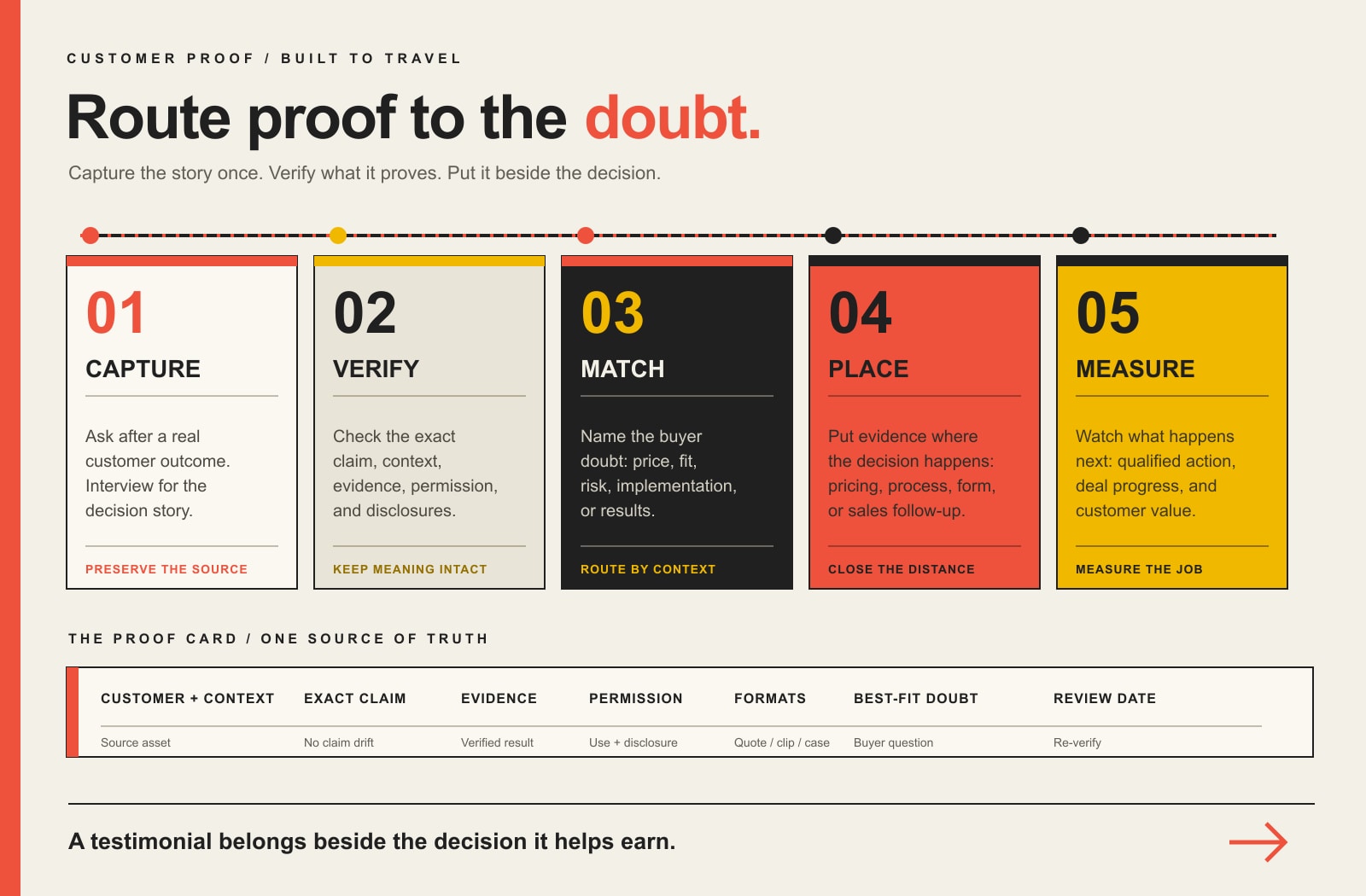
    Scope Design’s Proof Routing System uses five decisions: Capture, Verify, Match, Place, Measure. The point is not bureaucracy. The point is stopping good proof from turning into sloppy claims.

    The proof routing system captures customer stories, verifies claims and permission, matches proof to buyer doubts, places it near the decision, and measures downstream behavior; each Proof Card records context, claim, evidence, usage, formats, best-fit doubts, and review date.

    This also keeps this advanced playbook separate from our foundational guide to customer testimonials that sell without making things up. That article owns the basics of getting credible customer language. This one is about what happens after you have the raw proof.

    Build a Proof Card Before You Reuse Anything

    A Proof Card is a small source-of-truth record attached to each usable customer story. It prevents the classic “we have a great quote somewhere” mess and gives sales, marketing, and web teams the same evidence to work from.

    Proof Card fieldWhat to recordWhy it matters
    Customer + contextWho they are, industry, situation, product/service usedLets a prospect decide whether the story is relevant
    Exact claimWhat the customer is actually saying happenedStops vague praise from becoming an inflated promise
    EvidenceNumbers, dates, screenshots, project records, or clearly labeled opinionSeparates proof from enthusiasm
    Permission + disclosureWhere it may be used, attribution allowed, incentives/material connectionsReduces legal, platform, and relationship risk
    Usable formatsFull video, short clip, quote, case study, email excerpt, sales deckMakes repurposing intentional
    Best-fit doubtsPrice, fit, risk, implementation, service, results, switchingDetermines where the proof belongs
    Review dateWhen to confirm the claim is still current and representativeKeeps old proof from outliving the facts behind it

    17 Advanced Testimonial Strategies

    1. Trigger the Ask After a Meaningful Outcome

    Do not automate the request around an arbitrary calendar date. Ask when the customer has actually experienced something worth describing: a successful launch, a resolved problem, a measurable milestone, a smooth handoff, a renewal, or a moment when the customer says some version of “that made my life easier.” Timing around evidence produces better raw material than timing around “30 days since purchase.”

    2. Interview for Decisions, Not Compliments

    “How was your experience?” invites beige praise. Better questions expose the buying decision: What were you worried about? What did you try before? Why did you choose this approach? What surprised you? What changed afterward? What would you tell somebody with the same hesitation?

    3. Capture One Rich Source Asset

    A recorded customer interview can become a full testimonial video, short clips, written quotes, a case-study section, sales-deck proof, email snippets, and social posts. Capture once at high quality, then derive. Repeatedly asking the same customer for another version of the same story is a good way to make advocacy feel like unpaid employment.

    4. Tag Proof by Situation, Not Just Customer Name

    “Acme testimonial” is a weak retrieval system. Tag proof by industry, company size, service, use case, objection, buying stage, result type, and channel. When sales needs a switching story for a skeptical manufacturer, the right proof should be findable in seconds.

    5. Set a Claim Floor Before Marketing Touches It

    Decide what the source actually proves before turning it into copy. “We launched two weeks earlier than our old process” is not permission to write “cut launch time in half” unless the underlying facts support that calculation. The testimonial is evidence; it is not a coupon for creative arithmetic.

    6. Keep the Original Beside Every Edited Version

    Editing for length and clarity is normal. Meaning drift is not. Preserve the original transcript, email, review, or recording beside the approved derivative so anyone can check whether the short version still reflects the customer’s experience. If a five-word pull quote changes the claim, it is not an edit. It is new copy wearing the customer’s name tag.

    7. Record Permission and Material Connections

    Track where the customer approved use of their name, company, image, voice, metrics, and story. Also record compensation, free products, discounts, employment, ownership, or other connections that could affect how an audience evaluates the endorsement. The operational goal is simple: nobody should have to reconstruct the disclosure story six months later from Slack archaeology.

    8. Map Every Testimonial to One Buyer Doubt

    Instead of asking “Where can we put testimonials?” ask “What doubt is slowing the decision?” Price proof can show why the investment was justified. Implementation proof can show that onboarding did not become a dumpster fire. Service proof can show what happened when something went wrong. Switching proof can explain why a customer left another provider.

    9. Match the Customer Context to the Prospect Context

    A recognizable logo can attract attention, but relevance usually does more work than fame. A local contractor may care more about another contractor’s scheduling problem than a national brand’s broad praise. Use industry, scale, geography, use case, and risk profile to decide which proof earns the slot.

    10. Build an Objection-to-Proof Matrix

    List the five or six doubts you hear most often, then identify the strongest proof asset for each. If one objection has twelve testimonials and another has zero, you do not have a “more testimonials” problem. You have a coverage problem. That gap should influence what you ask future customers to discuss.

    11. Separate Reviews, Testimonials, and Case Studies by Job

    Reviews are broad public feedback. Testimonials are selected advertising messages. Case studies are deeper evidence packages. They can share source material, but they are not interchangeable. If your main problem is generating genuine Google feedback, use a dedicated Google review generation strategy rather than forcing a testimonial workflow to do the wrong job.

    12. Put Proof Beside the Decision, Not in a Testimonial Museum

    A dedicated testimonial page can be useful as an archive, but it should not be the only place proof exists. Place relevant proof near pricing, service explanations, comparisons, forms, product details, implementation steps, and calls to action. Good placement reduces the distance between the buyer’s question and the evidence that answers it.

    13. Build a Video Master, Then Cut by Use

    Do not make a 90-second website video and shove the same file everywhere. Build one strong master interview, then create deliberate cuts for the homepage, service page, social ad, email, sales follow-up, and longer case-study context. Our guide to business video formats and when to use them helps choose the container after you know the communication job.

    14. Let Sales Trigger the Right Proof

    Store proof where sales can actually use it. A CRM field, proposal component, email snippet library, or sales-enablement page can route proof based on objection or deal stage. The goal is not more content in the CRM. It is fewer moments where a salesperson says, “I know we have a customer who talked about this somewhere.”

    15. Feed Proof Back Through the Customer Lifecycle

    The strongest testimonial systems connect delivery, customer success, sales, and marketing. Delivery knows what changed. Customer success knows when the customer recognized value. Sales knows which objections are recurring. Marketing knows which channels need proof. That is the same handoff problem we address in our customer lifecycle management framework: evidence gets stronger when the handoffs stop dropping context.

    16. Instrument the Behavior Around Proof

    Track what a visitor can do after encountering proof: open the video, continue to pricing, start a form, complete an inquiry, book a call, reply to an email, advance in the sales process, or become a qualified opportunity. A testimonial can influence a decision without being the only cause, so avoid fake precision. Measure directionally and compare similar experiences.

    17. Rotate, Retire, and Re-Verify Proof

    Customer proof can age. The product changes. The customer changes roles. The metric stops representing a typical outcome. The company gets acquired. Set a review date, re-check high-stakes claims, and retire proof that no longer fits. Reputation work is easier when monitoring and response are part of the operating system, not a panic button; our online reputation management guide goes deeper on that discipline.

    Video Testimonials: Build One Source Asset, Then Cut by Use

    A useful video testimonial gives the viewer enough context to understand who is speaking, what problem existed, why the customer chose the solution, what changed, and how confident they are in the result. Pretty lighting cannot rescue an empty story.

    There is no magic universal length. Current guidance from testimonial-video producer Wyzowl uses roughly 60–90 seconds for many standard testimonial videos, shorter 30–45 second cuts for social/paid uses, and longer 2–3 minute versions when the story needs more detail or supports a sales presentation. Treat those as production benchmarks, not conversion laws. The right length is the shortest version that preserves the context needed for the placement.

    • Homepage: one clear problem and outcome, with a route to deeper proof.
    • Service page: focus on fit, process, and the objection specific to that service.
    • Social/paid: start at the strongest relevant moment; do not burn ten seconds introducing the company if the viewer needs the customer problem first.
    • Sales follow-up: include enough context to mirror the prospect’s situation.
    • Case study: keep the detail that proves how the result happened, not just the victory lap.

    Audio matters. Captions matter too. WCAG 2.2 Success Criterion 1.2.2 requires captions for prerecorded audio content in synchronized media at Level A when you are conforming to that standard. Captions also make the story usable when sound is unavailable. Keep a transcript in the Proof Card even when the final experience is video-first.

    Testimonial Compliance: Truth, Permission, Disclosures, and Platform Rules

    In the United States, testimonial marketing is advertising. That matters because the customer’s words do not give the advertiser permission to communicate something deceptive.

    The FTC’s Consumer Reviews and Testimonials Rule took effect on October 21, 2024. Among other things, it addresses fake or false reviews and testimonials, incentives conditioned on a required positive or negative sentiment, certain insider reviews, review suppression, and fake indicators of social media influence. The FTC also makes an important distinction: when a business takes a consumer review and features it in advertising or marketing, that content can become a testimonial rather than merely a hosted review.

    The FTC’s Endorsement Guides also say endorsements must be truthful and not misleading, and material connections that could affect how people evaluate an endorsement should be disclosed. If a testimonial communicates an atypical result, advertisers may need to explain what consumers can generally expect; a vague “results may vary” line is not a magic shield.

    Platform rules can be stricter than the federal baseline. Google’s review policies, for example, prohibit incentivized reviews and selective solicitation of positive reviews. So “the FTC allows an incentive if it is not tied to positive sentiment” does not mean “pay people to leave Google reviews.” Check the policy of the platform where the review is being collected or displayed.

    This is general operational guidance, not individualized legal advice. For high-risk claims, regulated industries, unusual incentive programs, or disputes about rights and disclosures, use qualified counsel.

    How to Measure Whether Testimonials Are Actually Helping

    Do not report “we added seven testimonials” as a success metric. That is inventory. The useful question is whether the proof reduced friction around a real decision.

    PlacementUseful behavior to watchWhat not to claim
    Pricing pagePricing-to-inquiry progression, form starts/completions, qualified lead rateThat the testimonial alone caused the lead
    Service pageCTA clicks, deeper service-page engagement, inquiry qualityThat more time on page automatically means more persuasion
    VideoStarts, meaningful watch depth, clicks after viewingThat a view equals trust or purchase intent
    Email or sales follow-upReplies, meetings, stage progression, objection resolutionThat every advanced deal moved because of one proof asset
    Social/paidQualified destination behavior after the ad, not just engagementThat likes are revenue wearing a tiny hat

    Use the same discipline we recommend for customer success metrics: define the behavior, owner, denominator, and decision the metric is supposed to change. If traffic is small, run bounded tests, compare periods carefully, and be modest about causation.

    A 30-Day Testimonial Marketing Rollout

    Week 1: Inventory and Map

    Collect the existing quotes, reviews, videos, emails, case studies, screenshots, and sales stories. Build Proof Cards for the strongest material. List the top buyer doubts and mark which ones have credible proof.

    Week 2: Capture the Gaps

    Choose customers whose situations cover missing objections or segments. Ask decision-based questions. Get explicit usage permission and record any connection or incentive that may require disclosure.

    Week 3: Route and Produce

    Create the master assets, then derive channel-specific cuts. Add the strongest proof to high-intent pages, sales follow-ups, and the specific campaigns where it can answer a known doubt.

    Week 4: Instrument and Review

    Confirm tracking, establish the comparison window, and watch qualified behavior. Record what changed and what did not. Keep the proof that earns its place. Move, rewrite, or retire the rest.

    Frequently Asked Questions About Testimonial Marketing

    What is testimonial marketing?

    Testimonial marketing is the intentional use of customer endorsements or customer-derived proof in advertising, websites, sales material, email, social media, and other marketing. The advanced version does not merely display praise; it matches credible proof to a specific buyer question or objection.

    What are good examples of testimonial marketing?

    Useful examples include an ROI-focused customer quote beside pricing, an implementation story beside a process section, a short video answering a switching objection, a case-study excerpt in a proposal, and a customer clip in a retargeting campaign that mirrors the audience’s use case.

    How long should a video testimonial be?

    There is no universal ideal. A common vendor benchmark is roughly 60–90 seconds for a standard testimonial, shorter cuts for social or paid media, and longer versions for detailed sales or case-study use. Choose the shortest edit that preserves the context needed for the decision you are supporting.

    What is the best software for collecting testimonials?

    The best tool is the one that fits your collection method, consent requirements, video workflow, CRM, publishing stack, and review-platform rules. Do not buy software before defining the Proof Card fields and routing process; otherwise you automate a messy system faster.

    How many testimonials should a website show?

    There is no evidence-based universal number. Show enough relevant proof to answer the important doubts without burying the page in repetitive praise. One specific, well-matched testimonial can be more useful than a carousel of eight generic compliments.

    Can you pay or incentivize people for testimonials?

    Sometimes, but the rules depend on the context. FTC guidance does not categorically ban every incentive, but compensation cannot be conditioned on a required positive or negative sentiment under the Reviews and Testimonials Rule, and material connections may require disclosure. Specific platforms can be stricter: Google prohibits incentivized reviews. Separate testimonial advertising from third-party review-platform policy before designing an incentive.

    Can you edit a customer testimonial?

    Edit for clarity or length only when the edited version remains truthful and does not change what the customer experienced or claimed. Preserve the original, document approval when appropriate, and never turn a qualified statement into a guarantee.

    Are fake testimonials illegal?

    In the United States, the FTC’s Consumer Reviews and Testimonials Rule prohibits specified conduct involving fake or false consumer reviews and testimonials and allows civil penalties for knowing violations. The details are fact-specific, so businesses should use the FTC’s current guidance or qualified counsel for legal decisions.

    Build a Proof System, Not a Wall of Love

    The best testimonial marketing system makes customer evidence easier to trust, easier to find, and harder to misuse. Capture the story. Verify the claim. Match it to a doubt. Place it where the decision happens. Measure what changes.

    If your website, campaigns, and sales process have plenty of happy-customer material but no coherent proof architecture, Scope Design can help map the objections, content, destinations, and measurement into one system. See our Advertising & Marketing services and bring the proof you already have. We can figure out what deserves a bigger job.

  • Customer Service Recovery: Handle Refund Requests Without Making It Worse

    Customer Service Recovery: Handle Refund Requests Without Making It Worse

    Customer service recovery is the process of finding out what failed, making a fair and proportionate repair, communicating the decision clearly, and fixing the system that caused the failure. When a customer asks for a refund, the goal is not to perform a loyalty magic trick. It is to determine what was promised, what was delivered, what the customer is entitled to, and whether the right outcome is rework, a refund, credit, or a clean exit.

    That sounds less sexy than “turn every refund into a customer for life.” It is also substantially less full of crap.

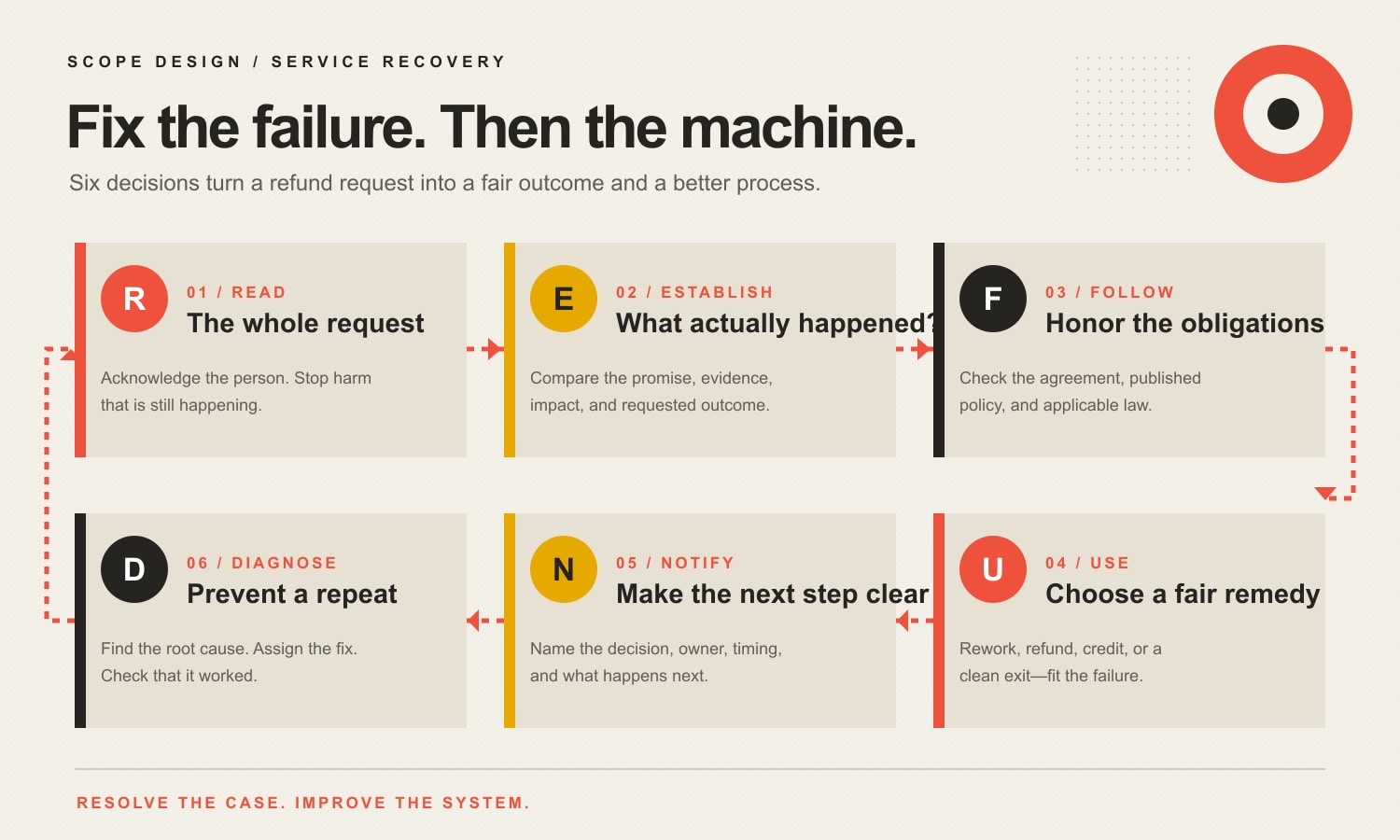
    TL;DR: Stop treating refund requests as isolated customer-service tickets. Use Scope Design’s REFUND Recovery Loop: Read the request and stop ongoing harm; Establish the facts; Follow the contract, policy, and law; Use a proportionate remedy; Notify the customer with an owner and deadline; and Diagnose the root cause so the same failure does not keep collecting victims.

    This article provides general U.S. business guidance, not legal advice. Refund, cancellation, warranty, licensing, and consumer-protection requirements vary by transaction, industry, contract, and jurisdiction.

    Table of contents

    1. What is customer service recovery?
    2. Why the “refund equals loyalty” promise is shaky
    3. The REFUND Recovery Loop
    4. Step 1: Read the request and stop ongoing harm
    5. Step 2: Establish the facts
    6. Step 3: Follow the contract, policy, and law
    7. Step 4: Use the right remedy
    8. Step 5: Notify the customer clearly
    9. Step 6: Diagnose the root cause
    10. What should a refund response say?
    11. What should you track?
    12. Which service-recovery metrics matter?
    13. What should you never do?
    14. How to build a usable recovery system
    15. Frequently asked questions

    What is customer service recovery?

    Customer service recovery is a planned response to a product, service, communication, billing, or delivery failure. It includes acknowledging the problem, investigating what happened, choosing a fair remedy, following through, and feeding the lesson back into operations.

    The important word is planned. A good recovery process does not depend on whether the customer reaches your nicest employee, catches the owner between meetings, or writes an angry enough email to win the escalation lottery.

    The current ISO 10002 complaints-handling standard treats complaint handling as an organizational process involving operation, maintenance, analysis, improvement, management commitment, accessible feedback, and review. In other words, “give Janet a coupon and hope she stops emailing” is not much of a system.

    The U.S. Agency for Healthcare Research and Quality describes service recovery as identifying and fixing a problem or making amends for a failure. Although its guidance is written for healthcare, the operating principles travel well: give frontline staff clear authority, use planned protocols, document complaints, identify failure points, and connect recovery to process improvement.

    Why the “refund equals loyalty” promise is shaky

    You will find endless articles promising that a heroic refund experience can make a customer more loyal than if nothing had gone wrong. This is usually called the service recovery paradox.

    The phenomenon is not imaginary, but the marketing version is wildly oversold. A peer-reviewed meta-analysis of service recovery paradox research found a positive cumulative effect on satisfaction, but no significant overall effect on repurchase intentions, word of mouth, or corporate image. Study design, audience, and service category also changed the result.

    So yes, a strong recovery can improve how someone feels about the response. No, that does not mean you should treat failure as a clever retention campaign.

    The better rule is this:

    Recover the customer’s position before trying to recover the customer.

    Make the situation fair. Then let continued business be an honest option—not the price of receiving the remedy they were already owed.

    This fits the larger Scope Design view of customer lifecycle management: retention is useful only when the customer is a fit, the promised outcome is still achievable, and both sides can move forward without pretending the failure never happened.

    The REFUND Recovery Loop

    Scope Design’s REFUND Recovery Loop turns an emotional, inconsistent refund conversation into six operational decisions.

    LetterDecisionWhat it prevents
    R — ReadRead the complete request, acknowledge it, and stop any ongoing harm.Defensive replies and avoidable escalation
    E — EstablishEstablish the promise, facts, impact, evidence, and desired outcome.Guessing, blame, and policy-by-vibes
    F — FollowFollow the contract, published policy, and applicable law.Improvised rules and unlawful shortcuts
    U — UseUse the remedy that matches the failure: rework, refund, credit, or clean exit.Cheap offers that prolong the damage
    N — NotifyNotify the customer of the decision, owner, timing, and next step.Vague promises and repeated chasing
    D — DiagnoseDiagnose the root cause, assign corrective action, and verify the change.Paying for the same failure repeatedly
    The six-step REFUND Recovery Loop: Read the request, Establish the facts, Follow the agreement and applicable requirements, Use a fair remedy, Notify the customer clearly, and Diagnose the root cause.

    The loop has two outputs: a resolved case and a better business. If you only produce the first one, congratulations—you have built a complaint treadmill.

    Step 1: Read the request and stop ongoing harm

    Start by reading the entire request, including the order, agreement, project history, support thread, and prior promises. Do not reply to the first angry sentence while ignoring the six useful facts beneath it.

    Then ask whether harm is still occurring. Examples include:

    • a subscription continuing to bill;
    • a broken integration corrupting data;
    • an advertisement still making the disputed claim;
    • a security or privacy exposure;
    • unfinished work blocking the customer’s operation;
    • a shipment, appointment, or automated process that can still be stopped.

    Containment comes before debate. Arguing over a $500 refund while another $2,000 of damage accumulates is not principled. It is expensive theater.

    Send a prompt acknowledgement even if the final decision requires investigation. State who owns the case and when the customer will receive the next update. “We are reviewing this and will respond soon” is not a timeline. It is fog wearing a necktie.

    Step 2: Establish the facts

    A refund request contains at least three stories: what the customer expected, what the business believes it promised, and what the evidence shows actually happened. Recovery begins by separating them.

    Collect:

    • the signed agreement, proposal, order, invoice, or warranty;
    • the sales page, advertisement, email, or conversation that shaped expectations;
    • the promised deliverable, result, timing, or service level;
    • what was delivered and when;
    • what failed and how the failure affected the customer;
    • prior attempts to correct the issue;
    • dependencies owned by the customer or a third party;
    • the remedy the customer is requesting;
    • the business’s ability to correct the problem reliably.

    The Federal Trade Commission’s consumer resolution guidance tells consumers to gather contracts, receipts, warranties, transaction details, dates, communications, and the resolution they want. A competent business should be able to review the same record without making the customer reconstruct the entire crime scene three times.

    Classify the failure before choosing a remedy:

    Failure classPractical meaningTypical next question
    No business failureThe agreed work was substantially delivered; the request is based on preference, changed circumstances, or new scope.What does the agreed cancellation or refund policy allow?
    Minor defectThe delivered value remains usable and the defect is specific and reliably correctable.Can we repair it promptly without new inconvenience?
    Material defectA meaningful part of the promised value is missing, late, or unusable.Is a reliable cure still reasonable, or is an adjustment/refund cleaner?
    Fundamental failureThe customer received little meaningful value or the core outcome cannot be delivered.What refund and exit terms make the customer whole?
    Mixed responsibilityBusiness, customer, or third parties contributed in different ways.What does the evidence and agreement assign to each party?
    High-risk issueSafety, property, privacy, regulated activity, threatened litigation, or significant damages are involved.Who must be notified and what specialist advice is required?

    Do not use this table as a legal damages formula. Use it to stop the team from treating every complaint as either “the customer is always right” or “our policy says no.” Both are slogans. Neither is analysis.

    Step 3: Follow the contract, policy, and law

    Review the commitment you actually made. That includes the contract and published policy, but it can also include material representations in sales pages, proposals, ads, and emails.

    FTC guidance says advertising must be truthful, non-deceptive, fair, and supported by evidence. A business should not promise an outcome in bold type and then discover a tiny disclaimer only after the customer complains.

    A written “no refunds” policy is not a universal force field. Different transactions can involve state consumer laws, mandatory cancellation periods, warranties, professional rules, subscription requirements, home-solicitation rules, or industry-specific obligations. If the amount or risk is meaningful, get advice for the actual jurisdiction and contract instead of borrowing legal confidence from a blog post—including this one.

    Create a clear escalation rule for cases involving:

    • possible statutory cancellation or refund rights;
    • personal injury, property damage, privacy, or security;
    • alleged fraud, deception, discrimination, or professional misconduct;
    • a disputed contract interpretation;
    • substantial consequential loss;
    • threats of litigation, regulatory reporting, or chargebacks;
    • a recurring failure that management already knew about.

    Legal review is not a customer-service failure. Waiting until everyone has written three emotional emails and admitted six unnecessary things is.

    Step 4: Use the right remedy

    Choose the remedy that matches the shortfall, not the option that costs the least this afternoon.

    SituationUsually appropriate directionWatch for
    The work is substantially correct and the customer changed their mind.Follow the agreed cancellation policy; consider a discretionary accommodation only if it makes business sense.Do not invent a failure to avoid an uncomfortable “no.”
    A small defect is identifiable and reliably fixable.Rework or correction at no additional charge.Give a real owner and completion date.
    A material defect can be cured and the customer still wants the outcome.Rework with a written recovery plan and verification step.Repeated failed cures make another attempt unreasonable.
    Only part of the promised value was delivered.Partial refund, fee adjustment, or another proportional remedy.Document how the adjustment was determined.
    The core value was not delivered or cannot be delivered.Full or substantial refund and a clean operational exit.Do not hold files, access, or cooperation hostage.
    The customer prefers future value and is legally free to choose it.Credit can be a voluntary alternative.Credit is not a substitute for a refund right.
    Trust or fit has collapsed.Clean exit with explicit financial, access, asset, and closure terms.Stop trying to save a relationship that will only fail louder.
    The issue creates legal, safety, property, privacy, or regulatory risk.Contain, escalate, document, and obtain appropriate advice.Do not let a frontline coupon become the whole response.

    When should you offer rework?

    Offer rework when the original objective remains achievable, the customer still wants it, the defect is understood, and the business can credibly prevent the same failure during the second attempt.

    Do not offer rework merely to avoid returning money. “Please let us fail one more time” is not a recovery plan.

    When should you issue a refund?

    A refund becomes more appropriate when the promised value was not delivered, the defect is material, a reliable cure is unavailable, the customer has already endured failed corrections, or the contract or law requires it.

    For partial performance, the amount may depend on the value actually delivered, the agreement, and applicable law. The internal starting question is simple: what value was promised, what value was actually delivered, and what adjustment fairly addresses the gap?

    When should you offer credit?

    Offer credit when the customer genuinely wants future service and is free to choose credit instead of another remedy. Credit can acknowledge inconvenience and preserve useful value. It should not be a trap that converts money the customer is owed into an expiring coupon.

    When is a clean exit the best outcome?

    Use a clean exit when trust is broken, the business lacks the capability to fix the problem, the customer is no longer a workable fit, or continued recovery would create more cost and frustration than value.

    A clean exit should state what will be refunded or paid, what work or assets will be transferred, which access will be removed, what obligations survive, and when the relationship is considered closed. The goal is not to “win.” The goal is to stop the mess from breeding.

    Step 5: Notify the customer clearly

    A useful recovery message contains five things:

    1. Acknowledgement: what you understand happened and how it affected the customer.
    2. Finding: what the review established, including the part the business got wrong.
    3. Remedy: what you will do and what choices the customer has.
    4. Ownership: the person responsible for completing the remedy.
    5. Timing: the date of the next update and the date the remedy should be complete.

    Do not bury the decision beneath three paragraphs about how seriously your company takes customer satisfaction. If the answer is a refund, say so. If the answer is no, explain the agreement and evidence without treating the customer like an enemy combatant.

    The response should also say what happens next: whether the customer must return something, approve rework, transfer files, stop using a service, or simply wait for the payment processor.

    Step 6: Diagnose the root cause

    The individual case is not finished until the business asks why its system allowed the failure.

    Open Brain contains a Scope Design complaint protocol built around acknowledgement, empathy, evidence, validity, a resolution plan, implementation, confirmation, and process improvement. The principle beneath it is blunt: complaints are process-improvement signals. Capture the fix and update the checklist.

    That matches ISO 10002’s emphasis on analyzing complaints to improve products and services, and AHRQ’s recommendation to maintain a complaint database, identify failure points, track trends, and stop handling recurring problems as if each one fell from space.

    Use root-cause categories that point toward an operational fix:

    • sales or expectation setting;
    • scope ambiguity or undocumented change;
    • scheduling or capacity;
    • staffing, training, or competency;
    • quality control;
    • communication or handoff;
    • equipment, software, hosting, or integration;
    • supplier or third party;
    • customer-owned input or approval;
    • billing, subscription, or payment;
    • policy or documentation;
    • an external event outside reasonable control.

    “Employee error” is often where lazy investigations go to die. Ask why the process did not prevent, detect, or contain the error.

    What should a refund response say?

    Use a response structure your team can adapt without sounding like a malfunctioning empathy bot:

    We reviewed your request, the agreement, and the project record. You expected [promised outcome], and [specific failure] prevented that from happening. We are [refunding / correcting / crediting / closing] [specific amount or work]. [Owner] is responsible for completing this by [date], and you will receive the next update by [date]. You need to [customer action, if any]. We are also changing [process or control] so this failure is less likely to repeat.

    If the business did not fail, keep the same clarity:

    We reviewed the request against [agreement/policy] and the delivery record. The agreed work was completed on [date], and the request falls outside [specific term]. We are therefore not issuing [requested remedy]. We can offer [legitimate option, if any]. If you believe we missed evidence, send [specific information] to [owner] by [date] and we will review it.

    Plain language is not an admission of weakness. It is evidence that someone competent owns the decision.

    What should you track?

    Track enough information to spot repeat failures without building a surveillance museum.

    Case and transaction

    • case, customer, order, or project ID;
    • product or service;
    • sale and delivery dates;
    • complaint date and channel;
    • case owner and escalation level.

    Promise, failure, and impact

    • promised outcome or deliverable;
    • actual outcome;
    • customer’s description;
    • objective failure classification;
    • severity and ongoing harm;
    • customer, financial, operational, safety, privacy, or legal impact.

    Remedy and closure

    • remedy requested, offered, and accepted;
    • refund, credit, rework, and direct remediation cost;
    • owner, due date, completion date, and customer confirmation;
    • final status: recovered, active with conditions, or clean exit.

    Prevention

    • root-cause category and contributing factors;
    • why the existing control did not catch the problem;
    • corrective action, owner, and due date;
    • policy, contract, sales, training, quality-control, or system change;
    • verification date and evidence that the change worked.

    The most useful field is not “Who screwed up?” It is “Why could this happen, and what now makes it harder to repeat?”

    Which service-recovery metrics matter?

    Measure the process without rewarding staff for denying legitimate remedies or buying silence with discounts.

    MetricWhat it tells youRequired action rule
    Time to acknowledgementWhether customers know someone owns the issueEscalate unacknowledged cases after your stated service window
    Time to decisionWhether investigation or approval is becoming a bottleneckReview cases exceeding the normal complexity band
    Time to completed remedyWhether promises are actually fulfilledEscalate missed remedy dates immediately
    Repeat-contact rateWhether customers must chase for the same issueAudit cases with avoidable repeat contacts
    Repeat-failure rateWhether the operational fix workedReopen root-cause work when the same failure recurs
    Remedy mix and costHow failures are being resolved and what they costReview unusual patterns by product, team, source, or failure class
    Post-resolution outcomeWhether the relationship continued, changed, or endedUse as evidence, not a quota to force retention
    Corrective-action closureWhether operational changes were completed and verifiedAssign overdue actions to a named manager

    Apply the Scope Design OWNER Metric Test to each metric: tie it to an outcome, define the measurement window, name an owner, specify the evidence, and write the response rule.

    Do not grade the recovery team solely on refund dollars avoided. That creates a predictable incentive: make legitimate customers fight until they leave. The spreadsheet may look better. The business will not.

    What should you never do?

    Do not condition a remedy on silence or praise

    Do not require a customer to remove an honest review, promise not to complain, or post a positive testimonial before receiving a remedy. The Consumer Review Fairness Act protects honest consumer opinions and prohibits certain form-contract provisions that restrict or penalize reviews.

    You may ask for feedback after resolution. You may not buy a five-star story and present it as spontaneous affection. Our guide to ethical marketing psychology applies here: if the tactic becomes embarrassing when explained plainly, it probably does not belong in the process.

    Do not hide behind policy when the business materially failed

    A clear refund policy is useful. A policy is not a substitute for delivering what was sold, and it does not automatically override contractual or statutory rights.

    Do not promise arbitrary response times you cannot staff

    “Every complaint resolved in 24 hours” sounds disciplined until a complex case requires records, vendors, legal review, or technical investigation. Promise acknowledgement and a next update quickly. Set the final timeline after classifying the case.

    Do not force retention

    The customer may not want another attempt. Your business may not be the right fit. Recovery should preserve a future relationship only when that relationship still makes sense.

    Do not automate the judgment away

    Automation can route cases, collect records, issue approved refunds, send updates, and detect repeated causes. It should not invent legal conclusions or trap a customer in chatbot hell. If you use automation, follow the same rules we recommend for business AI chatbots: define the job, the limits, the owner, and the escalation path.

    How to build a usable recovery system

    Start with the failures you actually see, not a software shopping spree.

    1. List the ten most common complaints and refund reasons. Include where they originate and how they are currently resolved.
    2. Define failure classes and escalation triggers. Staff need to know what they can decide and what requires management, legal, security, or insurance involvement.
    3. Set authority bands. Give frontline staff written authority for predictable remedies while preserving escalation for high-risk cases.
    4. Create the REFUND case record. Capture the promise, evidence, decision, owner, timing, root cause, and corrective action.
    5. Write response patterns, not robotic scripts. Standardize the information that must be communicated while allowing a human voice.
    6. Connect complaints to operations. Review repeated causes, overdue corrective actions, and process changes on a regular schedule.
    7. Verify the fix. A checked box is not evidence that the new control works.

    If this reveals a larger mess across sales promises, delivery, support, billing, and data, the problem is not “customer service tone.” It is operating design. Scope Design’s Impact Consulting is built for finding the actual bottleneck before prescribing another shiny tool.

    Frequently asked questions

    What is customer service recovery?

    Customer service recovery is the planned process of investigating a service failure, choosing and completing a fair remedy, communicating clearly, and correcting the underlying cause. It applies to refunds, complaints, billing errors, missed commitments, defective work, and other failures in the customer relationship.

    What are the five steps of service recovery?

    Many models use five steps such as acknowledge, listen, solve, follow up, and improve. Scope Design uses six because contract and legal review deserves its own decision: Read, Establish, Follow, Use, Notify, and Diagnose.

    What are the different types of service recovery?

    Common remedies include correction or rework, replacement, full or partial refund, fee adjustment, credit, apology or acknowledgement, operational assistance, and a clean exit. The correct type depends on what was promised, what failed, what value remains, what the customer wants, and what the contract or law requires.

    What should you say when a customer requests a refund?

    State what you understand happened, who owns the review, when the customer will hear back, and what information is needed. After review, explain the finding, remedy, owner, completion date, and next step in plain language.

    How do you politely decline a refund request?

    Explain the decision against the specific agreement, policy, and delivery record. Avoid blame and canned legalese. Offer a legitimate alternative only if it solves a real problem, and provide a path for the customer to submit evidence you may have missed.

    Should you always give a customer a refund?

    No. Some requests involve changed preferences, completed work, new scope, customer-controlled failures, or terms that do not provide a refund. But a “no refunds” policy should not be used to ignore material business failures or applicable legal rights.

    When is rework better than a refund?

    Rework is better when the outcome remains achievable, the defect is known, the customer still wants the result, and the business can reliably complete the correction without creating disproportionate inconvenience. Repeated failed attempts usually weaken the case for more rework.

    When is store credit appropriate?

    Credit is appropriate when the customer genuinely wants future value and can freely choose it. It should not replace a refund the customer is entitled to, expire unreasonably, or function as a way to keep the customer’s money after a fundamental failure.

    How quickly should a business respond to a refund request?

    Respond quickly enough to acknowledge ownership and stop ongoing harm, but do not invent a universal final-resolution deadline. The right decision time depends on complexity, evidence, payment systems, contract terms, and legal risk. Give the customer a specific next-update date.

    Can a business ask a customer to remove a bad review after a refund?

    You can invite a customer to update a review voluntarily after the case is resolved, but do not condition a refund or other owed remedy on silence, removal, or a positive review. Honest consumer reviews receive federal protection, and incentives or restrictions can create legal and trust problems.

    Does good service recovery always create loyalty?

    No. Research suggests service recovery can improve satisfaction, but the overall evidence does not show a reliable effect on repurchase intention, word of mouth, or corporate image. A fair recovery may preserve the relationship; it may also produce a respectful exit.

    What is the service recovery paradox?

    The service recovery paradox is the idea that a customer may become more satisfied after an excellent recovery than they would have been if no failure occurred. It can happen under some conditions, but it is not a dependable retention strategy and does not justify creating or tolerating avoidable failures.

    How should a small business track complaints?

    Track the transaction, promise, failure, evidence, severity, remedy, owner, dates, root cause, corrective action, and verification. Use the smallest system that supports consistent decisions and trend analysis; a structured spreadsheet can beat an expensive platform nobody maintains.

    Who should own service recovery?

    The individual case needs one named owner. The root-cause fix may belong to sales, delivery, finance, technology, management, or another team. Frontline staff also need written authority limits and a clear escalation path.

    How can a business prevent refund requests?

    Set accurate expectations, define scope, price, terms, dependencies, and limitations clearly, verify quality before delivery, communicate changes early, and monitor repeated failure causes. Prevention is not about making the policy harder to find. It is about reducing the gap between what was sold and what the customer actually receives.

    Fix the failure. Then fix the machine.

    A refund request is not automatically a lost customer, a difficult customer, or a retention opportunity. It is evidence that the expected exchange of value may have broken.

    Read it. Establish the facts. Follow the actual obligations. Use the right remedy. Notify the customer clearly. Diagnose why it happened.

    If the customer stays, earn the next transaction. If the relationship should end, exit cleanly. Either way, stop paying tuition for the same operational mistake.

  • How Entrepreneurs Stay Competitive: Mastering Business Adaptation in the Digital Age

    How Entrepreneurs Stay Competitive: Mastering Business Adaptation in the Digital Age

    Business adaptation is the discipline of changing how your business operates when the assumptions underneath it stop matching reality. It is not a race to adopt every new platform, AI tool, sales tactic, or design trend. The goal is simpler: notice meaningful change early, decide whether it affects a real customer or operating constraint, test the smallest useful response, and keep only what improves the business.

    That distinction matters for entrepreneurs because change creates two risks at the same time. Move too slowly and customer expectations, competitors, costs, or technology can pass you. Move too quickly and you can burn time and money modernizing things that were not actually broken. Competitive businesses learn to manage both risks.

    Business adaptation in 60 seconds

    • Adapt to evidence, not novelty. A trend matters when it changes customer behavior, economics, risk, or your ability to deliver.
    • Diagnose before you buy. Find the constraint first; choose the website change, process, automation, offer, or tool second.
    • Protect reversibility early. Small tests are easier to learn from and cheaper to undo than company-wide transformations.
    • Measure an outcome. Activity is not proof. Decide what should become faster, easier, more reliable, more profitable, or more valuable to the customer.
    • Scale selectively. A successful experiment earns a larger commitment; a weak one earns a lesson and a stop decision.

    Why business adaptation is a decision problem, not a technology shopping list

    When business owners hear “adapt,” the conversation often jumps straight to tools: install a CRM, add a chatbot, rebuild the website, automate follow-up, launch another channel, or replace a manual process with AI. Any of those could be useful. None is automatically adaptation.

    The better starting point is an operating question: What changed enough that one of our old assumptions is now costing us? Maybe prospects now expect an answer within hours instead of days. Maybe a once-reliable referral channel has slowed. Maybe staff are spending too much time re-entering the same information. Maybe customers reach the website on mobile and cannot complete the next step. Maybe margins changed enough that an old offer no longer makes sense.

    The U.S. Small Business Administration recommends combining market research and competitive analysis to understand customers and identify competitive advantage. That is useful here because adaptation starts with a signal you can explain—not with the existence of a new tool.

    Once the signal is real, use your business strategy as the filter. The question is no longer “Should we use this technology?” It becomes “Does this capability solve a problem that is important enough to change how we work?”

    The ADAPT Loop: a practical business adaptation framework

    At Scope Design, a useful way to make adaptation concrete is the ADAPT Loop: Acknowledge the signal, Diagnose the constraint, Act with a small bet, Prove with evidence, then Tune, scale, or terminate. The loop is deliberately simple. It keeps the business moving without pretending every change deserves a transformation program.

    The ADAPT Loop: Acknowledge a meaningful signal, Diagnose the real constraint, Act with a small reversible test, Prove the outcome against a baseline and guardrail, then Tune, scale, or terminate.
    The ADAPT Loop turns change into a repeatable decision cycle instead of a series of disconnected upgrades.

    A — Acknowledge the signal

    Start with something observable. A useful signal is a repeated change in customer behavior, demand, economics, regulation, competition, delivery capacity, or available technology. One complaint is a story. A pattern of the same complaint, lost opportunity, delay, workaround, or cost increase is a signal worth investigating.

    Write the signal as a sentence that separates fact from interpretation: “Qualified prospects are waiting two business days for a first response,” or “More customers are asking to book without calling,” is stronger than “We need AI” or “Our website feels old.”

    D — Diagnose the constraint

    Ask where the signal actually hurts. Is the constraint awareness, conversion, delivery, handoff, capacity, trust, margin, or retention? This step prevents a common failure mode: solving a visible symptom in the wrong system.

    For example, a lead problem may not require more marketing if inquiries are already arriving but getting lost between first contact and follow-up. In that case, the better adaptation is likely in the customer lifecycle and handoff process, not another traffic campaign.

    A — Act with the smallest reversible bet

    Make the first move small enough that you can learn without creating a new dependency. Before rebuilding an entire sales system, test a shorter intake flow. Before automating every customer message, automate one repeated handoff. Before expanding an offer, sell the narrow version manually. Before redesigning an entire site, test the page or path where the constraint is happening.

    Reversibility is a strategic advantage. A small bet gives you permission to be wrong cheaply. That is very different from being timid: you are buying information before buying scale.

    P — Prove with outcome evidence

    Decide what success means before the experiment starts. Pair one business outcome with one leading indicator. If the change is supposed to improve lead response, the leading indicator might be median first-response time and the business outcome might be qualified conversations started. If it is supposed to reduce administrative drag, measure time reclaimed and whether error or rework rates stay acceptable.

    The point is not to build a giant dashboard. It is to make the change falsifiable. If nothing meaningful improves, do not manufacture a success story from clicks, logins, generated content, or hours of “activity.”

    T — Tune, scale, or terminate

    After the test, choose one of three moves. Tune when the direction is promising but the implementation needs work. Scale when the benefit is repeatable and your team can support the larger operating load. Terminate when the evidence is weak, the hidden cost is too high, or the change solves a problem customers do not value.

    Stopping is not failure. A disciplined stop protects attention for the next signal and preserves the lesson for future decisions.

    What should entrepreneurs adapt first?

    Prioritize the change closest to a meaningful constraint, not the one with the loudest marketing around it. This table shows how to translate common signals into a testable next move.

    SignalLikely constraintSmallest useful testEvidence to watch
    Prospects repeatedly ask for faster answersLead-response handoffCreate one routed intake path with a response owner and deadlineResponse time and qualified conversations
    Staff copy the same information between toolsOperational frictionAutomate one stable, repetitive handoffTime saved, error rate, exceptions created
    Customers cannot complete an important website action reliablyDigital journey or technical foundationFix and test that path before redesigning everythingSuccessful completions and support friction
    A competitor introduces a feature customers begin requesting from youChanged customer expectationPrototype the minimum version or service equivalentAdoption, willingness to pay, retention or conversion effect
    An offer sells but creates weak margin or delivery strainBusiness-model economicsTest scope, price, packaging, or qualification on a subsetContribution margin and delivery load

    Notice what is missing from the table: “Everyone else is using it.” Competitor behavior is evidence only when it changes the market you actually serve.

    When adaptation becomes digital modernization

    Digital modernization is useful when the diagnosed constraint lives in a digital system. If leads are getting lost because there is no reliable handoff, the answer may involve CRM or automation. If staff repeat predictable work that can be safely standardized, AI automation workflows may be worth testing. If a slow, brittle, or confusing website blocks a customer from taking the next step, the problem may require stronger business website development.

    But modernization is a means, not a goal. A new stack that adds integrations, training, exceptions, security exposure, and maintenance can make the business less adaptable if it does not remove a real constraint.

    Risk belongs in the decision, too. The National Institute of Standards and Technology maintains Cybersecurity Framework 2.0 resources for small businesses to help organizations manage and reduce cybersecurity risk. When an adaptation changes how sensitive data, accounts, integrations, or critical processes work, security and recovery requirements should be part of the test—not an afterthought.

    What should you not change?

    Adaptability does not mean instability. Some parts of the business should stay boring when they are still doing their job. Keep a proven process until there is evidence that it is constraining the business. Keep a clear brand promise until customer or market evidence shows it no longer fits. Keep reliable infrastructure unless a replacement improves an outcome enough to justify migration risk.

    A useful “not now” list protects this discipline. For every adaptation you approve, write down the attractive ideas you are deliberately postponing and why. That makes strategy visible. It also stops the business from reopening the same shiny-object debate every week.

    How to measure whether business adaptation is working

    Measure at three levels so an improvement in one area does not hide damage somewhere else:

    • Customer outcome: Did the experience become easier, faster, clearer, more trustworthy, or more valuable?
    • Operating outcome: Did the change reduce delay, manual effort, rework, failure points, or dependency on one person?
    • Business outcome: Did it improve qualified demand, conversion, retention, margin, capacity, cash flow, or another result that matters to the model?

    You do not need all three to move at once. You do need to know which one the change was designed to affect and which guardrail must not get worse. If customer response becomes faster but errors double, the test is not finished. If automation saves time but creates low-quality customer interactions, the efficiency gain is incomplete.

    For customer-facing changes, define a small set of customer success metrics that someone can actually own. The best metric is not the one that looks sophisticated; it is the one that changes the next decision.

    Five business adaptation mistakes that make change more expensive

    1. Treating novelty as urgency

    A capability can be impressive without being relevant. Ask what customer behavior, economic condition, delivery constraint, or risk changed before you put it on the roadmap.

    2. Buying the system before defining the problem

    Tool selection feels like progress because it produces demos, pricing tables, and implementation tasks. But a vaguely defined constraint turns every product into a plausible answer. Diagnose first so you can reject most options quickly.

    3. Making the first experiment too large

    A company-wide rollout can hide what actually caused the result. Start with the smallest customer segment, workflow, page, or team that can give you useful evidence.

    4. Measuring activity instead of value

    More automations, more posts, more features, more dashboards, and more AI-generated output are not business outcomes. Track the constraint you intended to change.

    5. Scaling faster than the operating system can absorb

    A test can work in a controlled environment and fail at volume. Before scaling, ask what new exceptions, support needs, data dependencies, quality checks, and ownership requirements appear when usage multiplies.

    A 30-day business adaptation sprint

    You do not need a transformation committee to practice business adaptation. A focused month is enough to turn one meaningful signal into evidence.

    Week 1: Capture signals and establish a baseline

    • Collect repeated customer questions, lost-sale reasons, delays, workarounds, cost changes, and competitor moves.
    • Choose one signal tied to a meaningful constraint.
    • Record the current outcome so you have something to compare against.

    Week 2: Design the smallest reversible test

    • Define the one assumption you are testing.
    • Limit the test to one segment, workflow, offer, page, or team when possible.
    • Name the success metric, guardrail, owner, and stop condition in advance.

    Week 3: Run the test and log exceptions

    Do not “optimize” halfway through every uncomfortable result. Let the test run long enough to observe behavior, while recording exceptions, customer confusion, team friction, and edge cases that averages can hide.

    Week 4: Tune, scale, or stop

    Compare the result with the baseline and the guardrail. Then make a decision. If the test worked, document what made it work before expanding. If it did not, record the lesson and close the experiment. A finished “no” is more valuable than a zombie pilot that consumes attention indefinitely.

    When outside help is worth it

    Entrepreneurs should keep the decision close to the business, but implementation does not have to be entirely internal. Outside help is usually worth considering when the constraint crosses specialties, the change is expensive to reverse, security or data risk is material, or the team lacks the capacity to test without disrupting normal operations.

    The useful role of a partner is not to sell “modernization.” It is to help translate the diagnosed constraint into the smallest sensible implementation, identify dependencies, build the test correctly, and leave you with evidence you can act on. If your adaptation decision points to the website, customer journey, automation, analytics, or the systems connecting them, Scope Design can help turn the diagnosis into a scoped plan without treating every new tool as mandatory.

    Frequently asked questions about business adaptation

    What is business adaptation in simple terms?

    Business adaptation means changing an important part of how your company works because the environment around it changed. The change could involve an offer, process, customer experience, technology, pricing, channel, or operating model. The key is that the change responds to evidence, not fashion.

    Why is adaptation important in business?

    Because the assumptions that made a business effective do not stay true forever. Customer expectations move, costs change, competitors improve, regulations evolve, and technology creates new capabilities. Adaptation gives the business a repeatable way to respond without rebuilding everything every time conditions shift.

    What is a good example of business adaptation?

    Imagine a service business notices that qualified prospects increasingly ask to schedule online, but the company still requires a phone call. Instead of launching a full digital transformation, it tests online booking for one service, measures completed bookings and no-show rates, gathers feedback, and then decides whether to expand it. That is adaptation: a changed customer expectation produced a bounded response and a measurable decision.

    Is adopting AI automatically business adaptation?

    No. AI becomes part of business adaptation when it addresses a diagnosed customer or operating constraint and improves a defined outcome within acceptable quality, risk, and maintenance limits. Installing an AI tool because competitors mention AI is technology adoption, not proof of adaptation.

    How often should a small business adapt?

    Continuously scan for meaningful signals, but do not confuse constant observation with constant change. Review customer friction, operating bottlenecks, economics, competitive moves, and new capabilities on a regular cadence that fits your market. Make a change when the evidence shows an assumption is no longer serving the business—not because a calendar says a modernization project is due.

    Staying competitive means getting better at change—not doing more of it

    The most adaptable entrepreneur is not the one with the longest software list or the fastest reaction to every trend. It is the one who can tell the difference between noise and a meaningful signal, connect that signal to a real constraint, make a small move, learn quickly, and commit only when the evidence earns a larger bet.

    That is the practical advantage of the ADAPT Loop: acknowledge, diagnose, act, prove, tune. It turns business adaptation from an occasional panic response into a repeatable management habit—and keeps modernization subordinate to what customers and the business actually need.

  • How to Sell Services Online: 7 Strategies That Turn Interest Into Clients

    How to Sell Services Online: 7 Strategies That Turn Interest Into Clients

    If you want to know how to sell services online, start with this: do not copy an ecommerce product page and assume the sales process is solved. A professional-service buyer is usually deciding whether to trust a future outcome, whether your process fits their situation, and whether the next step is worth their time.

    That changes the job of your website, marketplace profile, referral page, or campaign. You are not only trying to generate a click. You are trying to make fit, value, proof, process, and the next action clear enough that a qualified buyer can move forward without guessing.

    The Scope Design take: selling services online is an uncertainty-reduction problem before it is a traffic or checkout problem. Traffic before clarity amplifies ambiguity. Lead volume before qualification creates sales labor.

    Selling services online is different from selling products

    A product buyer can often inspect specifications, compare models, read reviews, see a price, and buy the same thing another customer bought. Many services are different. The buyer is evaluating expertise, judgment, communication, scope, process, timing, and the chance that you can produce a useful result in their situation.

    That is especially true for consulting, design, development, marketing, accounting, legal-adjacent professional work, coaching, home services with variable scope, and other expertise-led offers. The buyer cannot put the finished outcome in a shopping cart before the work exists.

    So the strongest online sales path does three things well: it helps the right person recognize themselves, reduces uncertainty with specific evidence, and gives that person a next step that matches the complexity of the service. For a standardized service, that might be direct purchase or booking. For complex work, it may be an estimate, fit form, paid diagnostic, or discovery conversation.

    How to Sell Services Online: The SERVICE Sales System

    We use the SERVICE Sales System as a practical way to organize those decisions. It is a Scope Design editorial framework built from the same offer, qualification, discovery, proposal, and follow-up logic we use to think about professional-service sales.

    StepDecisionWhat the buyer needs
    S — Specific buyerWho is this really for?A fast way to recognize fit, the problem, and the desired outcome.
    E — Explicit offerWhat exactly are you selling?Outcome, scope, process, boundaries, and enough price logic to evaluate seriousness.
    R — Risk reductionWhy should they believe you?Real proof, a credible process, and claims that can be supported.
    V — VisibilityWhere will qualified buyers find you?Useful presence in search, referrals, communities, directories, or marketplaces.
    I — Intent-matched pathWhat should they do next?A next action that fits the complexity and risk of the service.
    C — Consultative saleIs there mutual fit?Qualification, discovery, clear recommendations, and a proposal tied to the goal.
    E — Evidence loopWhat is the process teaching you?Consistent follow-up and a sales process that improves from real objections and stage data.

    1. Specific buyer: make fit obvious

    Weak service marketing often starts with a list of capabilities: strategy, design, SEO, consulting, implementation, support. The seller sees flexibility. The buyer sees homework.

    A stronger starting point is a specific buyer with a specific expensive problem. That does not mean you must serve only one industry forever. It means each offer page should make the intended situation easy to recognize.

    • Who is this service for?
    • What problem or missed opportunity makes them look for help now?
    • What outcome are they trying to reach?
    • What conditions make someone a poor fit?
    • What do they already need to have in place?

    If those answers are fuzzy, solve the audience problem before buying more traffic. Our guide to identifying your target audience and finding them online covers that research job in more depth.

    Good qualification starts before a form. A visitor should be able to read the page and think either, “This sounds like my situation,” or, “This is probably not for me.” Both outcomes are useful.

    2. Explicit offer: sell the outcome, scope, and price logic

    Once fit is clear, make the offer concrete. “Custom solutions” and “tailored service” sound flexible, but they do not tell a buyer what they are actually evaluating.

    An explicit service offer should answer:

    • Outcome: What useful change are you helping create?
    • Scope: What is included, and what is not?
    • Delivery: What happens, in what sequence, and who participates?
    • Timing: What controls the schedule?
    • Price logic: Is this fixed, starting-at, ranged, retainer-based, hourly, value-based, or scoped after diagnosis?
    • Fit boundaries: What has to be true for the engagement to work?

    You do not always need to publish an exact price. You do need to provide enough price logic that a serious buyer can understand the kind of commitment being discussed. Hiding all commercial context can turn discovery into a basic budget-screening call. On the other hand, publishing a fake “package price” for work that genuinely cannot be scoped yet can create a different kind of confusion.

    The useful question is not “Should every service show pricing?” It is “What pricing information lets a qualified buyer decide whether the next step makes sense?”

    3. Risk reduction: put proof and process next to the claim

    Service buyers are buying a future result. Proof reduces the gap between what you say and what they can reasonably believe.

    Use evidence that is specific to the claim: a case example, real client review, before-and-after artifact, process screenshot, work sample, documented result, credential, guarantee with clear conditions, or explanation of how you handle a known risk. “Trusted by businesses” is weaker than evidence that shows why the process is credible.

    Keep the proof honest. The FTC’s small-business advertising guidance emphasizes that advertising claims should be truthful, non-deceptive, and supported by evidence. The FTC’s Consumer Reviews and Testimonials Rule guidance also addresses fake, false, and deceptive reviews and testimonials.

    That is one reason this revision does not preserve the old article’s unsupported conversion percentages. A made-up-looking statistic does not become stronger proof because it has a percent sign.

    A practical rule: put the evidence close to the claim it supports. If you say your process reduces project surprises, show the planning or approval step that does that. If you say clients value responsiveness, use a real review about communication. Do not make the buyer hunt for the reason to believe you.

    4. Visibility: go where qualified buyers already look

    Once the offer can survive scrutiny, distribution matters. Depending on the service, qualified buyers may find you through Google, local search, referrals, industry communities, directories, LinkedIn, partner relationships, email, events, paid campaigns, or service marketplaces.

    The mistake is treating the channel as the strategy. A marketplace can give you access to demand, but it cannot fix a vague offer. SEO can bring visibility, but it cannot make poor-fit leads valuable. Social content can create familiarity, but it cannot rescue a confusing next step.

    If search visibility is the bottleneck, use the Scope Design SEO strategy and analytics framework to work on acquisition and measurement. If you already have visitors but not enough business outcomes, our article on why traffic is not the business goal explains why adding more sessions can be the wrong first move.

    Visibility should feed a sales path that is ready for attention. Otherwise you are paying—in money, time, or reputation—to send more people into ambiguity.

    5. Intent-matched path: choose the right next action

    Not every service should end with “Buy now,” and not every service should force a 30-minute call.

    Service situationGood next actionWhy
    Standardized, low-risk, easy-to-scope serviceBuy or bookThe buyer can understand the deliverable without a high-touch sales step.
    Variable scope with a known estimating processRequest an estimateYou need a few facts before pricing.
    High-consideration professional serviceShort fit form, then discoveryBoth sides need to test fit before prescribing a solution.
    Problem is unclear or implementation could vary widelyDiagnostic or paid discoveryThe first useful product is clarity about the problem and options.
    Buyer is early and not ready to talkGuide, comparison, case study, or email follow-upForcing a sales call can be premature.

    This is where many service sites create accidental friction. A $150 standardized session does not need an enterprise sales process. A $20,000 custom engagement should not necessarily be reduced to a generic checkout button with three vague package names.

    Match the next action to the amount of uncertainty that still has to be resolved.

    6. Consultative sale: qualify before you prescribe

    For high-touch services, the form and sales call should protect both sides from a bad engagement. That means qualification is not a trick for manufacturing scarcity. It is a way to determine whether the problem, budget, timeline, decision process, and delivery model actually fit.

    A short fit form can ask for the service needed, current situation, primary goal, rough timing, budget range when appropriate, and anything that would materially affect scope. Keep it short enough to complete, but useful enough that the conversation does not start from zero.

    During discovery, confirm:

    • What is happening now?
    • What outcome matters, and why now?
    • What constraints could change the solution?
    • Who is involved in the decision?
    • What budget or investment reality applies?
    • What has already been tried?
    • What would make the engagement a poor fit?

    Then make the proposal do a job. It should connect the buyer’s stated goal to the recommended scope, timeline, assumptions, exclusions, responsibilities, and investment. A proposal is not stronger because it is longer. It is stronger when it reduces avoidable uncertainty.

    After the sale, the handoff matters just as much as the close. The larger customer lifecycle management system covers the transition from qualified lead through onboarding, delivery, retention, and referral so good leads do not get lost between owners.

    7. Evidence loop: follow up and learn from every stage

    A service-sales system gets better when you preserve what prospects are telling you. Track why people do not move forward, where they stall, what questions repeat, what proof they ask for, and what happens after a proposal.

    Follow-up should be useful, not needy. Recap the decision, answer the unresolved question, provide the promised evidence, state the next step, and make it easy to say “not now” or “not a fit.” If nothing changes after several sensible follow-ups, close the loop rather than turning the opportunity into permanent CRM clutter.

    Most importantly, diagnose the stage before changing the whole system. If qualified people reach the page but do not understand the offer, that is not automatically an SEO problem. If fit forms arrive but discovery calls are poor, that is not automatically a copy problem. If proposals stall, inspect scope, proof, decision authority, price logic, urgency, and follow-up.

    What a service sales page needs before you drive more traffic

    Before you spend more on traffic, see whether a qualified prospect can answer these questions from the page:

    Buyer questionWhat the page should provide
    Is this for me?Specific buyer, situation, or fit language.
    Do you understand my problem?A precise problem statement in the buyer’s terms.
    What result are we working toward?Outcome language without pretending the result is guaranteed.
    What do I actually get?Scope, deliverables, boundaries, and responsibilities.
    How does this work?A simple process or sequence.
    What does it cost?Exact price, starting point, range, pricing model, or a clear explanation of how price is determined.
    Why should I believe you?Relevant proof and process evidence.
    What would make us a bad fit?Real qualification boundaries.
    What happens next?One primary action that matches buyer intent.

    If the page cannot answer those questions, adding another traffic channel may simply create more confused visitors.

    Website vs. marketplace: where should you sell services online?

    Searches for where to sell services online often assume there is one best platform. There is not. Your best channel depends on how buyers discover the service, how much trust has to be built, how standardized the work is, and how much control you need over qualification and the customer relationship.

    ModelStrengthTradeoffBest fit
    Owned websiteMaximum control over positioning, proof, process, qualification, analytics, and brand.You must create or earn your own demand.Businesses building a durable brand, referral destination, search presence, or higher-consideration sales process.
    MarketplaceAccess to existing demand and familiar transaction mechanics.More direct comparison, platform rules/fees, and less control over presentation or relationship depending on the marketplace.Standardized services, early demand validation, or categories where buyers already shop on the platform.
    HybridUse marketplace demand while building an owned source of truth.Requires consistent positioning and operational discipline across channels.Businesses that benefit from marketplace discovery but do not want their entire sales system dependent on one platform.

    You can also sell services online without a full website at the beginning. A marketplace profile, booking page, referral network, or direct outreach can validate demand. But as the business matures, an owned page becomes increasingly useful as the place where your offer, proof, process, fit criteria, and next step live together.

    What to measure in a service-sales funnel

    You do not need a giant dashboard to improve selling services online. You need enough stage data to find the constraint.

    StageUseful signalIf it is weak, inspect
    Qualified attentionRelevant visitors or referrals reaching the offerChannel fit, search visibility, targeting, referral sources.
    Offer understandingEngagement with service/process/pricing/proof sectionsMessage clarity, buyer fit, page structure, unanswered questions.
    Fit actionQualified forms, estimate requests, bookings, or applicationsCTA fit, form friction, perceived risk, price logic, proof.
    DiscoveryQualified attendance and mutual-fit ratePrequalification, urgency, authority, expectations, meeting structure.
    ProposalProposal-to-decision progressionDiagnosis quality, scope, assumptions, proof, investment logic, decision process.
    Follow-upClear yes/no/not-now outcomesResponse time, unresolved objections, next-step clarity, cadence.

    The key is not to chase a universal benchmark. Compare your own stages over time and segment by service, channel, buyer type, and qualification quality when the volume is high enough to make that useful.

    Common mistakes that make services harder to buy online

    • Selling the toolbox. Buyers care less about your list of methods and software than about the problem, outcome, process, and fit.
    • Offering everything to everyone. Too many unrelated services can make the buyer assemble their own solution.
    • Hiding all price logic. If nobody can estimate the level of commitment, qualification starts too late.
    • Using vague or unsupported proof. Real evidence beats generic percentages and fabricated authority signals.
    • Calling every first step a “free consultation.” Give the interaction a job: fit check, estimate, diagnostic, strategy session, or discovery.
    • Optimizing traffic before the sales path. More visitors do not repair a confusing offer.
    • Sending every lead to a high-touch call. Self-service buyers should not need a call; poor-fit buyers should not consume scarce sales time.
    • Failing to follow up. A proposal with no explicit next step often becomes an open loop for both sides.

    Frequently asked questions about selling services online

    Can you sell services online without a website?

    Yes. You can validate and sell services through referrals, marketplaces, directories, booking tools, social platforms, direct outreach, or partner channels. A website becomes more valuable as you need one controlled place for positioning, proof, process, qualification, analytics, and a durable brand presence.

    Where is the best place to sell services online?

    The best place is where qualified buyers already look and where your service can be represented accurately. A standardized freelance service may fit a marketplace. A local service may depend heavily on local search and referrals. A complex B2B service often benefits from an owned website supported by search, referrals, partnerships, content, and direct relationships.

    Should a service business show prices online?

    Show enough pricing information to help a qualified buyer judge fit. That can be an exact price, starting price, range, retainer level, minimum engagement, or explanation of what determines scope. If price truly depends on diagnosis, say that and explain the estimating process instead of pretending the number is unknowable.

    How do you sell a high-ticket service online without a checkout page?

    Use the website to establish fit, value, process, proof, and price logic, then move qualified buyers into a fit form, discovery process, diagnostic, estimate, or proposal. The site still does sales work; it simply does not pretend a complex engagement can be responsibly scoped with one click.

    What services can you sell online?

    Almost any service with a describable buyer, outcome, process, and next step can use online sales—even if delivery happens offline. Consulting, coaching, design, web development, marketing, accounting, professional advice, repair estimates, appointments, training, creative services, subscriptions, retainers, and productized services can all be marketed or sold online with different levels of qualification.

    How do you qualify leads before a sales call?

    Use a short fit form that captures the problem, desired outcome, timing, relevant constraints, service needed, and budget context when appropriate. Then use discovery to confirm decision authority, urgency, willingness to participate, and delivery fit. The goal is not to interrogate prospects; it is to avoid prescribing before you understand the situation.

    Should consulting, coaching, design, or development services use the same funnel?

    No. The SERVICE principles transfer, but the next action should reflect risk and complexity. A one-hour standardized consultation may use direct booking. A custom development project may need a fit form and discovery. A coaching program may use an application when participation matters. A design audit may be productized and sold directly.

    How do I know whether my problem is traffic, offer, or sales process?

    Look at the stage where qualified prospects stop moving. If the right people never arrive, investigate visibility and targeting. If they arrive but cannot understand the offer, investigate positioning and page clarity. If they inquire but calls are poor-fit, investigate qualification. If good calls produce weak proposal outcomes, inspect diagnosis, scope, proof, decision authority, pricing logic, and follow-up.

    Build a service sales path prospects can understand

    The goal is not to make your service look more like a product than it really is. The goal is to remove avoidable uncertainty.

    Make the buyer specific. Make the offer explicit. Put real proof next to the claim. Get visible in the right places. Match the next action to intent. Qualify before prescribing. Then use what you learn from every stage to improve the system.

    If your service business is getting traffic or referrals but producing vague, inconsistent, or poor-fit inquiries, contact Scope Design. We can help diagnose the offer, service page, qualification path, and measurement together instead of changing one tactic at a time.