Category: Brand Strategy & Authority Building

  • Brand Differentiation: Make Money Being Weird Without Becoming a Gimmick

    Brand Differentiation: Make Money Being Weird Without Becoming a Gimmick

    Brand differentiation is the commercially useful difference that gives the right customer a reason to choose, remember, and recommend your business. It is not novelty for novelty’s sake. Purple hair, an edgy tagline, or a founder who swears on LinkedIn may be distinctive, but none of that becomes valuable until it helps a buyer understand why you are the better fit for a problem they care about.

    The profitable version of “being weird” is not acting random. It is refusing to sand off the useful differences your business has already earned.

    TL;DR

    • Different is not automatically valuable. A difference must matter to the customer and influence a real buying decision.
    • The strongest positioning is usually work-backed. Mine what you repeatedly recommend, refuse to do, have learned the hard way, and can prove.
    • Distinctiveness and differentiation are not the same. Distinctive assets help people recognize you; differentiation gives them a reason to prefer you.
    • A position should change business behavior. It should affect who you serve, what you sell, how you deliver it, what you decline, and what evidence you publish.
    • Use the WEIRD Positioning Test: Work-backed, Economically useful, Identifiable, Relevant, and Defensible.

    What is brand differentiation?

    Brand differentiation is the set of meaningful choices, capabilities, experiences, and proof that separates a business from credible alternatives in the mind of a customer.

    That definition has three important parts:

    1. Meaningful: the difference matters to the buyer.
    2. Credible: the business can actually deliver and prove it.
    3. Comparative: it helps the buyer understand why this option fits better than the alternatives.

    If your “differentiator” is an adjective every competitor claims—trusted, innovative, results-driven, customer-focused—you do not have a position. You have a bowl of corporate oatmeal.

    The point is not to be different from every business on Earth. The point is to be meaningfully different from the alternatives your buyer is genuinely considering.

    Weirdness, differentiation, positioning, and distinctiveness are different jobs

    These terms often get thrown into the same branding blender. They belong together, but they do different work.

    ConceptWhat it doesUseful exampleCommon failure
    WeirdnessCreates surprise, personality, or contrastA blunt, recognizable editorial voicePerforming eccentricity that has nothing to do with the buyer
    DifferentiationGives the buyer a meaningful reason to prefer youA diagnostic process that prevents an expensive wrong buildClaiming “better service” without defining or proving it
    PositioningDefines the customer, problem, alternative, value, and frame of comparison“We diagnose the operating constraint before prescribing the website”Trying to appeal to everyone
    DistinctivenessMakes the brand easier to identify and rememberConsistent colors, shapes, characters, language, or soundLooking unusual but remaining commercially interchangeable
    Brand personalityShapes how the business sounds and behavesDirect, irreverent, anti-mediocrity communicationInventing a costume employees cannot sustain

    The distinction between differentiation and distinctiveness matters. The Ehrenberg-Bass Institute describes distinctive assets as non-name elements—such as colors, logos, characters, or sounds—that uniquely signal a brand. Those assets can help someone identify you in a crowded environment, but recognition alone does not explain why they should hire you. A hot-pink van may be memorable. The process, service promise, and evidence determine whether the phone rings for the right reason. Read the Ehrenberg-Bass explanation of distinctive brand assets.

    Why being different is not enough

    A difference can be real and still be commercially useless.

    McKinsey’s branding analysis separates attributes that distinguish a brand and matter to customers from attributes that are different but irrelevant. It calls the latter the “fool’s gold” of branding. That is the trap: a team finds something unusual, falls in love with it, and forgets to ask whether a buyer gives a damn. See McKinsey’s discussion of relevance and differentiation.

    Consider three claims from an imaginary accounting firm:

    • “Our founder collects medieval spoons.” Different? Yes. Useful? Probably not.
    • “We answer every email within 15 minutes.” Potentially useful, but expensive to sustain and meaningless unless clients value that speed.
    • “We specialize in cleaning up multi-entity books before an acquisition, and every engagement starts with a documented risk map.” Specific, relevant to a defined buyer, operationally meaningful, and provable.

    The third claim can shape services, staffing, content, sales conversations, proof, and referrals. That is differentiation doing actual work.

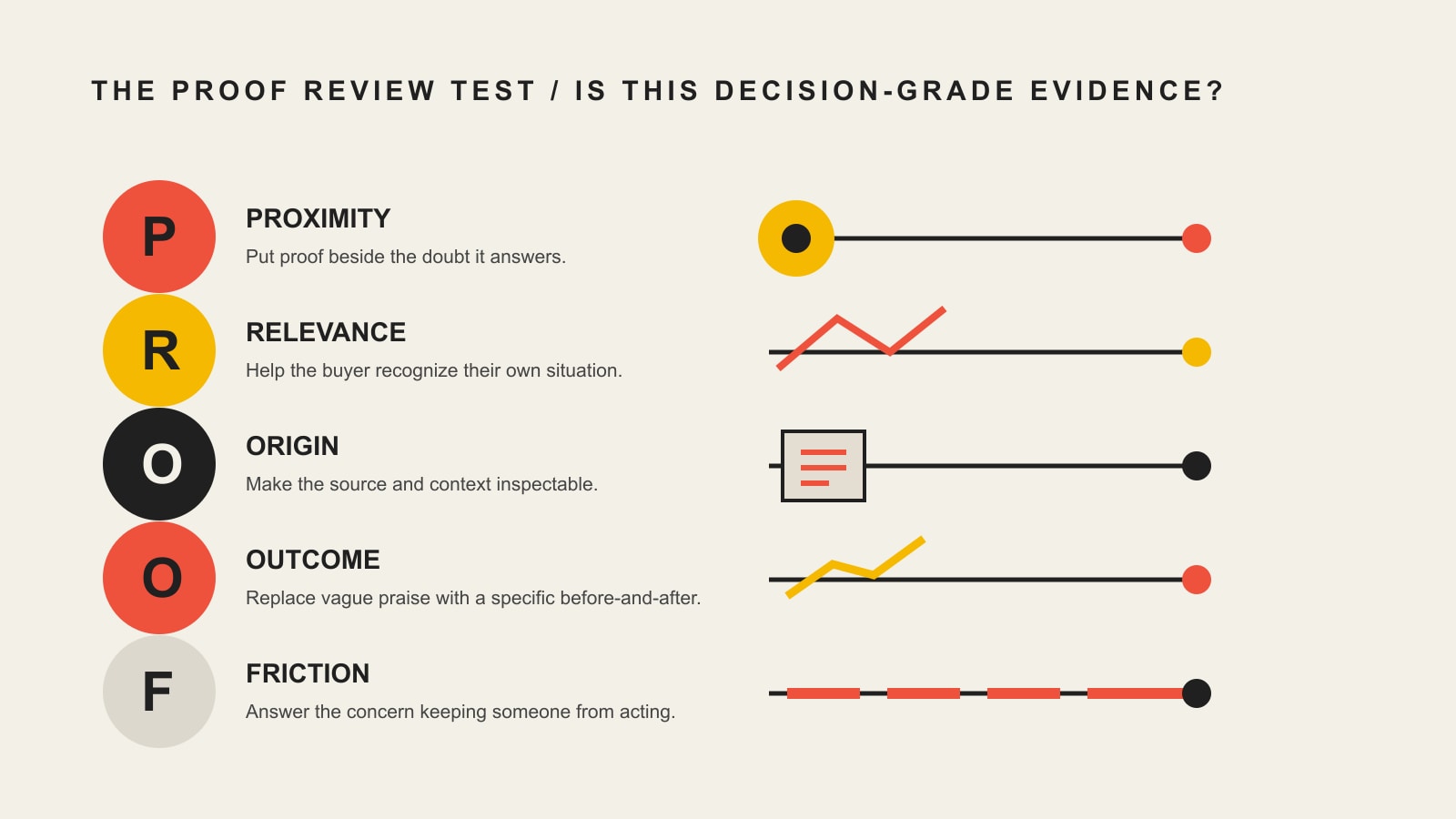
    The WEIRD Positioning Test

    Scope Design uses a simple test for separating commercially useful weirdness from branding theater.
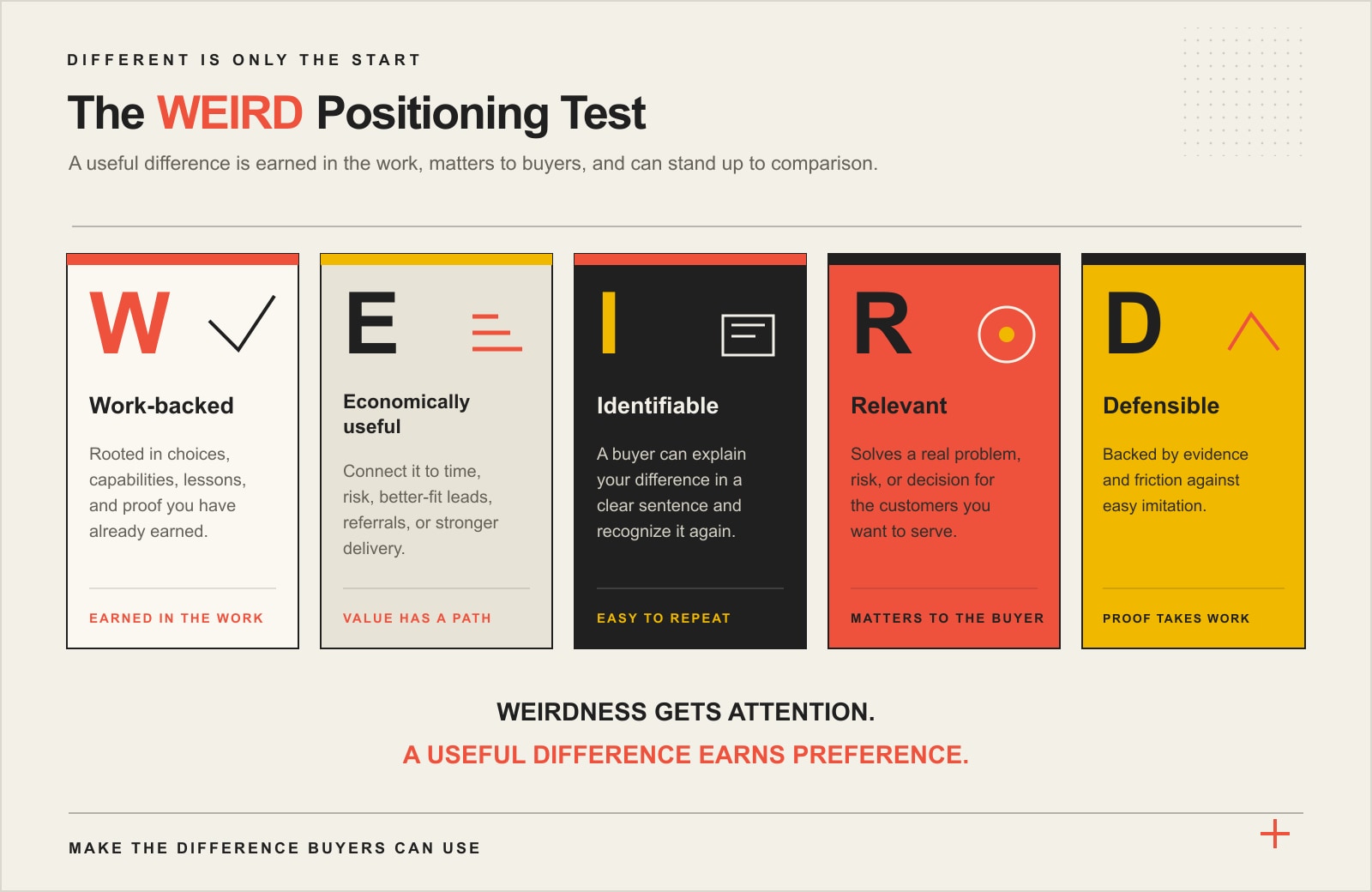
    The WEIRD Positioning Test evaluates whether a brand difference is Work-backed, Economically useful, Identifiable, Relevant to the buyer, and Defensible.
    The WEIRD Positioning Test: Work-backed, Economically useful, Identifiable, Relevant, and Defensible.

    The WEIRD Positioning Test: Work-backed, Economically useful, Identifiable, Relevant, and Defensible.

    W: Work-backed

    The difference should come from work you have done, decisions you have made, constraints you understand, or a capability you have built.

    Start with evidence from your own operating history:

    • work you repeatedly turn down;
    • advice you give even when it reduces the immediate sale;
    • mistakes that changed your process;
    • customer problems you can diagnose faster than competitors;
    • tasks your team performs differently for a reason;
    • tools, frameworks, or systems you built because the usual approach failed;
    • tradeoffs you are willing to explain publicly.

    Greg’s rule is sharper: “A position you have not already paid for is not a position.” A meaningful position usually costs something before it earns anything. You declined the wrong client. You invested in a better process. You learned where a fashionable tactic breaks. You chose not to sell a deliverable that would not solve the problem.

    If the position appeared during a two-hour adjective workshop and has never affected a business decision, keep digging.

    E: Economically useful

    The difference should improve at least one business outcome that matters:

    • attract more qualified inquiries;
    • help bad-fit prospects disqualify themselves;
    • reduce price-only comparisons;
    • make referrals easier and more accurate;
    • support a better-scoped engagement;
    • shorten explanation during the sales process;
    • improve delivery consistency;
    • justify investment in a capability customers value;
    • increase retention because the experience matches the promise.

    This does not mean every differentiator needs a neat percentage stapled to it. It means you should be able to explain the economic mechanism.

    “We use orange” may help recognition. “We map the business process before recommending software” can prevent the wrong system from being built. The second difference has a much clearer path to money, time, risk, and trust.

    I: Identifiable

    A buyer should be able to understand and repeat the difference without carrying around your brand strategy deck.

    Ask a customer, employee, referral partner, and salesperson to finish this sentence independently:

    “They are the people who ______.”

    If the answers share the same meaning, your position is becoming identifiable. If one says “beautiful design,” another says “cheap websites,” and a third says “I think they do marketing,” your brand has not settled on a useful signal.

    Identifiable does not mean simplistic. It means compressible. A complicated service can still have a clear organizing idea.

    R: Relevant

    The difference must connect to a problem, risk, desire, or decision criterion the chosen customer actually has.

    Relevance changes by buyer. A same-day response may matter enormously in emergency restoration and barely at all in long-term estate planning. Deep customization may matter for a complex operating platform and be a waste of money for a referral-driven consultant who needs five stable pages.

    This is where a lot of “be different” advice wanders into the weeds. The business tries to be interesting to the internet instead of useful to the customer.

    D: Defensible

    A defensible difference has evidence behind it and friction against imitation.

    Evidence can include:

    • a documented process;
    • a useful diagnostic or decision framework;
    • demonstrated work;
    • specific case evidence used with permission;
    • customer testimonials that substantiate the experience;
    • specialized knowledge;
    • operating systems competitors would need time and effort to reproduce;
    • a consistent pattern of decisions and public advice.

    A tagline is easy to copy. A practiced operating capability is not.

    The FTC also requires objective advertising claims to have a reasonable evidentiary basis before they run. That is a legal compliance issue, but it is also a useful positioning discipline: say what you can support, and stop decorating weak claims with confident typography. Review the FTC’s truth-in-advertising guidance for small businesses.

    How to find a brand position you have already paid for

    Most businesses do not need to invent a personality. They need to excavate the decisions already hiding inside the work.

    1. List what you refuse to do

    Refusals reveal standards.

    At Scope Design, we will not recommend a custom feature merely because somebody requested one. Discovery may show that the native platform already solves the problem, the team cannot maintain the proposed system, or the real constraint sits somewhere else. Saying no to unnecessary custom work is not a lack of capability. It is evidence of judgment.

    Your refusal list might include:

    • no work without access to the necessary data;
    • no fake urgency or fabricated proof;
    • no implementation before diagnosis;
    • no unsupported performance promises;
    • no projects that require unsafe shortcuts;
    • no “make it look like our competitor” brief without examining the business case.

    Publish the useful exclusions. The goal is not to sound difficult. The goal is to help the right buyer understand what your standards protect.

    2. Collect the advice you repeat

    Repeated advice often points to the problem you understand unusually well.

    Review sales calls, support emails, proposals, workshop notes, and project retrospectives. Which correction do you make over and over? What assumption do clients bring that you consistently have to untangle?

    Examples:

    • “A redesign will not fix a broken offer.”
    • “More leads will make a slow follow-up process worse, not better.”
    • “The website should not become the system of record just because it has a screen.”
    • “A logo cannot carry a positioning strategy the business refuses to live.”

    That repeated correction can become a body of content, a diagnostic, a sales tool, and a clear point of view.

    3. Review the clients and projects that went badly

    This is less fun than choosing brand colors. It is also more useful.

    Look for patterns:

    • Was the buyer wrong for the service?
    • Was the promise unclear?
    • Did the team accept work outside its strengths?
    • Did pricing assume a simpler delivery model than reality?
    • Did the client expect a result the business never controlled?
    • Did the sales message attract people who valued the opposite of your process?

    Bad-fit work often exposes the boundary your positioning failed to communicate.

    4. Identify the proof competitors would struggle to fake

    Authority is not follower count, awards, or publishing volume. It is usefulness that would be expensive to fake.

    That may be a detailed teardown, a working calculator, a documented operating method, a benchmark built from real data, or a case that shows how a difficult decision was made. If your differentiation claim is “we think strategically,” publish a diagnostic that demonstrates the thinking. Do not ask the adjective to carry the entire piano.

    Our guide to building brand authority explains how to turn expertise into a body of proof instead of a content costume.

    5. Write the disqualifiers

    A strong position identifies who should not buy.

    That can include:

    • the problem you are not designed to solve;
    • the stage at which your service becomes useful;
    • the minimum internal capacity required;
    • the tradeoff your method makes;
    • the situations where a cheaper or simpler option is smarter.

    This is not anti-sales. It is prequalification. The wrong inquiry costs time before it becomes revenue, and sometimes it never becomes revenue at all.

    Your difference can live anywhere in the customer experience

    Businesses often search for differentiation only inside the product: more features, a new package, a proprietary method with an impressive acronym.

    That is too narrow.

    Ian MacMillan and Rita McGrath argued in Harvard Business Review that companies can uncover differentiation across the customer’s entire “consumption chain”—from recognizing a need through purchasing, using, maintaining, and eventually disposing of a product or service. Read “Discovering New Points of Differentiation”.

    For a professional service business, examine each stage:

    StageQuestions that can reveal differentiation
    Problem recognitionDo you help customers diagnose the real issue before they buy?
    EvaluationDo you explain pricing, fit, risks, and alternatives more clearly?
    PurchaseIs your scope easier to understand? Are responsibilities explicit?
    OnboardingDo customers know what happens next and what you need from them?
    DeliveryDoes your process reduce risk, rework, delay, or uncertainty?
    HandoffDo customers receive ownership, documentation, and training?
    Ongoing useDo you support maintenance, measurement, and improvement?
    Exit or transitionCan the customer leave without being held hostage?

    This is especially useful for service businesses because the experience is part of the product. A competitor can copy a service list in an afternoon. Copying a disciplined way of diagnosing, communicating, delivering, and supporting the work is harder.

    What brand differentiation looks like at Scope Design

    “We make websites” is a category description, not a position.

    Scope Design’s more meaningful difference is diagnostic: the deliverable a client requests is not automatically the constraint the business needs solved. A request for a redesign may uncover broken forms, disconnected data, an unclear offer, missing ownership, an unworkable sales process, or a system the team cannot maintain.

    That point of view changes the work:

    • discovery happens before prescription;
    • business and operational constraints affect the recommendation;
    • a template is recommended when it genuinely fits;
    • custom work must earn its cost;
    • claims require evidence;
    • content is designed to educate and prequalify, not merely attract traffic;
    • the website is treated as part of a larger business system.

    The snark is part of the voice. The diagnostic discipline is the differentiation.

    That distinction matters. A voice can get attention. A useful operating principle gives the attention somewhere to go.

    Common brand differentiation mistakes

    Building the position from adjectives

    “Trusted, innovative, customer-first” describes the minimum price of admission. If a competitor can paste the same words onto its homepage without changing anything else, the language is not doing strategic work.

    Replace adjectives with decisions and evidence:

    • not “transparent,” but published pricing logic and exclusions;
    • not “strategic,” but a diagnostic process that changes recommendations;
    • not “customer-first,” but ownership terms and support practices that protect the customer;
    • not “experienced,” but shown work, specific constraints, and lessons learned.

    Choosing a niche with no economics behind it

    “Pick a niche” is incomplete advice. A niche must contain reachable buyers, recurring or valuable problems, budget, and a delivery model your business can support.

    Specializing in left-handed artisanal ferret accountants would certainly be specific. That does not make it a market.

    Confusing visual novelty with strategic difference

    An unusual identity can make the business easier to recognize. It cannot rescue an interchangeable offer.

    Build the strategic position first. Then let your brand strategy system turn that position into recognizable language, visual assets, behavior, and governance.

    Copying a category leader’s minimalism

    Large brands can remove explanation because customers already know the category, product, and reputation. A smaller business that copies the surface often removes the exact information a new buyer needs.

    The visible style is the easiest part to copy and usually the least responsible for the result.

    Performing a personality the team cannot sustain

    A founder may love a provocative brand voice. If support emails, proposals, onboarding, and delivery sound like a different company, the performance creates distrust.

    Personality should amplify how the business already behaves at its best. It should not require everyone to play a character eight hours a day.

    Promising an outcome you cannot substantiate

    “We double revenue,” “three times the engagement,” and “guaranteed growth” sound muscular right up until somebody asks for the evidence.

    Use customer testimonials and customer reviews to support specific experiences honestly. Do not make a testimonial carry a broader claim it does not prove.

    How to express differentiation on your website

    Your homepage should not dump a brand workshop onto the visitor. It should make the difference easy to understand.

    Above the fold

    State:

    1. who the service is for;
    2. what meaningful problem it solves;
    3. what makes the approach meaningfully different;
    4. what the visitor should do next.

    On service pages

    Explain the mechanism:

    • how the process works;
    • why each stage exists;
    • what the customer owns;
    • what is excluded;
    • when the service is the wrong fit;
    • what evidence supports the promise.

    In case evidence

    Show the decision, not just the after photo.

    What was requested? What did discovery reveal? What choice was made? What constraint shaped the solution? What result can actually be documented? That sequence demonstrates judgment better than “we refreshed the visual identity and the client was thrilled.”

    In brand messaging

    Translate the position into language customers and employees can repeat. Our brand messaging guide uses a Say → Prove → Repeat framework for doing that without turning the company into a slogan factory.

    In slogans and taglines

    A slogan can compress a position, but it cannot invent one. If the underlying difference is vague, the tagline becomes decorative word juggling. Use the slogan and tagline guide after the strategic work is clear.

    How to measure whether your differentiation is working

    Do not measure differentiation with likes alone. Visibility is a leading indicator. The commercial goal is better-fit demand and a business people can understand.

    Track a small set of signals before and after the position is applied:

    • percentage of inquiries matching your fit criteria;
    • reasons prospects say they contacted you;
    • language customers and referral partners use to describe you;
    • frequency of price-only objections;
    • sales-qualified opportunity rate;
    • close rate by source and service;
    • average scope quality or profitability;
    • time spent explaining what the business does;
    • bad-fit inquiries declined;
    • repeat and referral patterns;
    • whether delivery consistently fulfills the promise.

    Ask every qualified prospect: “What made you contact us instead of the other options?” Save the answer in your CRM. If buyers consistently repeat the intended difference, the position is landing. If they cite something accidental or irrelevant, you have useful evidence for the next revision.

    Avoid claiming causation from a single month or a handful of leads. Positioning is not exempt from measurement simply because it has a mood board.

    A practical brand differentiation exercise

    Use this process with your leadership, sales, delivery, and customer-facing teams.

    Step 1: Build the raw evidence list

    Independently answer:

    • What do we refuse to do?
    • What advice do we repeat even when it risks the sale?
    • Which customers get the most value from us?
    • Which customers create the most friction, and why?
    • What have we learned that changed our process?
    • What can we prove?
    • What can customers get from us that is difficult to get elsewhere?
    • Where would a cheaper option genuinely be enough?

    Step 2: Convert evidence into candidate claims

    Use this format:

    For [specific customer] dealing with [specific costly problem], we [meaningful approach or capability], unlike [credible alternative], because [proof or operating reason].

    Write several versions. The first one will probably sound like it escaped from a strategy workshop. Keep going.

    Step 3: Score each claim with WEIRD

    Give each dimension 0, 1, or 2 points:

    Dimension012
    Work-backedInventedSome evidenceRepeated operating reality
    Economically usefulNo clear mechanismPlausible valueClear path to fit, money, time, or risk
    IdentifiableConfusingUnderstandableEasy to repeat accurately
    RelevantInteresting only to usMatters to some buyersImportant to the chosen buyer
    DefensibleAnyone can claim itSome supporting proofStrong evidence or hard-to-copy capability
    • 0–4: branding confetti;
    • 5–7: promising, but incomplete;
    • 8–10: worth testing in messaging, sales, and delivery.

    The score is a decision aid, not a scientific instrument. Its job is to expose hand-waving before you print it on a wall.

    Step 4: Test it in real conversations

    Use the candidate position in sales calls, referral conversations, proposals, and a focused website section. Ask people to repeat what they think it means. Record objections and misunderstandings.

    Do not launch a total rebrand merely to avoid the discomfort of a small test.

    Step 5: Build the proof

    Create the assets the claim requires:

    • a diagnostic;
    • a transparent process page;
    • a comparison or decision guide;
    • a documented example;
    • a testimonial request tied to the claimed experience;
    • training and operating rules that make delivery consistent.

    If the business cannot produce evidence for the position, the work is not finished.

    Brand differentiation FAQ

    What is brand differentiation in simple terms?

    Brand differentiation is a meaningful and believable reason for a customer to choose your business over credible alternatives. It can come from what you offer, whom you serve, how you deliver, the experience you create, or a capability competitors cannot easily reproduce.

    What are the four types of differentiation?

    There is no single universal four-type model. A practical business grouping is product differentiation, service differentiation, channel or access differentiation, and brand or relationship differentiation. Strategy textbooks and consultants group them differently, so use the categories to find opportunities—not as holy scripture.

    What is a differentiation strategy in business?

    A differentiation strategy is a coordinated set of choices that makes an offering more valuable to a chosen customer than credible alternatives. It should shape the offer, operations, messaging, evidence, and customer experience, not merely the advertising.

    What is the difference between brand differentiation and brand positioning?

    Differentiation is the meaningful difference itself. Positioning is the larger strategic frame that defines the customer, problem, category, alternatives, value, and reason to believe. Differentiation is one essential ingredient inside positioning.

    What is the difference between differentiation and distinctiveness?

    Differentiation gives customers a reason to prefer the brand. Distinctiveness helps them recognize and remember which brand it is. A business usually needs both: a useful reason to choose and consistent signals that make the choice easy to identify.

    Does a brand need to be completely unique?

    No. Complete uniqueness is rare and often irrelevant. A brand needs a combination of choices and evidence that is meaningful within the buyer’s real comparison set. You can share many category conventions and still own a clearer, more relevant position.

    Can being too different hurt a business?

    Yes. A difference can confuse buyers, narrow demand beyond economic viability, create delivery costs customers will not pay for, or attract attention without trust. That is why relevance and economic usefulness belong in the WEIRD test.

    Should a small business choose a niche to stand out?

    Only when the niche has real economics: reachable buyers, a valuable problem, sufficient demand, and a delivery advantage. Specificity can improve relevance and referrals, but a microscopic audience with no budget is not a strategy.

    What has replaced differentiation in branding?

    Nothing has universally replaced it. Some brand-growth research emphasizes distinctiveness and broad availability because perceived differences can be weak in mature categories. That does not make meaningful differentiation useless; it means businesses should not confuse preference with recognition. Build a relevant difference and make the brand easy to identify.

    What is the 3-7-27 rule of branding?

    It is a popular marketing claim about the number of exposures required for recognition, trust, or purchase, but there is no dependable universal rule that applies across brands, channels, prices, and buying situations. Treat it as folklore, not a planning formula. Measure your actual customer journey instead.

    What are the four C’s of brand strategy?

    There are several competing “four C” frameworks. A useful positioning version examines customer, category, company, and competition. The labels matter less than the questions: who is buying, what alternatives define the category, what can the company credibly deliver, and where is the competitive opening?

    How do you know whether a brand is truly differentiated?

    Customers can explain the difference accurately, the difference matters to their decision, the business behaves consistently with it, and evidence supports the claim. If only the leadership team can see it, the position is not yet doing market work.

    Can better customer service be a differentiator?

    Yes, but “better service” is too vague. Define the behavior, customer value, and proof: response standards, named ownership, proactive reporting, easier transitions, specialized support, or a process that reduces risk. Then make sure the operation can sustain it.

    How often should brand differentiation be reviewed?

    Review it when customer needs, competitors, capabilities, pricing, delivery, or the market changes materially. Also review it when buyers consistently describe the company differently from the intended position. Do not rewrite the strategy every time a social post underperforms.

    A clear position helps a business publish specific, connected expertise instead of generic category content. That can produce better topic clusters, more precise entities and claims, stronger internal links, and original frameworks worth referencing. It does not guarantee rankings or AI citations; useful evidence still has to earn them.

    Stop trying to look different. Make a difference buyers can use.

    The best brand differentiation is not a costume. It is a visible operating truth.

    Work backwards from the decisions your business has already paid for. Find the standards, refusals, capabilities, and lessons that matter to the right customer. Make the difference easy to identify. Prove it. Then use enough personality that people remember who said it.

    If your current positioning is a pile of admirable adjectives with no commercial spine, Scope Design’s Impact Consulting can help diagnose the customer, constraint, offer, message, website, and operating reality before another rebrand spends money decorating the wrong problem.

  • Are You the Expert in Your Niche?

    Are You the Expert in Your Niche?

    If you want to become the expert in your niche, start by treating “expert” as a claim that needs evidence. The label itself does not create authority. Credible expertise comes from knowing a specific problem, doing the work well enough to make defensible decisions, showing proof, explaining what you know clearly, and being honest about the boundaries of your experience.

    That is a less glamorous answer than “post every day for 90 days and become the go-to authority.” It is also far more useful. Marketing can make expertise visible. It cannot manufacture competence that is not there.

    TL;DR: how to become the expert in your niche

    • Narrow the claim. “I help manufacturers reduce quoting friction” is easier to prove than “I am a business expert.”
    • Build relevant competence. Learn the buyer, constraints, language, trade-offs, and real-world decision points.
    • Collect proof. Save examples, outcomes, methods, artifacts, customer questions, testimonials, credentials, and limitations.
    • Translate the work. Explain your reasoning in a way the right buyer can understand and use.
    • Earn corroboration. Let clients, peers, references, citations, reviews, and other legitimate third parties validate what your bio says.

    If you are new to the market and do not yet have domain proof, do not skip straight to the last step. Our guide to entering a niche with zero experience explains how to learn and earn credibility without pretending to already be the expert.

    Expertise, visibility, and authority are different jobs

    These words get mashed together in marketing advice, but separating them prevents a lot of bad strategy.

    • Expertise is your relevant ability to understand a problem and make sound decisions about it.
    • Visibility is whether the right people encounter you or your work.
    • Authority is the judgment other people form when your expertise, proof, reputation, and communication repeatedly hold up.

    You can have expertise with little visibility. You can also have tremendous visibility with shallow expertise. And you can be technically excellent while making it almost impossible for a prospect to verify why they should trust you.

    That last problem is where positioning, content, web design, and marketing matter. They should not dress you in an expert costume. They should organize the evidence so a skeptical buyer can inspect it.

    The Scope Design Niche Expertise Evidence Ladder

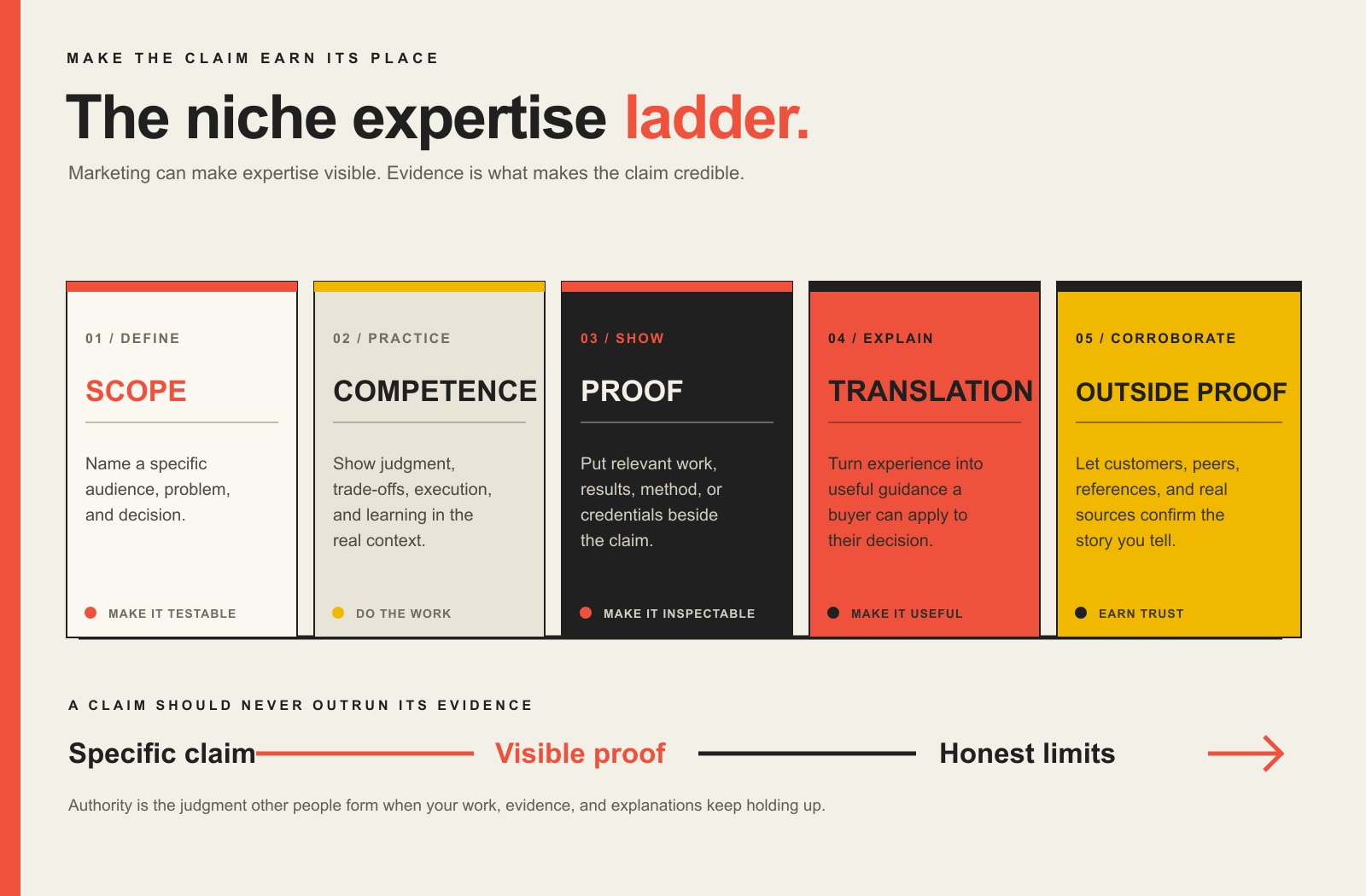
    We use a five-level ladder to think about what it takes to be the expert in your niche. You do not need every possible form of proof before you can be useful, but stronger claims should be supported by stronger evidence.

    1. Scope: define the problem narrowly enough to understand

    “Marketing,” “fitness,” “leadership,” and “technology” are not useful expertise claims by themselves. They are continents. A credible niche usually has a clearer audience, decision, constraint, or problem.

    Compare “I know digital marketing” with “I help local service businesses turn a confusing website and scattered campaigns into one measurable lead-generation system.” The second claim can be examined. It creates boundaries. It also tells you what you need to learn and what proof you need to collect.

    2. Competence: be able to do more than repeat the language

    Knowing the vocabulary of a niche is not the same as being useful inside it. Competence shows up in diagnosis, judgment, trade-offs, execution, and the ability to explain why one choice is more appropriate than another.

    Research matters here, especially when you are entering a new field. So do interviews, supervised work, experiments, project experience, formal training when the field requires it, and direct exposure to customer problems. The correct mix depends on the stakes and the work. A branding consultant and a structural engineer should not use the same standard for “qualified.”

    3. Proof: put evidence beside the claim

    Proof is where expertise becomes inspectable. It can include a relevant case example, a before-and-after with context, a demonstrated process, an annotated deliverable, a useful diagnostic, a result with honest scope, a client reference, a credential, or a clear explanation of a difficult decision.

    The form matters less than the fit. A giant wall of five-star reviews may be weaker than one detailed case study when the buyer is evaluating technical judgment. A certification may be essential in one field and nearly meaningless in another. Ask: What would a skeptical buyer need to see to believe this specific claim?

    4. Translation: make the expertise useful to someone else

    An expert who cannot explain the decision is difficult to evaluate. Translation means turning experience into useful guidance: a framework, comparison, checklist, teardown, FAQ, case analysis, demonstration, or article that helps the reader make a better decision.

    This is where content earns its place. Strong content marketing for a small business starts with something the business actually knows, then turns that knowledge into a durable asset. Content is evidence distribution, not an expertise generator.

    5. Corroboration: let other evidence confirm your story

    Authority becomes stronger when the evidence does not all come from you. Depending on the field, corroboration can include client testimonials, references, peer recognition, relevant credentials, citations, interviews, partnerships, repeat customers, independent reviews, or invitations to contribute your thinking.

    Corroboration should be real, attributable when appropriate, and no broader than the evidence supports. The Federal Trade Commission’s business guidance on advertising and marketing is a useful baseline for the marketing side of this: advertising claims should be truthful and evidence-based. Proof is not decoration.

    The five steps for earning an expertise claim: define a narrow scope, practice competence, show inspectable proof, explain it usefully, and earn corroboration.

    One rule runs through every level: honest boundaries. Say what you know. Show what supports it. Identify what is still uncertain. A precise claim is usually more credible—and more sellable—than a sweeping one.

    What counts as strong proof of expertise?

    Not every authority signal deserves the same weight. Here is a practical way to grade what you are showing prospects.

    SignalWhat it provesCommon weaknessHow to strengthen it
    “Expert” in a bioAlmost nothing by itselfSelf-awarded labelNarrow the claim and link to evidence
    Educational contentYou can explain the topicMay be derivative or untestedAdd original examples, decisions, sources, and limits
    Process or methodologyYou have a repeatable way to approach the workA process can sound polished without producing valueShow where it came from and when it does or does not apply
    Case exampleYou have applied judgment in a real situationCherry-picked or vague resultsState the starting point, intervention, outcome, timeframe, and constraints
    Testimonial or reviewA real person reports an experienceGeneric praise or unverifiable identityUse specific, attributable feedback and do not overgeneralize it
    Credential or third-party recognitionAn outside body validated a defined standard or contributionMay not match the buyer’s actual problemExplain why the credential or recognition is relevant

    The audit that changed this article

    There is a reason this revision is more skeptical of easy authority claims: this page had to pass its own test.

    When we audited the previous version in August 2026, GA4 showed no Organic Search landing sessions for this URL during the prior 12 complete months. Google Search Console returned no search-performance rows for the exact page and its URL Inspection report described the URL as unknown to Google. Bing recognized and crawled the page but reported zero clicks and zero impressions. Ubersuggest found no ranking-keyword data and no backlinks for the exact URL.

    Those numbers do not prove that search traffic equals expertise. They do not prove that every good expert should rank. They do show why “publish authority content” is incomplete advice. The old version was making big promises about expertise while providing little original evidence of its own.

    So we removed unsupported market-size figures, generic income ranges, claims that specialists universally command a particular premium, and timelines promising recognition or income growth. The stronger article is less certain about outcomes and much clearer about the work required to earn trust.

    How to build the next layer without pretending

    You do not have to wait until you feel omniscient. You do have to match the size of your claim to the evidence you have today.

    1. Write the narrowest useful expertise claim you can defend. Name the audience, problem, and kind of decision you help with.
    2. Inventory the evidence already available. Projects, examples, customer questions, data, methods, credentials, experiments, screenshots, outcomes, mistakes, and lessons all count when they are relevant and honestly described.
    3. Find the gaps. If the claim depends on experience you do not have, shrink the claim, collaborate with someone qualified, research it properly, or go earn the experience.
    4. Do one piece of work that creates new evidence. Run an audit, interview customers, document a project, compare options, build a diagnostic, or publish an annotated example.
    5. Turn the evidence into a useful explanation. Show your reasoning, not just the polished conclusion.
    6. Ask what a skeptic still cannot verify. That question determines the next proof asset.

    If your real situation is “I want to serve this market, but I am not yet the domain expert,” that is a market-entry problem, not an authority-copy problem. Start with the zero-experience niche framework and let stronger claims follow the evidence.

    How to make niche expertise visible on your website

    A prospect should not need to assemble your credibility from scattered clues. Put the proof near the decision it supports.

    • On a service page, place a relevant case example or process near the promise.
    • On an About page, explain the experience, qualifications, and point of view that matter to the work—not a life story that never connects back to the buyer.
    • On a case study, show the starting condition, the decision, what changed, and the limits of what can be concluded.
    • In articles, distinguish what comes from direct experience, what comes from research, and what is your recommendation.
    • In testimonials, favor specificity over adjectives.
    • In calls to action, make the next step proportional to the reader’s confidence. A useful diagnostic may be better than a hard sell when the purchase is complex.

    This is also why authority should sit inside a coherent small-business marketing system. Attention, offer, proof, conversion path, and follow-up have to support one another. More visibility cannot rescue a claim the buyer has no reason to believe.

    For the broader company-level version of this problem, see our guide to building brand authority as a body of proof. This article stays narrower: whether you have earned the right to make a specific expertise claim in a specific niche.

    Do you need credentials to be an expert?

    Sometimes. The wrong answer is “credentials never matter” or “credentials are always required.” The correct standard depends on the field, the risk, and the claim.

    If the work is licensed, regulated, safety-critical, medical, legal, financial, engineering-related, or otherwise high-stakes, formal qualifications and professional boundaries may be central to competence. In lower-risk advisory and creative fields, a portfolio of relevant work, judgment, results, and corroboration may tell a buyer more than a general certificate.

    Do not use marketing copy to blur that distinction. If a client needs a licensed or specialized professional, say so. Knowing where your expertise ends is part of being credible.

    Common mistakes that make “expert” positioning weaker

    • Making the niche too broad. The wider the claim, the more evidence it takes to support.
    • Confusing publishing volume with competence. Fifty derivative posts are still derivative.
    • Using vague social proof. “Amazing!” does not help a skeptical buyer understand what you actually solved.
    • Borrowing someone else’s authority. Citing experts is good research; implying their credentials are yours is not.
    • Hiding the limits. A useful caveat often increases trust because it shows you understand where the advice stops working.
    • Measuring fame instead of fit. A smaller audience of people with the exact problem may be more valuable than broad visibility with no buying context.

    Frequently asked questions about becoming the expert in your niche

    How does a person become an expert?

    For a business niche, expertise grows through focused learning, relevant application, feedback, evidence, and repeated judgment. The useful question is not “When may I call myself an expert?” but “What can I reliably help this audience understand or do, and what evidence supports that claim?”

    Does 10,000 hours make you an expert?

    There is no universal business rule that awards expertise after a fixed number of hours. Time can create exposure, but hours alone do not tell a client whether you practiced the relevant skill, received useful feedback, made sound decisions, or can solve this buyer’s problem. Use evidence that matches the claim instead of a stopwatch.

    How long does it take to become known as an expert in a niche?

    There is no honest universal timeline. Recognition depends on the starting level of competence, the size and competitiveness of the niche, the quality of the work, how much proof exists, how effectively that proof is distributed, and how often the right audience encounters it. Set evidence milestones instead of promising yourself a 30-, 60-, or 90-day authority finish line.

    What is the best proof of expertise for a consultant or service business?

    The best proof answers the buyer’s biggest doubt. That could be a detailed case example, a demonstrated process, a sample deliverable, relevant credentials, an annotated analysis, an outcome with context, or a specific testimonial. Use the evidence that helps the buyer judge this decision—not the evidence that is easiest to decorate a page with.

    Can content marketing make me an expert?

    No. Content can expose your thinking, organize what you have learned, demonstrate judgment, and distribute evidence. It can also help a serious researcher or newer practitioner become useful while learning. But publishing cannot substitute for the competence required by the work.

    Build a claim your evidence can carry

    You do not need to be famous to become the expert in your niche. You need a claim narrow enough to defend, competence relevant to the problem, proof a skeptical buyer can inspect, explanations that make your thinking useful, and corroboration that does not depend entirely on your own marketing.

    If your website or content says you are the expert but does not make the evidence easy to see, Scope Design can help you tighten the positioning, organize the proof, and connect it to a practical marketing system. The goal is not to make you look more authoritative than you are. It is to make the authority you have actually earned easier for the right buyer to recognize.

  • Customer Testimonials That Sell Without Making Shit Up

    Customer Testimonials That Sell Without Making Shit Up

    Direct answer: Customer testimonials sell when they support one specific business claim with a real customer’s relevant experience. The customer should be accurately identified or honestly anonymized, the quotation should preserve what they actually meant, any unusual result or material connection should be disclosed, and the evidence should appear beside the buyer’s doubt. A floating quote that says “Great team!” proves only that somebody found three words and a pair of quotation marks.

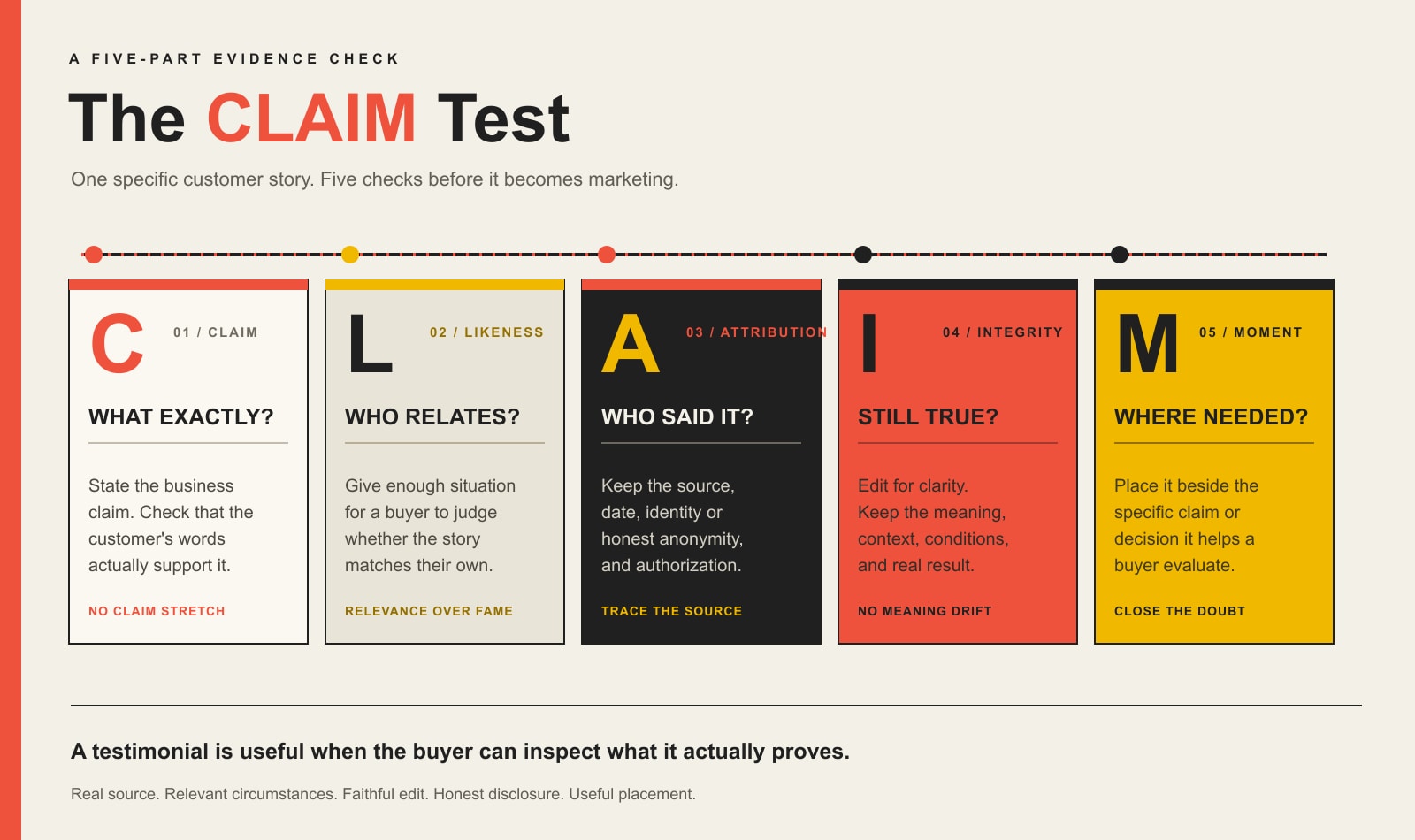
    TL;DR: Stop collecting compliments like decorative throw pillows. Build an evidence system. Match each testimonial to a claim, choose customers whose circumstances resemble the intended buyer, document permission and source material, edit only without changing meaning, disclose incentives or atypical results, and place the testimonial at the decision it helps someone make. Scope Design calls this the CLAIM Test: Claim, Likeness, Attribution, Integrity, and Moment.

    What this guide covers

    Customer testimonials are selected evidence, not independent applause

    A customer testimonial is an advertising message presented by a business that buyers are likely to understand as reflecting a customer’s actual opinion, belief, or experience. It may be a written quotation, a video, a short audio clip, an attributed social post, or part of a larger customer story.

    The business chooses what to publish and where to publish it. That is the important bit everybody politely steps around. A testimonial may come from a real customer and still be curated marketing. It is not automatically false, and it is not automatically independent.

    The Federal Trade Commission’s Consumer Reviews and Testimonials Rule Q&A draws a useful U.S. distinction: a review is submitted to and published through a site or platform that receives and displays customer evaluations, while a testimonial is an advertising message used by the business. The context can change the classification. Reusing customer feedback in company-controlled advertising is not the same act as leaving it in its original review environment.

    That distinction helps businesses stop treating every nice sentence as interchangeable proof.

    Evidence typeWho controls the presentation?What it can reasonably showWhat it does not prove by itself
    Public reviewCustomer and review platform, subject to platform rulesA customer’s reported experience within a broader public patternThat every reviewer is authentic, the result is typical, or the business fits this buyer
    Customer testimonialThe business selects and places itA real customer is willing to support a specific claim or describe an experienceIndependent consensus or universal results
    Case studyThe business usually structures the narrative, ideally with customer verificationContext, problem, work, constraints, and documented outcomesCausation beyond the evidence or results every buyer should expect
    Client logoThe business, with permissionA relationship existed in the represented contextSatisfaction, scope, duration, or outcome
    Demonstration or work sampleThe business presents inspectable workCapability and execution in a defined exampleCustomer satisfaction or commercial impact unless separately documented

    Our guide to how customer reviews influence buying decisions owns the public-review side of this cluster. This guide owns what happens when a business selects customer evidence for its own marketing.

    Why testimonials can help—and why the usual conversion statistics are bullshit

    People evaluate claims partly through their source. A customer describing an actual experience may be more believable than a company describing its own magnificence. That is not a shocking discovery. It is also not permission to staple “testimonials increase conversions by 80%” onto every marketing article until the internet collapses from recycled statistics.

    A 2013 Public Relations Review experiment compared a company spokesperson with a customer testimonial across business communication channels. The 2-by-7 experiment included 514 participants. It found partial and contextual support for customer quotations improving message credibility and attitudes toward the product. It did not find universal evidence that a customer spokesperson is always more credible, and it did not produce a magic website conversion rate. Read the study abstract and design.

    The broader source-credibility literature is not a confetti cannon either. A 2026 systematic review and meta-analysis covered 40 effects from 34 papers with 7,995 participants. It found a small positive average effect of credible sources on performed behavior, with meaningful differences by context. The authors explicitly cautioned that the cost of creating credible-source interventions should be balanced against their effectiveness. See the open research summary and article.

    The practical conclusion is more useful than a suspiciously precise percentage:

    • credible customer evidence can strengthen a relevant claim;
    • the source, audience, channel, context, and claim all matter;
    • a testimonial cannot rescue an irrelevant offer, confusing message, broken form, or nonexistent demand;
    • evidence should reduce a specific uncertainty, not merely decorate a layout.

    That fits Scope Design’s larger position on brand authority: authority comes from specific claims, shown work, named constraints, and a willingness to state what the evidence does not establish. Looking established may buy the first meeting. Useful proof helps a buyer survive the cheaper comparison.

    The CLAIM Test for customer testimonials

    Before publishing a testimonial, run it through five questions.

    C — Claim: What exact statement does this evidence support?

    Start with the business claim, not the compliment.

    “They were wonderful” has no clear evidentiary job. “The team explained the migration plan before touching the live system” supports a claim about process clarity and risk management. “The new site is easier for our staff to update” supports maintainability. “They answered the phone” may be valuable if response anxiety is the buyer’s actual objection.

    Write the claim in plain language. Then ask whether the customer’s words genuinely support it. If the quote and the claim do not match, do not force them into an arranged marriage.

    L — Likeness: Can the intended buyer recognize relevant circumstances?

    Likeness does not mean demographic cosplay. It means the customer story contains the context a buyer needs to judge relevance:

    • business or use-case type;
    • role in the decision or implementation;
    • problem being solved;
    • meaningful constraint;
    • stage, scale, or technical environment when it affects the result.

    A testimonial from a nationally recognized company may look impressive and still answer nothing for a local owner wondering whether the process will overwhelm a three-person team. Relevance beats logo worship.

    A — Attribution: Is the source real, accurate, and authorized?

    Record who said it, when, where the original statement lives, and what identifying details may be used. If the customer permits a full name, role, company, and photo, those details make the evidence easier to evaluate. If anonymity is necessary, use a truthful description rather than a theatrical one.

    “Operations director at a regional manufacturer” can be legitimate. “Fortune 100 executive” is not acceptable if the person was an intern at a vendor that once sold the company paper clips.

    Attribution also means disclosing a relationship a reasonable buyer would not expect: employee, relative, affiliate, reseller, investor, paid creator, free-product recipient, or another material connection.

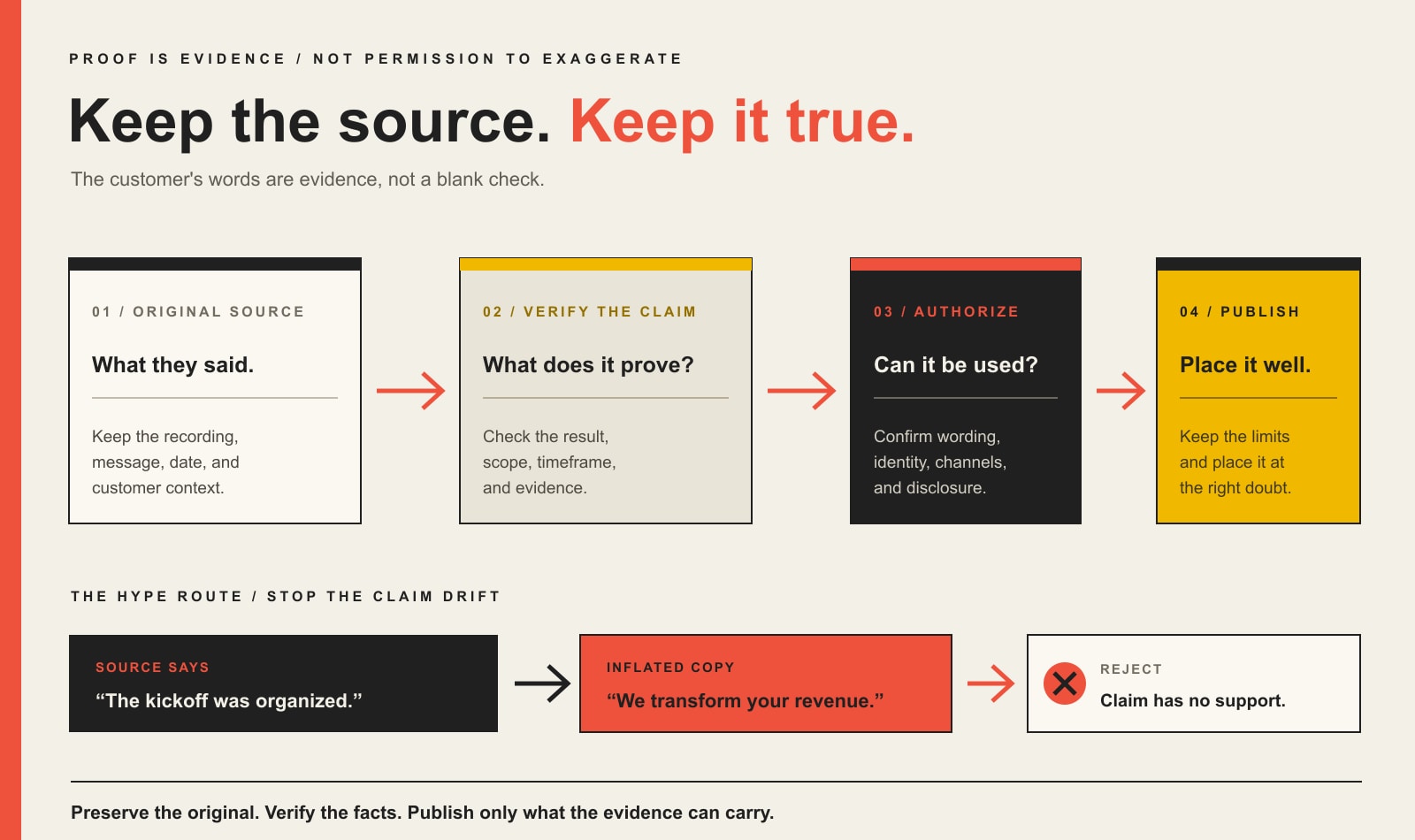
    I — Integrity: Did the published version preserve the experience and its limits?

    Editing for spelling, length, or clarity can be reasonable. Editing “the kickoff was organized” into “Scope Design transformed our revenue engine” is fiction with administrative overhead.

    Integrity requires:

    • preserving the customer’s intended meaning and tone;
    • retaining qualifications that affect interpretation;
    • verifying any number before publication;
    • explaining unusual results or limited applicability;
    • disclosing relevant incentives or relationships;
    • keeping the approved version and original source connected.

    M — Moment: Is the evidence where the doubt occurs?

    Put proof beside the claim it supports.

    A testimonial about smooth implementation belongs near the implementation process. Evidence about staff editing belongs near maintainability. A relevant customer quote about pricing clarity belongs near cost context. A testimonial page hidden in the navigation is a museum: technically full of artifacts and practically absent from the decision.

    The CLAIM Test checks whether a testimonial supports a precise claim, fits the buyer circumstances, has an accurate authorized source, preserves meaning and limits, and appears at the right decision moment.

    What a good customer testimonial actually contains

    A useful testimonial does not need to be long. It needs enough information to be judged.

    The strongest structure is usually:

    1. Situation: What was happening before the work or purchase?
    2. Decision: Why did the customer choose this approach or provider?
    3. Experience: What specifically happened during the work?
    4. Outcome: What changed, was completed, or became possible?
    5. Constraint: What conditions or limits affect how the result should be interpreted?

    Not every quote needs all five. A short testimonial may support one narrow claim. A full customer story can carry the larger sequence.

    Illustrative testimonial rewrites

    The examples below are writing demonstrations, not Scope Design customer claims.

    Vague praise: “Amazing company. Highly recommended.”

    Useful version: “We had three teams editing the same product information in different places. The project gave us one approved workflow and made ownership clear before new software was added.”

    The useful version supports process diagnosis. It gives a buyer a recognizable problem and a concrete change without inventing a percentage.

    Vague praise: “They built us a beautiful website.”

    Useful version: “Our staff needed to update ordinary pages without calling a developer. The new page system gave us reusable sections and a documented publishing process.”

    This supports maintainability, not aesthetics, sales, or search rankings.

    Vague praise: “Best investment ever.”

    Useful version: “Discovery showed that the requested dashboard would duplicate a report our existing platform already produced. We used the native report and spent the project budget on the broken intake process instead.”

    This supports diagnostic honesty and solution restraint. It does not claim a quantified return unless one was measured.

    Notice what the stronger examples do not contain: imaginary names, celebrity headshots, suspicious revenue figures, or the phrase “game changer.” Civilization continues.

    How to choose testimonials for a website

    Do not begin by sorting quotes from nicest to nicest. Begin with the claims and objections on the page.

    Create a simple evidence inventory with these fields:

    FieldQuestion
    Page or offerWhere is the buyer making a decision?
    ClaimWhat does the business ask the buyer to believe?
    DoubtWhy might a reasonable buyer hesitate?
    Best evidence typeTestimonial, review pattern, case study, demonstration, policy, credential, process detail, or data?
    Candidate sourceWhich real customer has relevant experience?
    Permission statusWhat words, name, role, company, image, video, and channels are authorized?
    Evidence statusIs the claim documented, externally supported, experiential, or still unverified?
    PlacementWhere should the evidence appear?
    Review dateWhen must accuracy and permission be checked again?

    This prevents a common error: trying to solve every trust problem with a testimonial. Some claims need a demonstration. Some need a policy. Some need a case study with measured data. Some need the business to stop making the claim.

    Select evidence using four priorities:

    • relevance before fame;
    • specificity before enthusiasm;
    • traceability before polish;
    • coverage before volume.

    Coverage means your evidence addresses the important doubts across the buying journey. Twenty quotes about friendliness do not compensate for silence about implementation, cost, ownership, accessibility, maintenance, or results.

    How to ask for a testimonial without writing it for the customer

    Ask after a credible moment of value, while the customer can still describe the situation clearly. That moment might be a successful launch, an avoided error, a completed migration, the first independent use of a new system, a resolved service problem, or a documented business outcome.

    Do not ask, “Can you say something nice about us?” That produces nice-sounding mush. Ask questions that recover evidence:

    • What was happening before this work?
    • What were you worried about?
    • What did we recommend or do that was most useful?
    • What changed after the work?
    • What surprised you?
    • Who would this approach fit, and who might need something different?
    • May we follow up to verify details and request publication permission?

    The customer can answer in writing, on a recorded call, or through a short interview. The format matters less than preserving the original response and approving the published version.

    Public review requests have different platform and policy considerations. Our ethical Google review generation guide covers timing, scripts, review gating, platform rules, and the Scope Design FAIR Review Loop. Do not turn a testimonial request into a disguised demand for a five-star public review.

    Can a business edit a customer testimonial?

    Yes, a business can edit a testimonial for length, grammar, clarity, or format if the result still accurately reflects the customer’s actual opinion and experience. The FTC’s Endorsement Guides state that an endorsement need not use the endorser’s exact words unless the advertisement says it does, but the message cannot be presented out of context or reworded to distort the opinion or experience.

    Use an editorial chain of custody:

    1. Preserve the original email, recording, form response, review, or interview transcript.
    2. Mark deletions and changes in a working copy.
    3. Verify names, roles, companies, dates, products, and any factual result.
    4. Send the exact edited version and intended attribution to the customer.
    5. Record approval, permitted channels, and any time limit.
    6. Store the final approved asset with the original source and disclosure notes.
    7. Recheck it when the offer, product, relationship, or customer’s role materially changes.

    Safer edits

    • correcting obvious spelling and punctuation;
    • removing filler or repetition;
    • shortening without removing a material condition;
    • replacing a confusing pronoun with the accurate company or product name;
    • dividing a longer statement into clearly faithful excerpts;
    • adding brackets or ellipses sparingly when they help readers understand an edit.

    Edits that cross the line

    • adding an outcome the customer did not report;
    • changing “helped” to “transformed”;
    • removing “for our small team” when scale affects relevance;
    • combining statements from different customers into one synthetic person;
    • converting an employee’s praise into an ordinary-customer endorsement;
    • turning an unmeasured impression into a percentage;
    • attaching a stock portrait or AI-generated person to a real quotation;
    • keeping a testimonial live after learning it no longer reflects the customer’s view.

    If your edit needs a defense memo, the edit probably sucks.

    Permission is part of the evidence

    FTC guidance focuses on truthfulness and deception, not on giving businesses a universal release-form template. Other rights, contracts, privacy laws, industry rules, and platform terms can matter. Get legal advice for your jurisdiction and risk profile.

    Operationally, written permission gives a business something essential: proof that the source authorized the represented use. A permission record should cover, as applicable:

    • the approved words or recording;
    • editing for length and clarity;
    • the customer’s name and preferred attribution;
    • job title and company name;
    • photograph, voice, likeness, and video;
    • website, email, social media, proposals, presentations, paid advertising, and other channels;
    • whether the business may create shorter excerpts;
    • incentives or material relationships;
    • an expiration or review date, if appropriate;
    • a practical contact and removal process.

    Public praise is not a bottomless asset library. A LinkedIn comment, Google review, private email, project chat, and recorded interview arrive in different contexts. Before moving content into company-controlled advertising, verify the original platform terms, accuracy, attribution, and permission.

    Scope Design applies the same standard to its own work: no named-client performance claim goes public without documented evidence and appropriate permission. When a story can be used only in anonymized form, the description must remain truthful and omit identifying details rather than adding theatrical ones.

    Incentives, insiders, and atypical results

    The United States FTC requires endorsements to reflect honest experience and prohibits claims that would be deceptive or unsubstantiated if the advertiser made them directly. It also requires clear disclosure of material connections that a reasonable audience would not expect and that could affect the weight or credibility of the endorsement.

    Material connections can include:

    • payment;
    • free products or services;
    • discounts, credits, upgrades, or sweepstakes entries;
    • affiliate commissions;
    • employment or family relationships;
    • reseller, investor, consultant, or partner relationships;
    • another benefit tied to providing the endorsement.

    Put the disclosure near the testimonial in language a normal person can understand. Do not bury “paid relationship” in a hover state, legal page, pale-gray footnote, or sixteenth accordion called “transparency.”

    The FTC’s small-business advertising FAQ also explains that an endorsement reflecting an exceptional result may mislead if the advertising does not clearly state what consumers generally can expect or the limited applicability of the endorser’s experience. “Results may vary” and “not typical” are not magic erasers.

    Ask four questions before publishing a result:

    1. Did the customer actually experience and report it?
    2. Can the underlying number or event be verified?
    3. What would a reasonable buyer infer about expected results?
    4. What context, typical-result information, or limitation must appear with it?

    Regulated health, financial, legal, employment, and other sensitive claims can carry additional rules. This article is a marketing operations framework, not individualized legal advice.

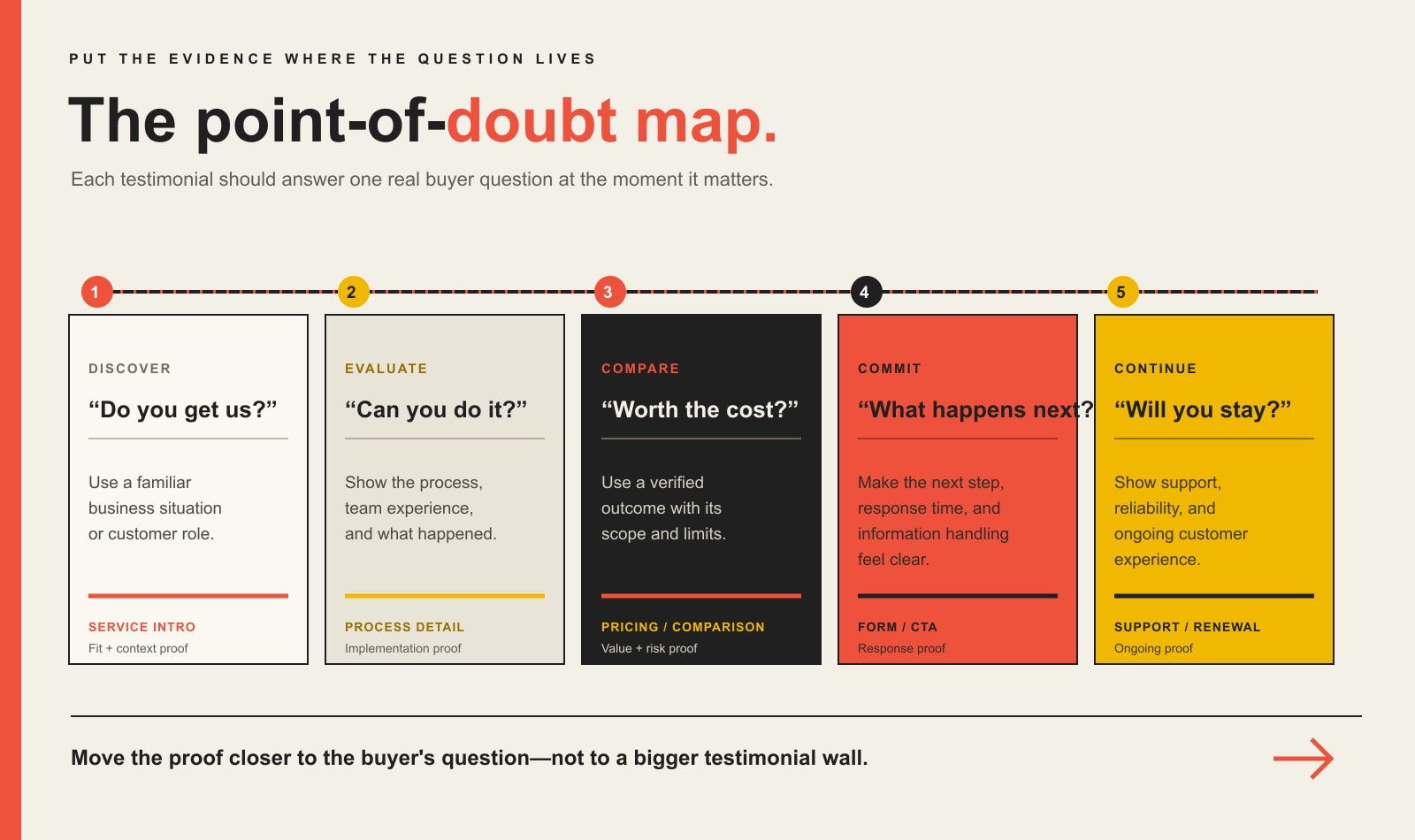
    Where testimonials should go on a website

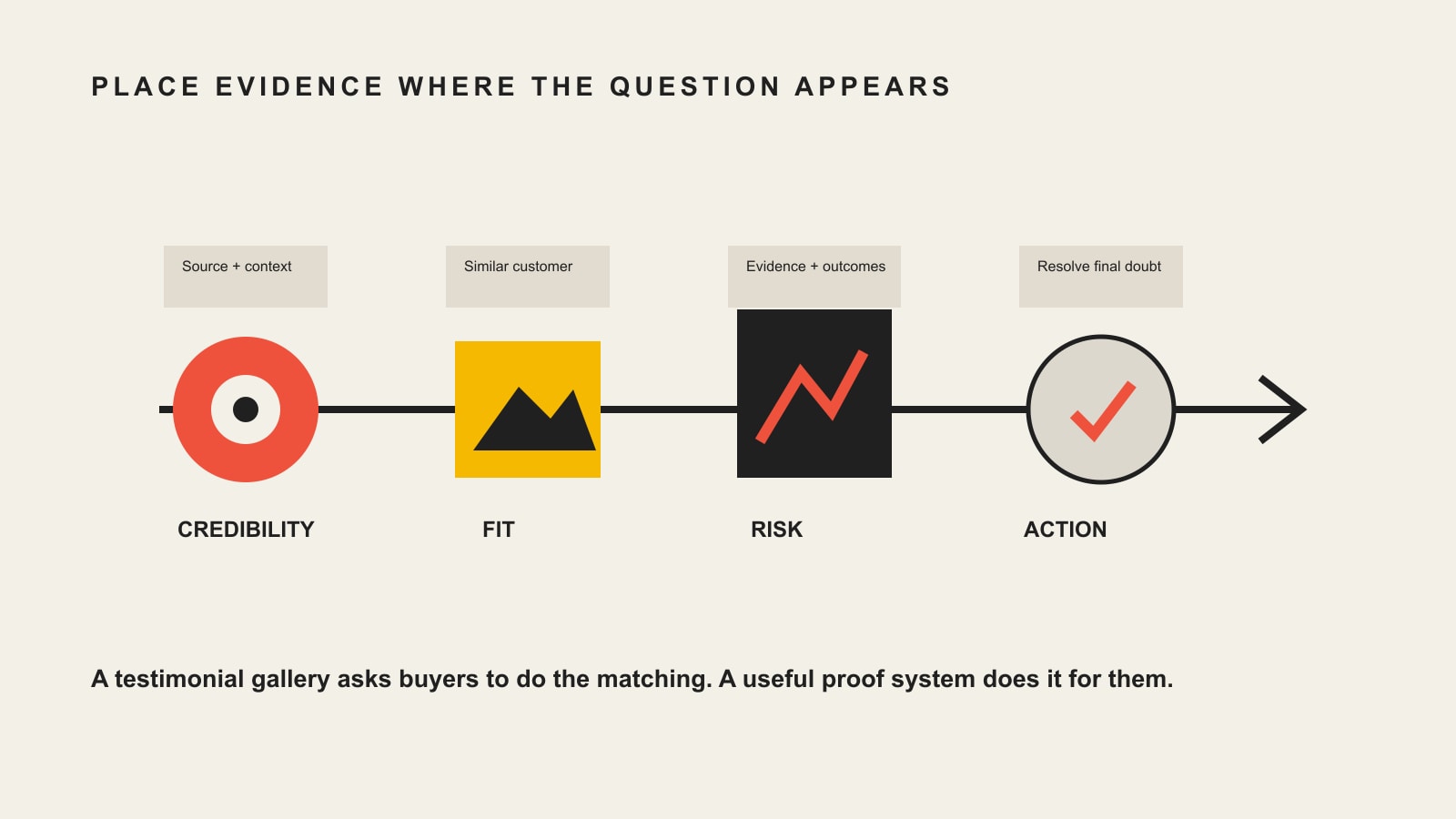
    Put each testimonial immediately before, beside, or after the claim or objection it helps resolve. The correct location depends on the evidence job.

    Buyer doubtBetter testimonial contentUseful placement
    “Do they understand a business like mine?”Relevant situation, role, business type, and constraintService introduction, industry/use-case section, or comparison page
    “Will this be a mess to implement?”Process clarity, communication, handoff, and ownershipProcess section, proposal, onboarding explanation, or near the primary CTA
    “Can our team actually use it?”Staff adoption, maintainability, training, or self-serviceFeature explanation, CMS/operations section, or implementation detail
    “Is the investment defensible?”Verified outcome with scope, timeframe, and conditionsPricing context, case evidence, or decision-stage page
    “Will they disappear after launch?”Support, response, maintenance, and responsibility experienceCare-plan or ongoing-management section
    “Are they telling me the whole story?”Honest trade-off, constraint, or recommendation against unnecessary workComparison, FAQ, fit, or discovery section
    A buyer journey map places relevant testimonial evidence near discovery, evaluation, comparison, commitment, and continued-service questions.

    Homepage testimonials

    Use a small number of broad, high-relevance testimonials that support the homepage’s main claims. Do not install an unreadable auto-rotating carousel and call the trust problem solved. If evidence changes before a visitor can finish reading it, the interface is fighting the content.

    Service and product pages

    Use evidence specific to that service, product, problem, and buyer. A general compliment about the company is weaker than a quotation about the exact uncertainty on the page.

    Pricing and comparison pages

    Use customer evidence to clarify value, fit, switching, implementation, or the cost of a problem—not to pressure someone with an outlier result. Pair every quantified claim with its context and substantiation.

    Forms and calls to action

    Evidence near a form should address the last remaining risk: what happens next, whether the conversation is useful, how information is handled, or whether the process respects the buyer’s time. “Join 50,000 happy customers” is not reassuring if the visitor is worried about a four-day response time.

    Dedicated testimonial pages

    A testimonial page can be a useful evidence library for sales teams and committed researchers. It should not be the only place testimonials exist. Organize it by buyer question, service, outcome, use case, or industry—not as a random wall of praise. Link each item to deeper context when available.

    Written, video, audio, and screenshot testimonials

    Choose the format that preserves the useful evidence and fits how buyers evaluate it.

    Written testimonials are fast to scan, easy to place near a claim, and easy to keep accessible. They become weak when over-edited, unattributed, or presented as identical cards with no context.

    Video testimonials can preserve voice, emotion, hesitation, and a fuller explanation. They are also expensive, slower to consume, harder to update, and not inherently more truthful. A polished production can make an honest customer look scripted. Keep the customer’s language and conditions intact.

    Audio testimonials can work when voice is meaningful and video adds little. Provide a transcript for access and scanning.

    Screenshots of messages or social posts can preserve original context, but they may expose personal information, become unreadable on phones, and create permission or platform-term questions. Transcribe the relevant text accessibly, retain the source, and obtain appropriate authorization.

    For prerecorded synchronized video, WCAG 2.2 guidance on captions requires synchronized text for the audio information at Level A. The W3C’s transcript guidance explains when basic or descriptive transcripts support additional access needs. Captions and transcripts also make the evidence searchable and reusable without forcing everyone to watch a video.

    There is no universal ideal length. Use the shortest version that preserves the claim, context, and limits. That may be one sentence beside a feature, a 45-second clip near a process explanation, or a full case study for a complex purchase.

    Can AI write or edit customer testimonials?

    AI can help organize source material. It cannot manufacture the customer’s experience.

    Reasonable uses include:

    • transcribing a recorded interview;
    • finding repeated themes across approved responses;
    • suggesting shorter versions that a human verifies;
    • tagging evidence by claim, buyer doubt, service, or format;
    • flagging numbers, names, and material connections for review;
    • generating captions, subject to human correction;
    • comparing the approved quotation with the published version.

    Unacceptable uses include:

    • inventing a customer;
    • generating praise and asking a customer to rubber-stamp it;
    • attaching an AI face to a quotation;
    • merging several customers into a fake composite without clear disclosure;
    • fabricating emotion, outcomes, or precise metrics;
    • changing the meaning because the original did not sound exciting enough.

    Use AI for assembly and checking. Keep human approval for publication, attribution, legal review, and any judgment about whether the result remains truthful. Fake proof is not automation. It is lying faster.

    How to measure testimonial performance

    Do not judge testimonial strategy by quote count. A swollen asset folder is not a business outcome.

    Measure the last useful behavior the evidence can reasonably influence:

    • clicks from an evidence block to a relevant case study or process explanation;
    • qualified form starts and completions on pages where evidence was added;
    • progression from service or comparison content to a high-intent next step;
    • sales use of testimonial assets and the objections they help answer;
    • lead quality, held conversations, proposal progression, or sales-cycle movement where attribution is credible;
    • evidence coverage across priority claims and objections;
    • percentage of published assets with documented source, permission, disclosure, and review status.

    A/B testing can help on high-traffic pages, but low-volume service businesses should not spend eighteen months testing whether Sarah’s quote belongs two inches higher. Start with claim coverage, sales feedback, usability observation, and qualified behavior. Our guide to web design versus content explains why diagnosing the actual constraint matters more than polishing the most visible thing.

    Testimonial evidence should also feed operations. If several customers independently praise a process step, the business may have a differentiator worth documenting. If the strongest available evidence is about friendliness while sales promises technical expertise, the evidence gap deserves attention. If customers repeatedly mention a problem, the answer is not to hide those comments and buy a happier widget. The online reputation management guide owns the correction loop.

    Common testimonial mistakes

    • Publishing vague praise. “Great service” consumes space without reducing uncertainty.
    • Hiding every quote on one page. Proof separated from the claim arrives too late.
    • Using fame instead of relevance. A recognizable logo does not answer a buyer’s actual question.
    • Inventing specificity. A fake percentage is not stronger than an honest qualitative result.
    • Losing the source. If nobody can recover the original statement or approval, the asset is weak and risky.
    • Over-editing. Removing qualifications can change the testimonial’s net impression.
    • Ignoring permission. Publicly visible does not mean reusable everywhere forever.
    • Forgetting disclosures. An employee, affiliate, free product, or unusual result can change how the evidence should be understood.
    • Using dark-pattern proof. Fake purchase popups, fabricated counters, and stock-person testimonials are manipulation, not evidence. The ethical marketing psychology guide covers the Scope Design CLEAN Test.
    • Treating video as automatically superior. Format cannot compensate for weak substance.
    • Measuring raw conversions only. More low-quality submissions can create a reporting win and an operational loss.
    • Never retiring old evidence. Roles, products, opinions, permissions, and expected outcomes can change.
    A customer statement is checked against its source, claim, evidence, permission, and context; unsupported inflated copy is rejected before publication.

    The Scope Design testimonial workflow

    1. Map claims and doubts. List what each priority page asks a buyer to believe and why they may hesitate.
    2. Choose the right evidence type. Do not demand a testimonial when a demonstration, policy, case study, public review pattern, or measured result would be stronger.
    3. Identify relevant customers. Choose people with actual experience that matches the claim and audience.
    4. Ask evidence questions. Recover situation, decision, experience, outcome, and constraint in the customer’s language.
    5. Preserve the source. Store the original response, recording, or message with date and context.
    6. Verify factual details. Check names, roles, company, scope, timeframe, and every number.
    7. Edit faithfully. Shorten or clarify without strengthening the claim or removing material conditions.
    8. Approve and authorize. Confirm the exact wording, attribution, media, channels, and disclosures in writing.
    9. Apply the CLAIM Test. Reject or revise any asset that fails Claim, Likeness, Attribution, Integrity, or Moment.
    10. Publish near the doubt. Put the evidence where a buyer encounters the relevant uncertainty.
    11. Measure qualified behavior. Watch coverage, sales usefulness, and business outcomes rather than counting quotes.
    12. Review and retire. Recheck high-use evidence when facts, relationships, products, or permissions change.

    This is slower than asking an AI tool for twelve ecstatic testimonials from fictional CEOs. It is also how a business builds a body of proof instead of a content costume.

    Frequently asked questions about customer testimonials

    What is a customer testimonial?

    A customer testimonial is an advertising message presented by a business that buyers are likely to understand as reflecting a customer’s real opinion, belief, or experience. It can be written, recorded, filmed, or republished from another source with appropriate accuracy, attribution, permission, and disclosure.

    What is an example of a good testimonial?

    A good testimonial identifies a recognizable situation, describes what specifically happened, and supports a limited claim. For example: “Our staff needed to update ordinary pages without calling a developer. The reusable page system and publishing guide let the communications team handle those updates directly.” This is an illustrative example, not a claimed customer quotation.

    What makes a testimonial credible?

    Credibility comes from a real and relevant source, specific context, accurate attribution, preserved meaning, verified facts, honest limits, and disclosure of incentives or relationships that could affect how buyers evaluate the endorsement. Polish without traceability is just shinier uncertainty.

    What is the best format for a testimonial?

    The best format is the one that preserves useful evidence and fits the buyer’s decision. A short written quote works well beside a narrow claim. Video can preserve emotion and explanation. A case study is stronger for complex context and measured outcomes. Format should follow the evidence job.

    How long should a testimonial be?

    Use the shortest version that retains the relevant situation, experience, outcome, and limits. There is no universal ideal length. One or two sentences may support a page claim; a complex purchase may need a longer video, transcript, or case study.

    How should a testimonial start?

    Start with the customer’s situation or concern, not with praise for the company. “We had three teams updating the same information in different places” gives buyers a recognizable problem. “Scope Design is amazing” gives them an adjective and no reason to believe it.

    Where should testimonials go on a website?

    Place each testimonial near the claim or doubt it addresses: fit evidence near service context, implementation evidence near the process, maintainability evidence near editing or ownership, and verified outcome evidence near cost or decision-stage content. A dedicated library can supplement this placement but should not replace it.

    How do I put testimonials on my website?

    Map the page’s claims, select a relevant approved testimonial for each important doubt, include truthful attribution and necessary disclosure, format it accessibly, and connect it to deeper evidence when available. Avoid auto-rotating carousels that disappear before people can read them.

    Is a testimonial the same as a customer review?

    No. A public review is generally a customer’s evaluation submitted to a platform or system that displays customer evaluations. A testimonial is an endorsement selected and presented in business-controlled advertising. Reusing a public review on a company website can change its context and obligations.

    What is the difference between a testimonial and a case study?

    A testimonial is an attributed customer endorsement, often short and focused on one experience or claim. A case study is a structured account of the situation, work, constraints, and outcome, usually assembled by the business and verified with the customer. Case studies can carry more context but still require evidence and permission.

    Can a business edit a customer testimonial?

    Yes, editing for grammar, length, clarity, or format can be acceptable when it does not distort the customer’s opinion or experience. Preserve the original, verify facts, send the exact edited version for approval, and never add outcomes or remove conditions that change the meaning.

    Do I need permission to publish a testimonial?

    Written permission is the safest operational standard, especially when using a person’s name, image, voice, employer, or statement in new advertising contexts. FTC guidance addresses truth and disclosure, while contracts, privacy, publicity rights, platform terms, and industry rules may add requirements. Get legal advice for the applicable jurisdiction.

    How should testimonial incentives be disclosed?

    Disclose a material connection clearly, conspicuously, and near the testimonial in plain language—for example, that the customer received a free product, discount, payment, affiliate commission, or another benefit. Do not condition incentives on positive sentiment or hide the disclosure in distant fine print.

    Are video testimonials better than written testimonials?

    Not automatically. Video can preserve voice, emotion, and a fuller explanation, while written testimonials are faster to scan, place, update, and make accessible. Substance, relevance, permission, and placement matter more than format. Prerecorded synchronized video should include accurate captions.

    Can AI write customer testimonials?

    AI can transcribe, organize, tag, and suggest faithful edits to real customer source material. It should not invent customers, praise, outcomes, faces, or composite experiences presented as real. A human should verify the source, facts, permission, disclosure, and final wording before publication.

    How many testimonials should a website have?

    Enough to cover the important claims and objections without repetition. A page may need two highly relevant testimonials rather than twelve generic ones. Measure evidence coverage and usefulness, not the size of the testimonial pile.

    How do you measure whether testimonials work?

    Track qualified behavior near the evidence: relevant case-study clicks, form starts and completions, progression to high-intent pages, sales use, objection resolution, lead quality, and sales-cycle movement where attribution is credible. Also audit whether every published asset has a traceable source, approval, disclosure, and review status.

    Build proof buyers can inspect

    The goal is not to make every customer sound ecstatic. The goal is to help the next buyer judge a claim with less uncertainty.

    Map the doubt. Find the relevant experience. Preserve the source. Verify the facts. Obtain permission. Edit without strengthening. Disclose what changes interpretation. Put the evidence beside the decision. Then measure whether better-informed buyers take a useful next step.

    That is customer testimonial strategy. Everything else is a quote carousel auditioning for a role in a website nobody trusts.

    Sources

  • How Customer Reviews Influence Buying Decisions

    How Customer Reviews Influence Buying Decisions

    Customer reviews influence buying decisions when they reduce a specific uncertainty at the moment a buyer feels it. A useful review helps someone answer: Did this work for a person like me, under constraints like mine, and what happened after they bought? A wall of five-star adjectives may look impressive, but applause without context is weak evidence.

    Scope Design TL;DR: Buyers do not need more praise. They need credible proof close to the decision. Use the PROOF Review Test: check the review’s proximity to the decision, relevance, origin, outcome specificity, and the friction it answers. Then place the strongest evidence beside the claim or objection it supports. That is review marketing. Everything else is decorative optimism.

    What this guide covers

    Customer reviews influence buying decisions by reducing uncertainty

    A buyer rarely arrives asking, “Does this company possess testimonials?” They arrive with risk questions:

    • Will this work for my situation?
    • Will the result justify the cost?
    • What will implementation be like?
    • What happens if something goes wrong?
    • Is the company describing reality or performing marketing karaoke?

    Customer reviews are useful because they provide information from outside the seller’s voice. Researchers usually describe this as electronic word of mouth, or eWOM. The practical point is less academic: a buyer is trying to estimate an outcome with incomplete information, and another customer’s experience can reduce that uncertainty.

    That does not mean any review increases sales. A generic “Great company!” review may confirm that somebody somewhere was pleased. It does not help a cautious buyer evaluate fit, process, risk, or results. Reviews influence purchase decisions when the content is credible, relevant, diagnostic, and available where the doubt occurs.

    That last part matters. If your strongest review answers a pricing objection but lives on a testimonial page nobody visits, you have created evidence and then hidden it from the jury.

    The research supports review influence, but not every recycled statistic

    The internet has spent years photocopying the same review statistics until the source disappeared and the caveats died of neglect. We are not doing that here.

    A 2024 open-access meta-analysis of 156 studies combined 214 effect sizes and 69,006 observations. It found significant relationships between purchase intention and review factors including valence, usefulness, credibility, rating, sidedness, argument quality, volume, and reviewer characteristics. Review valence had the strongest combined relationship in that analysis, but the researchers also found substantial differences by context, product type, culture, research method, and other moderators.

    Translation: reviews matter, but there is no universal percentage you can staple onto every restaurant, software company, law firm, roofer, and industrial supplier.

    A meta-analysis of review helpfulness found positive influences from review depth, review age, reviewer information disclosure, and reviewer expertise. It did not find significant effects for readability or rating in its pooled helpfulness analysis, and it found that platform and product type helped explain inconsistent results. That is another warning against pretending one rating number explains the whole decision.

    A separate source-credibility meta-analysis synthesized 20 research papers and found that expertise, trustworthiness, and similarity between source and reader influenced review usefulness, credibility, information adoption, and purchase intention. Buyers are not merely counting stars. They are deciding whether the reviewer knows what they are talking about and whether the experience applies to them.

    What about the famous “270% more likely to purchase” claim?

    The Medill Spiegel Research Center reported that purchase likelihood for a product with five reviews was 270% greater than for a product with none. That is a real finding from its retail research, not permission to claim that five Google reviews will increase every business’s sales by 270%.

    The result compares reviewed and unreviewed products in a particular research setting. It is valuable evidence that the presence of reviews can matter, especially early in review accumulation. It is not a universal forecast, a service-business guarantee, or a substitute for measuring your own buyer journey.

    Specific evidence gets stronger when its boundaries remain attached. Marketing gets dumber when the footnote is thrown into the sea.

    Use the Scope Design PROOF Review Test

    The PROOF Review Test determines whether a customer review is decision-grade evidence or just a pleasant sentence taking up space.

    1. Proximity: Is the review close to the claim, concern, or decision it supports?
    2. Relevance: Does the reviewer share the buyer’s situation, use case, industry, constraint, or desired outcome?
    3. Origin: Can the experience be traced to a real source, platform, transaction, or permitted customer identity?
    4. Outcome: Does the review describe what changed, how the work unfolded, or what result occurred?
    5. Friction: Does the review answer a real hesitation about cost, time, fit, complexity, risk, support, or switching?
    The PROOF Review Test assesses proximity, relevance, origin, outcome specificity, and friction addressed by customer evidence.
    The PROOF Review Test turns a customer quote into decision-grade evidence by testing proximity, relevance, origin, outcome, and friction.

    The test is deliberately stricter than “Is it positive?” Positive is a sentiment. Proof is useful information expensive to fake.

    Proximity: put the evidence where the doubt happens

    Evidence loses power when it is separated from the claim it should support. Put a review about response time near the service promise. Put implementation evidence beside the process. Put a review about value near pricing or scope. Put a recovery story near the support commitment.

    Do not force a buyer to remember a vague compliment from three pages ago and mentally attach it to a new concern. That is not persuasion. That is homework.

    Relevance: help the buyer recognize themselves

    A review becomes more useful when the reader can say, “That sounds like our situation.” Relevant details may include:

    • business type or industry;
    • project size or complexity;
    • starting problem;
    • important constraint;
    • role of the buyer;
    • product or service used;
    • desired outcome;
    • location, when location affects delivery.

    This does not require exposing confidential information. “A regional healthcare practice replacing a legacy scheduling workflow” can create more recognition than “Acme Medical Group” while protecting the client. Specificity and privacy are not enemies; lazy writing makes them look that way.

    Origin: make the evidence inspectable

    The strongest public evidence lets a reasonable reader understand where it came from. Useful origin signals include a link to the original platform review, a verified-purchase label controlled by a platform, a dated case study, a real person’s permitted name and role, or a clearly described anonymized client context.

    Do not manufacture a headshot, invent a company, or turn a customer’s private email into public marketing without permission. If the evidence cannot survive a polite “Who said this, and how do you know?” it is not ready to carry a commercial claim.

    Outcome: replace adjectives with a before-and-after

    “Professional, responsive, and amazing” is nice. It is also nearly interchangeable with praise for a dentist, an accountant, a dog groomer, or a taco truck.

    Outcome-rich reviews explain what happened:

    • what problem existed before the purchase;
    • why the customer chose the business;
    • what the process was like;
    • which obstacle was handled;
    • what changed afterward;
    • who would or would not be a good fit.

    Not every review needs a revenue number. A credible process outcome—fewer handoff failures, clearer decisions, faster onboarding, less confusion, a problem resolved without drama—can be highly diagnostic.

    Friction: answer the question keeping the buyer from acting

    The most commercially useful review often addresses a hesitation the company cannot resolve credibly by praising itself.

    Buyer hesitationUseful review evidenceWeak substitute
    “Will they understand our unusual situation?”A customer with a comparable constraint explains how discovery changed the solution“They are creative”
    “Will this become an operational mess?”A review describes communication, milestones, ownership, and handoff“Great service”
    “Is the higher price worth it?”A customer explains avoided rework, improved decisions, or a more durable result“Worth every penny” with no context
    “What happens when something goes wrong?”A credible recovery story shows response, correction, and accountabilityA suspicious wall of perfection
    “Are we the right fit?”A reviewer identifies the kind of buyer or project most likely to succeedA universal claim that the business is perfect for everyone

    Buyers use a bundle of review signals—not one magic metric

    Review platforms compress complex evidence into visible shortcuts: average rating, review count, dates, distribution, reviewer identity, response, photos, verified status, and written content. Buyers combine these cues differently depending on the decision.

    Rating and valence create a fast first impression

    Positive or negative direction matters. The 2024 meta-analysis found review valence had the strongest combined relationship with purchase intention among the factors it examined. But an average rating is an entry cue, not the entire case.

    A 4.8 rating can still feel untrustworthy if the reviews are generic, arrive in a suspicious burst, or describe a different service. A lower rating can remain credible when the distribution makes sense, critical reviews receive accountable responses, and the content answers real questions.

    Volume creates consensus—until context changes

    Review count can reduce the risk that one unusual experience is carrying the whole signal. Its value depends on category, competition, recency, and the cost of the decision. Ten detailed reviews may be meaningful for a specialized B2B service and practically invisible for a busy restaurant.

    Do not chase a universal count. Compare relevant competitors, track the rate at which eligible customer experiences produce honest reviews, and examine whether buyers are reaching decision pages with enough evidence to judge fit.

    For the ethical operating process behind asking, use our guide to getting more Google reviews without gaming customers. This article owns how reviews influence decisions; that one owns how the requests should work.

    Recency tells buyers whether the evidence still describes the business

    An old review can remain true, especially for durable results. A profile containing only old reviews raises a different question: is this still how the company operates?

    Use the date as context, not an automatic expiration rule. Reviews about current service quality, staff, inventory, software, pricing, or response practices often need fresher corroboration than reviews documenting a long-lived result.

    Detail increases diagnostic value

    Review depth repeatedly appears in research on helpfulness. Details help buyers distinguish a real experience from a generic claim and decide whether the experience matches their situation.

    The goal is not maximum word count. A concise review can be highly useful when it names the problem, process, and outcome. A 700-word emotional fog bank can still say nothing.

    Source credibility changes how the message is interpreted

    Reviewer expertise, trustworthiness, and similarity to the reader influence credibility and adoption. For a technical purchase, demonstrated experience may matter. For a subjective service, similarity of goals or circumstances may matter more.

    This is why a relevant three-star review can sometimes teach a buyer more than an anonymous five-star sentence. The buyer is evaluating the source and the argument, not merely admiring the icon color.

    Business responses reveal accountability

    A response cannot erase the customer’s experience. It can show whether the business listens, protects privacy, accepts responsibility, explains appropriate context, and offers a next step.

    Responses belong to online reputation management, where monitoring and recovery are handled systematically. Here, the buyer-decision lesson is simple: the original review and the business response form one visible evidence unit.

    Relevance usually beats a giant pile of generic praise

    Suppose a business has 400 reviews saying “Great job,” while a competitor has 80 reviews describing specific situations, constraints, process decisions, and outcomes. The larger count may win the first glance. The more diagnostic evidence may win the considered decision.

    That distinction grows with price, complexity, risk, and buyer accountability. A person choosing a $20 lunch may rely heavily on aggregate cues. A team choosing a six-month website engagement needs evidence about discovery, communication, technical judgment, handoff, and what happens when reality refuses to follow the original plan.

    Scope Design’s authority standard applies here: authority is usefulness expensive to fake. A real framework, a shown decision, a named constraint, or an honest refusal does more work than another self-awarded adjective. Customer reviews should corroborate that usefulness, not become a glitter cannon pointed at the About page.

    This is also why selected customer quotations and public-platform reviews should not be managed as identical assets. Our guide to testimonials and social proof covers permission, editing, selection, and on-site presentation. Public reviews are customer-authored platform evidence. Testimonials are curated marketing assets. They can support one another, but pretending they are the same weakens both.

    Place review evidence beside the decision it supports

    The default “Testimonials” page is usually a storage closet. Serious buyers do not want a museum tour of praise; they want an answer near the point of doubt.

    A buyer journey links credibility, fit, risk, and action decisions to relevant customer evidence placed at each point.
    Relevant review evidence belongs beside the buyer decision it supports—not marooned in a testimonial museum.

    Use this placement map:

    Decision momentBuyer questionReview evidence to place nearby
    First credibility check“Do they solve the kind of problem I have?”A concise review naming the problem, audience, and relevant service
    Service or product evaluation“How does this work in a situation like mine?”Context-rich reviews grouped by use case, industry, or constraint
    Pricing and scope“Is the cost justified, and what am I actually paying for?”Evidence about decisions, avoided rework, durability, support, or business outcome
    Process and implementation“Will this be painful?”Reviews describing communication, milestones, collaboration, migration, or handoff
    Objection or risk section“What happens if the project gets complicated?”Honest recovery evidence or an example of a difficult constraint handled well
    Call to action“Is taking the next step sensible?”A brief, highly relevant review plus a clear expectation for the next step

    Use review excerpts without rewriting the customer’s meaning

    Shortening a review for layout is not permission to upgrade the claim. Preserve the meaning, indicate omissions when necessary, retain the source, and link to the original review where practical. Get permission when the usage, identity, platform terms, or context requires it.

    If the edited version sounds more impressive than the customer’s actual experience, you did not “tighten the copy.” You created a better review than the customer wrote.

    Build evidence groups around buyer questions

    Organize review evidence by the decision it helps make:

    • fit and audience;
    • process and communication;
    • results and outcomes;
    • technical competence;
    • speed and responsiveness;
    • recovery and support;
    • value and scope;
    • long-term relationship.

    This creates reusable evidence modules for service pages, proposals, sales follow-up, and content. It also exposes gaps. If you have 200 compliments about friendliness and no evidence supporting your most important commercial promise, you have learned what the next case study or feedback prompt needs to investigate.

    Negative reviews can increase credibility—but do not fetishize them

    Buyers know perfect systems are rare and fake systems are plentiful. A mix of opinions can make review evidence feel more realistic, show tradeoffs, and help the right customer self-select.

    That does not mean “negative reviews increase sales” is a universal law. A study summarized by Harvard Business Review found that a negative review from a dissimilar reviewer increased purchase intent in a specific experiment involving NFL fans and a team-branded hoodie. The mechanism was identity distance: participants could treat the disliked reviewer’s objection as evidence that the product might fit them.

    Interesting? Yes. A reason to engineer one-star reviews? Absolutely not.

    Use negative reviews as information:

    • Is the complaint a real service failure?
    • Does it reveal a wrong-fit customer or an unclear promise?
    • Is the response accountable and privacy-safe?
    • Has the operating problem been corrected?
    • Would the criticism help a future buyer understand a genuine tradeoff?

    One bad review does not automatically ruin a business. A pattern of similar failures, defensive responses, or unanswered complaints can. The correct response is not to hide the signal; it is to diagnose the operation.

    Fake, suppressed, and sentiment-conditioned reviews destroy the evidence

    The United States Federal Trade Commission’s Consumer Reviews and Testimonials Rule addresses fake or false reviews, certain insider reviews, sentiment-conditioned incentives, company-controlled review sites presented as independent, review suppression, and fake social indicators. The rule took effect on October 21, 2024.

    For a business trying to create credible proof, the operational rules are straightforward:

    • do not buy or create reviews from nonexistent people;
    • do not ask people who did not have the claimed experience to review it;
    • do not condition compensation or incentives on positive or negative sentiment;
    • do not threaten or intimidate people to suppress honest negative reviews;
    • do not present a company-controlled “independent” review property without clear disclosure;
    • do not move a review from one product or service to a substantially different one;
    • follow the platform’s rules when they are stricter than the federal baseline.

    The FTC’s guide for marketers soliciting reviews also warns against asking only people expected to leave positive reviews and against treating supposedly independent rankings as pay-to-play decorations.

    Authenticity is not merely a compliance chore. It is the product. Once buyers suspect the review system has been manipulated, the business has converted proof into another claim it must defend.

    Measure whether review evidence improves decisions—not whether the widget exists

    Raw review count and average rating are useful diagnostics. They are not complete business outcomes.

    For a considered service, the website’s job is often to produce better-informed, better-fit conversations. Track review evidence through that job:

    Evidence coverage

    List the important claims and objections on each commercial page. Record whether each has relevant customer evidence beside it. Coverage reveals whether review content supports the actual sale or simply accumulates in a gallery.

    Evidence engagement

    Measure interactions that represent real evaluation: expanding a review, selecting a use-case filter, following a source link, opening a case study, or continuing from an evidence module to the next decision step. Do not treat time staring at a giant carousel as strategy.

    Qualified conversion

    Compare meaningful outcomes for visitors who encountered relevant review evidence: qualified inquiries, completed applications, held appointments, purchases, or the last website-controlled step in the buyer journey. Segment by page and traffic source. Avoid claiming causation from a tiny sample.

    Sales feedback

    Ask sales which reviews, case studies, or examples prospects mention. Record whether the evidence shortened explanations, answered an objection, improved fit, or created a new concern. Qualitative evidence matters when traffic is too low for a defensible experiment.

    Review-to-reality consistency

    Compare public praise and criticism with support tickets, refunds, project retrospectives, churn reasons, and delivery data. If the website says “responsive” while unresolved requests collect birthdays, the review strategy is not the constraint.

    Responsible testing

    High-traffic sites can test evidence placement and presentation. Lower-traffic B2B and service sites should prioritize large, theory-backed changes and qualitative evaluation. A three-week button-color test on 200 visitors is random variance wearing a lab coat.

    The website strategy and measurement system should connect traffic, buyer intent, evidence, qualified action, and downstream revenue. Our website strategy and conversion playbook explains how those pieces fit without pretending the website closes a complex sale by itself.

    Run this practical customer-review evidence audit

    Use this audit on one high-value service, product, or landing page at a time.

    1. List the buyer’s real uncertainties

    Interview sales, support, and delivery. Review search queries, sales-call notes, lost-deal reasons, and customer questions. Write the five to ten uncertainties that actually delay a decision.

    2. Inventory every available proof asset

    Include public reviews, customer emails with permission status, survey responses, case studies, call transcripts, support recoveries, referral notes, project retrospectives, and measurable outcomes. Record the exact source and what can be used publicly.

    3. Score each asset with PROOF

    Give each element one point for proximity potential, relevance, inspectable origin, outcome specificity, and answered friction. A low score does not make the customer unimportant. It means the quotation cannot carry a large claim alone.

    4. Match evidence to claims and objections

    Build an evidence ledger with these columns:

    Page or decisionClaim or buyer questionEvidence assetPROOF scoreSource and permissionPlacementGap or next action
    Pricing section“Is the investment justified?”Review describing avoided rework5Public review; link verifiedBeside pricing rationaleAdd evidence for ongoing support

    This turns review marketing from decoration into content architecture.

    5. Remove weak, duplicate, or misleading presentations

    Retire invented names, vague anonymous quotes, screenshots with no readable context, duplicates presented as separate endorsements, and excerpts that change the original meaning. Keep a recoverable archive and source record.

    6. Place the best evidence in the buyer journey

    Move relevant evidence beside the decision it supports. Use a smaller number of strong examples before adding carousels, sliders, badges, and other widgets that make the page move while the argument stands still.

    7. Create an evidence backlog

    Document unsupported claims and unanswered objections. Feed those gaps into customer interviews, case-study development, project retrospectives, and the ethical review-generation process. Do not ask customers to repeat your preferred marketing claim; ask about the real decision and experience.

    8. Measure and revisit

    Review evidence coverage quarterly and after major offer, team, process, or product changes. The goal is not a permanently polished wall. It is current, inspectable evidence that helps the right buyer make a better decision.

    Reviews are one part of an authority system

    Customer reviews corroborate what other authority assets explain in more depth:

    That separation prevents five articles from competing to say “reviews are important” with different clip art. Each page owns a job, links to the next decision, and makes the cluster more useful as a whole.

    Frequently asked questions

    What is a customer review?

    A customer review is a customer’s evaluation of a real product, service, or business experience, usually published on a business-controlled or third-party platform. It may include a rating, written account, photos, video, reviewer information, date, and a business response.

    How do customer reviews influence buying decisions?

    Customer reviews influence buying decisions by reducing uncertainty, shaping perceived quality, and providing evidence outside the seller’s own claims. Their impact depends on factors such as valence, usefulness, credibility, detail, source, volume, product type, and relevance to the buyer’s situation.

    Why are customer reviews important?

    Customer reviews help buyers evaluate fit, risk, process, and likely outcomes. They also give businesses evidence about recurring strengths, expectation gaps, service failures, and buyer language that can improve operations and communication.

    Are customer reviews reliable?

    Some are more reliable than others. Look for specific experience details, a traceable source, reviewer context, a plausible distribution of opinions, recency appropriate to the purchase, and consistency across independent sources. A star average alone does not establish reliability.

    What makes a customer review credible?

    A credible review has an inspectable origin, describes a real and relevant experience, includes diagnostic detail, preserves the customer’s meaning, and does not show signs of sentiment-conditioned incentives or manipulation. Reviewer expertise and similarity to the buyer can also increase usefulness.

    What is an example of a good customer review?

    A useful review might say: “We hired the team after two failed migration attempts. They mapped the old data first, identified records that could not be carried over safely, and gave our staff a staged handoff. The launch took longer than the original estimate, but we understood why and did not lose customer records.” It provides context, process, tradeoff, and outcome instead of empty praise.

    Do customer reviews increase sales?

    Research finds meaningful relationships between online-review factors and purchase intention or sales, but no universal lift applies to every business. The effect changes with product type, price, familiarity, platform, review content, buyer context, and the quality and placement of the evidence.

    How many reviews do customers read before buying?

    There is no defensible universal number for every buyer and purchase. A low-risk routine purchase may require only a fast aggregate check, while an expensive or unfamiliar decision can lead buyers to examine multiple positive and negative reviews across several sources.

    Are five-star reviews always best?

    No. Positive ratings generally help, but a five-star review with no detail may be less useful than a balanced review describing the buyer, problem, process, and result. An implausibly perfect profile can also create suspicion when the content or review pattern looks manipulated.

    Can negative reviews help a business?

    Negative reviews can make the evidence set more realistic, reveal tradeoffs, help wrong-fit buyers self-select, and show how the business responds. They can also hurt when they reveal repeated failures. The effect is contextual; businesses should learn from legitimate criticism rather than manufacture, suppress, or celebrate it.

    Should a business respond to negative reviews?

    Usually, yes. A useful response acknowledges the concern, protects private information, corrects factual errors without hostility, explains an appropriate next step, and moves detailed resolution to a private channel. The operational problem must still be fixed behind the response.

    Where should reviews appear on a website?

    Place reviews beside the claim or buyer concern they support: fit evidence on service pages, implementation evidence near the process, value evidence near pricing, recovery evidence near support commitments, and a highly relevant proof point near the call to action.

    Is a testimonial the same as a customer review?

    Not exactly. A public review is generally customer-authored content published through a review platform or review system. A testimonial is a customer endorsement selected and presented by the business, often with permission and light editing. Both require accurate sourcing and preservation of meaning.

    Can businesses offer incentives for reviews?

    Rules depend on the platform and circumstances. The FTC rule prohibits incentives conditioned on positive or negative sentiment, and material connections may require disclosure. Platforms can be stricter; Google prohibits incentives for posting, changing, or removing Google reviews. Check the current platform and legal requirements before using incentives.

    How should a business measure review marketing?

    Measure evidence coverage, engagement with relevant proof, qualified conversions after evidence exposure, sales feedback, and consistency between public reviews and operational data. Track review count and rating as diagnostics, not as the only business outcomes.

    Turn customer praise into evidence a buyer can use

    Your business does not need a louder testimonial carousel. It needs an honest map from buyer uncertainty to credible proof.

    Scope Design can audit the claims, objections, customer evidence, and conversion paths across your website; identify where proof is missing or marooned; and build an evidence architecture that helps the right buyers reach a confident next step. Start with Impact Consulting.

  • Compelling Taglines: What Psychology Actually Says About Memory, Emotion, and Brand Recall

    Compelling Taglines: What Psychology Actually Says About Memory, Emotion, and Brand Recall

    Compelling taglines do not need to “hack the brain.” They need to cue one useful idea, connect that idea to the right brand, survive a delay, and remain believable when a customer encounters the real business.

    That sounds less exciting than promises about subconscious triggers and neurological buy buttons. It is also much closer to what the evidence supports. Research on hundreds of real slogans shows that the wording people like most is not automatically the wording they remember best. Other research shows that repetition can help familiarity and liking, but not without limits. And decades of branding work point to another problem that famous-tagline lists often miss: people can remember the words and forget who said them.

    This guide focuses on the psychology of evaluating a tagline: memory, processing, repetition, brand association, credibility, and the limits of neuromarketing claims. If you need the full ideation and writing process, use our guide to writing memorable slogans and taglines. That page owns the writing craft; this one owns the evidence test.

    What Makes Compelling Taglines Work?

    A useful tagline is a compact brand cue, not a miniature sales page. It cannot explain the entire company, carry weak positioning on its back, or guarantee a sale by choosing the correct adjective.

    At minimum, a strong line should do five things well enough for its intended job:

    • Express one strategically useful idea. People should have a clear association to attach to the company.
    • Remain true. The line should survive contact with the actual product, service, proof, and customer experience.
    • Link to the brand. Remembered words have little value if the audience credits a competitor.
    • Leave useful memory. The goal is not merely immediate applause in a meeting.
    • Process well enough for the context. People must be able to understand, say, scan, or hear the line—but “easier” is not automatically “more memorable.”

    This is why a tagline should sit downstream from a coherent brand messaging system. The tagline compresses one idea from that system. It does not replace the system.

    Psychology Says Liking and Memory Are Different Jobs

    One of the most useful findings in slogan research is also one of the easiest to ignore: likability and memorability can pull in different directions.

    A Journal of Consumer Research study by Brady T. Hodges, Zachary Estes, and Caleb Warren analyzed more than 800 brand slogans and combined that work with laboratory experiments, eye tracking, and a field study. The researchers found a tradeoff between linguistic fluency and memory. Features that made slogans easier to process tended to improve liking while reducing memory; some less-fluent features improved memory at the cost of liking.

    In their data, shorter slogans, familiar words, and omitting the brand name were generally associated with greater liking. Longer slogans, more concrete or less-common words, and including the brand name were more likely to be remembered.

    That is not a recipe for making every tagline long or awkward. It is a warning against optimizing the wrong outcome.

    What the tagline needs to doWhat to testCommon mistake
    Create immediate easeComprehension and naturalnessAssuming the smoothest line will also be remembered
    Build recallDelayed unaided recallJudging memory immediately after exposure
    Strengthen brand linkageCorrect brand attributionCelebrating recall of the words alone
    Clarify the offerWhat people think the company means or doesConfusing cleverness with clarity
    Support a promiseCredibility and available proofChoosing a claim because it sounds powerful

    The practical question is not “What wording do we like best?” It is “What job does this line need to do, and what evidence would show that it is doing it?”

    Repetition Helps, but “More Is Always Better” Is Not Psychology

    Branding depends on repeated exposure. A line that appears once in a brainstorm deck is unlikely to become a durable cue. But the popular version of the mere-exposure effect—“show it enough and people will love it”—is too simple.

    A 2017 Psychological Bulletin re-examination of the mere-exposure effect synthesized 268 exposure-response curves from 81 articles. The results supported positive exposure effects, but also negative quadratic effects and meaningful moderators. In plain English: repeated exposure can increase familiarity and liking, yet the relationship is often curved rather than unlimited.

    For a business, the lesson is operational rather than mystical. Use a tagline consistently enough to build an association, but do not turn repetition into wallpaper. The line should appear where it has a job and alongside the same recognizable identity, promise, and experience. That is part of a larger brand strategy system, not a reason to stamp the same six words onto every available surface.

    Brand Linkage: Remembered Words Are Useless If the Wrong Brand Gets Credit

    Marketers often ask, “Will people remember the tagline?” A better question is, “Will they remember whose tagline it is?”

    In “Got slogan? Guidelines for creating effective slogans”, Chiranjeev Kohli, Lance Leuthesser, and Rajneesh Suri discuss the role slogans can play in recognition, recall, image, and differentiation—and the persistent problem of weak brand-slogan linkage.

    This changes how you evaluate famous taglines. A line may be culturally familiar because the company spent years pairing it with a logo, media budget, packaging, spokespeople, sound, and product experience. Copying its sentence shape does not copy the system that made it famous.

    It also changes the brand-name question. The Journal of Consumer Research work found that including the brand name could improve memory, even though omission tended to improve liking. That does not mean every company should force its name into the line. It means brand attribution is an outcome worth testing.

    Use the Scope Design STAMP Test for Compelling Taglines

    For this guide, we built the Scope Design STAMP Test to translate the evidence into a practical evaluation tool. It is not a neuroscience score. It is a way to stop five different questions from being mashed into one vague reaction like “I like it.”

    S — Strategic idea

    What useful association should this line create?

    The answer cannot be “we want something catchy.” Start with the thing worth remembering: a relevant difference, useful outcome, point of view, category cue, or promise. If the company has not decided why a buyer should choose it, the tagline is being asked to invent a position that does not exist. Our guide to brand differentiation goes deeper on finding a meaningful difference before turning it into language.

    T — Truth

    Can the business prove or consistently deliver what the line implies?

    A tagline can be aspirational without becoming fictional. If it contains a specific performance claim, the standard is higher. The Federal Trade Commission’s advertising guidance for small businesses explains that advertising must be truthful and non-deceptive and that objective claims need an adequate basis. That applies to meaningful implied claims too, not only numbers printed in giant type.

    The strongest brand claims are connected to actual evidence. That same principle is central to building brand authority from proof rather than from costume.

    A — Association

    Do people connect the line to the correct company and the intended idea?

    Ask people what company they think of and what they believe the line means. If the language could belong to ten competitors, you may have produced a pleasant sentence rather than a useful brand asset.

    M — Memory

    What survives after attention moves somewhere else?

    Do not ask people to repeat the line three seconds after reading it and call that brand recall. Add a filler task. Ask again later. If possible, check again the next day. Delayed memory is closer to the commercial job you actually care about: whether the brand can come back to mind when the buying situation appears.

    P — Processing

    Can the audience understand, say, hear, and scan the line in the places where it will actually appear?

    Processing matters, but do not turn fluency into an absolute rule. A line can become so generic and frictionless that there is nothing distinctive left to remember. Use the fewest words that preserve meaning, credibility, brand connection, and rhythm—not the fewest words at any cost.

    How to Test a Tagline Without Pretending Preference Is Proof

    You do not need a brain scanner to learn whether a candidate line is helping. A small business can get useful signal with disciplined message testing. The key is to separate the outcomes instead of asking one lazy question: “Which one do you like?”

    1. Test comprehension

    Show the line in realistic context, then remove it. Ask, “What do you think this company is trying to say?” and, when relevant, “What do you think this company does?” You are looking for the intended meaning, not verbatim repetition.

    2. Test brand linkage

    After exposure, ask which brand the line belongs to. If you are comparing candidates, keep presentation conditions consistent. A line that wins on recall but loses the brand is not a clean win.

    3. Test delayed recall

    Put another task between exposure and recall. For a more realistic check, follow up later rather than immediately. Ask what words or ideas they remember and which company they connect them with.

    4. Test credibility

    Ask, “What would have to be true for you to believe this line?” That question is more useful than “Does this sound trustworthy?” because it exposes the proof the audience expects.

    5. Test context

    A website hero, a trade-show banner, a social profile, a truck door, a podcast read, and a search result create different constraints. Test the line in the places where it will live. A tagline that needs a two-minute explanation beside it has failed at being a short brand cue.

    Avoid fake universal benchmarks such as “70% recall means success.” Compare candidates, look for consistent patterns across relevant people, and use the test to discover why a line succeeds or fails. For the actual writing and elimination process before testing, the ECHO slogan and tagline framework gives you the companion workflow.

    What Neuromarketing Can—and Cannot—Prove About a Tagline

    Neuromarketing is a broad label for using neuroscience, biometric, physiological, or behavioral measurement to study marketing response. Some of those methods can add useful information in a well-designed study. What they do not provide is a universal shortcut from a word choice to a sales percentage.

    If someone claims that a particular tagline structure “activates the reward center,” “bypasses rational thought,” or raises conversions by a fixed percentage, ask five questions:

    1. What study produced that result?
    2. Was the actual audience comparable to mine?
    3. Was the actual wording or message structure tested?
    4. Was the measured outcome attention, liking, memory, purchase intent, or actual behavior?
    5. Has the finding been replicated or corroborated outside the person selling the tactic?

    A change in attention is not automatically a change in preference. Preference is not automatically memory. Memory is not automatically brand attribution. Brand attribution is not automatically purchase. Those are different steps, and collapsing them into a single “neuro” claim is where marketing advice starts sounding scientific without behaving scientifically.

    For most small businesses, ordinary research is a better first investment: clarify the strategic idea, collect real customer language, generate multiple routes, test comprehension and brand linkage, check delayed recall, and verify the promise. Specialist research can come later if the decision is valuable enough to justify it.

    When the Tagline Is Not the Real Problem

    If every tagline option feels vague, the problem may not be copywriting. It may be that the business has not made the strategic choices the line is supposed to compress.

    Before polishing another round of three-word phrases, make sure you can answer:

    • Who is this for?
    • What problem or desired outcome matters most?
    • Why this option instead of the obvious alternatives?
    • What can the business credibly promise?
    • What proof supports that promise?
    • What should a customer remember when the buying situation appears?

    If those answers are fuzzy, return to brand messaging and positioning before you write the final line. A slogan can compress a position. It cannot invent one.

    Psychology is only one constraint. A tagline also has to survive commercial and legal reality.

    If the line contains an objective product or performance claim, make sure the evidence exists before using it in advertising. And if the line is intended to function as a protectable brand identifier, do not assume catchiness equals trademark strength. The U.S. Patent and Trademark Office notes that common phrases or slogans can be refused when consumers would not perceive them as identifying source, and other conflicts can arise from descriptiveness or similarity to existing marks.

    For a high-stakes launch, clearance is a legal task, not a creative-team confidence check. Search the relevant records and involve a qualified trademark attorney when the risk justifies it.

    Frequently Asked Questions About Tagline Psychology

    What makes a tagline memorable?

    Memorability can come from concrete or distinctive wording, meaningful association, brand-name linkage, repeated exposure, and consistent use. Research suggests that the line people like most immediately is not automatically the line they remember best later. Test delayed recall and correct brand attribution instead of relying only on preference.

    Are short taglines always better?

    No. Short lines are easier to place and repeat, but there is no universal ideal word count. The Journal of Consumer Research study described above found that shorter slogans tended to be liked more, while longer slogans were more likely to be remembered. Use the fewest words that preserve the intended meaning, brand connection, credibility, and rhythm.

    Should a tagline include the brand name?

    Sometimes. Including the brand name can strengthen memory and brand linkage, especially for an unfamiliar company, but it can make a line less smooth. The research points to a tradeoff rather than a universal rule. Test whether people remember the correct brand with and without the name.

    Does emotion make a tagline more persuasive?

    Emotion can matter because people respond to outcomes, identity, risk, relief, status, belonging, humor, and other meaningful associations. But there is no single emotional trigger that guarantees persuasion or lets a line bypass rational evaluation. The emotion still has to be relevant to the audience, credible for the brand, and connected to the experience that follows.

    Does repeating a tagline make it more effective?

    Repeated exposure can increase familiarity and liking, and repetition is necessary for building many brand associations. However, research on mere exposure shows that the effect is moderated and can follow an inverted-U pattern. Consistency is useful; unlimited repetition is not a law of psychology.

    Can neuromarketing prove that a tagline will increase conversions?

    Not from a generic principle or a recycled statistic. A specific study can measure specific responses from a specific sample under specific conditions. That does not create a universal conversion guarantee for another company, audience, offer, or channel. Ask what was actually measured before accepting a neuroscience-sounding claim.

    What is the difference between a tagline and a slogan?

    People often use the terms interchangeably. A practical distinction is that a tagline usually represents the enduring brand, while a slogan often supports a campaign, product, or initiative. There is no universally enforced terminology, so the more important question is what job the line needs to do.

    Does every business need a tagline?

    No. A weak tagline can consume space without adding meaning. If the business name, headline, product context, and visual identity already make the important idea clear, a separate line may not be necessary. Use one when it has a defined strategic job.

    The Bottom Line: Build a Useful Association, Not a Brain Hack

    The best psychology lesson for compelling taglines is not a secret word list. It is discipline.

    Decide what deserves to be remembered. Make the line true. Test whether people connect it to the correct brand. Measure memory after a delay. Keep the language easy enough to use without sanding away everything distinctive. Repeat it consistently, but do not confuse repetition with inevitability.

    If the STAMP Test exposes a deeper problem—no clear difference, no credible promise, no proof, or no consistent message—fix that system first. The tagline will get easier once the strategy has something worth compressing.

    Sources

  • Are Websites Still Relevant? When Your Business Actually Needs One

    Are Websites Still Relevant? When Your Business Actually Needs One

    Are websites still relevant in 2026? Yes—but not every business needs a large or complicated one. The useful question is no longer “website or social media?” It is: Which business jobs require a destination you can control, change, measure, and connect to the rest of your operation?

    A website earns its place when it helps buyers verify your claims, take a useful next step, find durable answers, or complete tasks that a platform profile cannot handle well. If referrals, a Google Business Profile, a marketplace, social profiles, and a phone number already handle those jobs adequately, a profile-first presence—or a very small site—can be a rational choice for now.

    That is a different answer from “every serious business needs a 20-page website.” It is also different from declaring websites dead because discovery increasingly happens in search results, maps, social feeds, marketplaces, and AI-generated answers. Discovery and destination are separate jobs.

    Are websites still relevant in 2026?

    They are relevant when they do work the business actually needs. A website is not strategic merely because it exists. A forgotten brochure site with stale copy, no proof, no clear next step, and no useful connection to sales or operations does not become valuable by surviving another calendar year.

    At the same time, the argument that social media or AI has “replaced” websites confuses where a customer discovers a business with where the business can organize evidence, guide a decision, and complete a transaction or handoff. A buyer may first encounter you in Maps, a TikTok video, a referral text, a marketplace listing, an AI answer, or a search result. The website can still be the place where that scattered discovery becomes a coherent decision.

    Google itself makes the distinction visible. Its Business Profile guidance explains that eligible local businesses can appear in Search and Maps, show hours and contact information, collect reviews, and direct customers to a website, booking link, or other next step. In other words, basic local discovery does not always require a substantial website. That is exactly why the website has to justify its own job.

    Four jobs websites still do well

    At Scope Design, we use a simple decision model before talking about pages, templates, features, or redesigns. We call it the Website Job Test. A website becomes more valuable as it takes responsibility for one or more of four jobs.

    Four jobs to test before building a website: proof, a controlled customer path, durable discoverability, and operational integrations.

    1. Proof and authority

    Can a potential customer verify that you are credible, relevant, and capable of doing what you claim? A strong website can organize case studies, work examples, reviews, credentials, people, policies, process, pricing context, service boundaries, and answers to objections in one coherent system.

    Social profiles can provide excellent evidence, but they usually organize it according to the platform’s format and feed logic. A website lets the business decide which proof belongs next to which claim. That matters when the purchase is expensive, risky, technical, unfamiliar, or simply hard to evaluate. Our brand authority framework goes deeper into building a body of proof instead of decorating weak claims.

    2. A controlled conversion path

    Can the right visitor take the right next step without fighting the interface or guessing what happens next? That step might be a purchase, appointment, quote request, assessment, application, download, account login, support task, or detailed inquiry.

    This does not mean “put a form on every page.” It means designing the path around the customer decision and the business’s ability to respond. If your site sends every visitor to the same generic contact form, while nobody owns follow-up, the problem is not a shortage of buttons. If you are still deciding what the site should be accountable for, start with the purpose of the business website before buying more features.

    3. Durable discoverability

    Do customers ask questions that deserve stable, crawlable, linkable answers? A useful website gives those answers a durable address. Search engines can index them, people can bookmark or share them, salespeople can send them, newsletters can point to them, and other sites can cite them.

    That matters even as AI changes how search results are presented. Google’s current guidance for AI experiences in Search still tells site owners to make pages accessible, useful, technically eligible, and easy to use. A website can therefore be a source and a destination in AI-assisted discovery. It is not, however, a guarantee of ranking, indexing, mention, or citation.

    4. Operations and integrations

    Does the customer-facing experience need to connect to booking, ecommerce, CRM, email automation, inventory, support, payments, memberships, portals, documents, calculators, account data, or internal workflow? At that point the website is not merely “marketing.” It is part of how the business operates.

    This job is where the difference between a profile, a simple website, and a custom system becomes obvious. A restaurant that mainly needs hours, directions, a menu, and a reservation link has a different website problem from a manufacturer with specification libraries and distributor workflows, or a service company that must qualify leads across multiple locations and route them to the right team.

    The Website Job Test: do you actually need one?

    Before deciding how much website to buy, answer these questions without assuming the website is the solution.

    1. Proof: Do buyers need evidence, explanation, comparison, policies, or reassurance that a profile cannot organize well enough?
    2. Path: Do you need to control or improve a meaningful next step such as booking, buying, applying, requesting an estimate, or getting support?
    3. Persistence: Do you need durable pages that can be searched, linked, cited, updated, and reused outside a platform feed?
    4. Operations: Do customer actions need to connect reliably to business systems or workflows?

    If the honest answer is “not really” to all four, do not invent a 30-page website project because somebody said every business needs one. If two or three answers are clearly yes, a website is probably doing real work. If all four are essential and the workflows are complex, you are no longer choosing between “a website” and “social media.” You are designing part of the business system.

    This is the same diagnostic discipline behind Scope Design’s constraint-first website strategy: the deliverable somebody requests is evidence of dissatisfaction, not proof that the requested deliverable is the binding constraint.

    How much website do you need?

    Website levelUsually fits whenTypical jobsWarning sign
    Profile-first or minimalDemand is mostly referrals, local/maps, marketplace, or direct contact; offer is simpleBasic legitimacy, contact, location, one destinationYou are hiding real buyer questions because the profile cannot answer them
    Simple business siteBuyers need a clear offer, proof, FAQs, and direct next stepExplain, reassure, route, contactPages multiply without a distinct decision job
    Growth/marketing siteSearch, content, campaigns, lead quality, multiple services, or longer decisions matterDiscovery, evidence, segmentation, conversion, measurementTraffic is blamed for an offer, follow-up, or positioning problem
    Custom or app-like siteTransactions, portals, integrations, data, rules, account flows, or operational logic matterCommerce, self-service, workflow, automation, system integrationCustom development is purchased before the process is understood

    The point is not to graduate every business toward the bottom row. The point is to match the investment to the job. A simple site that does three important things reliably can be more valuable than a custom site full of features nobody uses.

    When a business can rationally start without a big website

    Some businesses can function well for a period with a verified local profile, marketplace presence, social account, direct messaging, phone, email, and a lightweight landing page—or even no substantial site. That can be rational when:

    • the offer is simple and low-risk;
    • most qualified demand already comes through referrals or one dominant marketplace;
    • customers mainly need hours, location, availability, a phone number, or a booking link;
    • the business is validating demand before investing in a larger system;
    • there is little unique information to publish yet; or
    • the operational constraint is somewhere else, such as slow response, capacity, pricing, sales follow-up, or fulfillment.

    The word yet matters. Platform-first can be a stage, not a doctrine. As the business accumulates proof, creates distinct intellectual property, serves more audiences, needs deeper qualification, invests in search/content, or integrates systems, the cost of squeezing everything through a profile often rises.

    Website vs. social media is the wrong comparison

    A website and social media usually solve different parts of the customer journey. Social platforms are excellent for native distribution, conversation, community, discovery, and repeated exposure. A website is better suited to organizing durable information, controlling information architecture, connecting proof to decisions, and integrating with systems.

    Use social media where people already spend attention. Use the website when the buyer needs depth, structure, persistence, or a controlled task. If you are deciding which social channels actually fit the business, our guide to which types of social media can benefit a business owns that platform-selection question.

    Also be precise about “ownership.” A business can usually control its domain, website content, information architecture, conversion paths, and integrations more directly than it can control a platform profile. That is valuable. But it is not absolute ownership of hosting infrastructure, analytics vendors, third-party software, search distribution, or every piece of customer data. Those systems still have contracts, technical dependencies, privacy obligations, and failure modes.

    What AI search changes—and what it does not

    AI answers can resolve simple questions before a person visits any website. That increases the pressure on weak pages whose only purpose was to restate generic information. It does not eliminate the need for original evidence, current facts, detailed proof, transactional destinations, account experiences, or operational tools.

    For website owners, the practical requirement is not a magical “AI SEO” file. Google says the ordinary technical requirements still matter across classic and AI Search experiences: the page needs to work, be accessible to Google, and contain indexable content. Helpful, unique content and a usable page experience still matter too. None of that guarantees an AI citation.

    That is why the safest AI-search strategy is also a sound website strategy: publish things worth finding. Document real expertise. Answer recurring customer questions clearly. Show evidence behind claims. Maintain important facts. Give each page a defined job. Then make sure the system can technically access the page.

    What auditing this exact page taught us

    We applied the same diagnostic rule to this article before rewriting it. The old version made confident claims about “digital dominance,” mixed in trend predictions about progressive apps, voice interfaces, augmented reality, blockchain, and serverless technology, and still did not answer the business decision with enough precision.

    The performance data was even more useful because it kept us from pretending. In the 12 months ending August 19, 2026, the exact URL recorded only 5 GA4 landing sessions, all Direct, with 0 engaged sessions and 0 key events. The prior comparison returned no row. Correct exact-page Search Console filters returned no query rows for either 12-month period, and URL Inspection currently reports the URL as unknown to Google. Bing recognizes the page historically but currently reports 0 clicks and 0 impressions. Ubersuggest found no ranking-keyword data and no discovered backlinks for the exact page.

    Those numbers do not prove nobody cares whether websites are still relevant. They prove this version of this page had almost no measurable search footprint. Separate keyword research still shows modest informational demand around “are websites still relevant” and “do I need a website for my business.” That distinction matters: low page performance is not the same thing as no audience demand.

    So we did not change the long-standing URL just to force the keyword into the slug. We changed the job of the article: direct answer, explicit exceptions, first-party framework, right-sizing guidance, current platform/search evidence, and links to the deeper pages that own website purpose and strategy.

    What should you do next?

    1. Write down the business outcome. What should become easier or more likely because the website exists?
    2. Run the Website Job Test. Identify whether proof, conversion, durable discoverability, or operations actually require a website.
    3. Choose the smallest useful level. Profile-first, simple, growth, or custom is a business decision—not a status symbol.
    4. Assign one leading purpose. If several jobs matter, decide which wins when priorities conflict.
    5. Measure the whole handoff. A form submission nobody answers is not website success.

    If you already have a site, do not assume a redesign is the first move. Use the Website Fitness Test to see whether the current site is actually failing its assigned job. If you are starting from scratch or the diagnosis is unclear, Scope Design can help define the job before pages and features turn into an expensive substitute for strategy.

    Frequently asked questions about whether websites are still relevant

    Do people need websites anymore?

    Not everyone needs a substantial website, but many businesses still benefit from one when buyers need organized proof, a controlled next step, durable searchable information, or integrations that profiles and feeds do not handle well.

    Do I need a website for my business?

    You probably need at least a simple website when customers regularly need more context than a profile provides, when you need to qualify or convert inquiries, when search/content is part of acquisition, or when customer actions connect to business systems. If none of those conditions applies yet, a profile-first approach may be sufficient temporarily.

    Can social media replace a website?

    It can replace some discovery and communication functions, especially for simple offers and early-stage businesses. It is weaker when you need structured proof, durable information architecture, controlled conversion paths, deep search content, or custom integrations. In most mature systems, social media and the website do different jobs.

    Is a Google Business Profile enough without a website?

    For some eligible local businesses, it can cover important basics such as discovery in Search and Maps, hours, location, phone, reviews, photos, and links to booking or other destinations. It becomes limiting when the buying decision needs deeper proof, unique information, qualification, content, or workflows the profile cannot own.

    Are websites obsolete because of AI?

    No. AI can answer more informational questions without a click, which makes generic pages less defensible. But AI systems still depend on sources, businesses still need destinations for proof and transactions, and many customer tasks cannot be completed inside an answer box. A website should contain useful evidence and functionality rather than exist as a ceremonial homepage.

    What is the minimum website a small business needs?

    The minimum is the smallest site that completes the jobs the business cannot reliably handle elsewhere. For one company that may be a single clear page with proof and contact information. For another it may require service pages, FAQs, case studies, booking, ecommerce, or an integrated application. Start with the job, not an arbitrary page count.

  • UX Web Design and Content Strategy to Boost Website Value

    UX Web Design and Content Strategy to Boost Website Value

    UX content strategy is the practice of planning what a website needs to say, how people will find and understand it, and what should happen next as one connected system. For a business website, the most useful unit is not the page. It is the decision the visitor is trying to make on that page.

    That changes the job of web design. Instead of creating a polished layout and filling it with copy later, you start with the visitor’s intent, the business objective, the evidence needed to resolve doubt, and the path to an appropriate next action. UX shapes how that path works. Content strategy determines what information belongs in it, why it exists, who owns it, and how it stays useful.

    Scope Design’s rule: A requested tactic is evidence, not a diagnosis. Before redesigning pages or rewriting copy, define the objective, identify the binding constraint, clarify the positioning, choose the strategy, then select tactics and measurement.

    What does UX content strategy actually mean?

    UX design, content strategy, and copywriting overlap, but they are not interchangeable.

    • UX design shapes the experience of completing a task: navigation, hierarchy, interaction, forms, feedback, accessibility, and the sequence of steps.
    • Content strategy decides what information should exist, what purpose it serves, how it is structured and governed, who maintains it, and how success is measured.
    • Copywriting and UX writing turn that strategy into the actual words people read and act on.

    Nielsen Norman Group’s Content Strategy 101 describes content strategy as an ongoing practice for planning the creation, delivery, governance, maintenance, and eventual retirement of useful content. Its more recent comparison of content strategy and UX writing makes the same distinction: strategy establishes goals, systems, standards, research, and measurement; writing executes within that system.

    For a marketing website, those disciplines meet everywhere. A navigation label is content and UX. A service-page heading is content and information hierarchy. A form field is both a business qualification choice and a usability choice. A case study is content, but where it appears in the decision path determines whether a visitor sees the proof when doubt actually occurs.

    If the underlying problem is simply weak, generic, company-centered writing, our guide to why website content fails goes deeper on content quality. This article is about the larger system: making content and UX work together.

    Before integrating UX and content, diagnose the real constraint

    A prettier website can still fail. Better copy can still fail. Faster pages can still fail. Each is valuable only when it addresses the constraint currently preventing the business outcome.

    Scope Design diagnoses website problems upstream to downstream:

    1. Measurement and technical integrity: Do analytics, forms, notifications, mobile behavior, speed, and tracking actually work?
    2. Sufficient relevant volume: Is there enough intent-bearing traffic to evaluate conversion behavior?
    3. Traffic quality and acquisition fit: Are the right people landing on pages that match the promise that brought them there?
    4. Messaging clarity: Can visitors understand what you do, who it is for, why it matters, and what to do next?
    5. UX friction: Are interested visitors getting lost, blocked, surprised, or forced to work too hard?
    6. Offer and positioning: Do qualified visitors understand the offer but still believe the trade is not worthwhile?
    7. Sales and operational follow-through: Does the business respond, qualify, route, and close the opportunities the site creates?

    That order matters. If your tracking is broken, a conversion-rate diagnosis is weak. If almost nobody relevant reaches the page, changing button copy is unlikely to be the highest-value move. If good-fit prospects arrive and understand the offer but do not believe it, navigation tweaks may be treating the symptom.

    If you are specifically deciding which discipline to fix first, see Web Design vs. Content: Which Should You Fix First? If the broader question is why qualified visitors are not converting, use our UX diagnosis guide. Here, we will assume the website genuinely needs UX and content to be planned together.

    Use a Website Decision Architecture instead of decorating a sitemap

    A sitemap tells you which pages exist. It does not tell you whether those pages deserve to exist, what decision each page supports, what evidence belongs there, or how the visitor moves from uncertainty to action.

    Six layers of website decision architecture: arrival intent, page decision, message, proof, path and friction, and outcome measurement.

    For every important page, answer six questions before polishing the visual design:

    Decision layerQuestion to answerWhat it changes
    Arrival intentWhat question or job is in the visitor’s head when they land?Page promise, search/acquisition fit, opening message
    Page decisionWhat decision should this page help them make?Scope, hierarchy, what to include or remove
    MessageWhat must they understand before they can decide?Headings, explanations, comparisons, objections
    ProofWhat evidence resolves doubt at the moment it appears?Case studies, examples, credentials, reviews, process proof
    Path + frictionWhat should be easy, and what qualification friction is intentional?Navigation, CTAs, forms, progressive disclosure
    Outcome + measurementWhat is the last meaningful outcome this page can influence?Analytics events, CRM handoff, success criteria

    The key is sequencing. Content should not merely describe what the business wants to say. UX should not merely make that content attractive. Both should help the visitor make the next reasonable decision with enough context and confidence.

    How to integrate UX design and content strategy in a website project

    1. Define the business objective and the website’s job

    Start with the outcome, not the deliverable. “Redesign the website” is a tactic. “Generate more qualified opportunities from referral and organic traffic” is an objective that can guide strategy.

    Then decide what the website can realistically control. A considered B2B site may be responsible for generating qualified conversations, not closing the sale by itself. A local service page may be responsible for booked-and-attended appointments. An ecommerce product page can be held much closer to purchase.

    2. Research arrival intent, not just demographics

    “Small-business owner, age 35–55” rarely tells a designer what to build. The useful question is what the person is trying to figure out right now.

    • A search visitor may need a direct answer before they trust the company.
    • A referral may already trust the brand but need proof of fit.
    • A paid-ad visitor needs the landing page to continue the exact promise in the ad.
    • A prospect sent by a salesperson may need pricing, process, proof, or implementation detail to reduce uncertainty.

    Design the experience for that arrival state. The same person can need different content on different visits.

    3. Give every important page a job

    Before wireframes, define the decision each page supports. A service page might help someone decide, “Is this company a fit for my problem?” A case study may answer, “Have they solved something like this before?” A pricing page may answer, “Is this option financially realistic?”

    This is where information architecture becomes strategic. Navigation, internal links, page hierarchy, and content structure should mirror the questions people need answered—not the departments on your org chart.

    4. Draft content structure and proof before polished visual design

    This does not mean every final sentence must be approved before design begins. It means the designer should know the real content requirements: the message hierarchy, likely content length, proof assets, objections, comparisons, CTAs, data, forms, media, and edge cases.

    NN/g explicitly recommends bringing content into the design process early and planning structure, information architecture, metadata, accessibility, standards, and governance before last-minute content insertion. That matches our experience: lorem ipsum can hide the very constraints the finished page must solve.

    5. Put proof where doubt occurs

    Do not dump every testimonial into one carousel and call it trust. Match the proof to the claim. If you claim a complicated migration is safe, show how you handled one. If you claim industry expertise, show relevant work or insight. If you claim a process reduces risk, explain the checkpoints.

    This is also where UX, content, and brand authority intersect. Authority is more useful as a body of evidence than as a visual costume. Good UX makes the right proof easy to encounter; good content strategy makes sure the proof exists and stays current.

    6. Design actions and forms around fit, not raw conversion volume

    Many conversion checklists say to remove fields and eliminate friction. Sometimes that is right. Sometimes it is exactly wrong.

    If a considered-service business cannot serve a certain geography, project size, or timeline, asking about that constraint may reduce total form submissions while improving the percentage that become real opportunities. The goal is not to maximize button clicks. The goal is to improve the business outcome after lead quality, staff time, no-shows, churn, and trust are counted.

    We use two ethical tests for conversion tactics: would the improvement survive if the visitor understood why the tactic was used, and does the improvement remain after downstream costs and trust are included? That rules out fake urgency, hidden costs, inaccessible design, and other mechanics that make the metric look better by making the experience worse.

    7. Test the combined experience

    Do not test content and interface as if they live in separate universes. Give people realistic tasks and watch where meaning or interaction breaks down. A participant who understands the service but cannot find the next step has a UX problem. A participant who can navigate perfectly but cannot explain the offer has a messaging problem. A participant who completes the form but is a terrible fit may expose a qualification or acquisition problem.

    Performance and accessibility are part of UX content strategy

    Content is not useful if the experience prevents people from reaching, reading, understanding, or operating it.

    Google’s current Core Web Vitals guidance measures loading performance, responsiveness, and visual stability. Google recommends aiming for Largest Contentful Paint within 2.5 seconds, Interaction to Next Paint under 200 milliseconds, and Cumulative Layout Shift under 0.1 for a good experience. Those metrics matter, but Google also makes clear that page experience is broader than any single metric.

    Accessibility has the same integrated character. WCAG 2.2 organizes accessibility around content and interfaces being perceivable, operable, understandable, and robust. At Level AA, for example, headings and labels must describe their topic or purpose. That is simultaneously a writing, hierarchy, design, and implementation responsibility.

    A fast page can deliver the wrong answer very efficiently. A beautiful page can be inaccessible. A technically compliant page can still be confusing. Treat performance, accessibility, structure, and meaning as one experience.

    Example: the requested redesign was not the real problem

    A long-established specialty auction business came to Scope Design asking for a new website and new features. Discovery showed that a prettier website was not the real constraint.

    The public site sat on top of broken or incomplete customer-facing functions, disconnected data, manual processes, legacy software, and systems that could not support where the business needed to go. Starting with visual page design would have made the surface look newer while leaving the underlying customer and operational experience fragile.

    So we mapped the business processes and rebuilt the foundation around them before treating requested features as isolated page components. The strategic lesson is bigger than that project: the requested deliverable was a symptom; discovery exposed the constraint.

    Measure the last meaningful outcome the website can influence

    Sessions, impressions, rankings, scroll depth, time on page, and button clicks are diagnostic signals. They are not automatically business success.

    Choose a primary outcome based on the website’s actual job:

    • Ecommerce: purchases, repeat purchase behavior, and average order value.
    • Considered B2B: qualified opportunities and pipeline value.
    • Local services: booked-and-attended appointments and correctly tracked calls.
    • Subscription businesses: activation, retention, and lifetime value.
    • Operational/self-service sites: staff time saved, errors reduced, or issues resolved without manual intervention.

    Then use supporting metrics to locate the bottleneck. Search visibility can diagnose acquisition. Engaged sessions can help diagnose landing-page fit. Form completion can reveal friction. Qualified-opportunity rate can reveal whether the content and form are attracting and filtering appropriately. Follow the chain far enough that optimizing one metric does not quietly damage the next one.

    What revising this exact page taught us

    We applied the same diagnosis to this article before rewriting it. The old version was about 1,300 words and contained broad UX/content advice, unsupported conversion statistics, and essentially one context-free internal CTA.

    In the latest complete 12-month analytics window ending August 19, 2026, it recorded only one organic-search session and no tracked key event. Search Console returned no page/query performance rows for either of the two 12-month comparison periods, and URL Inspection reported the live page as Discovered – currently not indexed. Bing showed zero clicks and zero impressions. Ubersuggest found zero ranking page keywords, backlinks, and referring domains.

    That does not prove the topic has no demand. Ubersuggest estimates about 170 U.S. monthly searches for “ux content strategy,” and the current Google results include an AI Overview plus high-authority articles from Nielsen Norman Group, HubSpot, and specialist UX publications. The more useful conclusion is that the old article did not earn a distinct enough job in that result set.

    This revision therefore changes the value proposition instead of merely adding words: it removes unverified statistics, makes the Constraint-First diagnosis explicit, introduces a reusable Website Decision Architecture, adds first-hand project evidence, connects the article to relevant Scope resources, and gives both search engines and readers a clearer reason this page should exist.

    UX content strategy FAQ

    What does “UX content” mean?

    UX content is the information people encounter while using a digital experience: headings, navigation labels, service explanations, buttons, instructions, forms, error messages, help content, proof, and more. The important point is not the label. The content helps people understand where they are, what something means, what choice they are making, and what happens next.

    How do UX design and content strategy work together?

    Content strategy defines the purpose, information, structure, ownership, and measurement. UX design turns those requirements into an experience people can navigate and operate. They should iterate together: real content changes layout and hierarchy, while prototypes and user testing expose missing, confusing, or badly timed content.

    Should content come before web design?

    The strategy and real content requirements should come before polished visual design, but the work should not be a rigid waterfall. Designers need enough real content to understand hierarchy, length, proof, edge cases, and interactions. Writers and strategists need prototypes to see whether the information works in context. Plan early, then iterate together.

    What are the seven pillars of UX design?

    There is no single universally accepted set of seven UX-design pillars. Different authors use different frameworks. For a business website, a more useful question is whether the experience is useful for the intended visitor, understandable, findable, operable, accessible, credible, and connected to a measurable business outcome. Do not force a numbered framework onto the project unless it improves the diagnosis.

    What is an example of a UX content strategy?

    For a B2B service page, the strategy might define the visitor as a comparison-stage buyer, the page decision as “Is this firm a fit?”, the core message as the problem and outcome, the proof as a relevant case study, the intentional friction as project-size and timeline qualification, and the primary outcome as a qualified consultation request. UX then determines how those elements are ordered, revealed, labeled, navigated, and completed on desktop and mobile.

    How do you measure whether UX content strategy is working?

    Measure the last meaningful outcome the website or page can directly influence, then use diagnostic metrics to locate problems. For a service company that may be qualified opportunities rather than raw form submissions. For ecommerce it is much closer to purchase. Tie page and traffic data to CRM or revenue data where possible so you can distinguish activity from value.

    Build the website around the decision you need to improve

    The strongest UX content strategy does not begin with “How should this page look?” or “How many words should we write?” It begins with the business objective, the visitor’s intent, and the constraint preventing the desired outcome.

    From there, design the argument, proof, navigation, interactions, qualification, and measurement as one system. That is how a website becomes more than a collection of attractive pages—it becomes an asset that helps the right people make good decisions.

    If your website looks fine but you are not sure whether the real problem is traffic, messaging, UX, content, the offer, or follow-through, contact Scope Design. We can help diagnose the constraint before you invest in the wrong fix.